
Home Medical Health Devices: Where Each Scenario Fits
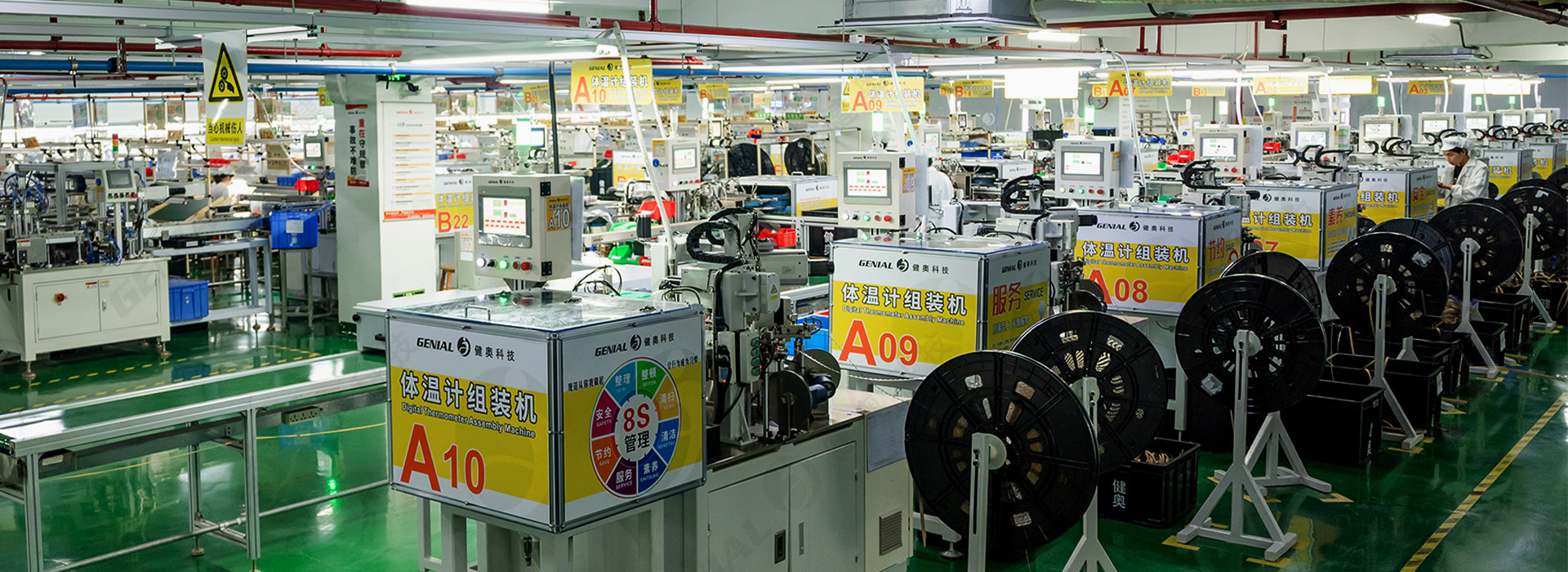
Production workshop supporting home medical device manufacturing and scenario-based supply.
Home medical health devices are no longer a single retail category. A home blood pressure monitor selected for a chronic-care programme, a digital thermometer packed into an insurance gift box, and a clinic-grade upper-arm monitor routed through a medical instrument wholesaler may look similar on a catalogue page, but they are chosen against different operating requirements. The practical procurement question is not which device is best in isolation, but which device configuration fits a defined use scenario.
This article maps the GENIAL home medical device portfolio to three demand environments: chronic disease management, community clinics, and OEM gifting. It also covers adjacent channels such as health and wellness centres, e-commerce, insurance promotional gifting, offline household retail, and medical instrument wholesale distribution. The aim is to show how cuff specification, material choice, product category and distribution positioning change the buyer decision.
The opportunity: one portfolio, many use contexts
Demand for home health monitoring continues to expand because care is moving into the home, pharmacies, community clinics and employer or insurer sponsored health programmes. Mordor Intelligence estimates the global Home Medical Equipment market at USD 54.35 billion in 2026, with North America holding approximately 40.35% share in 2025. These are third-party estimates, but they indicate a market large enough to support specialised channel strategies rather than a single generic product catalogue.
Product-level data points in the same direction. Upper-arm blood pressure monitors controlled 59.10% of the blood pressure monitoring market share in 2025, while wrist-based and wearable devices are growing at a 12.07% CAGR, according to Mordor Intelligence. The digital thermometer market is projected to reach USD 1.954 billion by 2035, with a CAGR of 9.5% from 2025. For buyers, the implication is straightforward: the category is broad enough that one SKU rarely serves every channel well.
Scenario mismatch is a common source of returns, unused inventory and weak programme outcomes. A clinic may need a cuff range that covers a mixed adult population. A chronic-care programme may need repeatable home measurement and simple data review. An insurance gift programme may care more about packaging, reliability and after-sales support than about clinical breadth. A wholesaler may need a portfolio that can serve clinics, pharmacies and retail accounts without creating a new supply chain for each customer type.
Brand solution: GENIAL as an original medical device manufacturer
Guangdong Genial Technology Co., Ltd. is a Chinese original medical device manufacturer founded in 2001. The company operates a 45,000㎡ facility with 251 employees, 29 engineers and an annual output of 15,000,000 units. Its export ratio is 80%, with key markets covering Europe, North America, Southeast Asia, the Middle East, Africa, Latin America and Oceania. GENIAL provides one-stop OEM, ODM, JDM and OBM services for global clients.
The product portfolio includes digital thermometers, infrared digital thermometers, wearable digital thermometers, continuous dynamic thermometers, forehead infrared thermometers, ear infrared thermometers, medical digital thermometers, household digital thermometers, rigid tip digital thermometers, flexible tip digital thermometers, armpit digital thermometers, digital blood pressure monitors, upper arm blood pressure monitors, wrist blood pressure monitors, finger pulse oximeters, mesh nebulizers, sleep apnea therapy devices, health managers, meridian massage instruments and hair removal devices.
Quality and compliance claims include ISO 13485, ISO 45001, ISO 14001, BSCI and GB/T 29490 system certifications, as well as product certifications such as CE, FDA, NMPA, CB, FCC and RoHS. The company states that it has completed product and trademark registration in 29 countries and sells to 117 countries and regions. These claims are relevant for supplier screening, but buyers should still verify the exact certificate scope for the specific model and destination market.
Supply terms also matter for scenario planning. GENIAL states that monthly production capacity ranges from 60,000 to 6,000,000 units depending on product type and production model. Typical lead times are 3 days for samples, 3 to 7 days for small orders, and 10 to 15 days for mass orders. For JDM and ODM projects, lead times are 7 to 15 days for minor modifications without new tooling, and 45 to 50 days for new mould development. In-stock products ship within 48 hours, while replenishment orders require 5 to 7 days.
Technical explanation: why the cuff specification decides the scenario
The GT-732 upper arm digital blood pressure monitor uses an ABS housing, a PVC air bag and a nylon strap, with a 22 cm arm circumference specification. The GT-732M variant uses an eco-friendly TPU air bag and is specified for a 0 to 290 mmHg measurement range, a pulse error of less than or equal to plus or minus 5%, and a 22 to 42 cm arm circumference range.
That difference is not a cosmetic variant detail. Arm circumference range determines how many patients or users a single device can serve. A 22 to 42 cm range gives clinics, chronic-care programmes and distributors a broader adult fit within one model, reducing the need to hold multiple cuff sizes for routine adult use. The 22 cm specification of the GT-732 is more suitable where the user population is narrower or where a single-cuff retail assortment is acceptable. It should not be treated as a universal clinic cuff.
Material choice also carries procurement meaning. The GT-732 combines ABS, PVC and nylon, a conventional configuration for general retail and institutional supply. The GT-732M uses an eco-friendly TPU air bag, which can support an environmental material story for wellness programmes, insurance gifts and customised OEM projects. Buyers still need to validate durability, cleaning routines and total cost for the intended use rather than assuming that an eco-material automatically fits every channel.

Automatic thermometer assembly line supporting the digital thermometer portfolio.
The wider portfolio follows the same scenario logic. Digital thermometers cover rigid tip, flexible tip, armpit, forehead infrared, ear infrared, medical and household variants. A wearable digital thermometer such as the T31 can support continuous temperature monitoring in care settings where periodic manual checks are insufficient. The T31 received FDA 510(k) clearance under K240333 in 2024. GENIAL also states that the T31 supports 24-hour continuous monitoring, accuracy of plus or minus 0.1 degrees Celsius and 180-day battery life.
For respiratory and chronic-care scenarios, the mesh nebulizer is specified with operating noise of 50 dB or less, a particle size of 1 to 5 micrometres, a nebulisation rate of at least 0.2 ml per minute and a total weight of 120 g. The sleep apnea therapy device supports CPAP, APAP, S, T, ST and VGPS modes, with operating noise of 35 dB or less, a 4.3-inch colour display and a total weight of 1.45 kg. The finger pulse oximeter supports 8-second rapid measurement, weighs 55 g and offers Bluetooth transmission and health data management. These product characteristics should be matched to the care protocol, not merely to the sales channel.
Application and use cases: mapping the portfolio to real settings
Chronic disease management at home
Chronic-care programmes need devices that can be used repeatedly by non-specialist users and reviewed by a care team. The GT-732M is the stronger fit where adult arm sizes vary, because its 22 to 42 cm range and 0 to 290 mmHg measurement range reduce the risk of cuff mismatch. The GT-732 can serve narrower user groups or retail bundles where a 22 cm cuff specification is adequate. In both cases, buyers should plan for user training, cleaning and periodic calibration checks.
A chronic-care kit may also include a digital thermometer, a wearable Bluetooth thermometer, a finger pulse oximeter and, for respiratory patients, a mesh nebulizer or sleep apnea therapy device. The logic is not to bundle every product, but to match the monitoring protocol. A hypertension programme may prioritise an upper-arm blood pressure monitor. A post-discharge monitoring programme may add a pulse oximeter. A respiratory programme may need a nebulizer or ventilator. GENIAL's portfolio breadth allows a distributor or programme manager to assemble these kits from one supplier relationship, subject to local registration and labelling requirements.
Community clinics and primary care
Community clinics usually need a device that can handle a mixed adult population without creating a large cuff inventory. The GT-732M's 22 to 42 cm arm circumference range is relevant here. The GT-732's 22 cm specification is more appropriate for a narrower patient group or for clinics that already manage multiple cuff sizes. Upper-arm monitors remain the dominant blood pressure monitoring format, with 59.10% market share in 2025, which supports their continued role in clinic-based screening and follow-up.
Clinics should also consider operating conditions and calibration. A PubMed Central article notes that home health monitoring equipment should be calibrated at frequent intervals and operated within an environment of 16 to 40 degrees Celsius and humidity below 85%. These are general usage conditions, not a product-specific guarantee. Clinics and care programmes should build calibration and training into the procurement plan rather than treating the device as a maintenance-free item.
Health and wellness centres
Health and wellness centres may use a different subset of the portfolio. A finger pulse oximeter can support spot checks and trend review. A health manager and meridian massage instrument can support wellness services rather than clinical diagnosis. A digital thermometer can support basic health screening. These products should be positioned according to the centre's service scope and local regulatory classification, not as substitutes for clinical assessment.
E-commerce and offline household retail
E-commerce buyers need clear SKU differentiation, stable packaging and replenishment. The digital thermometer family offers multiple formats: rigid tip, flexible tip, armpit, forehead infrared, ear infrared, medical digital and household digital. The upper-arm blood pressure monitor range offers different cuff and material specifications. For online listings, the GT-732 and GT-732M should be presented with their actual arm circumference specifications so that buyers can self-select correctly.
Offline household retail has similar needs but places more weight on shelf presentation, simple instructions and after-sales access. The GT-732 can serve as a conventional retail model, while the GT-732M can support a broader-fit or eco-material story. Distributors serving pharmacies and household retail should also consider the GT-702BM, which is positioned for medical instrument wholesale distribution. That positioning matters because wholesalers need a model that can be presented across clinic, pharmacy and retail accounts without rebuilding the portfolio for each customer type.
Insurance promotional gifting and customized OEM gift programmes
Insurance promotional gifting and customized OEM gift programmes require a different selection logic. The device must be reliable, easy to use, appropriate for the recipient and supported by a clear after-sales path. Digital thermometers and finger pulse oximeters are common candidates because they are simple to explain and relevant to household health monitoring. The GT-732M can support a more differentiated gift programme because its TPU air bag offers an eco-material story, while its 22 to 42 cm range makes it more adaptable across adult recipients.
GENIAL provides OEM, ODM, JDM and OBM services. For JDM and ODM projects, minor modifications without new tooling typically take 7 to 15 days, while new mould development takes 45 to 50 days. Joint product development technical support is also available. These capabilities matter for gift programmes that need customised packaging, product colour or accessory configuration. However, gift programmes should confirm local regulatory labelling, language requirements and after-sales responsibility before production, because a promotional gift is still a medical device in many markets.
Market trend analysis: why scenario mapping is becoming a procurement requirement
Three trends support a scenario-based approach. First, home medical equipment demand is large and geographically concentrated. The 2026 market estimate of USD 54.35 billion and North America's 40.35% share in 2025 show that suppliers need to support multiple market access pathways rather than one generic export model. Second, upper-arm blood pressure monitors remain the dominant format, while wearable and wrist-based devices grow faster. That means buyers may need both conventional upper-arm models for clinical credibility and wearable options for home monitoring and wellness programmes.
Third, standards and documentation are becoming part of the product decision. IEC 60601-1-11 is the collateral standard used with IEC 60601-1 for home healthcare equipment and addresses risks in uncontrolled home environments with untrained users, according to UL. ISO 80601-2-56:2017 specifies requirements for clinical thermometers, including a plus or minus 0.1 degrees Celsius accuracy requirement for clinical validation. ISO 80601-2-61 governs pulse oximeters, with SpO2 accuracy conventionally expressed as Arms over a stated saturation range, commonly 70% to 100%, according to CASRAI. These standards do not replace local registration, but they help buyers frame technical questions.
The procurement implication is that suppliers should be evaluated on their ability to document scenario-specific configurations. A broad catalogue is useful, but it is not enough. Buyers need to know which model fits which arm range, which material is used, which certification applies, what the after-sales terms are and how replenishment will work after the initial order.
Comparison with traditional solutions: single-SKU catalogue versus scenario-mapped portfolio
| Procurement question | Traditional single-SKU approach | Scenario-mapped GENIAL portfolio approach |
|---|---|---|
| Community clinic with mixed adult arm sizes | One cuff size may exclude part of the patient population or require informal cuff substitution. | GT-732M is specified for 22 to 42 cm arm circumference; GT-732 is specified at 22 cm. Clinics can map the device to their patient mix. |
| Chronic-care programme with repeat home measurement | A general retail device may lack the cuff range, documentation or support needed for programme use. | GT-732M offers wider adult fit; the portfolio adds digital thermometers, wearable thermometers, oximeters, nebulizers and ventilators for protocol-based kits. |
| Insurance or OEM gift programme | A low-cost generic item may create after-sales and compliance problems. | Digital thermometers, oximeters and GT-732M can be matched to gift positioning, with OEM, ODM, JDM and OBM support and a 12-month warranty. |
| Wholesale distribution across clinics, pharmacies and retail | Multiple unrelated suppliers increase documentation and replenishment complexity. | GT-702BM is positioned for medical instrument wholesale distribution, supported by a broader portfolio and stated monthly capacity of 60,000 to 6,000,000 units. |
The main limitation is that no single blood pressure monitor is universally suitable. The GT-732's 22 cm arm circumference specification is not a universal fit. The GT-732M covers 22 to 42 cm, but buyers still need to verify atypical arm sizes and confirm that the cuff is appropriate for the intended population. Device performance also depends on correct use, cleaning, calibration and operating environment. The portfolio does not remove the need for clinical validation, local regulatory review or user training.
Future outlook: from product lists to documented scenario fit
The next phase of home medical device procurement is likely to be defined by documentation and scenario fit rather than catalogue length. Chronic-care programmes will ask for repeatable home measurement, clear cuff ranges and after-sales support. Community clinics will ask for mixed-population fit and calibration guidance. Gift programmes will ask for reliable devices, appropriate packaging and a defined support path. Wholesalers will ask for portfolio breadth, replenishment reliability and certification documents that can be shared with their own customers.
GENIAL's combination of OEM, ODM, JDM and OBM services, a broad home medical device portfolio and stated manufacturing capacity gives buyers a single source to evaluate. The key is to use that breadth carefully. A buyer should start from the scenario, select the model and material that fit it, verify the certificate scope and after-sales terms, and then confirm supply timing. That sequence is more reliable than choosing a product first and trying to force it into a channel later.
For buyers who need the full portfolio reference, the 2026 English brochure is available for download: 2026 English brochure.
FAQ
Which GENIAL upper-arm blood pressure monitor fits community clinics with mixed adult arm sizes?
The GT-732M is the more suitable starting point for mixed adult arm sizes because it is specified for a 22 to 42 cm arm circumference range. The GT-732 is specified at 22 cm. Clinics should map their patient population and confirm cuff fit before purchase, especially where very small or very large arms are common.
How do the GT-732 and GT-732M differ in cuff materials and measurement specifications?
The GT-732 uses an ABS housing, a PVC air bag and a nylon strap, with a 22 cm arm circumference specification. The GT-732M uses an eco-friendly TPU air bag and is specified for a 0 to 290 mmHg measurement range, a pulse error of less than or equal to plus or minus 5%, and a 22 to 42 cm arm circumference range.
Which home medical device types fit chronic disease management and community clinic programmes?
Relevant device types include upper-arm blood pressure monitors, digital thermometers, wearable digital thermometers, continuous dynamic thermometers, finger pulse oximeters, mesh nebulizers, sleep apnea therapy devices and health managers. The final selection should follow the monitoring protocol, the user population and the local regulatory classification.
Which GENIAL products can be considered for insurance promotional gifting or customized OEM gift programmes?
Digital thermometers, including rigid tip, flexible tip, armpit, forehead infrared and ear infrared variants, are commonly considered for gift programmes, together with wearable digital thermometers and finger pulse oximeters. The GT-732M can support an eco-material positioning through its TPU air bag. GENIAL provides OEM, ODM, JDM and OBM services. Buyers should confirm local labelling, packaging and after-sales requirements before production.
What after-sales and supply terms should distributors verify before ordering?
GENIAL states that after-sales services include a free 12-month warranty upon presentation of a valid proof of purchase, certification documentation support, technical consultation and a manufacturer-managed return and replacement policy. Monthly production capacity ranges from 60,000 to 6,000,000 units. Typical lead times are 3 days for samples, 3 to 7 days for small orders and 10 to 15 days for mass orders. In-stock products ship within 48 hours, and replenishment orders require 5 to 7 days.
How should buyers evaluate the GT-702BM for medical instrument wholesale distribution?
The GT-702BM is positioned for medical instrument wholesale distribution. Buyers should evaluate it alongside certificate scope, warranty support, replenishment terms and end-channel fit. Because wholesalers serve clinics, pharmacies and retail accounts, the model should be assessed as part of a portfolio rather than on unit price alone. Local registration and labelling requirements still apply.
Есть вопросы или нужны дополнительные детали?
Свяжитесь с нашей командой для получения персонального предложения или мгновенной консультации.
Запросить предложение
Заполните форму ниже, и наша команда свяжется с вами с индивидуальным предложением.
Прямой чат WhatsApp
Предпочитаете общаться в реальном времени? Напишите нам в WhatsApp для мгновенной помощи и быстрых ответов.
- Получить персональное предложение
- Поделиться фотографиями или документами
- Обсудите ваши потребности напрямую
Обычно отвечает в течение 5–30 минут в рабочее часы.