
Home Medical Health Devices: Scenario-Fit Evaluation Guide
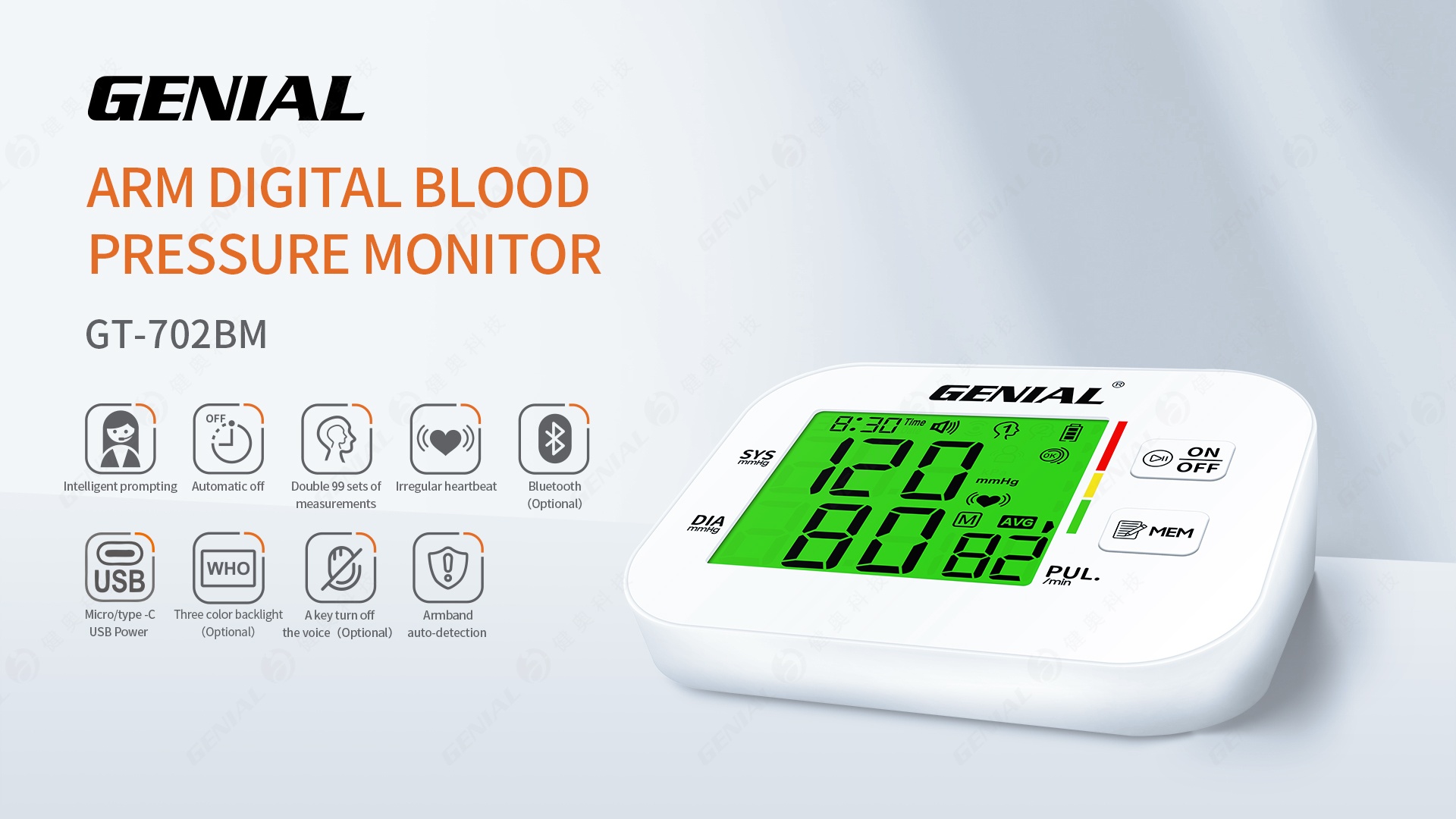
Upper-arm blood pressure monitors are among the most frequently specified home medical health devices in institutional and retail projects.
For buyers and procurement teams, selecting home medical health devices now starts from a different question: not simply which category is needed, but which version of the product fits this project's users, environment, compliance pathway, and supply model. This scenario-fit approach applies equally to tender projects from hospitals, school and public-health programs, pharmacy chains, cross-border distribution, and OEM/ODM partnerships.
A useful reference is Guangdong Genial Technology Co., Ltd. (GENIAL), a medical device manufacturer established in 2001. The company operates a 45,000 sqm manufacturing base, employs 251 employees, and reports an annual output capacity of 15,000,000 units, with about 80% exported to markets across Europe, North America, Southeast Asia, the Middle East, Africa, Latin America, and Oceania. Its portfolio includes digital thermometers, blood pressure monitors, pulse oximeters, mesh nebulizers, sleep apnea therapy devices, and other health-management products.
The mismatch problem in device selection
Many procurement failures are not caused by poor product quality but by a mismatch between product specifications and the real project context. A clinic may need a contact thermometer with plus or minus 0.1 degrees Celsius accuracy and a buzzer to indicate completion. A school entry-screening program may need a non-contact forehead thermometer with 32-set memory and fast measurement. An elderly-care project may need an upper-arm blood pressure monitor with 22 to 42 cm cuff compatibility and WHO blood pressure classification.
Market research signals indicate why this fit is a growing concern. According to Research and Markets, the digital thermometer market was valued at approximately USD 805.1 million in 2024 and is projected to reach USD 1 billion by 2030. Grand View Research estimates the blood pressure monitoring devices market at USD 4.2 billion in 2025, growing to USD 8.6 billion by 2033 at a CAGR of 9.3%. The same research firm projects the pulse oximeter market to reach USD 5.3 billion by 2030. Market Research Future values the vibrating mesh nebulizer market at USD 0.75 billion in 2024, with growth to USD 1.57 billion by 2035.
These categories are not interchangeable. Digital blood pressure monitors already account for about 48% of the total revenue share in the blood pressure monitoring devices market, according to Fortune Business Insights. Procurement teams therefore need a more precise evaluation framework than a simple product-category checklist.
What scenario-fit means for home medical health devices
Scenario-fit can be understood as the ability of a device to satisfy a project's specific functional, environmental, and regulatory conditions. For example, a wearable thermometer designed for continuous maternal or infant monitoring should be paired with adhesive patches, charging accessories, smartphone support, and cloud-based alerts. An infrared thermometer for public epidemic prevention must meet non-contact measurement, rapid response, and certification requirements.
| Evaluation dimension | What to check |
|---|---|
| Measurement accuracy and range | Contact thermometers typically cover 32.0 to 42.9 degrees Celsius with accuracy of plus or minus 0.1 degrees. Infrared forehead models cover 32.0 to 42.9 degrees with error no greater than 0.2 degrees in the 35 to 42 degree range. Wearable thermometers cover 20.0 to 45.0 degrees with plus or minus 0.1 degree accuracy. |
| Waterproof and cleaning | Infrared thermometers often carry IPX4; contact and wearable models may carry IPX4 or IPX5 depending on the intended hygiene routine. |
| Operating environment | Common specifications include 5 to 40 degrees Celsius operating temperature, 15% to 85% relative humidity, and storage conditions suitable for long-distance sea and land transport. |
| Data and connectivity | Bluetooth 5.0, Android and iOS support, cloud storage, multi-user profiles, remote sharing, and one-to-many batch monitoring through Bluetooth gateways are becoming relevant in institutional projects. |
| Compliance | Domestic and export projects may require NMPA Class II Medical Device Registration, Metrology Certificate, FDA, CE, FCC, GCC, MDR, RoHS, and IECEE CB. |
| Supply model | OEM, ODM, JDM, and OBM options differ in MOQ, lead time, customization depth, and after-sales responsibility. |
Mapping product categories to project types
Thermometers: from clinic to campus
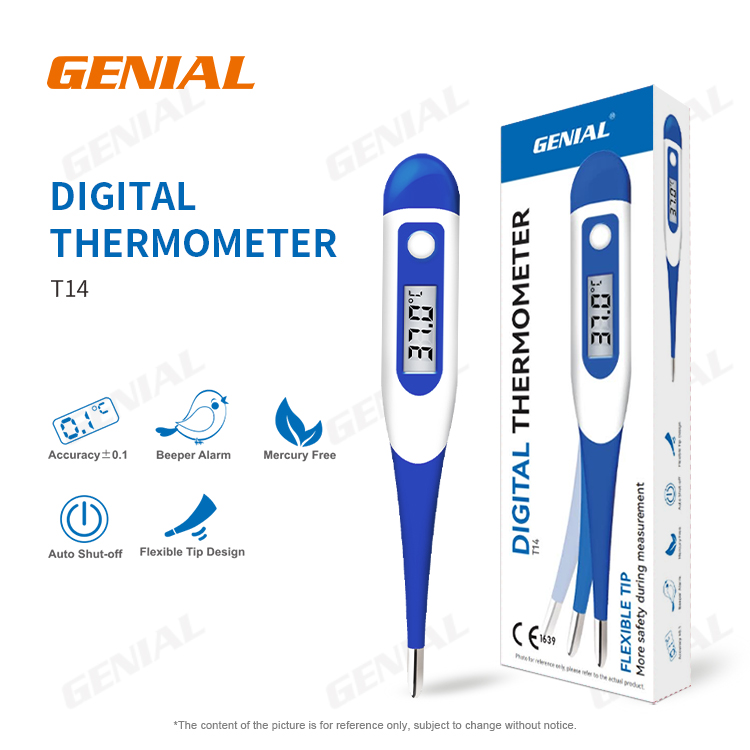
Contact digital thermometers with rigid or flexible tips are common in clinic, pharmacy, and maternal-infant projects.
Contact digital thermometers such as the T14/T14SL/T14Y, T28, T23/T24, T19C/T19D, and T11/T12 are specified for clinic supply, pharmacy chains, maternal and infant distribution, and medical institution tenders. They operate in contact physical temperature measurement mode with buzzer notification upon completion. The T14 family provides accuracy of plus or minus 0.1 degrees Celsius and IPX5 waterproofing. The T28 adds a flexible probe and is used in hospitals, pharmacies, maternal and infant stores, and physical examination centers.
Infrared thermometers including the T86/T87 non-contact forehead models, T81/T80 voice broadcast models, T90/T92 and T94 ear models address public epidemic prevention and high-throughput screening. The T86/T87 offers forehead temperature measurement from 32.0 to 42.9 degrees Celsius with error no greater than 0.2 degrees in the 35 to 42 degree range. The T81/T80 stores 32 temperature records. Public epidemic-prevention projects include regional CDC procurement, school healthcare equipment tenders, industrial park security support, customs quarantine consumables procurement, overseas bulk epidemic-prevention material orders, and postpartum care center supporting procurement.
For continuous monitoring, the wearable Bluetooth digital thermometer T31 measures temperature from 20.0 to 45.0 degrees Celsius with plus or minus 0.1 degree accuracy, is IPX4 splash-proof, and weighs 33 g including the battery. It supports Bluetooth synchronization, mobile APP alerts, and cloud-based trend reports. This product requires supporting equipment including a storage case, battery, and smartphone support.
Blood pressure monitors: chronic care and pharmacy retail
Upper-arm blood pressure monitors remain the most common category for home hypertension management. The GT-702BM supports 99 memory sets for 2 users, covers arm circumferences from 22 to 42 cm, and is used in medical instrument wholesale and offline household retail. The GT-732M adds TPU air bag construction and is suited to chronic disease management institutes, community medical centers, and insurance promotional gift projects. The GT-702LM is positioned for global supermarket channels and medical equipment distributors.
Automatic pressurization measurement, one-button operation, battery or USB power, and optional voice broadcast and APP connection are common configuration points. For projects serving older adults, cuff compatibility and memory functions are often more important than raw price.
Pulse oximeters: respiratory and elderly-care monitoring
Fingertip pulse oximeters in the GX3/GX5/GX7/GX8/GX12/GX13/GX14 series measure SpO2 from 35% to 100% with plus or minus 2% accuracy in the 70% to 100% range, and pulse rate from 30 to 250 bpm. They are used in respiratory departments, elderly-care institutes, outdoor sports, household medical, and pharmacy channels. For project buyers, the key fit criteria are measurement range, display readability, and certification coverage for export markets.
Mesh nebulizers and sleep apnea therapy devices
Portable mesh nebulizers in the N11/N21 and N12/N22 series use 106 kHz ultrasonic mesh atomization, with a liquid capacity of 8 ml and particle size D50 below 5 microns. They are used in pediatric wards, respiratory clinics, domestic cough treatment, rehabilitation centers, and pet medical care. For pediatric-hospital equipment procurement, high-density aerosol output and particle size below 5 microns are the central technical criteria.
For sleep-disordered breathing projects, non-invasive CPAP ventilators such as the GH-B20V/GH-B25V/GH-B20T/GH-B20/GH-B25/GH-A20A/GH-A20 provide working pressure from 4 to 20 or 25 cmH2O, support CPAP/APAP/S/T/VGPS modes, and maintain noise no higher than 35 dB. These devices are relevant to sleep disorder centers, hospital respiratory departments, rehabilitation institutes, home snoring treatment, and telemedicine channels.
Technical parameters as decision criteria
Evaluators should treat product parameters as evidence of scenario fit, not just specification-sheet entries.
- Temperature accuracy: contact models with plus or minus 0.1 degree accuracy are appropriate for clinical or maternal-infant use. Infrared forehead models prioritize speed but require correct positioning. Wearable models support trend monitoring rather than one-time spot checks.
- Waterproof rating: IPX4 is common for infrared thermometers; IPX5 covers most contact thermometers; wearable thermometers are splash-proof for continuous wear.
- Cuff compatibility: upper-arm blood pressure monitors with 22 to 32 cm cuffs suit average adults, while 22 to 42 cm cuffs better serve elderly and diverse populations.
- Aerosol particle size: for lower-respiratory delivery, mesh nebulizers should provide particle size D50 below 5 microns.
- Compliance standards: clinical electronic thermometers must meet ISO 80601-2-56:2017 for basic safety and essential performance. Medical electrical equipment must meet IEC 60601-1-2 for electromagnetic compatibility. GENIAL's system certifications include ISO 13485, ISO 45001, ISO 14001, BSCI, and GB/T29490. Product certifications include CE, FDA, NMPA, CB, FCC, and RoHS.
Project archetypes and supply evidence
From GENIAL's application and case records, several recurring project archetypes can be mapped to specific product clusters.
| Project archetype | Typical product cluster | Observed project evidence |
|---|---|---|
| Hospitals and clinics | Contact and infrared thermometers, blood pressure monitors, pulse oximeters, nebulizers | 50,000 to 200,000 units over a 5-year relationship; digital management, continuous monitoring, automatic alerts, and reduced manual inspections. |
| Pharmacy chain systems | Thermometers, blood pressure monitors, oximeters | 100,000 to 1,000,000 units over 5 years; complete product portfolio to meet different consumer segments. |
| Maternal and infant companies | Wearable Bluetooth thermometer T31, contact and animal-shaped thermometers | 10,000 to 100,000 units over 5 years; continuous infant monitoring with no repeated nighttime temperature measurements. |
| Medical device distributors | Multi-category home medical health portfolio | 100,000 to 500,000 units over 5 years; one-stop procurement reduces supplier management costs. |
| Consumer electronics and e-commerce channels | Thermometers, oximeters, blood pressure monitors, hair removal devices | 50,000 to 100,000 units over 5 years; comprehensive international certifications, stable quality, and long-term supply capability support brand expansion. |
Comparison with traditional solutions
Digital home medical health devices bring speed, safety, memory, and data connectivity that traditional instruments cannot provide. A mercury thermometer requires a longer measurement period and carries toxicity and breakage risks; an electronic contact thermometer offers faster readout, fever alert, and IPX5 cleaning convenience. A manual sphygmomanometer requires stethoscope skills; an automatic upper-arm monitor provides one-button measurement, memory storage, and WHO blood pressure classification. A compressor nebulizer is often bulky and requires a power outlet; a portable mesh nebulizer is quieter and battery-capable.
However, digital devices also have boundaries. They are not replacements for clinical diagnostic equipment. Infrared thermometer readings can be affected by ambient temperature and probe positioning. Wrist blood pressure monitors are convenient, but upper-arm models remain the more common category for accuracy-sensitive protocols. Wearable temperature monitors are designed for trend detection and alerting rather than single-event diagnosis. Mesh nebulizers require regular cleaning of the medication cup and mesh to maintain consistent output. These limitations should be part of the project-fit evaluation.
Market trends shaping project requirements
- Digital product formats are taking share. Digital blood pressure monitors account for approximately 48% of the total revenue share in the blood pressure monitoring devices market in 2024.
- Portable respiratory formats are growing. The vibrating mesh nebulizer market is expected to grow from USD 0.75 billion in 2024 to USD 1.57 billion by 2035.
- Connectivity is becoming a specification. Bluetooth 5.0, cloud storage, multi-user profiles, remote data sharing, and one-to-many gateway monitoring are increasingly listed as requirements in smart healthcare projects.
- Compliance is becoming a market-access asset. GENIAL has completed product and trademark registration in 29 countries, and its products are sold to 117 countries and regions worldwide.
Future outlook
As home medical health devices move into more project-based procurement, supplier evaluation will become more multidimensional. Buyers will increasingly require evidence of accuracy, certification documentation, data interoperability, and manufacturing stability. Manufacturers that combine in-house research and development, vertical production, and global compliance registration are likely to be well positioned for hospital, pharmacy, distribution, and e-commerce projects.
Frequently asked questions
What does scenario-fit mean when selecting home medical health devices?
Scenario-fit means matching the device's measurement range, accuracy, operating environment, supporting equipment, compliance package, and procurement model to a specific project type. A device that works for household spot checks may not satisfy a medical institution tender or a public epidemic-prevention program.
Which compliance documents should be verified before a project order?
Special requirements may include domestic NMPA Class II Medical Device Registration, Metrology Certificate, and export certifications such as FDA, CE, FCC, GCC, MDR, RoHS, and IECEE CB. GENIAL holds system certifications including ISO 13485, ISO 45001, ISO 14001, BSCI, and GB/T29490, while its products carry CE, FDA, NMPA, CB, FCC, and RoHS certifications.
Are wearable thermometers suitable for maternal-infant or elderly-care projects?
Yes. The wearable Bluetooth digital thermometer T31 provides continuous temperature monitoring with plus or minus 0.1 degree accuracy, IPX4 splash-proof protection, and Bluetooth and cloud synchronization. It is suitable for maternity centers, baby product industry, and chronic disease monitoring. Supporting equipment includes a storage case, battery, and smartphone support.
What project types commonly use infrared thermometers?
Infrared thermometers are often specified for public epidemic-prevention projects, including regional CDC procurement, school healthcare equipment tenders, industrial park security support, customs quarantine consumables procurement, overseas bulk epidemic-prevention material orders, and postpartum care center supporting procurement.
How should mesh nebulizers be specified for pediatric hospital projects?
For pediatric-hospital equipment procurement and respiratory-department supporting projects, mesh nebulizers producing high-density aerosol with particle size below 5 microns are relevant. They operate in 106 kHz ultrasonic mesh atomization mode and are designed for use in pediatric wards, respiratory clinics, and home respiratory treatment.
Do blood pressure monitors differ in project fit?
Yes. Upper-arm models support different cuff ranges, such as 22 to 32 cm or 22 to 42 cm, and may include 99 memory sets for two users, WHO blood pressure classification, irregular-heartbeat detection, voice broadcast, or APP connectivity. The choice depends on the target population and the clinical or retail purpose of the project.
Reference material
Technical and certification details for the GENIAL home medical health device portfolio are available in the English corporate brochure: GENIAL English Product Brochure (PDF).
Есть вопросы или нужны дополнительные детали?
Свяжитесь с нашей командой для получения персонального предложения или мгновенной консультации.
Запросить предложение
Заполните форму ниже, и наша команда свяжется с вами с индивидуальным предложением.
Прямой чат WhatsApp
Предпочитаете общаться в реальном времени? Напишите нам в WhatsApp для мгновенной помощи и быстрых ответов.
- Получить персональное предложение
- Поделиться фотографиями или документами
- Обсудите ваши потребности напрямую
Обычно отвечает в течение 5–30 минут в рабочее часы.