
Home Medical Health Devices: What Buyers Should Know Before Sourcing

Factory workshop exterior of Guangdong Genial Technology Co., Ltd., a medical device manufacturer established in 2001.
Home medical health devices—digital thermometers, blood pressure monitors, pulse oximeters, mesh nebulizers, and sleep apnea therapy devices—have moved from clinical settings into everyday household use. For buyers evaluating suppliers of these products, the critical question is not just which device to choose, but how to assess the manufacturer behind it. This article provides a framework for understanding what home medical health devices are, how the category is evolving, which product types buyers encounter most often, and what evidence-based criteria should guide supplier evaluation.
What Are Home Medical Health Devices?
Home medical health devices are medical-grade or consumer-accessible instruments designed to measure, monitor, or support health conditions outside clinical facilities. The category spans diagnostic and monitoring tools such as digital thermometers, digital blood pressure monitors, and fingertip pulse oximeters, as well as therapeutic and wellness devices including mesh nebulizers, non-invasive sleep ventilators, meridian massage instruments, and IPL hair removal devices.
What distinguishes the category from general consumer electronics is the presence of health-related measurement functions, physiological sensing, or therapeutic output that may be subject to medical device regulations in various jurisdictions. In practice, many products in this segment must demonstrate compliance with standards such as ISO 80601-2-56 for electronic thermometers or IEC 60601-1-2 for electromagnetic compatibility.
For buyers, the practical implication is that product selection and supplier selection cannot be separated. Certification status, manufacturing process, quality control, and compliance engineering are as important as price and aesthetics.
Market Context: Demand Drivers and a Shifting Landscape
The home medical health device market has expanded steadily in recent years, driven by aging populations, the shift of chronic disease management toward home settings, and the growth of preventive health behaviors. Market data supports this trajectory across several core categories.
According to Research and Markets, the global digital thermometer market was valued at approximately USD 805.1 million in 2024 and is projected to reach USD 1 billion by 2030. Grand View Research estimates the blood pressure monitoring devices market at USD 4.2 billion in 2025, with a projected value of USD 8.6 billion by 2033 at a CAGR of 9.3%. The same research firm estimates the global pulse oximeter market will reach USD 5.3 billion by 2030, with a CAGR of 6.6% between 2024 and 2030. Market Research Future values the vibrating mesh nebulizer market at USD 0.75 billion in 2024, expected to reach USD 1.57 billion by 2035.
These figures point to a durable tailwind for home diagnostics and respiratory care. Notably, digital blood pressure monitors already account for approximately 48% of the total revenue share in the blood pressure monitoring devices market in 2024, according to Fortune Business Insights. That figure underscores the commercial importance of the connected, easy-to-use monitoring segment.
From a buyer perspective, these trends mean that sourcing decisions made now will operate in a rapidly expanding market. They also imply that supplier capacity and certification breadth—not just product features—become strategic concerns.
Product Categories and What They Do
Most procurement discussions for home medical health devices begin with a core question: which device categories are relevant to the buyer's channel or project? The following overview maps the main categories and the practical functions buyers can expect.
Digital Thermometers
Digital thermometers are the most widely distributed home diagnostic device. They fall into several functional types: contact models for axillary or oral measurement, non-contact infrared forehead models, infrared ear models, and newer wearable continuous-monitoring devices.
Typical technical profiles observed in this category include:
| Type | Example Models | Key Characteristics |
|---|---|---|
| Rigid tip digital thermometer | T19C / T19D, T23 / T24 | 32–42.9°C measuring range, ±0.1°C accuracy typical, IPX5 waterproof, PP or medical PP body |
| Flexible tip digital thermometer | T28, T15SC | Flexible medical silicone probe, designed for axillary use, measuring time ≤1 minute, IPX5 rating |
| Animal-shaped thermometer | T15S / T15SL / T15SC | Flexible food-grade rubber tip, ±0.1°C accuracy, IPX5, aimed at baby gift and children's channels |
| Non-contact infrared forehead thermometer | T86 / T87 | 32–42.9°C, ±0.2°C error between 35–42°C, IPX4, suited for rapid screening |
| Infrared ear thermometer | T90 / T92, T94 | Ear temperature 32–42.9°C, repeat accuracy ±0.3°C, IPX4, common in pediatric and home settings |
| Wearable Bluetooth thermometer | T31 | 20–45°C range, ±0.1°C accuracy, IPX4, adhesive patch design, 24-hour continuous monitoring |
The contact thermometer segment is increasingly framed around the replacement of mercury thermometers. As regulatory pressure against toxic mercury devices increases in multiple markets, producing an accurate, affordable, mercury-free alternative has become a stated function of many digital thermometer lines. One example of this is the role played by flexible and rigid tip models that measure temperature from 32.0 to 42.9°C and provide audible or visual fever alerts for preliminary screening.
The wearable thermometer, by contrast, answers a different user need: continuous monitoring without repeated manual measurement. Devices such as the T31 use a medical-grade adhesive patch, support Bluetooth synchronization, and send abnormal-temperature alerts to a paired application. This is the segment where home devices begin to overlap with smart health platforms.
Digital Blood Pressure Monitors
Blood pressure monitoring is a high-frequency home health activity, particularly for elderly users and those managing hypertension. Two form factors dominate: upper arm monitors and wrist monitors.
| Form Factor | Example Models | Typical Parameters |
|---|---|---|
| Upper arm | GT-702LM, GT-732M, GT-712B/C/E, GT-702VA | Pressure 0–290 mmHg, arm circumference 22–42 cm (or 22–32 cm), ABS housing |
| Wrist | GT-701, GT-701C, GT-701F, GT-701L | Pressure 0–290 mmHg, wrist circumference 13.5–21.5 cm, compact size, lightweight |
Many upper arm monitors now include dual-user memory, WHO blood pressure classification indication, and irregular heartbeat detection. These functions support long-term hypertension management at home and add clinical-grade interpretation that ordinary consumer devices lack. The GT-732M, for instance, is designed for chronic disease management and community medical centers, with an arm circumference range of 22–42 cm, a pulse error tolerance of ±5 percent, and construction using ABS and eco-friendly TPU air bladder.
For buyers, the commercial distribution of blood pressure monitors is broad: pharmacy chains, supermarket retail, insurance and corporate gift programs, cross-border e-commerce, and healthcare distribution all source this category. The breadth of channels means manufacturers must be prepared to support different packaging, labeling, certification, and private-label requirements.
Fingertip Pulse Oximeters
Pulse oximeters became a standard household item after respiratory illnesses drove demand for blood oxygen monitoring. They measure oxygen saturation (SpO₂) and pulse rate with a photoelectric transmission method, typically using an OLED display and one-button operation.
A representative device family, such as GENIAL's GX series (GX3, GX5, GX7, GX8, GX12, GX13, GX14), measures SpO₂ in the range 35–100 percent with ±2 percent accuracy between 70–100 percent, and pulse rate from 30 to 250 bpm. The finger clip is sweat-splash proof, and the device is intended for elderly care institutions, respiratory departments, outdoor sports, household use, and pharmacy distribution.
From an application standpoint, pulse oximeters support respiratory disease management, home care for chronic conditions, and screening of hypoxia risk. Their affordability and ease of use give them a wide channel footprint, spanning medical distribution and outdoor consumer channels.
Portable Mesh Nebulizers
Mesh nebulizers convert liquid medication into fine aerosol particles for inhalation therapy. They are used in pediatric wards, respiratory clinics, domestic cough treatment, rehabilitation centers, and increasingly in home care.
Portable mesh nebulizer models N11/N21 and N12/N22/N12C/N22C/N12L/N22L share a similar compact architecture: liquid capacity 8 ml, nebulization rate ≥0.2 ml/min, and particle size D50 below 5 μm for at least 60 percent of particles. The N11/N21 versions add a noise specification of ≤50 dB(A) and are designed with a PP medicine cup and medical silicone tube. Their compact dimensions—42×55×99 mm—make them genuinely portable.
For buyers, the clinically relevant parameter in this category is particle size distribution, since smaller particles reach the lower respiratory tract more effectively. Certification requirements matter equally: many export destinations require medical device registration, and the global market for vibrating mesh nebulizers is projected to grow from USD 0.75 billion in 2024 to USD 1.57 billion by 2035, according to Market Research Future.
Sleep Apnea Therapy Devices
Non-invasive sleep ventilators (CPAP/APAP devices) address obstructive sleep apnea, a condition associated with snoring, sleep interruption, and daytime fatigue. These devices deliver continuous or auto-adjusting positive airway pressure during sleep.
A sleep ventilator family such as GENIAL's GH series (GH-B20V, GH-B25V, GH-B20T, GH-B20, GH-B25, GH-A20A, GH-A20) supports CPAP, APAP, S/T, and VGPS modes. The working pressure range is 4 to 20 or 25 cmH₂O, noise is kept at ≤35 dB, and the main unit measures 260×153×121 mm at 1450 g. The mask uses medical silicone, and the housing is flame-retardant ABS and aviation plastic.
Although not as high-volume as thermometers or blood pressure monitors, sleep therapy devices represent a more specialized, higher-value procurement category. They are typically sourced for sleep disorder centers, hospital respiratory departments, rehabilitation institutes, and home snoring treatment programs.
Adjacent Categories in the Home Health Portfolio
Beyond the core diagnostic devices, manufacturers of home medical health devices often supply adjacent categories: IPL hair removal devices, meridian massage instruments, health manager systems, and related wellness electronics. A sapphire ice cooling IPL hair removal device, for example, uses 560–1200 nm intense pulsed light with sapphire contact cooling to suppress hair regrowth and reduce skin irritation. Such devices are typically sourced by beauty channels and personal-care e-commerce brands rather than medical distributors.
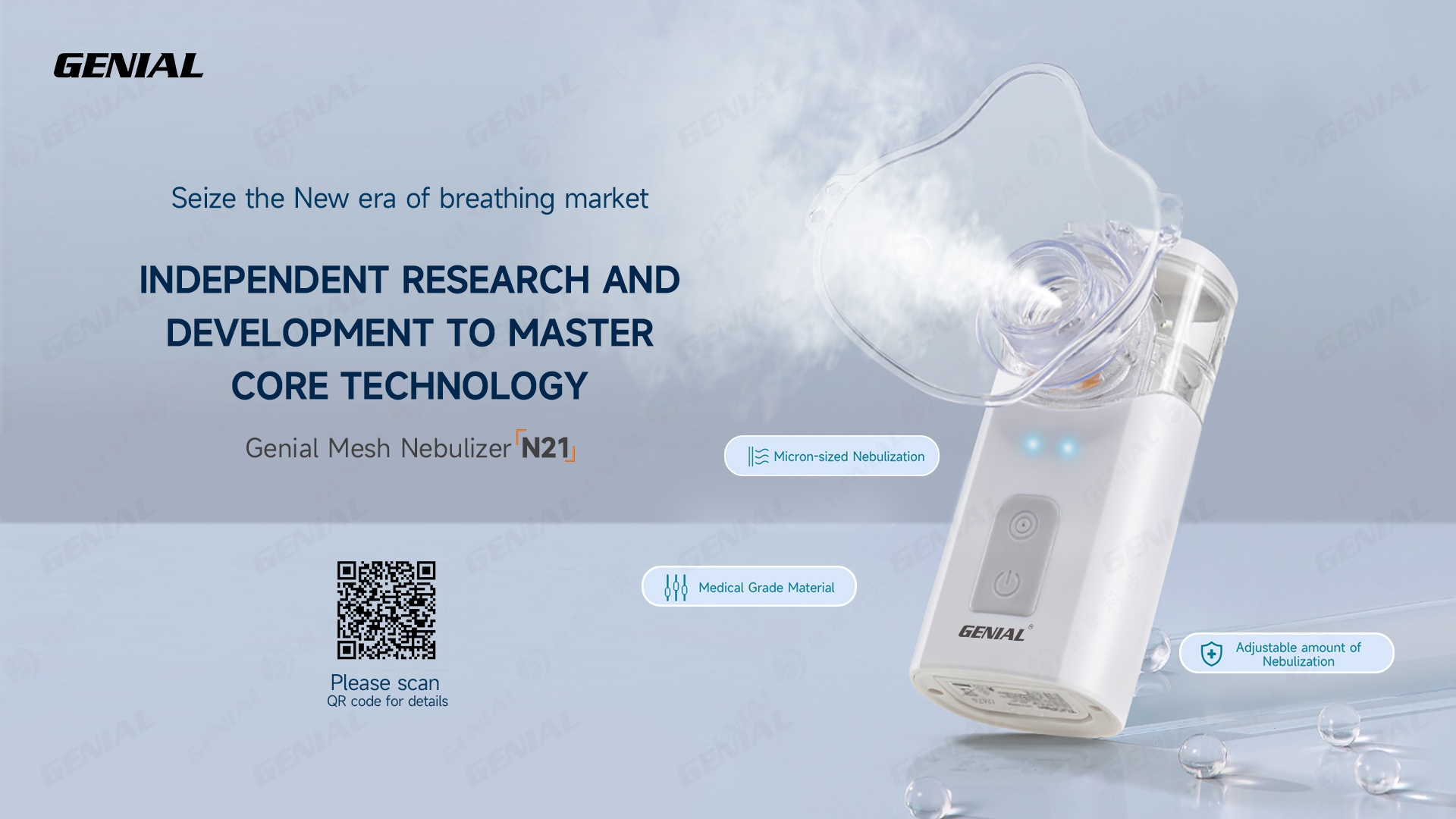
A portable mesh nebulizer designed for home care and clinical respiratory therapy.
How to Evaluate a Home Medical Device Manufacturer
Buyers at the awareness and research stage need a practical evaluation framework. The following criteria are common to successful supplier assessments in this category.
1. Verify Manufacturing Base and Scale
Manufacturing scale matters because it affects capacity, consistency, and responsiveness. A manufacturer like Guangdong Genial Technology Co., Ltd., established in 2001, operates a 45,000-square-meter facility with a workforce of approximately 251 staff and an R&D team of 29 engineers. Annual production capacity reaches 15,000,000 units. Export business accounts for 80 percent of total sales, with products shipped to 117 countries and regions.
For buyers, these figures allow a quick capacity check: can this supplier handle the order sizes, delivery timelines, and post-sale quality requirements of your channel?
2. Examine Certification Breadth
Medical devices are regulated in nearly all developed markets. A supplier's certification portfolio determines how easily its products can enter specific geographies.
Relevant system certifications in the home medical device space include ISO 13485 for quality management, ISO 14001 for environmental management, ISO 45001 for occupational health and safety, and BSCI for social compliance. Product-level certifications in global trade commonly include CE, FDA, NMPA, CB, FCC, and RoHS.
For clinical electronic thermometers, ISO 80601-2-56:2017 is the relevant international standard for basic safety and essential performance. Medical electrical equipment generally must also meet IEC 60601-1-2 for electromagnetic compatibility.
GENIAL reports completion of product and trademark registration in 29 countries, which is an unusually concrete indicator of regulatory capability. Buyers should ask prospective suppliers for their certification matrix and check its relevance to target markets.
3. Assess Quality and Compliance Infrastructure
A manufacturer's quality system is only credible if it is embedded in daily operations. Relevant indicators include professional laboratories, documented compliance with technical specifications, traceability systems, and in-process inspection. Buyers should request factory audits or at minimum a virtual tour of production areas.
4. Consider OEM/ODM/JDM Capability
Many buyers do not seek an existing branded product; they seek a manufacturing partner who can execute private-label or custom-development projects. In this context, the supplier's engineering depth becomes decisive.
GENIAL positions itself as a one-stop OEM, OBM, ODM, and JDM partner, with services spanning product R&D, mass production, brand incubation, and global medical device compliance registration. The company also operates a medical technology research institute and has obtained 262 intellectual property certificates. These assets indicate a capacity for product iteration and custom feature development rather than pure assembly.
5. Review Application and Channel Fit
Different channels impose different requirements. Pharmacy chains typically prioritize regulatory compliance and stock reliability. Supermarket channels emphasize packaging, shelf appeal, and price points. Insurance and corporate gift programs value customization of branding and presentation. OEM medical device manufacturing, cross-border e-commerce, and maternal-infant channels each have distinct packaging, regulatory, and certification needs.
Buyers should map their intended channels to the manufacturer's existing product line. A supplier with a broad portfolio—offering, say, both rigid-tip thermometers and wearable Bluetooth thermometers—is more likely to support channel expansion than one with a single niche product.
Manufacturer Profile: Guangdong Genial Technology Co., Ltd.
Guangdong Genial Technology Co., Ltd. (GENIAL) is a Chinese original manufacturer of medical devices and smart wearable devices. Founded in 2001, the company integrates R&D, production, and sales, with a main product portfolio covering electronic thermometers, blood pressure monitors, pulse oximeters, nebulizers, sleep ventilators, therapeutic instruments, and personal-care devices.
The company's own description of its capabilities highlights four areas: intelligent manufacturing, global compliance registration, independent R&D, and delivery responsiveness. GENIAL states that its branded products can be shipped within 24 hours after order confirmation, while OEM orders take 3 to 7 days for delivery. It also reports the establishment of a medical technology research institute, a doctoral workstation, and a big health industry engineering technology research center.
For a buyer, the relevant interpretation is practical: a manufacturer that has invested in both R&D and regulatory infrastructure can reduce time-to-market and compliance risk for its partners. The company exports to Europe, North America, Southeast Asia, the Middle East, Africa, Latin America, and Oceania.
Product Selection Logic for Buyers
The following selection logic summarizes how buyers commonly approach each major category in the home medical health device space.
| Device Category | Core Buyer Question | What to Look For |
|---|---|---|
| Digital Thermometer | Contact, non-contact, or wearable? | Accuracy, waterproofing, fever alert, target-channel design, mercury-free claim |
| Blood Pressure Monitor | Upper arm or wrist? | Pressure range, cuff compatibility, memory, WHO indication, irregular heartbeat detection |
| Pulse Oximeter | Is SpO₂ accuracy adequate? | SpO₂ range, pulse range, display readability, portability, certification |
| Mesh Nebulizer | Will medication reach the lower airways? | Particle size distribution (D50 <5 μm), nebulization rate, noise, portability |
| Sleep Ventilator | Which therapy modes are needed? | CPAP/APAP modes, pressure range, noise level, humidification, global voltage |
This table is a starting point, not a substitute for application-specific engineering reviews. But it demonstrates that even at the awareness stage, buyers should be thinking in terms of measurable parameters, not just product names.
Limitations and Boundaries: What a Manufacturer Alone Cannot Guarantee
An honest assessment of home medical health devices must acknowledge the limits of both individual devices and manufacturer claims. The following boundaries are important for buyers to keep in mind.
First, device certification is country-specific. A CE mark does not automatically grant access to the U.S. market, and FDA clearance does not replace EU MDR registration. Global compliance portfolios reduce but do not eliminate the need for per-market legal review.
Second, home-use devices are not substitutes for professional clinical diagnosis. A blood pressure monitor can support hypertension management, but it is not a diagnostic instrument. A pulse oximeter provides a screening signal, not a medical opinion. A wearable thermometer improves monitoring convenience, but its readings must still be interpreted by a caregiver or clinician.
Third, product performance is environment-dependent. Many devices specify operating conditions such as indoor temperature 5–40°C and humidity 15–85 percent RH. Extreme storage or use conditions can affect measurement accuracy and battery life. Buyers must ensure that the chosen device's environmental specifications match their target market's conditions.
Fourth, OEM suppliers cannot guarantee end-customer experience. Brand owners remain responsible for user instructions, after-sales support, translation accuracy, and local regulatory filing. A manufacturer can provide compliance-ready products, but the importing brand or distributor owns the final market risk.
Future Outlook: Where the Home Medical Health Device Market Is Headed
Looking ahead, four trends appear structurally important for the home medical health device category.
Connected monitoring will become standard. Devices that sync to applications and cloud platforms—such as Bluetooth-enabled wearable thermometers and APP-connected blood pressure monitors—are moving from differentiators to expectations. The Genial Cloud Health Management Platform is one example of this direction, supporting individual monitoring and, through Bluetooth gateways, institutional one-to-many batch monitoring.
Continuous, not episodic, measurement will shape new product development. The 24-hour wearable thermometer concept offers an early illustration of how medical device companies are shifting from spot checks to longitudinal data collection. This reduces the burden on caregivers and provides a richer picture for remote chronic disease follow-up.
Global regulatory alignment will remain fragmented. The ongoing coexistence of NMPA, FDA, CE, FCC, GCC, MDR, RoHS, and IECEE CB requirements means that manufacturers with broad registration capability will retain a competitive advantage in cross-border procurement.
Respiratory and home therapy devices will grow within the broader trend. The projected growth of the vibrating mesh nebulizer market and the sustained demand for sleep apnea therapy devices suggest that home respiratory care will be one of the more active procurement categories in the coming cycle.
How Buyers Should Use This Information
For buyers at the awareness and research stage, the practical takeaway is to build a shortlist of suppliers using the following steps:
1. Define your channel requirements and target markets before evaluating specific products.
2. Map the device categories and performance parameters you actually need, using the tables above as a checklist.
3. Verify the manufacturer's certifications against your target markets, not against a generic global claim.
4. Assess manufacturing scale, engineering capacity, and OEM/ODM experience.
5. Request evidence—product specifications, factory photos, certification copies, and compliance documentation—before committing to a sourcing conversation.
This approach keeps the focus on verifiable facts and reduces the risk of selecting a supplier based on appearance or a single product demo.
Frequently Asked Questions
What is the difference between a rigid tip and flexible tip digital thermometer?
A rigid tip digital thermometer has a stiff probe, typically made of PP or medical PP, designed for standard axillary or oral measurement. A flexible tip digital thermometer uses a bendable probe made of materials such as elastic medical silicone or PVC, which can improve comfort during axillary use. Both types typically measure temperatures from 32.0°C to 42.9°C, and many models provide IPX5 waterproof protection.
What accuracy can buyers expect from a digital thermometer?
Many digital thermometers in the home medical category offer an accuracy of ±0.1°C in the measurement range of 32.0 to 42.9°C. Infrared forehead thermometers often specify a slightly wider error tolerance: for example, ±0.2°C in the 35–42°C range. Infrared ear thermometers typically indicate repeat accuracy of ±0.3°C. Buyers should verify the accuracy specification against the intended use case and local regulatory requirements.
What is the clinical standard for electronic thermometers?
Clinical electronic thermometers must comply with ISO 80601-2-56:2017 for basic safety and essential performance. This international standard is commonly referenced as a baseline for contact and non-contact thermometers sold into medical and home health channels. Buyers should ask suppliers whether their products and quality systems align with this standard.
Which certifications do home medical health devices need for export?
Certification requirements differ by country. Common export certifications for home medical devices include CE for Europe, FDA for the United States, NMPA for China, CB for international electrical safety recognition, FCC for U.S. electromagnetic compatibility, and RoHS for hazardous substance restriction. System certifications commonly requested from manufacturers include ISO 13485, ISO 14001, ISO 45001, and BSCI. Buyers should map their target markets and request a supplier's certification matrix.
What is the difference between an upper arm and wrist blood pressure monitor?
Upper arm blood pressure monitors measure blood pressure at the brachial artery using a cuff placed around the upper arm. They typically support arm circumferences of 22–42 cm or 22–32 cm and are generally recommended as a more stable measurement site. Wrist monitors measure at the wrist artery and are more compact, typically supporting wrist circumferences of 13.5–21.5 cm. Both types measure pressure in the range of 0–290 mmHg and are widely used in home settings; upper arm models are more common in clinical and chronic disease management contexts.
What parameters should buyers evaluate when sourcing a mesh nebulizer?
The key performance parameters for a portable mesh nebulizer include liquid capacity, nebulization rate, and particle size distribution. A common specification is liquid capacity of 8 ml, a nebulization rate of at least 0.2 ml/min, and a particle size D50 below 5 μm for at least 60 percent of particles. Smaller particle sizes allow medication to reach the lower respiratory tract more effectively. Noise level, materials, and battery operation also matter for home use.
What is a wearable digital thermometer used for?
A wearable digital thermometer is a patch-style device designed for continuous body temperature monitoring. It attaches to the body with a medical-grade silicone adhesive patch, measures temperature across a range such as 20.0 to 45.0°C, and transmits readings via Bluetooth to a mobile application. It is commonly used for infant fever monitoring, postpartum maternal monitoring, chronic disease patient temperature tracking, and elderly remote care. The T31 model is one example of this category.
What should buyers verify about a manufacturer's quality system?
Buyers should verify system certifications, laboratory capabilities, and production-side quality documentation. ISO 13485 certification indicates a quality management system tailored to medical devices. Professional laboratories, documented compliance with technical specifications, and traceability procedures matter in practice. A supplier's registration and audit history can also indicate how its quality system performs under real market conditions.
Where are GENIAL home medical health devices sold?
Guangdong Genial Technology Co., Ltd. exports to multiple regions, with key markets including Europe, North America, Southeast Asia, the Middle East, Africa, Latin America, and Oceania. Export business accounts for 80 percent of total sales. The company reports product and trademark registration in 29 countries and sales to 117 countries and regions worldwide.
What is the difference between OEM, ODM, and JDM in medical device sourcing?
OEM (Original Equipment Manufacturing) means the supplier manufactures a product according to the buyer's design and specification. ODM (Original Design Manufacturing) means the supplier provides its own design and manufacturing capability, which the buyer can brand as its own. JDM (Joint Design Manufacturing) is a collaboration model in which buyer and supplier co-develop the product. For home medical devices, the choice depends on whether the buyer has proprietary design requirements or prefers a faster route using an existing platform.
How should buyers evaluate the future continuity of a home medical device supplier?
Buyers should assess manufacturing capacity, R&D investment, certification renewal capability, and the breadth of the product portfolio. A supplier with a large production base, a dedicated R&D team, and a track record of product registration across multiple countries is more likely to sustain long-term availability and compliance support. Asking for the supplier's intellectual property portfolio and export registration records can provide useful evidence.