
Home Textile Fabric Supplier Capability: Reading Model Specs
Home Textile Fabric Supplier Capability: Reading Model Specs
Supplier capability in home textile fabric is easiest to assess at model level. A model-level specification — fibre composition, yarn construction, weight and width attached to a specific article number — can be checked, re-tested and compared between quotations. A general capability statement cannot. For a buyer who has already shortlisted sofa and curtain fabric suppliers, the operative question is therefore not what a supplier claims to be capable of producing, but which numbered articles the supplier will let the buyer hold accountable.
T-LAND TEXTILE, the brand under which Suzhou T-land Textile Co., Ltd. trades, is an upholstery and curtain fabric supplier based in Shengze, Jiangsu, China — a textile cluster widely referred to as the Silk Capital of China, close to Shanghai and its sea and air ports. The company reports a 5,000 m² facility, an in-house laboratory used for quality testing across items, and a stated annual output of 5,000,000 metres. Three of its articles differ enough at specification level to show how model-level evidence is read in practice: TL0329, TL07242 and TL0901.
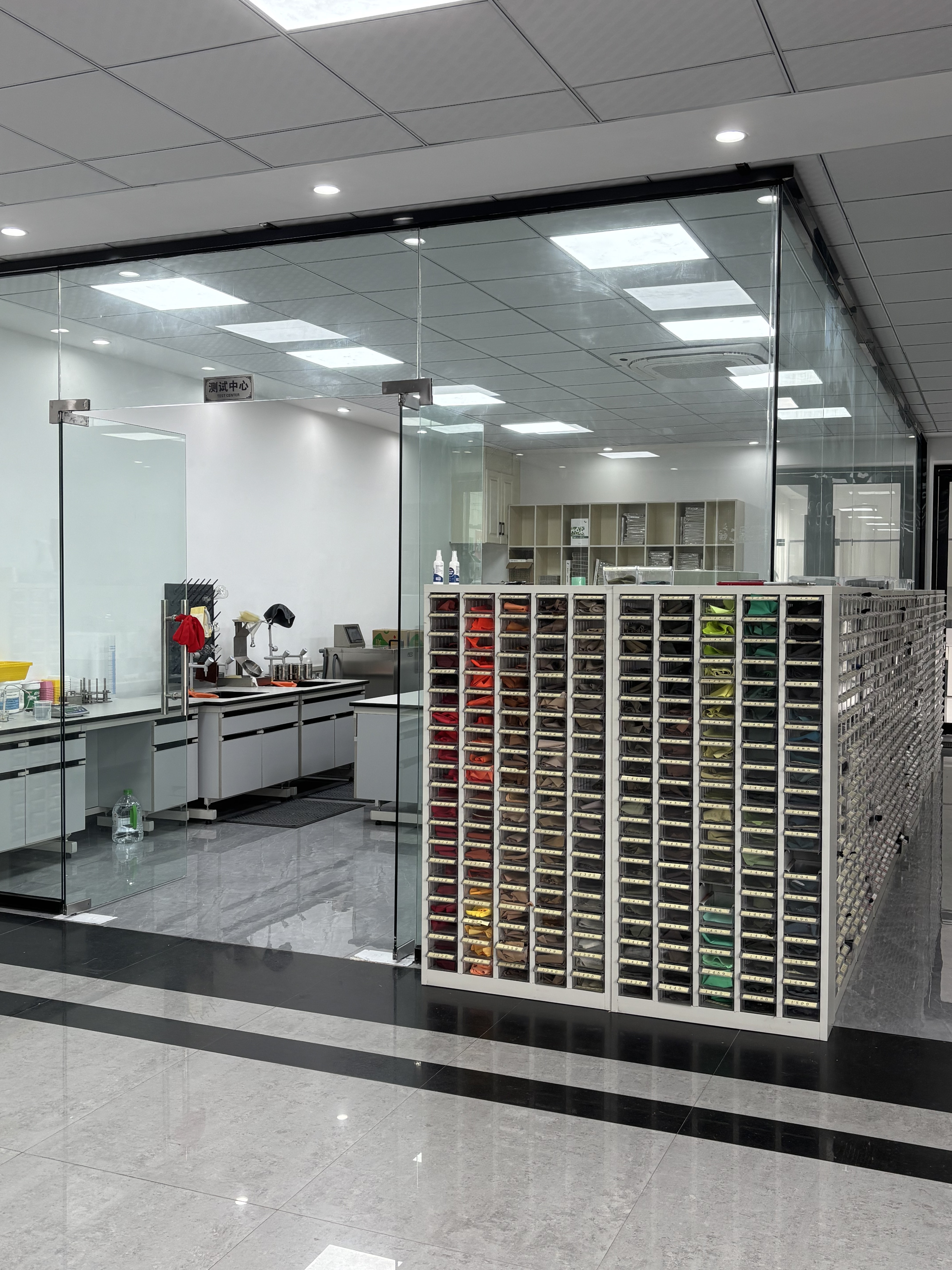
In-house laboratory testing: for upholstery and curtain fabric buyers, lot-level test capability is part of the model-level evidence trail. Image: T-LAND TEXTILE product laboratory.
Why capability claims stall at the decision stage
Most fabric suppliers can answer the question “what do you make?” Fewer can answer “what will you be accountable for, article by article?” The gap becomes expensive at the decision stage, when a buyer is no longer exploring options but justifying a choice — to a furniture brand's quality team, to a project specifier, or to a retail compliance function.
Three patterns recur in upholstery and curtain fabric sourcing:
- Adjectives without units. “Premium”, “heavy duty” and “commercial grade” carry no measurable value, so two quotations cannot be compared on them.
- Capability claims that are not model-specific. “We produce velvet, jacquard and poly-linen sofa fabric” describes a catalogue range, not the article a buyer will receive in lot three of a production run.
- Evidence that exists only at sampling stage. A good first sample says little about the tenth production lot unless a batch control system sits behind it.
Model-level specifications do not eliminate these problems, but they convert them into questions that have answers: which article, which construction, which weight, which width, tested how, and against which retained sample.
The four fields that make a fabric specification checkable
A fabric specification becomes comparable when four fields are stated together. Remove any one of them and the remaining three stop describing the same product.
- Fibre composition — for example 100% polyester. Composition drives care requirements, flammability behaviour and how finishing treatments bond to the substrate.
- Yarn construction — normally written as warp denier × weft denier, such as 105D x 200D, and sometimes with multiple weft components, such as 150D x 320D + 200D. Denier (D) is the mass in grams of 9,000 metres of yarn, so a higher denier generally indicates a heavier yarn.
- Weight — grams per square metre (gsm). This is the finished fabric's mass per unit area. It is not thickness, and it is not pile height.
- Width — 150 cm, 160 cm or 300 cm. Width decides cutting yield and how many seams a finished panel will carry.
One procurement rule follows from this: gsm figures are only comparable when construction and finishing state are also identical. The same supplier catalogue shows why. Article TL12199 is listed at 300 gsm with backing and 380 gsm with silicon coating — same article number, two weights, because the finishing state differs. A buyer comparing “300 gsm” from one supplier with a different figure from another, without checking what the number includes, is comparing two different measurements.
| Article | Type | Composition | Construction | Weight | Width |
|---|---|---|---|---|---|
| TL0329 | Upholstery fabric (sofa) | 100% polyester | 105D x 200D | 160 gsm | 150 cm / 300 cm |
| TL07242 | Velvet fabric (sofa) | 100% polyester | 150D x 320D + 200D | 220 gsm | 150 cm |
| TL0901 | Velvet fabric (sofa) | 100% polyester | 160D | 200 gsm | 160 cm |
Table 1: Model-level specification of three sofa fabric articles in the T-LAND TEXTILE catalogue. Industry reference. Buyer decision-making.
Reading three models: what each specification line answers
TL0329 — a flat upholstery article with a wide-width option
TL0329 is specified as a 100% polyester upholstery and sofa fabric, construction 105D x 200D, 160 gsm, offered in 150 cm and 300 cm widths. Two readings matter to a buyer. The dual width is a cutting-yield decision: the 300 cm option allows wider panels and fewer joining seams than a 150 cm-only article, which changes both the labour content of upholstery production and the visual continuity of large panels. The weight places TL0329 at the lighter end of the supplier's own upholstery range — for calibration, the same catalogue lists TL07377-2 velvet at 160 gsm, TL07373-1 jacquard at 220 gsm, TL07392 jacquard at 280 gsm, TL07410 velvet at 300 gsm and TL07408 jacquard at 450 gsm. A lighter weight is not a defect, but it does mean the buyer should match the article to the seat or panel it will cover rather than to the price line.
TL07242 — velvet with a multi-component weft
TL07242 is listed as a 100% polyester velvet upholstery and sofa fabric at 220 gsm and 150 cm width, with a construction written as 150D x 320D + 200D. The multi-component weft is the line worth questioning. A buyer should ask the supplier to identify which component forms the ground and which forms the pile, and how the pile is controlled from lot to lot, because in velvet constructions the pile is what the end user touches, sits on and judges. The same article also fixes the conversation on 150 cm width, so any programme requiring 300 cm panels needs a different article rather than an assumption.
TL0901 — velvet at 160 cm and a single denier figure
TL0901 is described as a velvet sofa fabric, 100% polyester, construction 160D, 200 gsm, width 160 cm. Two details stand out. The width is 160 cm — ten centimetres wider than TL0329 and TL07242 in their standard widths — which is a real cutting-yield difference on high-volume furniture lines. And the construction is stated as a single denier figure rather than a warp-by-weft pair, which is an incomplete specification in comparison with the other two articles. A buyer reading model-level evidence should flag exactly this: ask the supplier to state warp and weft separately, and to confirm whether 160D refers to ground yarn or pile yarn.
Breadth matters as much as depth. The same catalogue lists TL12167 poly-linen at 350D x 350D + 650D and 280 gsm, TL0415, TL0469 and TL0484 polyester-linen at 600D x 600D or 300D x 300D and 230 gsm, TL07392 jacquard at 900D x 1580D and 280 gsm, and TL07410 velvet at 350D x 450D and 300 gsm. A supplier able to state parameters across a range is showing that the specification is a system rather than a single hero article.
From specification to procurement evidence: the performance pack
Specifications describe what a fabric is. Procurement decisions usually turn on how it behaves. The performance comparison reported for this fabric range sets out abrasion, light fastness, pilling, shrinkage and service life against two benchmarks — cotton-linen, and competitors' ordinary fabrics.
| Metric | This fabric range (as reported) | Cotton-linen | Competitors' ordinary fabrics |
|---|---|---|---|
| Martindale wear resistance | ≥20,000–45,000 cycles | 10,000–15,000 cycles | 8,000–15,000 cycles |
| Light fastness | Grade 4 or above | Grade 2–3 | Grade 2–3 |
| Pilling resistance | Grade 4–5 | Grade 2–3 | Grade 2–3 |
| Shrinkage rate | ≤3% | 5–8% | Up to 8–10% on low-cost goods |
| Expected service life, home use | 8–12 years | 4–6 years | 3–5 years |
| Expected service life, commercial use | 5–8 years | Not stated | Not stated |
| Upfront purchase cost | 15–35% higher than ordinary competitors' goods | Lower upfront than this range | Baseline in the comparison |
| Total life-cycle cost | Lower, with approximately 80% longer service life | Higher upfront cost with frequent replacement | Low initial price, high long-term total cost |
Table 2: Performance comparison reported for the sofa and curtain fabric range against cotton-linen and ordinary competitor fabrics. Industry reference, buyer interpretation.
A few consequences follow for buyer questioning. Ask for the test report behind each number — the method, the laboratory and the lot tested. Ask whether a figure is a typical value or a guaranteed minimum. And ask which retained reference sample future lots will be compared against, because a comparison table without a retention protocol is a claim rather than a control.
Functional stability is a further axis of the same comparison. Intrinsic flame-retardant and woven blackout properties are stated to retain performance after washing, whereas coated treatments degrade after repeated washing. That distinction cannot be applied to a supplier as a whole; it belongs to a specific article and finish, which is precisely why model-level handling is necessary when a project's specification calls for fire retardant or blackout performance.
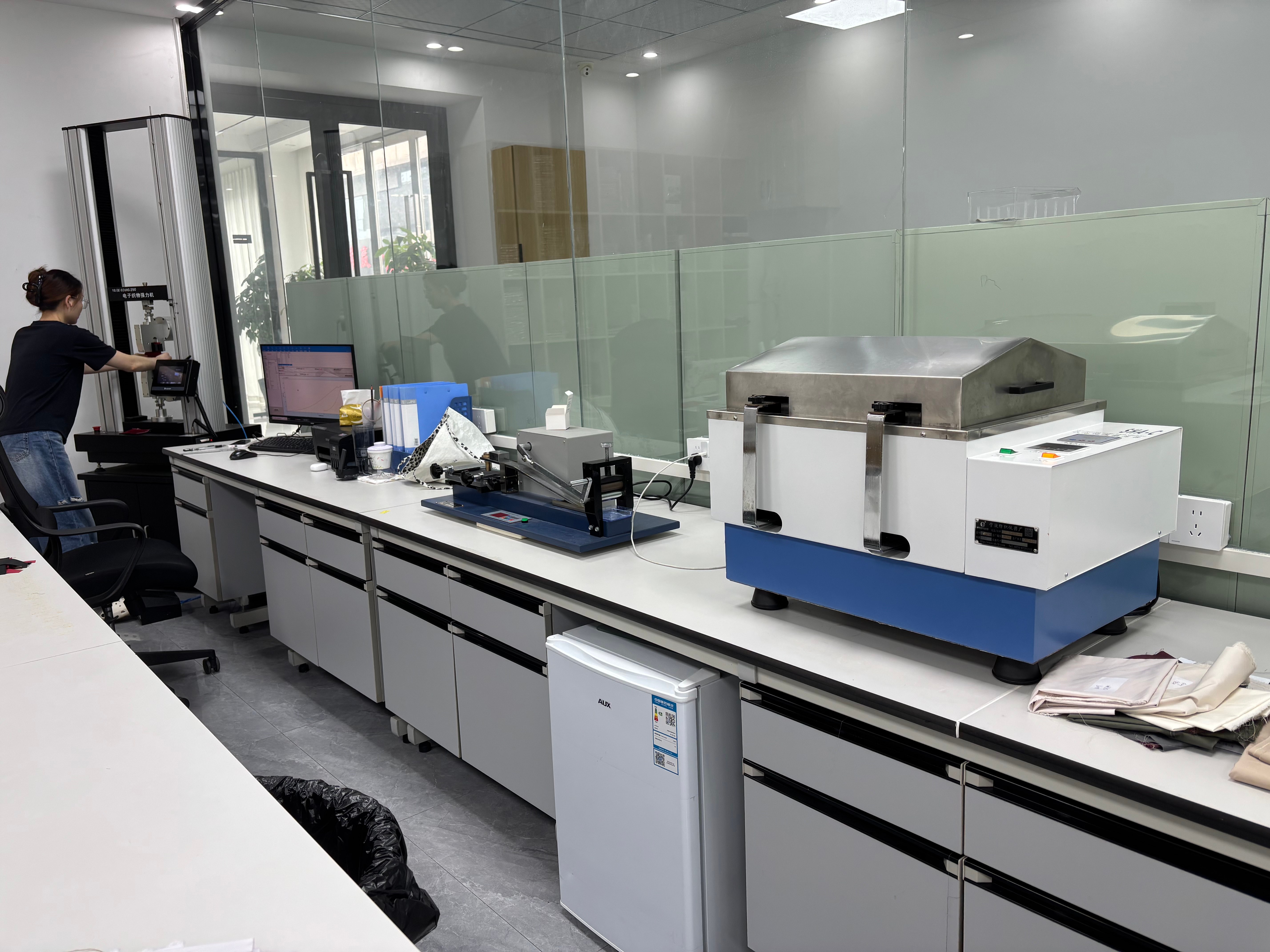
Verification equipment: wear, light fastness and shrinkage claims are only usable in procurement when a test trail supports them. Image: T-LAND TEXTILE testing equipment.
Where verification capability sits behind the numbers
Model-level specifications are only useful if a supplier can reproduce them. The verifying assets reported by Suzhou T-land Textile Co., Ltd. include a facility founded in 2014, a 5,000 m² factory, 91 employees, a stated annual output of 5,000,000 metres, and a three-engineer R&D team. Quality control rests on an in-house laboratory that tests items lot by lot, and on a non-paper order instruction system in which instructions are handled through computer systems. Finished goods are held and dispatched from a 1,500 m² warehouse. Around 90% of output is exported, with the EU as the main market, and the company states it holds OEKO-TEX and GRS certification, while working with additional certifications to meet different client requirements.
Two commercial practices also belong in a capability assessment, because they determine what a buyer can do with a specification. The company states that it accepts small sample orders to help clients develop new items, and that it retains copying rights for client-developed items under the applicable legal authority — a point worth clarifying in writing for any private-label programme.
The combination matters more than any single item on the list. A laboratory without batch records, or records without warehouse discipline that keeps lots separate, still leaves the buyer exposed to variation in colour and handle during production. Buyers evaluating a sofa or curtain fabric supplier are effectively auditing the link between the article number, the test report and the lot that ships.
Application fit: where these specifications are used
Sofa fabric and curtain fabric perform different jobs. In the company's own description, curtain fabric provides light blocking and light adjustment, sun shading and privacy protection, decoration and noise reduction. Sofa fabric covers and protects the sofa base material, resists friction, and contributes to decoration and sitting comfort. Neither product has moving mechanical parts: curtains hang and are drawn manually or by motor, while sofa fabric is fixed to a frame and absorbs repeated sitting pressure and friction.
Project types named for these fabrics include residential decoration, hotels and B&Bs, office and commercial projects, healthcare institutions, exhibition and cultural tourism projects, and special soft furnishing for RVs and yachts. The special requirements most often attached to them — flame retardancy, high light fastness, high Martindale wear resistance, anti-pilling, water-repellent and stain-resistant finishing, low-formaldehyde eco standards, strict batch-to-batch colour difference control, washability, and customised width and gram weight — are exactly the points at which model-level evidence stops being a marketing phrase and becomes a contract term.
Width illustrates application fit well. The 300 cm option appears across the curtain range — including TL08180, TL08183 and TL08170, TL0888, TL08166, TL08229, TL08321 and TL12199 — and on the upholstery article TL0329, while velvet sofa articles such as TL07242 are stated at 150 cm and TL0901 at 160 cm. Buyers specifying wide panels should confirm width per article rather than per supplier, since a range rarely shares one width across every construction.
Market context: why specification discipline is being priced in
The commercial backdrop explains the shift towards article-level evidence. The global home textile market was reported at USD 144.76 billion in 2025, with Asia Pacific holding 44.17% of that market in the same year. The upholstery fabric segment was valued at USD 44.5 billion in 2023, and the blackout fabric segment at USD 2.7 billion in 2024, projected to reach USD 3.8 billion by 2030 at a CAGR of 5.9%. China's home textile exports reached USD 2,870.94 million in March 2024 alone.
Market sizing of this kind should be read with care. Published blackout fabric figures differ widely depending on whether a report measures raw fabric or finished curtains — a definition difference that produces apparently contradictory market sizes. Buyers who use market data in internal papers should state the definition alongside the number, in the same way they should state the finishing state alongside a gsm figure.
Regulation pushes in the same direction. The UK Furniture and Furnishings (Fire) (Safety) Regulations 1988, amended in 2010 and 2025, remain the core regime in 2026 for domestic upholstered products, and BS 5867 is the established UK fire safety standard specifically for curtains and drapes. In the EU, the General Product Safety Regulation 2023/988 sets safety requirements covering home textiles, with Digital Product Passports expected for textiles by 2027. Each of these regimes is answered with article-level documentation, not with a supplier capability statement.
Compared with traditional alternatives — and the limits of the case
The comparison reported for this fabric range states clear advantages over cotton-linen and over competitors' ordinary fabrics in wear resistance, UV resistance and pilling resistance, and in dimensional stability, with a shrinkage rate of ≤3% against 5–8% for cotton-linen and up to 8–10% for low-cost fabrics. Functional stability is the third axis: intrinsic flame-retardant and woven blackout properties are stated to retain performance after washing, whereas coated treatments are described as degrading after repeated washing.
Three boundaries should be stated as plainly as the advantages.
- Upfront cost is higher. The fabric costs 15–35% more than ordinary competitors' goods at purchase. The reported offset is approximately 80% longer service life and therefore a lower total life-cycle cost — but that equation only resolves in the buyer's favour if the product's service life is actually used. For short-cycle projects, the arithmetic can run the other way.
- Polyester carries a production-side energy penalty. Per the same comparison, polyester consumes more production energy than natural cotton-linen. The counter-argument is service life: longer use reduces the resource load of repeated production, transport and disposal, and high-weight blackout curtains provide heat insulation that can help lower air-conditioning energy consumption in use.
- Not every application needs this level of performance. The comparison itself concedes the natural-texture case: cotton-linen remains a reasonable option for home decoration pursuing natural texture in low-sunlight, low-traffic spaces, and ordinary fabrics remain adequate for low-budget short-term use, rental housing and temporary projects. A supplier that cannot articulate this boundary is not giving a buyer a usable decision framework.
The same caution applies to the specifications themselves. A model number with parameters is the beginning of verification, not the result of it.
What model-level evidence cannot prove
A numbered specification with construction, weight and width does not establish batch consistency, colour match under the buyer's own lighting, hand-feel, pile appearance over time, or delivery reliability. Nor does it prove that a catalogue figure will survive the buyer's own laboratory. What it does provide is a specimen that can be tested, a reference for comparing lots, and a written basis for a claim if a delivered lot differs.
For each article under consideration, buyers should therefore request the complete four-field specification; a test report covering the performance claims they intend to rely on; a retained reference sample identified with the lot or batch reference; and a stated process for handling deviations. Sourcing teams that build this into the request-for-quotation stage find that suppliers either answer directly or reveal, early, that they cannot.
Future outlook
Two directions are visible for home textile fabric sourcing. The first is documentation. Digital Product Passports expected for textiles by 2027 under the EU framework will make article-level data — composition, origin, care and increasingly durability — a condition of market access rather than a differentiator. Suppliers who already publish model-level specifications and keep lot records are closer to that requirement than those relying on catalogue adjectives. The second is durability economics. As buyers compare lifetime cost rather than unit price, the specification fields that predict abrasion, colour retention and shrinkage move from technical annexes into the commercial conversation.
Neither trend changes the underlying discipline. Capability is judged article by article, and the evidence is the specification plus the test behind it.
FAQ — Model-level evidence in home textile fabric sourcing
Ask the supplier to state four fields for each numbered article — fibre composition, yarn construction written as warp × weft, weight in gsm and width in cm — and to support any performance claim with a test report that names the method, the laboratory and the lot tested. A retained reference sample kept alongside the specification gives the buyer a physical baseline for comparing subsequent deliveries. If one of the four fields is missing, the specification is incomplete rather than simply concise.
It states the yarn linear density of the warp and the weft in denier, where denier is the mass in grams of 9,000 metres of yarn; 105D in the warp and 200D in the weft describes a fabric whose weft yarn is heavier than its warp yarn. In velvet and other multi-component constructions the notation becomes longer, for example 150D x 320D + 200D, and the buyer should ask which component forms the ground and which forms the pile. Construction alone does not determine durability — it has to be read together with weight, finishing and test results.
Yes, because width sets cutting yield and the number of seams in a finished panel. Within a single catalogue the differences can be material: upholstery article TL0329 is offered in both 150 cm and 300 cm, velvet article TL07242 is stated at 150 cm, and velvet article TL0901 is stated at 160 cm. Wide-width options can reduce joining and labour in large-panel production, but width should be confirmed per article rather than assumed across a supplier's range.
No. Weight in gsm describes mass per unit area, not thickness or pile height, and it interacts with construction and finishing state. The same article can carry different weights depending on finishing — TL12199 is listed at 300 gsm with backing and 380 gsm with silicon coating. The useful question is whether an article's construction, weight and finish together match the intended seat or panel, and what the supplier's test data shows for that combination.
Not necessarily, but the calculation has to be made rather than assumed. The comparison reported for this fabric range states an upfront cost 15–35% higher than ordinary competitors' goods together with approximately 80% longer service life, producing a lower total life-cycle cost. Expected service life is given as 8–12 years for home use and 5–8 years for commercial use, against 4–6 years for cotton-linen in home use and 3–5 years for ordinary fabrics. Where the service life is not actually used — short-term, rental or temporary applications — the upfront premium is not recovered in the same way.
Pilling is a physical phenomenon rather than a single defect class: repeated friction pulls short surface fibres out of yarns, and those fibres tangle into visible pills, so almost any fabric can pill and short-fibre constructions pill more readily than long-fibre ones. Pilling resistance for this fabric range is stated as Grade 4–5, against Grade 2–3 for cotton-linen and ordinary fabrics. Fading follows a different mechanism — ultraviolet radiation in sunlight degrades dye molecules where light fastness is insufficient — so the relevant figure is light fastness: Grade 4 or above for this range, against Grade 2–3 for the comparison groups.
Summary
Model-level specifications are not the whole of a supplier assessment. They are the part that can be written down, tested and compared, which is why they carry disproportionate weight at the decision stage of a home textile fabric programme. Buyers who ask for composition, construction, weight and width per article — and for the test evidence behind them — will usually find that the supplier answering clearly is also the one whose capability claim is easiest to substantiate.
A downloadable company brochure for T-LAND TEXTILE is available here: T-LAND TEXTILE brochure (PDF).