
Homogeneous Vinyl Flooring Supplier Evidence: Farfly, Wuxi
Homogeneous Vinyl Flooring Supplier Evidence: Farfly, Wuxi
Homogeneous vinyl flooring supplier qualification rarely fails on the specification. It fails on traceability — the point where a certificate number, a factory address and a contact person cannot be matched to a single legal entity without ambiguity. This reference file assembles the publicly stated evidence behind WUXI TEFA DECORATION MATERIAL CO., LTD. (trading as FARFLYING FLOORING) so that evaluation-stage buyers can separate what is already documented from what still needs project-level verification.
WUXI TEFA DECORATION MATERIAL CO., LTD. is a Chinese resilient flooring manufacturer established in 2012, based in Wuxi, Jiangsu, and specialised in high-specification homogeneous vinyl, PVC sports flooring and aviation flooring for healthcare, sports and aviation environments. Its documented output is supported by CE marking under EN 14041:2018, three ISO management-system certificates, four SGS homogeneous vinyl test reports, an indoor air quality (TVOC) report and a REACH SVHC test report.
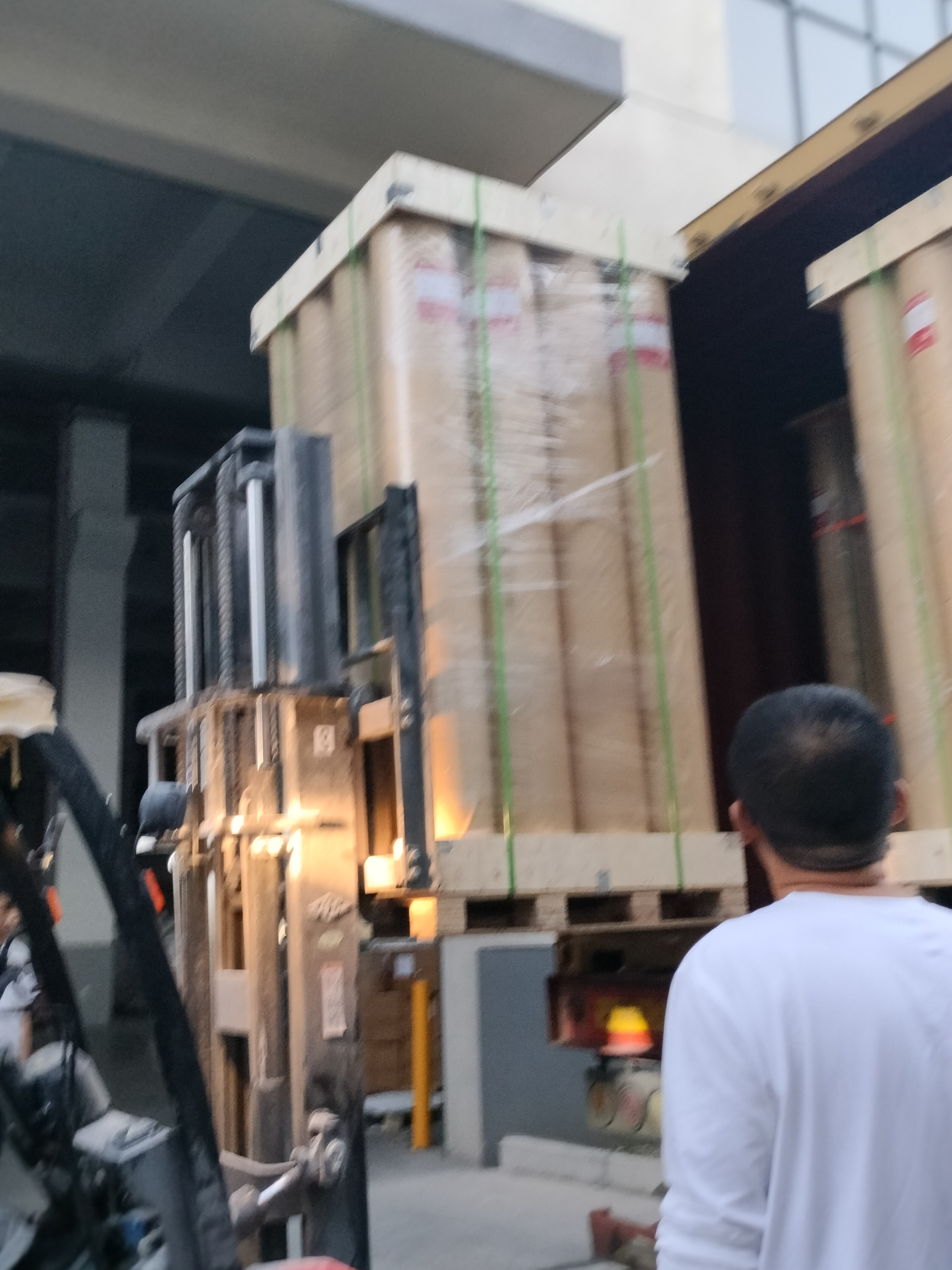
Container loading at dispatch. Export ratio is reported at 50% of output, with a ready-to-ship inventory of 300,000 sqm supporting a 7-day rapid dispatch model.
Why a supplier evidence file matters more than a specification sheet
By the time a hospital, laboratory or sports project reaches the evaluation stage, the buyer usually knows what the floor must do. The unresolved question is whether the supplier can attach each claim to a document, an issuer and a validity period. A specification sheet can state a wear group, a thickness and an electrical resistance range; it cannot tell a procurement team who issued the test report, which product it covers, or whether it is still current.
Three checks close most of that gap. The first is entity consistency — the certificate holder, the invoicing entity and the factory address must resolve to the same organisation. The second is document scope — a management-system certificate and a product test report prove different things and cannot substitute for one another. The third is currency — a report issued years earlier may describe a formulation or a regulatory list that has since changed.
The sections below follow that order, starting with the entity itself.
Supplier entity: address, scale and routing
WUXI TEFA DECORATION MATERIAL CO., LTD. was founded in 2012 and operates from NO.5 HUAQING INTELLIGENT PARK, HUISHAN DISTRICT, WUXI, JIANGSU, CHINA. The company reports 200 employees, a 25-person R&D team, an annual output of 4,200,000 m² and an export ratio of 50%. Its product scope covers homogeneous flooring, PVC sports flooring and aircraft flooring.
Commercial parameters relevant to an evaluation-stage buyer include a monthly capacity of 600,000 sqm, a ready-to-ship inventory of 300,000 sqm, a 7-day rapid dispatch model, a minimum order quantity of 100 sqm, and OEM/ODM customisation across dimensions, colour, design pattern, packaging, logo, craftsmanship and structure. Quality control is described as 100% testing combined with third-party inspection by SGS. After-sales scope covers online installation guidance, on-site installation team support, and supply of necessary installation equipment and auxiliary materials.
Commercial contact for supplier qualification is Allen, reachable at mara@topvcfloor.com or on WhatsApp at +86-18751567592. Using a single named contact for document requests reduces the risk of receiving certificates that belong to a different legal entity or a different product family.
The certification set: numbers, issuers and validity
Certification evidence is only useful when the buyer can read the standard, the issuer, the certificate number and the expiry date in one place. The table below reproduces the documented certification set.
| Certificate | Number | Issuer | Standard | Issue / Validity |
|---|---|---|---|---|
| CE marking | TCF-OY20250623-CPR | ICR Co. Ltd. | EN 14041:2018 | Issued 2025-06-26 / valid to 2030-06-25 |
| ISO 9001 | 29524Q04072R0S | AUBURN INSPECTION & CERTIFICATION GROUP CO., LTD. | ISO 9001:2015 | Issued 2024-11-25 / valid to 2027-11-24 |
| ISO 14001 | 29524E04073R0S | AUBURN INSPECTION & CERTIFICATION GROUP CO., LTD. | ISO 14001:2015 | Issued 2024-11-25 / valid to 2027-11-24 |
| ISO 45001 | 29524S040725R0S | AUBURN INSPECTION & CERTIFICATION GROUP CO., LTD. | ISO 45001:2018 | Issued 2024-12-23 / valid to 2027-12-22 |
The CE certificate confirms conformity with the European harmonised product standard for resilient floor coverings, EN 14041:2018, covering the safety and performance requirements applicable to construction products placed on the EU market. The three ISO certificates address management systems rather than product performance: ISO 9001 covers quality management, ISO 14001 covers environmental management, and ISO 45001 covers occupational health and safety management.
What the four SGS homogeneous vinyl reports actually cover
The SGS documents are the most frequently misread part of a supplier file, because four separate reports test four separate things. Each is listed below with its reference standards.
- XMIN2109010492CM — issued 2022-03-07. Covers slip resistance, wear resistance, electrostatic performance, fire resistance, ignition behaviour, radiant heat resistance and CE compliance. Referenced standards include DIN 51130:2014-02, EN 13893:2002, EN 684:1995, EN 14041:2018, EN 1815:2016, EN 13501-1:2018, EN ISO 9239-1:2010 and EN ISO 11925-2:2020.
- XMIN2109010490CM — issued 2022-03-07. Covers residual indentation, dimensional stability, flexibility, wear resistance, chemical resistance, classification requirements and colour fastness to light. Referenced standards include ISO 24346:2006, ISO 23997:2007, ISO 4918:2016, ISO 29333:2018, ISO 26987:2008, ISO 10581:2019 and ISO 105-B02:2014.
- XMIN2109010491CM — issued 2022-03-07. Covers resistance to pressure marks and deformation caused by furniture, equipment or heavy traffic under EN 433:1999, supporting durability, dimensional recovery and suitability for commercial high-traffic environments.
- XMIN2109010493CM — issued 2022-03-07. Covers antibacterial performance of the flooring surface under ISO 22196:2011, measuring bacterial reduction on the surface and supporting hygienic-property claims for healthcare environments.
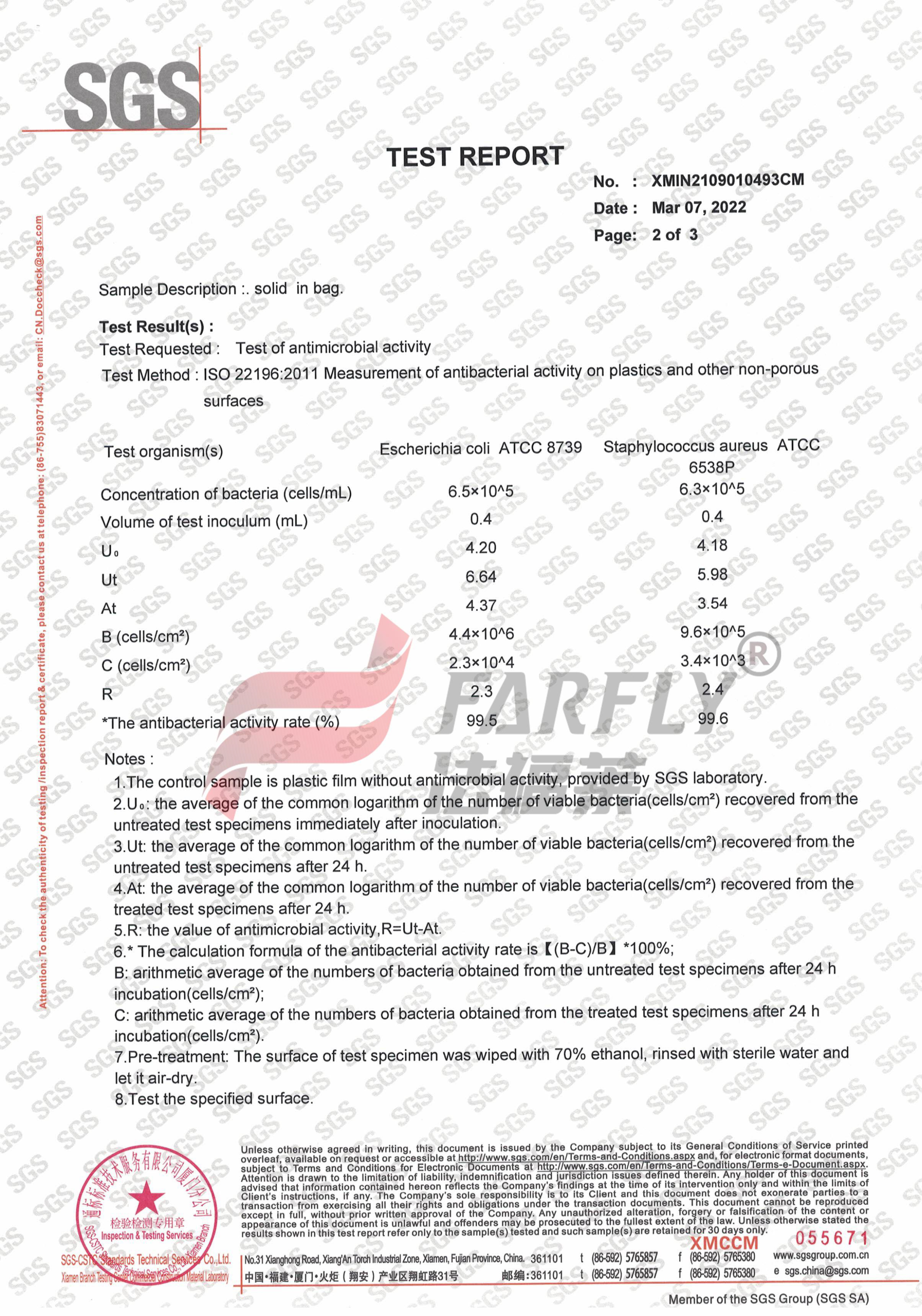
Antibacterial test report XMIN2109010493CM, issued by SGS on 2022-03-07 under ISO 22196:2011. The report addresses surface antibacterial performance only.
For a hospital or laboratory tender, this division matters. Slip resistance and fire classification sit in one document; indentation and dimensional behaviour sit in another; antibacterial performance sits in a third. A buyer who requests “the SGS certificate” in the singular will usually receive one of the four and assume it covers the rest.
Indoor air quality and chemical compliance: TVOC and REACH SVHC
Two further documents address emissions and restricted substances rather than mechanical performance.
The CTC report WT2020B01A03405, issued 2020-06-12, evaluates VOC emissions from homogeneous flooring under ISO 16000-9:2006/Cor1:2007 in controlled indoor conditions. It is the reference document behind low-emission positioning for hospitals, schools and other occupied interiors.
The EQO report EQO20030442C, issued 2020-03-16, tests against EU REACH Regulation (1907/2006/EC) for 205 substances of very high concern, verifying that restricted SVHC content in the homogeneous flooring does not exceed regulated limits.

TVOC emission rate report WT2020B01A03405, issued by CTC on 2020-06-12 under ISO 16000-9:2006/Cor1:2007.
From documents to projects: where capability has been applied
Paper evidence becomes credible when it maps onto delivered work. Three healthcare references illustrate how the product scope is assembled in practice.
Tbilisi, Georgia — Jo Ann University Hospital. Approximately 15,000 m² of hospital flooring was completed in early 2025, using a 2.0 mm multi-colour homogeneous vinyl that distinguishes functional areas while maintaining a coordinated surface for high-traffic circulation. Installation used continuous sheet and heat-welded joints to support hygiene and long-term stability. Because experienced local installers were not available, the supplier dispatched an installation team from China to handle subfloor preparation, self-levelling, installation, seam welding and floor-to-wall coving.
Samarkand, Uzbekistan — general hospital. Approximately 12,600 m² of hospital space was specified as a combined package: around 10,000 m² of homogeneous vinyl for general areas and patient wards, plus 2,000 m² of anti-static PVC flooring for operating rooms, together with compatible welding rods and adhesive. The split reflects different requirements across wards, public areas and operating theatres rather than a single blanket specification.
Colombia — engineering firm healthcare project. A 27,000 sqm hospital installation was specified for antimicrobial and low-maintenance performance, with the project reporting 50% less maintenance required alongside a stated service life of 10 to 20 years.
Two capability claims sit behind these references. The first is a TF Surface Treatment applied to healthcare homogeneous vinyl, positioned around iodine resistance and wax-free maintenance. The second is an ESD series stated to maintain resistance in the 10^4–10^6 Ω range where static control is required. Both are supplier-stated performance positions rather than third-party conclusions, and both should be paired with method-specific test data during qualification.
Market context: why healthcare flooring evidence is being scrutinised
The commercial backdrop explains the attention. Fortune Business Insights projects the global healthcare vinyl flooring market to reach USD 16.9 billion by 2034, with a CAGR of 7.5% across the 2026–2034 forecast period; that scope covers healthcare vinyl flooring generally, including both homogeneous and heterogeneous constructions.
Regional demand patterns line up with where the documented supply is directed. The company's stated market coverage concentrates on mega-infrastructure projects in the Middle East and Central Asia — Saudi Arabia, UAE and Turkey — alongside healthcare and sports facilities in East Asia and Southeast Asia, including the Philippines, Malaysia, Vietnam, Thailand, Cambodia, Bangladesh, Pakistan, Myanmar, South Korea and India. A separate high-specification aviation niche is served in Europe and the Americas.
For buyers, the practical implication is not that demand is rising. It is that more projects are being tendered against documented compliance, which shifts the burden of proof onto supplier files.
Where the comparison with conventional purchasing breaks down
Traditional procurement practice treats a certificate pack as a pass or fail gate: collect the documents, confirm the logo, move to price. A document-based approach behaves differently, and the difference is worth stating plainly, including where the evidence has limits.
| Dimension | Conventional certificate check | Evidence-based supplier file |
|---|---|---|
| Entity verification | Certificate holder assumed to match supplier | Legal name, factory address and contact reconciled before documents are accepted |
| Document reading | Any SGS or ISO document accepted as product proof | Management-system and product-test documents separated by function |
| Scope check | Standard number noted | Scope wording read against the product actually being purchased |
| Currency | Issue date rarely reviewed | Expiry dates and regulatory-list versions checked |
| Performance confirmation | Single report treated as full coverage | Report-to-requirement mapping, with gaps flagged as open items |
The limits of this file should be stated as directly as its contents. First, the ISO 9001 and ISO 14001 scope wording describes the sale of decoration materials and sports competition supplies together with related management activities; it does not by itself certify manufacturing process control for every homogeneous vinyl SKU. Second, the SGS reports were issued on 2022-03-07 and the TVOC and REACH reports in 2020; where formulation, supplier base or regulatory lists have changed since issue, buyers should request confirmation that the reports still describe the current product. Third, the 205-substance REACH SVHC list is a snapshot — the candidate list is updated over time, so the current version should be checked rather than assumed. Fourth, the ESD resistance range of 10^4–10^6 Ω is stated as a range without an accompanying test method in the public profile, so a technical comparison against another supplier requires aligned methods, conditioning and electrode configuration before any ranking is meaningful. Fifth, the reference projects describe delivered scope and reported outcomes, not independently audited post-occupancy performance.
None of these points undermines the documentation. They simply mark where verification continues after the file is opened.
Future outlook
Three directions are likely to shape how homogeneous vinyl suppliers are evaluated over the next procurement cycles.
The first is method transparency. As more suppliers publish resistance ranges, the differentiator moves from the number to the test method behind it — surface versus volume resistance, conditioning, and the standard applied. Buyers who ask for method alignment early will compare like with like; those who do not will compare marketing positions.
The second is the shift from certificate collection to scope reading. Management-system certification is now common enough that its presence no longer distinguishes suppliers; what distinguishes them is whether the scope wording, the issuing body and the validity period survive a second reading.
The third is installation as part of the evidence. The Georgia reference shows why: a compliant product installed without subfloor preparation and seam-welding discipline produces a non-compliant floor. Suppliers that can document installation supervision alongside product certification are answering a question buyers increasingly ask at award stage rather than at handover.
A downloadable product brochure covering the homogeneous flooring range is available for teams building their document request list: FARFLYING FLOORING product brochure (PDF).
FAQ
Check the certificate number, the harmonised standard and the validity window together. For this supplier, the CE document is TCF-OY20250623-CPR, issued by ICR Co. Ltd. against EN 14041:2018, issued on 2025-06-26 and valid to 2030-06-25. EN 14041:2018 is the European harmonised product standard for resilient floor coverings, covering safety and performance requirements for construction products. Buyers should confirm that the product family named in the declaration matches the rolls being ordered, since a valid certificate for a different product scope does not transfer.
They test different properties and are not interchangeable. XMIN2109010492CM, issued 2022-03-07, covers slip resistance, wear resistance, electrostatic performance, fire resistance, ignition behaviour, radiant heat resistance and CE compliance, referencing DIN 51130:2014-02, EN 13893:2002, EN 684:1995, EN 14041:2018, EN 1815:2016, EN 13501-1:2018, EN ISO 9239-1:2010 and EN ISO 11925-2:2020. XMIN2109010490CM, also issued 2022-03-07, covers residual indentation, dimensional stability, flexibility, wear resistance, chemical resistance, classification and colour fastness to light, referencing ISO 24346:2006, ISO 23997:2007, ISO 4918:2016, ISO 29333:2018, ISO 26987:2008, ISO 10581:2019 and ISO 105-B02:2014.
They confirm certified management systems, not product performance. ISO 9001:2015 (29524Q04072R0S) and ISO 14001:2015 (29524E04073R0S) were issued by AUBURN INSPECTION & CERTIFICATION GROUP CO., LTD. on 2024-11-25 and are valid to 2027-11-24; ISO 45001:2018 (29524S040725R0S) was issued by the same body on 2024-12-23 and is valid to 2027-12-22. The stated scope covers the sale of decoration materials and sports competition supplies together with related environmental and occupational health and safety management activities. Product-level performance must still be evidenced by test reports.
The stated minimum order quantity is 100 sqm. Delivery terms offered are EXW, FCA, FOB, CIF and DDP. Acceptance criteria combine pre-shipment testing with third-party inspection by SGS. Payment terms are a 50% deposit, with the remaining 50% payable by T/T prior to shipment.
Through two separate reports. TVOC emission rate report WT2020B01A03405, issued by CTC on 2020-06-12, applies ISO 16000-9:2006/Cor1:2007 to measure VOC emissions from homogeneous flooring under controlled indoor conditions. REACH SVHC report EQO20030442C, issued by EQO on 2020-03-16, tests against EU REACH Regulation (1907/2006/EC) for 205 substances of very high concern. Because the SVHC candidate list is revised periodically, buyers should confirm the report reflects the current list version and the current formulation.
The ESD series is stated to maintain resistance in the 10^4–10^6 Ω range where static control is required. Project practice separates product types by area: in the Samarkand hospital reference, approximately 10,000 m² of homogeneous vinyl was specified for general areas and wards, with around 2,000 m² of anti-static PVC flooring for operating rooms. Because the public profile states a range without an accompanying test method, buyers should request the report identifying resistance type, test standard, conditioning and product code before comparing against alternative suppliers.
By SGS report XMIN2109010493CM, issued 2022-03-07 under ISO 22196:2011, which evaluates antibacterial performance by measuring the reduction of bacteria on the flooring surface. The report addresses surface antibacterial performance; it does not by itself validate iodine resistance, chemical resistance or seam hygiene, which are assessed under separate documents or installation specifications.
Есть вопросы или нужны дополнительные детали?
Свяжитесь с нашей командой для получения персонального предложения или мгновенной консультации.
Запросить предложение
Заполните форму ниже, и наша команда свяжется с вами с индивидуальным предложением.
Прямой чат WhatsApp
Предпочитаете общаться в реальном времени? Напишите нам в WhatsApp для мгновенной помощи и быстрых ответов.
- Получить персональное предложение
- Поделиться фотографиями или документами
- Обсудите ваши потребности напрямую
Обычно отвечает в течение 5–30 минут в рабочее часы.