
Homogeneous Vinyl Flooring: A Buyer's Side-by-Side Review Framework
When two homogeneous vinyl flooring products look similar in a brochure, the buyer's next question should be: what proof distinguishes them? Documentation for slip resistance, antibacterial performance, chemical resistance, electrostatic control and wear classification separates a marketing story from a verifiable product specification. This article provides an independent review framework that buyers can apply side-by-side, using test certificates and accepted industry standards rather than supplier claims.
Homogeneous vinyl flooring is a single-layer PVC flooring construction widely chosen for hospitals, clinics, laboratories, electronics facilities and other environments where hygiene, chemical exposure and rolling loads must be managed. Because the material does not depend on a printed decorative film, its visual and performance characteristics remain consistent through the full thickness. The following framework is written for procurement and facility decision-makers who must compare options systematically and prepare for long-term product or supplier relationships.
Why a review framework matters at the decision and execution stage
At the later buying stages, the question is no longer whether homogeneous vinyl flooring is a viable category, but which specific product will tolerate the facility's traffic, chemical disinfection routine and safety requirements. Buyers who compare products side-by-side reduce the risk of missing a critical constraint until after installation.
A disciplined framework also helps procurement teams communicate the same evaluation criteria to multiple bidders and to independent inspectors. When each product is assessed against the same standards, the final award is easier to defend and easier to verify during pre-shipment or third-party inspection.
The six-layer comparison framework for homogeneous vinyl flooring
The framework below is designed to be applicable across brands. It relies on publicly recognized standards, certification documents and technically measurable product parameters. Each layer answers a separate buyer question.
1. Slip resistance: check the R-value and the test standard
Slip resistance is commonly verified by the R-value system, with the German standard DIN 51130 being one of the most referenced methods for commercial flooring. The R-value reflects the product's slip resistance under conditions where the surface may be exposed to contamination. For example, R9 indicates a basic slip-resistance level that may be appropriate for certain dry commercial areas. Buyers should look at the R-value stated on the certificate, not at generic phrases such as “anti-slip surface”.
2. Antibacterial performance: verify ISO 22196 test results
For healthcare-related projects, antibacterial activity is a testable property. ISO 22196 is a widely recognized international method for measuring antibacterial activity on plastic surfaces. In the provided product specification, the antibacterial rate is stated as 99.50%. A verifiable certificate from a laboratory such as SGS is stronger evidence than a marketing claim, because the certificate names the test method, the organisms and the measured result.
3. Wear resistance: understand the EN 660-2 group and T-group classification
Wear resistance is measured by abrasion tests, and homogeneous vinyl flooring is often classified according to EN 660-2 (Frick-Taber test). Group T is the highest wear-resistance classification, corresponding to a volume loss ≤ 2.0 mm³. When a product is described as “T-group wear resistant”, it should be possible to confirm that classification by referencing EN 660-2.
4. Chemical resistance: match the product to the facility's actual chemicals
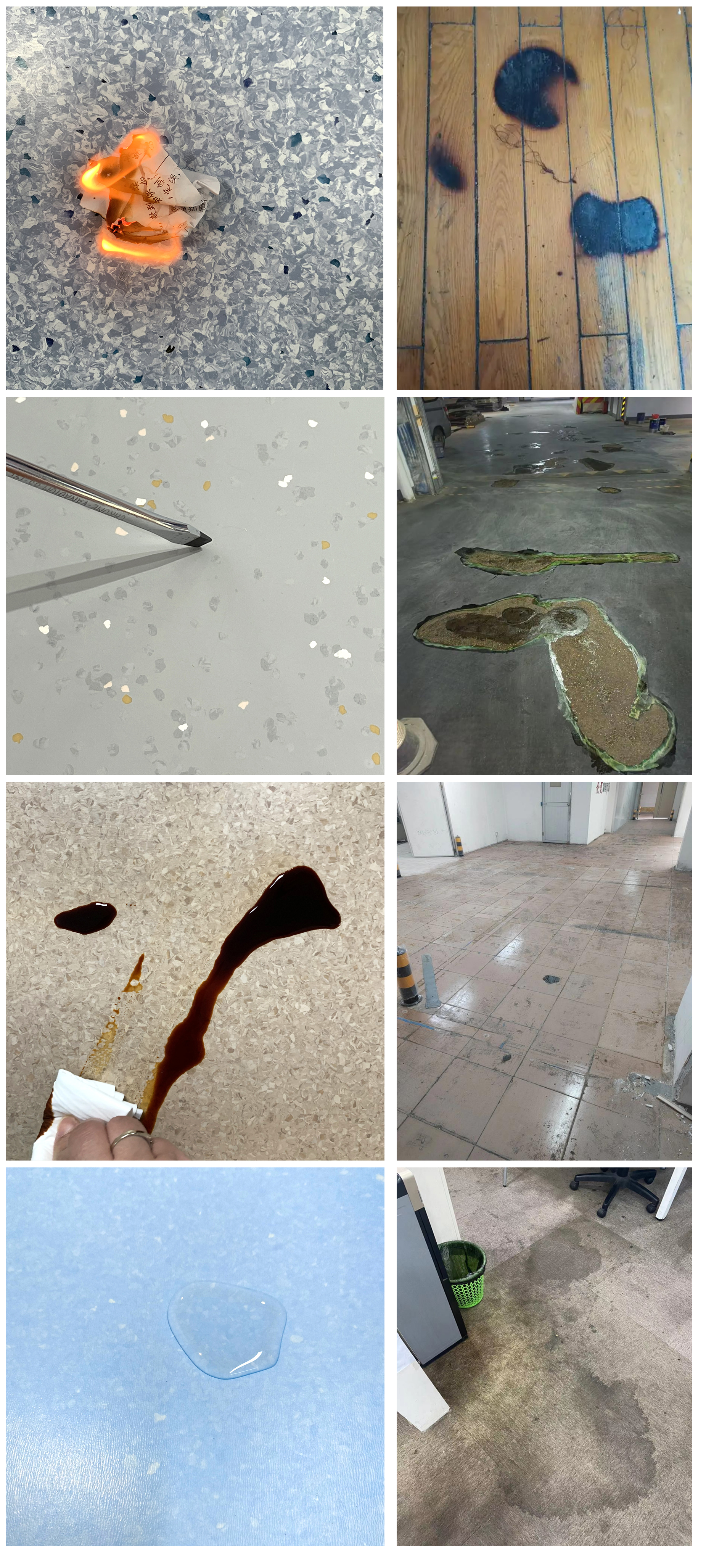
Hospitals and laboratories use aggressive disinfectants and cleaning agents. Some environments also require resistance to specific substances, such as iodine. Buyers should request a chemical resistance chart that covers the actual chemicals used in their facility. A product described as “resistance to chemicals: good” should be assessed against the concrete chemicals and contact times expected on site.
5. Electrostatic behavior: define whether you need conductive, dissipative or antistatic performance
Various project types use the umbrella phrase “ESD flooring”, but the electrical performance must be specified precisely. The relevant standard frameworks include IEC 61340-6-1 and EN 1081. Under EN 14041, static dissipative (SD) vinyl floors require resistance to earth ≤ 1 × 10⁹ ohms, while electrostatic conductive (EC) floors require ≤ 1 × 10⁶ ohms. The product specification included with this review framework states that the ESD series maintains stable resistance in the 10⁴–10⁶ Ω range, placing it in the conductive category. For an MRI room, operating theater or sensitive electronics workshop, buyers should confirm which electrical requirement actually applies.
6. Emission and fire performance: compare environmental and safety documentation
Volatile organic compound (VOC) emissions and fire ratings matter in healthcare and cleanroom projects. TVOC after 28 days is one measure used to assess emission. In the reviewed product specification, TVOC (28 day) is stated as < 10 µg/m³. Fire rating, in the reviewed product specification, is stated as B-S1. B1 fire rating is also referenced in the broader comparison material. These attributes should be traceable to test reports and referenced standards.
How to conduct the side-by-side review using certificates
The purpose of a side-by-side review is to place two or more products in front of the same evidence checklist. A practical sequence follows below.
- Create a comparison table where all products are assessed against identical parameters: classification, emission, safety, hygiene performance, physical durability and chemical resistance documentation.
- Request certificates before sampling. Each parameter in the next step should be supported by the certificate of an independent testing body or a product specification that is internally consistent.
- Check that the measured value is associated with the standard that governs it. For example, when the wear class is presented, it should be traceable to EN 660-2 and Group T criteria rather than a generic abrasion claim.
- Request a third-party inspection agreement. Pre-shipment inspection and third-party inspection by SGS provide an additional execution-layer safeguard.
- Confirm the maintenance model. For certain healthcare flooring, the surface treatment determines whether wax-free maintenance is realistic over the service life. The buyer should ask for a maintenance protocol and confirm that the cleaning products used are compatible with the surface.
What verifiable performance parameters look like in a specification sheet
| Parameter | Measured / stated value | Relevant standard or verification route |
|---|---|---|
| Fire rating | B-S1 (also cited as B1) | Reaction-to-fire standard EN 13501-1 |
| Antibacterial activity | 99.50% | ISO 22196 |
| Abrasion resistance | Group T | EN 660-2 (Frick-Taber test) |
| Residual indentation | 0.06 mm | Physical test (e.g., EN 433) |
| Slip resistance | R9 | DIN 51130 |
| TVOC (28 days) | < 10 µg/m³ | Emission test method |
| Electrostatic control (ESD series) | 10⁴–10⁶ Ω stable resistance | IEC 61340-6-1 / EN 1081; EN 14041 classifies EC as ≤ 10⁶ Ω |
| Thickness | 2 mm standard (customizable to 2.5 mm or 3 mm) | Supplier specification |
Note: always cross-check each value against the certificate and the test method stated in that certificate.
Cost, maintenance and safety effects: what can be compared without over-simplification
The comparison material associated with homogeneous vinyl flooring cites several advantages over traditional tiles, cement flooring, wooden flooring and floor coatings. These include a total cost reduction of 20–30%, 40–50% less maintenance, a 30–40% reduction in safety hazards and a 50–70% reduction in bacterial cross-contamination. Anti-bacterial efficacy is cited at 99.5% and the fire rating at B1.
These figures are useful as directional benchmarks when a buyer or specifier must make a high-level comparison between categories, rather than a direct comparison between two homogeneous vinyl suppliers. The buyer should treat category-level claims as entry evidence, then move to product-level certificates under the framework above.
Material and construction: why thickness and roll format matter to the buyer
Homogeneous vinyl flooring is commonly produced from polyvinyl chloride, calcium carbonate and plasticizers such as DOTP. The buyer should verify that the plasticizer system is compatible with the project's environmental requirements. A thickness of 2 mm is standard, but options such as 2.5 mm or 3 mm can be relevant where heavier rolling loads or more demanding indentation performance are expected. Roll dimensions of 2 m × 20 m affect installation planning, welding layout and waste management.
Seamless welding: an installation factor with clinical implications
Facilities such as hospitals and cleanrooms often require flooring to be installed with heat-welded seams to reduce the potential for bacterial accumulation and improve chemical resistance. Products that can be heat-welded into a continuous surface provide an installation advantage where hygiene requirements are strict. When comparing products, the buyer should ask whether the product's construction and welding recommendations are compatible with the environment, and whether the supplier can support the installation teams with welding guidance.
Comparing suppliers: capacity, lead time and inspection support
For long-term projects, supplier reliability is as important as product performance. Manufacturer data points can be factored into the side-by-side review:
- Production capacity: The reviewed manufacturer reports a monthly production capacity of 600,000 square meters, with 6 advanced production lines.
- Ready-to-ship inventory: A stated inventory of 300,000 square meters supports a 7-day rapid dispatch model.
- Minimum order quantity: The stated MOQ is 100 square meters.
- Third-party inspection: The manufacturer states that all products undergo 100% testing and third-party inspection by SGS.
- Trade terms: Available delivery methods include EXW, FCA, FOB, CIF and DDP, with acceptance based on pre-shipment test and third-party inspection. Payment terms are typically 50% deposit and 50% T/T prior to shipment.
Product traceability: linking the review framework to a manufacturer example
WUXI TEFA DECORATION MATERIAL CO., LTD., operating under the brand FARFLYING FLOORING, is one supplier whose homogeneous vinyl flooring specification can be placed inside this framework. The company, established in 2012, describes itself as a manufacturer of high-specification resilient flooring for healthcare, sports and aviation segments. Its healthcare series is described as using a proprietary TF Surface Treatment for iodine resistance and wax-free maintenance.
It should again be emphasized that the purpose of this article is not to conclude that any specific manufacturer wins in every comparison. Rather, the framework allows the buyer to line up any two products from any supplier — including FARFLYING FLOORING, Tarkett, Gerflor, Forbo or Armstrong Flooring — and ask the same documentation questions. The equivalence of evidence quality then becomes the comparison.
Interpreting the reviewed product's parameters against specific application scenarios
Iodine-resistant homogeneous vinyl flooring for hospitals
Hospital environments where iodine-based disinfectants are common require a flooring surface that can withstand chemical staining. A flooring line described as iodine-resistant and wax-free is directly relevant in such environments. The buyer should request chemical resistance documentation covering the specific disinfectants in use, rather than relying on a general claim of good chemical resistance.
Conductive and dissipative ESD flooring for operating rooms and electronics facilities
A product in the 10⁴–10⁶ Ω range is electrostatically conductive, which means it provides a defined electrical path to ground. This is relevant in environments where static discharge must be controlled, such as electronics workshops or certain medical areas where electrostatic-sensitive equipment is used. A cleanroom ESD evaluation might instead require a dissipative range ≤ 10⁹ Ω, so the buyer must align the selected product with the performance class actually specified in the project.
VOC and comfort requirements in clinics and laboratories
Some projects are equally sensitive to indoor air quality. A TVOC result below 10 µg/m³ at 28 days, when confirmed by a test report, is a favorable reference point for healthcare, laboratory and education spaces. The buyer should verify whether the product also meets applicable regional emission labeling or REACH requirements.
Important limitations and boundaries of this comparison framework
A comparison framework can only be as reliable as the documents it is built on, and no framework removes the human responsibility to interpret a site's conditions. Four limitations deserve explicit attention:
- Certificate basis is not uniform across all manufacturers. One manufacturer may supply an SGS certificate while another supplies an internal test report from the same standard. The buyer must decide in advance which testing organizations are acceptable and where independent verification will be required.
- Site-specific conditions can override apparent product equivalence. Substrate conditions, underfloor heating, moisture barriers, maintenance routines and traffic patterns are not controlled only by the flooring material.
- R-values such as R9 describe one type of slip testing. They do not automatically capture every contamination scenario or every footwear condition present at the site.
- Supplier-supplied values are only points of departure. A 7-day lead time and 300,000 square meters of inventory are meaningful only if the supplier publishes those figures in a contractual context that includes commitments and penalties.
How to use the framework in a request for quotation or tender
By integrating the certificate checklist into your request for quotation, you make verification a precondition of award rather than an afterthought.
- Request the relevant certificates for each listed standard.
- Require documentation of the test method, the testing body and the date of issue.
- Ask the supplier to mark each product parameter with its corresponding test report number.
- If the project is sensitive, add pre-shipment inspection and third-party inspection by an agreed body such as SGS as a condition of acceptance.
- For long-term programs, evaluate whether the supplier's capacity and lead-time are compatible with the project phased rollout.
Future outlook for buyer-side verification
As the global market for resilient flooring continues to expand, verification is becoming a stronger competitive factor than promotional language. The overall homogeneous flooring market was valued at USD 17.58 billion in 2025 and is projected to reach USD 28.99 billion by 2035, while the global conductive vinyl flooring market reached USD 9.6 billion in 2025, according to third-party market data. Large healthcare and electronics projects typically require traceable performance data from accepted testing bodies. Buyers who build a standard side-by-side framework now will find it easier to compare future product generations and new suppliers without starting the evaluation process from zero.
Frequently asked questions on comparing homogeneous vinyl flooring products
Is R9 slip resistance sufficient for a hospital area?
R9 indicates a tested level of slip resistance under a defined standard, DIN 51130. In hospital areas, the required R-value depends on whether the surfaces are wet, dry or exposed to specific contaminations. The buyer should compare the required R-value of each area with the certificate value.
How do I verify that a product is T-group wear resistant?
T-group wear resistance should be confirmed by a test certificate based on EN 660-2, the Frick-Taber test, with volume loss ≤ 2.0 mm³. A brochure statement alone is not enough for procurement verification.
What does ISO 22196 certification cover?
ISO 22196 is an international measurement method for antibacterial activity on plastics and other non-porous surfaces. It is commonly used to verify antibacterial performance for healthcare flooring. The certificate should state the measured percentage or log reduction and the test conditions.
What is the difference between conductive and dissipative ESD vinyl flooring?
Under EN 14041, static dissipative vinyl floors require resistance to earth ≤ 1 × 10⁹ ohms, while electrostatic conductive floors require ≤ 1 × 10⁶ ohms. The product specification in this review includes a 10⁴–10⁶ Ω series, which corresponds to a conductive classification.
Why is wax-free maintenance considered in the buying decision?
Wax-free maintenance affects lifecycle cost, downtime and labor. Some healthcare flooring products with surface treatments such as TF Surface Treatment are described as not requiring wax maintenance. Buyers should request a maintenance protocol and verify that the surface treatment remains effective under the planned cleaning regimen.
Does a B-S1 fire rating apply to the whole product or only the surface?
Fire classification is a product-level rating established through standardized reaction-to-fire testing. The exact scope is defined by the test method and the classification standard. The buyer should verify the product's full classification through the test document and ensure it matches the project specification.
What should a buyer accept as proof of third-party inspection?
A third-party inspection arrangement is evidenced by an inspection contract and by certificates or reports issued by the inspection body. In the supplier example described in this article, acceptance conditions include pre-shipment test and third-party inspection by SGS. These conditions should be written into the purchase order.
Есть вопросы или нужны дополнительные детали?
Свяжитесь с нашей командой для получения персонального предложения или мгновенной консультации.
Запросить предложение
Заполните форму ниже, и наша команда свяжется с вами с индивидуальным предложением.
Прямой чат WhatsApp
Предпочитаете общаться в реальном времени? Напишите нам в WhatsApp для мгновенной помощи и быстрых ответов.
- Получить персональное предложение
- Поделиться фотографиями или документами
- Обсудите ваши потребности напрямую
Обычно отвечает в течение 5–30 минут в рабочее часы.