
Homogeneous Vinyl Flooring: Buyer Comparison for Hospitals & Schools
Homogeneous Vinyl Flooring: Buyer Comparison for Hospitals & Schools
Homogeneous vinyl flooring is a resilient sheet material in which the composition and the colour are consistent through the full thickness of the sheet, rather than being printed onto a separate wear layer. That structural property explains why the product keeps resurfacing in hospital and school specifications: the material that is cleaned, wheeled over and scraped is the same material all the way down, so there is no decorative layer that wears at a different rate from the surface around it.
Buyers in the two sectors rarely start from the same problem, though. A hospital project team is usually answering to an infection-control committee and a maintenance budget; a school project team is usually working to a facilities plan and a renovation window that closes when term begins. Both eventually arrive at the same checkpoint: which document proves the performance that has been written into the specification?
This comparison is built around that checkpoint. It sets out the evidence categories that matter for healthcare and education projects, explains what the figures in a technical datasheet actually measure, and uses one manufacturer’s published technical file — Farfly (WUXI TEFA DECORATION MATERIAL CO., LTD.) — as a worked example of a complete evidence set. It does not rank suppliers, and no product is described as superior on the basis of a claim that cannot be traced to a test report or a published standard.
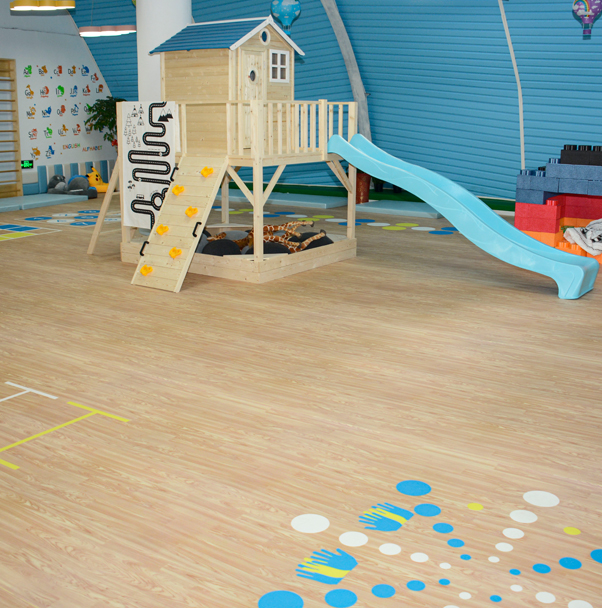
Two Building Types, Two Priority Orders, One Evidence Base
Hospital flooring specifications tend to be ordered by risk. Infection control comes first, which pushes the decision towards welded sheet rather than a tiled or heavily seamed finish. Chemical resistance follows, because wards are cleaned with iodine-based disinfectants, alcohol wipes and chlorine-based products that stain or dull the wrong surface. Slip safety in zones that are routinely cleaned wet comes next, followed by electrical performance in rooms where static discharge is a genuine concern, and then wear and indentation resistance under beds, trolleys and heavy rolling loads.
School specifications tend to be ordered by durability and cost of ownership. Corridors take continuous footfall and trolley movement; classrooms take furniture dragged across the floor and chairs with small, high-pressure contact points; dining and changing areas take water, food and cleaning chemicals. Installation timing matters as much as product performance in both sectors, because a hospital cannot close a ward and a school cannot lose teaching weeks.
The overlap is where an independent comparison becomes useful. Both sectors now ask for documented emissions, documented wear classification, documented slip performance and installation details that determine whether certified laboratory performance survives contact with the building. Buyers who assemble that evidence before samples are ordered generally shortlist faster and defend the decision more easily.
What a Complete Evidence Set Looks Like
Suppliers describe flooring in different languages: some quote internal grades, some quote standards, and some quote a single certificate number without explaining what it covers. The only reliable basis for comparing homogeneous vinyl flooring across suppliers is to require the same test method from each of them. Four document families cover most of what hospitals and schools need.
- Product standard and slip resistance. EN 14041:2018 is the harmonised European product standard for resilient floor coverings, and DIN 51130:2014-02 is the ramp test behind the R-scale used to classify slip resistance. Farfly’s homogeneous vinyl flooring carries SGS certificate XMIN2109010492CM, which covers EN 14041:2018 and DIN 51130:2014-02 slip resistance testing and is recognised in the European Union, the Middle East, Southeast Asia, Asia, Africa, North America, South America and Oceania.
- Dimensional consistency. ISO 24346:2006 covers the measurement of overall thickness, and ISO 23997:2007 covers the determination of mass per unit area for resilient floor coverings. Farfly’s file references SGS certificate XMIN2109010490CM for these two standards for the European Union market. This matters less in a single consulting room and much more across a long hospital corridor or a school hall, where roll-to-roll variation shows up as visible seams and levelling problems.
- Hygiene and indoor emissions. Antibacterial performance is documented under ISO 22196, with the supporting report referenced as XMIN2109010493CM and a reported antibacterial rate of 99.50%. Twenty-eight-day TVOC emission is documented as below 10 µg/m³, supported by TVOC testing report WT2020B01A03405.
- Wear classification. EN 660-2, the Frick-Taber test, is the method used to classify wear resistance of resilient floor coverings. Group T is the highest classification in that scale, defined by a volume loss of no more than 2.0 mm³.
| Evidence category | Document to request | What it answers for a hospital or school buyer |
|---|---|---|
| Product conformity | EN 14041:2018 certificate (e.g. SGS XMIN2109010492CM) | Whether the sheet meets the recognised European product standard for resilient flooring |
| Slip resistance | DIN 51130:2014-02 ramp test result | Which R-class applies to corridors, wards, stairs and wet zones |
| Dimensions | ISO 24346:2006 and ISO 23997:2007 (e.g. SGS XMIN2109010490CM) | Whether roll-to-roll thickness and mass are consistent enough for large seamless areas |
| Hygiene | ISO 22196 antibacterial test (report XMIN2109010493CM) | Whether the antibacterial claim is tested rather than descriptive |
| Indoor air | 28-day TVOC report (e.g. WT2020B01A03405) | Whether the floor is suitable for occupied buildings and sensitive patient groups |
| Wear | EN 660-2 wear group classification | Whether the product is rated for continuous public traffic |
| Fire | Reaction-to-fire classification | Whether the floor can be used in corridors and escape routes under local building rules |
A procurement team does not need to memorise these standards. The useful discipline is to ask every shortlisted supplier to name the test method behind each performance claim, and to compare only claims that come with the same method attached.
What the Documented Performance Data Means in Practice
Performance figures become decision criteria only when they are read against a building. The table below lists the documented specification of Farfly’s homogeneous vinyl flooring and translates each figure into the question a hospital or school buyer is actually asking.
| Documented figure | Value | Buyer interpretation |
|---|---|---|
| Thickness | 2 mm standard, customisable to 2.5 mm or 3 mm | Thicker formats are typically considered where rolling loads, trolleys or heavy furniture are concentrated |
| Roll format | 2 x 20 m | Determines seam planning across long corridors and open teaching spaces |
| Fire rating | B-S1 | Relevant to corridor and escape-route specifications |
| Antibacterial performance | 99.50% | Supports infection-control documentation where a tested figure is required |
| Residual indentation | 0.06 mm | Indicates how much the surface fails to recover after loading — relevant to beds, trolleys and classroom furniture |
| Abrasion resistance | T-group (EN 660-2) | The highest wear classification, appropriate for continuous public traffic |
| Chemical resistance | Good | Relevant to routine disinfection; iodine staining is a separate, product-specific property |
| Slip resistance | R9 (DIN 51130) | The entry class of the ramp scale, typical of dry, regularly cleaned interiors; wet zones usually require a higher class |
| TVOC after 28 days | <10 µg/m³ | Relevant to occupied renovation projects and sensitive patient areas |
Three reading rules are worth keeping in mind. First, a wear classification such as Group T is only comparable with another Group T result from the same standard; a supplier’s internal “commercial grade” wording cannot be placed on that scale. Second, slip class describes a test condition rather than real-world safety on its own: cleaning regime, contaminant type and footwear all matter, which is why R9 is normally paired with a maintenance protocol instead of being treated as a complete answer. Third, residual indentation measured in a laboratory is an indicator of recovery behaviour under standard loading; the presence of small, high-pressure contact points such as chair legs is the practical reason schools ask for it.
The iodine problem deserves separate treatment in healthcare. Iodine-based disinfectants leave brown staining on many resilient surfaces, and the stain is difficult to remove once it has penetrated the surface finish. Farfly’s homogeneous vinyl flooring uses TF Surface Treatment, documented for iodine resistance and wax-free maintenance — a combination that changes the maintenance workload rather than only the appearance.
ESD, Dissipative and Conductive Flooring in Healthcare
Hospital specifications use three overlapping terms: conductive, static dissipative and ESD. In the European framework, EN 14041 defines static dissipative flooring as having a resistance to earth of no more than 1 x 10^9 ohms, and conductive (EC) flooring as no more than 1 x 10^6 ohms. ESD flooring in healthcare facilities is specified under IEC 61340-6-1 and tested according to EN 1081.
Farfly’s ESD series homogeneous flooring is documented as maintaining a stable 10^4–10^6 ohm resistance range, which places it in the conductive band of that scale.
Two verification points matter more in practice than the headline number. The first is that resistance is a property of the installed assembly, not of the roll alone: the adhesive and the grounding path form part of the circuit, so the certificate should always be read together with the installation method. The second is stability — a resistance range that is documented as stable is more useful to a facility than a single spot measurement taken at handover. Rooms where the specification is commonly raised include imaging and diagnostics areas, electronics workshops and laboratories, which also appear in the manufacturer’s documented application list.
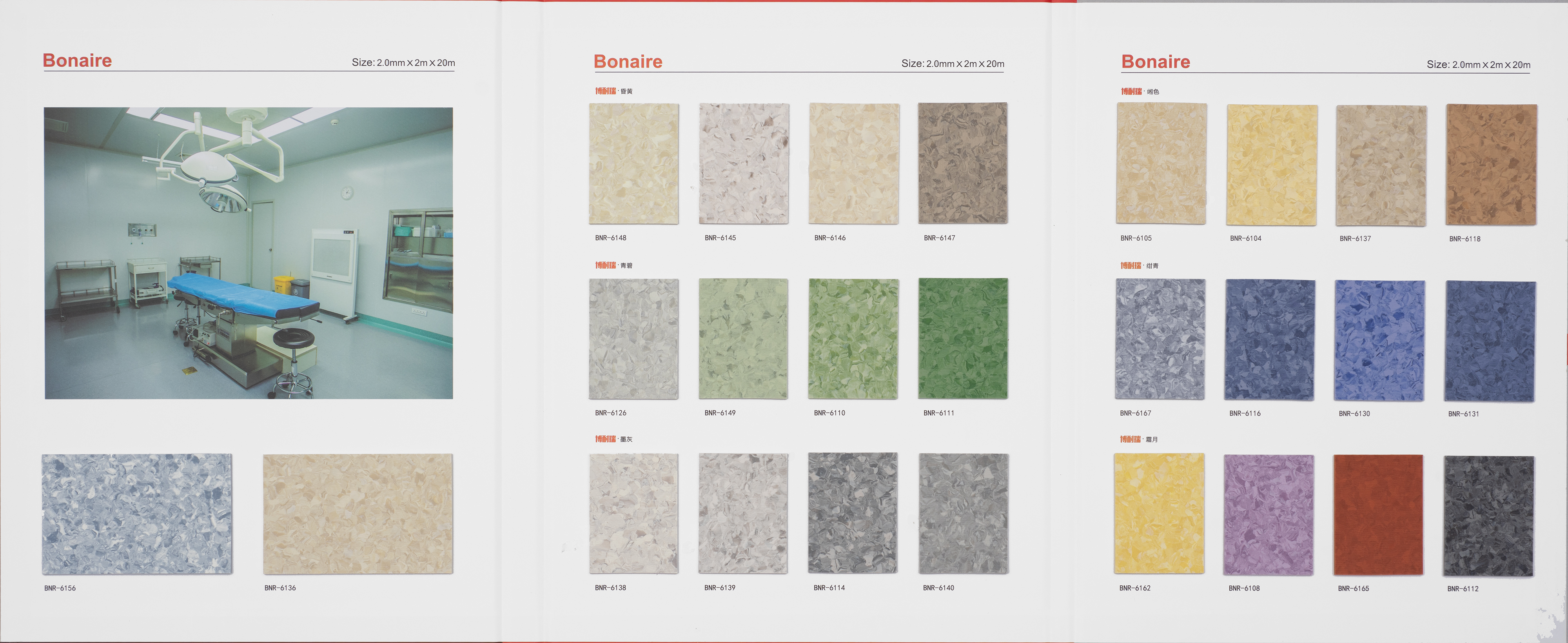
Where Farfly’s Documented Evidence Sits in This Framework
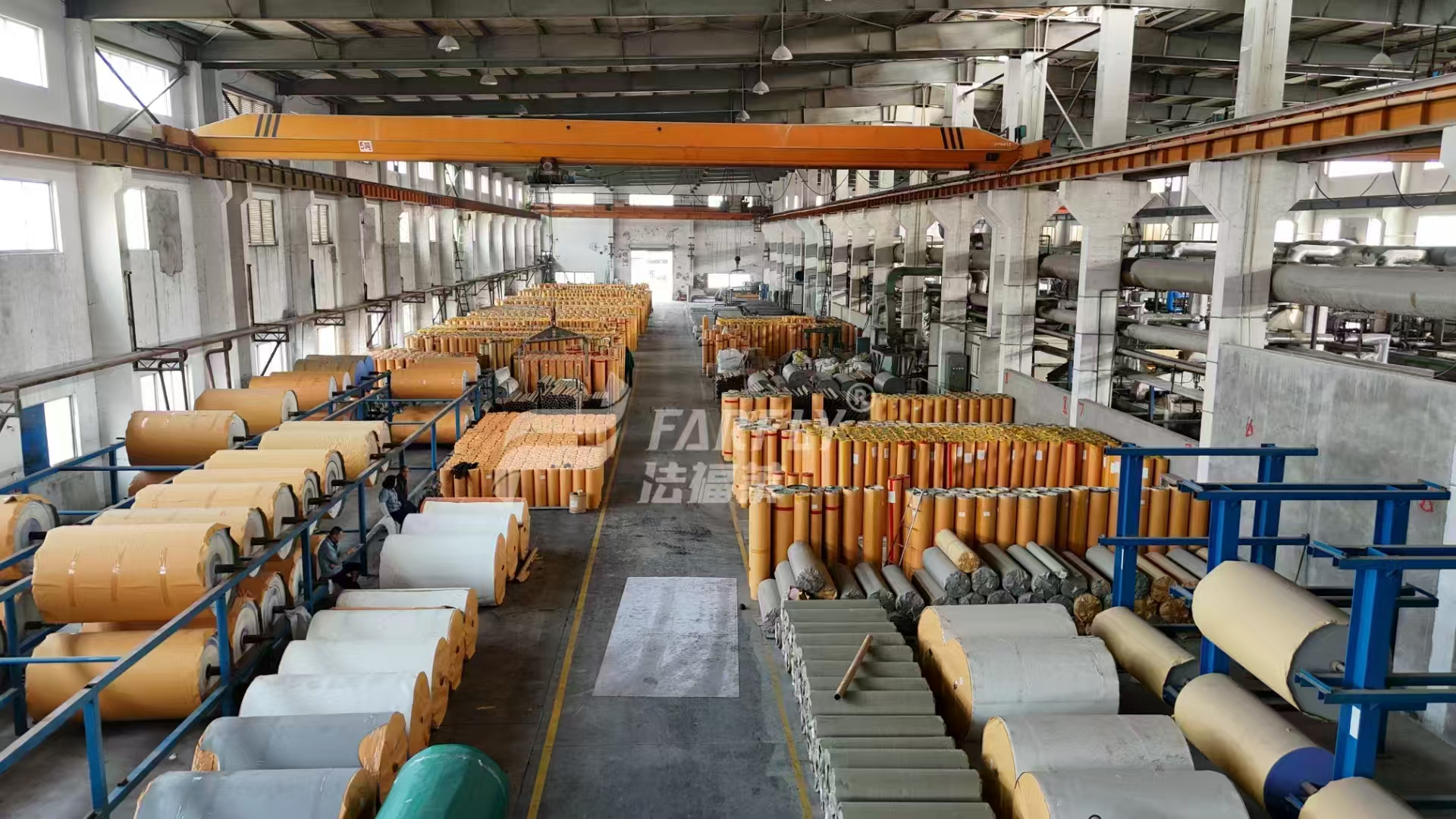
WUXI TEFA DECORATION MATERIAL CO., LTD., which trades as Farfly, was established in 2012 and manufactures high-specification resilient flooring for healthcare, sports and aviation applications. Its main product lines are homogeneous flooring, PVC sports flooring and aircraft flooring, produced at a 3,000 m² manufacturing facility with approximately 200 staff, including an R&D team of 25 engineers, and an annual production capacity of 4,200,000 m². The company states that it holds more than 399 international testing certificates, that exports account for 50% of sales, and that its major markets include the Middle East and Central Asia, East Asia, Southeast Asia, Europe and America.
The product-level facts that matter to a hospital or school buyer are narrower. The homogeneous vinyl range is composed of polyvinyl chloride, calcium carbonate and eco-friendly DOTP plasticizer, is supplied in 2 mm standard thickness with 2.5 mm and 3 mm options, and comes in 2 x 20 m rolls. The documented model range includes Bonaire, Bonet, Boniro, Bonize, Bones, Bonear, Bonegas, Bonzya, Bonami, Bona star, Bonee, plus ESD flooring and Bathroom floor variants. Products are positioned across the homogeneous, antibacterial, ESD, hospital and conductive flooring categories.
Supply behaviour is part of the comparison for project buyers, because a certificate is only useful if the product behind it can be delivered consistently. Farfly operates six advanced production lines and maintains a ready-to-ship inventory that it states at 300,000 m², supporting a seven-day rapid dispatch model and mixed-container shipping for contractors working across multiple sites.
What this evidence set does not establish is equally important. It is a first-party technical file with third-party certification references; it is not an independent head-to-head laboratory comparison of one brand against another under identical conditions. Buyers comparing multiple suppliers should expect to run the same request for documentation against each of them before drawing conclusions about relative performance.
Documented Applications and Project Fit
The product is documented for hospitals, clinics, schools, factories, offices, warehouses, shopping malls, exhibition halls, electronics workshops and laboratories, and for both new construction and renovation projects, including hospital renovation and gymnasium construction. It is specified for indoor, regular environment conditions, and roll flooring is installed as a continuous sheet rather than as individual tiles.
Two boundaries follow from that description. First, the indoor, regular environment framing matters when a specification is extended by analogy — swimming pool surrounds, commercial kitchens and semi-external circulation areas carry their own slip and chemical requirements that sit outside a general interior specification. Second, “school” is a wide category: classrooms, corridors, libraries and dining halls sit comfortably inside the documented range, while specialist teaching areas such as chemistry laboratories should be assessed separately against chemical resistance and slip requirements.
Market Direction: Hygiene and Static Control Are Spreading Beyond Specialist Rooms
The wider category is expanding, although published estimates vary with how the market is defined. One market research estimate places the global homogeneous flooring market at USD 17.58 billion in 2025 and projects USD 28.99 billion by 2035. A separate estimate values the global conductive vinyl flooring market at USD 9.6 billion in 2025, driven by demand from healthcare and electronics applications. Other research houses size the broader vinyl flooring market at USD 26.6 billion, USD 41.94 billion and USD 54.58 billion depending on whether luxury vinyl tile and residential segments are included — a spread wide enough that buyers should treat headline market figures as directional rather than precise.
The dependable signal is qualitative. Requirements that were once confined to operating theatres and electronics cleanrooms — tested antibacterial surfaces, documented low emissions, controllable electrical resistance — are increasingly written into general ward, corridor and classroom specifications. That shift raises the value of documentation and lowers the value of descriptive product language.
Homogeneous Vinyl Against Traditional Floor Finishes — and Where Its Limits Are
Comparing homogeneous vinyl with alternative finishes is useful mainly because each alternative moves the risk somewhere else.
| Criterion | Homogeneous vinyl sheet | Layered (heterogeneous) vinyl | Vinyl composition tile | Ceramic tile | Resin or epoxy coating |
|---|---|---|---|---|---|
| Joint strategy | Continuous sheet with welded seams | Continuous sheet with printed wear layer | Many joints between tiles | Rigid joints and grout lines | Seamless, but applied on site |
| Wear behaviour | Composition consistent through the thickness | Wear limited to the surface layer | Dependent on the surface layer | Highly resistant to abrasion | Depends on coating thickness and cure |
| Underfoot comfort and indentation | Resilient, with a documented indentation figure | Resilient | Resilient, with more movement at joints | Hard and cold, recovers from point loads | Hard |
| Renovation over an existing floor | Often laid over a prepared substrate | Similar | Similar | Usually requires removal | Usually requires removal |
| Static control options | Conductive and dissipative variants available | Limited in some ranges | Available in specialised formats | Not typically used for static control | Conductive systems available |
| Installation dependency | High: substrate, adhesive, welding | High | Moderate | High, but less sensitive to moisture vapour | High, plus cure time |
The limits of homogeneous vinyl are real and should be stated before a specification is signed.
- Substrate sensitivity. A 2 mm sheet follows the floor beneath it. Flatness, moisture and substrate integrity have to be corrected first; otherwise the certified performance of the product will not be visible in the finished installation.
- Installation skill. Welded seams, adhesive selection and — in ESD installations — the grounding path are the difference between a laboratory result and a building result.
- Product-specific claims. Iodine resistance and wax-free maintenance come from the surface treatment of a specific product, not from the category. Buyers should verify them per model rather than assuming that all homogeneous vinyl behaves the same way.
- Not a control system on its own. In electronics or high-risk environments, conductive flooring is one element of an electrostatic control programme that also includes grounding practice and footwear; the floor does not replace those measures.
- Occupied-building constraints. Repairs and replacement in a working hospital or a term-time school require phasing, which affects programme and cost as much as product choice does.
Future Outlook
Three changes are likely to shape the next round of hospital and school flooring specifications. The first is standardised documentation: buyers are increasingly requesting the same test set from every supplier, which shifts competition from descriptive claims to traceable evidence. The second is maintenance economics — wax-free and iodine-resistant surfaces reduce recurring labour, and facilities with constrained budgets are starting to price that into the decision rather than treating it as a premium feature. The third is the spread of static-control requirements from specialist rooms into broader clinical and technical spaces.
One practical caution applies to all three. Certification is a snapshot: buyers should confirm that certificate numbers, product names and validity periods correspond to the exact product being supplied, and re-check them whenever a specification is repeated on a later project.
Frequently Asked Questions
How is ESD or conductive vinyl flooring verified for a hospital project?
Under EN 14041, static dissipative flooring is defined by a resistance to earth of no more than 1 x 10^9 ohms, while conductive (EC) flooring is defined at no more than 1 x 10^6 ohms. Healthcare ESD installations are specified under IEC 61340-6-1 and tested according to EN 1081. Farfly’s ESD series homogeneous flooring is documented as maintaining a stable 10^4–10^6 ohm range. Because resistance is a system property, verification should cover the installed assembly — sheet, adhesive and grounding path — rather than the roll alone.
What does “wax-free” maintenance mean for a hospital floor?
Wax-free refers to a surface that does not require an applied polish or wax layer to maintain its appearance, so the recurring maintenance routine is limited to cleaning. Farfly’s homogeneous vinyl flooring uses TF Surface Treatment, documented for iodine resistance together with wax-free maintenance. For a hospital buyer the two properties are linked: iodine-based disinfectants are a common cause of staining on resilient floors, and a surface treatment that resists staining also reduces the frequency of restorative work. The claim should be checked per model, because it depends on the surface treatment rather than on the homogeneous vinyl category as a whole.
Which slip resistance class should a school specify?
DIN 51130:2014-02 is the ramp test used to classify slip resistance on the R-scale, and R9 is the entry class, typically associated with dry interior areas that are cleaned routinely. Farfly’s homogeneous vinyl flooring is documented as R9. Areas that are frequently wet — entrances, dining halls, changing areas and stair landings — are usually specified with a higher ramp class than general teaching spaces. Slip class describes a test condition, so the cleaning regime and the type of contaminant present in a given area remain part of the specification decision.
How can a buyer verify a low-VOC or TVOC claim?
Ask for the emission test report and note the test duration, because values from different durations are not comparable. Farfly’s file documents 28-day TVOC emission below 10 µg/m³, supported by TVOC testing report WT2020B01A03405. The same product carries a B-S1 fire rating and an antibacterial performance figure of 99.50%, documented under ISO 22196 with report XMIN2109010493CM. For schools that renovate during holiday periods, the 28-day figure is the relevant one because it reflects emissions after the flooring has been installed and the building is back in use.
What is the difference between directional and non-directional homogeneous vinyl?
Directional products carry a visible pattern, grain or chip orientation that must be laid in a consistent direction across the floor, while non-directional products can be rotated during installation without creating a visible pattern break. In long hospital corridors and school halls, the choice affects seam appearance, cutting waste and how obvious a future patch repair will be. Both formats exist within the same product categories, so buyers should confirm which one is being quoted and request a layout plan before installation begins.
Is homogeneous vinyl flooring suitable for both new construction and renovation projects?
Farfly’s roll flooring is documented for new construction and renovation projects in commercial and public buildings, including hospital renovation and gymnasium construction, under indoor, regular environment conditions, and is installed as a continuous sheet. Renovation projects add variables that new builds usually avoid: the condition and moisture content of the existing substrate, the removal method for the old finish, working hours that fit around patient care or teaching, and phasing that keeps part of the building in use while the floor is laid.
Documentation note: the manufacturer’s product brochure, which contains the certificate references discussed in this article, is available at Farfly resilient flooring brochure.