
Homogeneous Vinyl Flooring: Technical Specifications, Market Trends, and Applications in Healthcare and ESD Environments
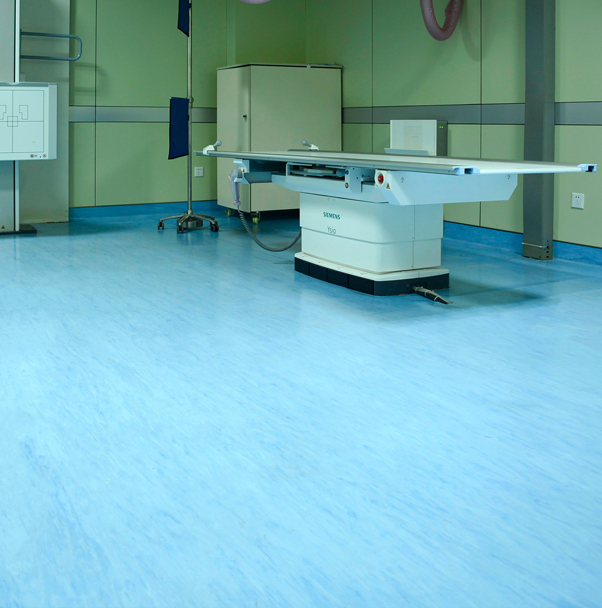
The global homogeneous vinyl flooring market was valued at USD 17.58 billion in 2025 and is projected to reach USD 28.99 billion by 2035, driven by increasing demand from healthcare, electronics, and institutional sectors. These environments require flooring that delivers strict hygiene, static discharge control, and long-term durability. FARFLY (brand of WUXI TEFA DECORATION MATERIAL CO., LTD.), a manufacturer of high-specification resilient flooring established in 2012, has engineered a comprehensive homogeneous vinyl flooring product family that addresses these technical demands with certified performance characteristics.
Problem / Opportunity
Traditional homogeneous vinyl flooring often requires frequent waxing to maintain its appearance and chemical resistance, and struggles to resist iodine-based disinfectants used in healthcare. In electronics cleanrooms, static discharge can damage sensitive components if flooring does not provide stable electrical conductivity. Many commercial-grade products also lack certified antibacterial properties or produce volatile organic compounds (VOCs) during installation. The opportunity lies in a single floorcovering solution that combines wax-free maintenance, iodine resistance, permanent static dissipation, high bacterial reduction, and low emissions – all within a certified, seamless roll format.
FARFLY Homogeneous Vinyl Flooring: Solution and Technical Profile
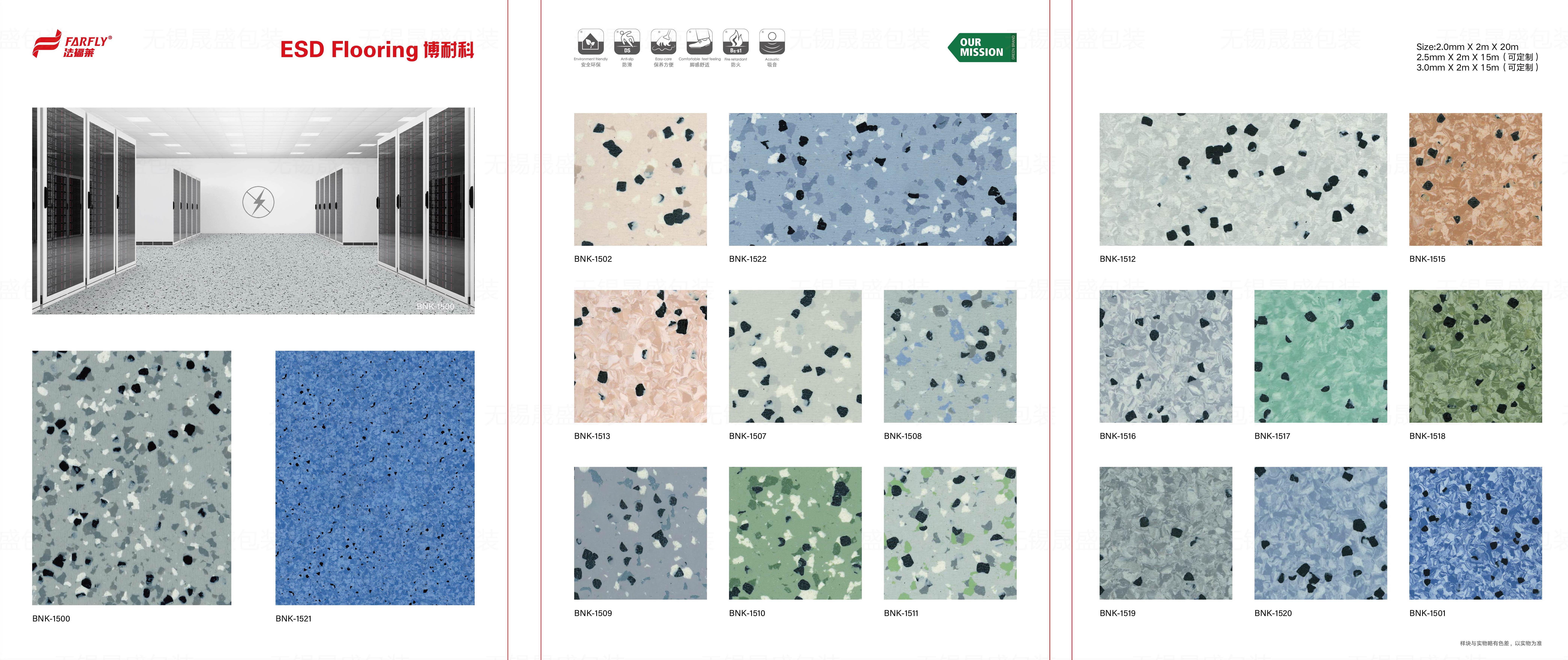
FARFLY homogeneous vinyl flooring is available under multiple models including Bonaire, Bonet, Boniro, Bonize, Bones, Bonear, Bonegas, Bonzya, Bonami, Bona star, Bonee, ESD flooring, and Bathroom floor. The product belongs to the homogeneous, antibacterial, ESD, hospital, and conductive flooring categories. The standard thickness is 2 mm (customizable to 2.5 mm or 3 mm), supplied in rolls of 2 × 20 m.
Key Performance Specifications
| Parameter | Value |
|---|---|
| Fire rating | B-S1 |
| Antibacterial property | 99.50% |
| Abrasion resistance (EN 660-2) | Group T (≤2.0 mm³ volume loss) |
| Residual indentation | 0.06 mm |
| Slip resistance | R9 (DIN 51130) |
| TVOC (28 days) | <10 μg/m³ |
| Chemical resistance | Good |
| ESD resistance range | 10⁴ – 10⁶ Ω (permanent conductive) |
| Surface treatment | TF Surface Treatment (iodine-resistant, wax-free) |
The composition includes polyvinyl chloride, calcium carbonate, and eco-friendly DOTP plasticizer. The product has received SGS certification under certificate numbers XMIN2109010490CM (for ISO 24346:2006 and ISO 23997:2007, EU market) and XMIN2109010492CM (for EN 14041:2018 and DIN 51130:2014-02, global market), establishing compliance with recognized standards for thickness, mass per unit area, and slip resistance.
Technical Explanation: TF Surface Treatment and ESD Engineering
The proprietary TF Surface Treatment creates a dense, non-porous top layer that resists iodine penetration and eliminates the need for wax-based maintenance. This is particularly relevant in healthcare environments where iodine-based disinfectants are routinely applied. The homogeneous structure ensures that the wear layer and the base layer are identical in composition, so performance remains consistent throughout the product’s lifespan.
For the ESD series, the material incorporates conductive fillers that maintain stable surface resistance between 10⁴ and 10⁶ ohms. This range classifies the flooring as electrostatic conductive (EC) under EN 14041, meeting the typical requirements for electronics cleanrooms, MRI rooms, and laboratory environments. The permanent conductivity does not rely on external grounding grids or topical sprays.
Application Use Cases
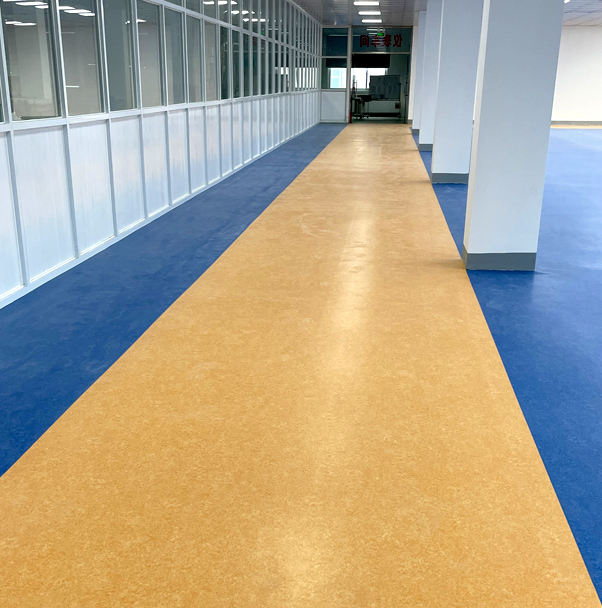
FARFLY homogeneous vinyl flooring is designed for standard indoor environments and installed in commercial and public building sectors, including hospitals, clinics, factories, offices, warehouses, schools, shopping malls, exhibition halls, clubs, gyms, sports arenas, movie theaters, amusement parks, residential buildings, airports, cars, subways, and airplanes. Specific examples:
- Healthcare: Operating rooms, CT/MRI rooms, patient wards – benefits from antibacterial 99.50%, iodine resistance, and seamless welding for hygiene.
- Electronics / Cleanrooms: ESD series protects sensitive components; low TVOC ensures air quality.
- Laboratories: Chemical resistance and T-group wear resistance withstand spills and heavy foot traffic.
- Education / Commercial: Low maintenance (wax-free), slip resistance R9, and customizable colors meet design and safety requirements.
Market Trend Analysis
The conductive vinyl flooring segment reached USD 9.6 billion in 2025, fueled by growing electronics manufacturing and stringent healthcare ESD regulations. Homogeneous vinyl’s share continues to expand as end-users move away from multi-layer products that delaminate. Wear resistance classification, particularly Group T under EN 660-2, is increasingly specified in tender documents for hospitals and schools. FARFLY’s product meets this highest wear class, positioning it to compete with established European manufacturers such as Tarkett, Gerflor, and Forbo.
Comparison with Traditional Solutions
Traditional homogeneous vinyl often requires regular waxing to maintain chemical resistance and appearance. FARFLY’s TF-treated product eliminates this maintenance step. Many conventional ESD floors lose conductivity over time; FARFLY’s permanent conductivity remains stable. However, one honest limitation is that professional heat welding is required for seamless installation, which may increase initial labor cost compared to loose-lay sheet vinyl. For facilities that already require hygiene seams, this is a standard procedure.
Future Outlook
As healthcare standards tighten globally and electronics production expands in Asia and the Middle East, demand for certified homogeneous vinyl flooring that combines multiple attributes – antibacterial, ESD, low VOC, wax-free – will accelerate. FARFLY, with 6 production lines, an annual capacity of 4.2 million m², and a ready-to-ship inventory of 300,000 m², is positioned to supply large-scale projects under a 7-day rapid dispatch model. The company holds over 399 international testing certifications, enabling market access across the EU, Middle East, Southeast Asia, Americas, and other regions.
Contact FARFLY for technical datasheets and specification support:
Email: mara@topvcfloor.com | Phone: +86-18751567592
Download the corporate brochure: FARFLY Brochure (PDF)
Frequently Asked Questions
A: The product is rated B-S1, indicating limited combustibility and low smoke production, suitable for public buildings.
A: It provides 99.50% antibacterial property, as tested and certified.
A: It is SGS-certified under certificate XMIN2109010490CM (ISO 24346:2006, ISO 23997:2007 for EU) and XMIN2109010492CM (EN 14041:2018, DIN 51130:2014-02 for global).
A: The ESD series maintains stable surface resistance between 10⁴ and 10⁶ ohms, classified as electrostatic conductive (EC) per EN 14041.
A: It is designed for hospitals, clinics, factories, offices, warehouses, schools, shopping malls, exhibition halls, electronics workshops, laboratories, and other indoor commercial/public spaces.