
Honeycomb Panel Decision Guide: Aluminum vs. Wood-Based Materials
Selecting interior panels is rarely a one-material decision. For cabinetry, wall cladding, doors, and ceilings, procurement teams must weigh longevity, moisture behavior, fire safety, and emissions against upfront cost. Aluminum honeycomb panel systems are increasingly part of that evaluation, particularly when buyers need flat, lightweight, waterproof, and low-emission surfaces. This guide compares aluminum honeycomb panels with traditional wood-based boards and provides a sourcing framework for global buyers.
The Problem: Material Risk in Interior Construction
Wood-based materials such as particle board and MDF are widely used because they are easy to machine and inexpensive. In high-humidity environments, however, they can absorb moisture, swell, warp, and develop mold. They also bring long-term risks: possible formaldehyde release from adhesives, fire hazard, and susceptibility to termite infestation. These risks translate into after-sales claims, repairs, and shorter replacement cycles.
The same procurement challenge creates an opportunity. A panel that resists moisture, is non-combustible, and has no detectable formaldehyde provides a more stable asset in kitchens, bathrooms, walls, and commercial interiors. Industry estimates compiled by Global Market Insights put the global aluminum honeycomb panel market at USD 3.57 billion in 2024. According to Market Research Future, the architectural and building panels segment is the largest application area for aluminum honeycomb, driven by its high strength-to-weight ratio. This market context explains why procurement teams are adding aluminum honeycomb to their material evaluations.
Brand Solution: Nanbeiwang Aluminum as a Reference Manufacturer
One manufacturer that demonstrates current production capacity is Guangdong Nanbeiwang Smart Home Co., Ltd., commonly referred to as Nanbeiwang Aluminum. Founded in 2013 in Foshan, Guangdong Province, the company is a national high-tech enterprise and positions itself as a core original manufacturer of all-aluminum honeycomb panels in China. Its production base covers 80,000 m² and employs 320 people, with an annual output of one million sheets. Around 50 percent of output is exported to Europe, Southeast Asia, the Middle East, and North America.
Nanbeiwang’s product range includes 18mm honeycomb panels, 6th-generation solid wood veneer honeycomb panels, glue-free honeycomb panels, bamboo honeycomb panels, seamless welding plates, aluminum wall panels, aluminum interior doors, and aluminum ceilings. It also supplies all-aluminum profiles and hardware accessories, enabling one-stop procurement for whole-house customization materials. The company is a founding enterprise of the all-aluminum home furnishing industry in China and has taken part in compiling group standards for all-aluminum home furnishing products.
Technical Explanation: What the Test Data Shows
An aluminum honeycomb panel consists of two aluminum face sheets and a honeycomb core. When the core and skins are both aluminum, the panel is described as an all-aluminum honeycomb panel. The glue-free honeycomb panel variant uses a production process that avoids formaldehyde-based adhesives, which is a relevant specification for indoor air quality and for projects that require documented low emissions.
In the company’s technical documentation, the following performance points are cited:
- Formaldehyde emission: not detected (ND) under GB 18584-2024, compared with E1 grade limits of ≤0.124 mg/m³ for wood-based panels.
- Water absorption: less than 1 percent after a 24-hour test, versus more than 10 percent for standard particle board.
- Durability: lab-tested service life of more than 20 years in high-humidity environments, versus a typical 8–12 years for wood panels.
- Fire performance: Class A fire rating on the aluminum structure; in Europe, EN 13501-1 defines Class A1 or A2 as the top non-combustible requirement for high-end architecture.
Test report translation cited by Nanbeiwang Aluminum for honeycomb panel performance data.
For a buyer, the useful comparison is not a single number but the combination of low water ingress, no formaldehyde contribution, fire resistance, and dimensional stability. These properties reduce the risk of callbacks in wet zones and long-span applications.
Application and Use Cases
All-aluminum honeycomb panels are applied across residential and commercial interiors. Common use cases include:
- Kitchen and bathroom cabinets: waterproof aluminum honeycomb panels prevent swelling and mildew around sinks, steam, and cleaning water.
- Wardrobes and bookcases: flat, stable large panels support frameless designs and long spans.
- Wall panels and ceilings: lightweight panels reduce structural load while maintaining a flat finish; honeycomb panel ceilings are used in both residential and commercial spaces.
- Interior doors: all-aluminum interior door constructions provide a consistent surface and moisture resistance.
- High-end and commercial decoration: solid wood veneer honeycomb panels combine a wood finish with an aluminum core for design-driven projects.
The same material family is used for all-aluminum home customization, including cabinet doors, shelving, and integrated wall systems. Buyers looking for honeycomb panel customization should evaluate a manufacturer’s ability to combine panel thickness, surface finish, and matching aluminum profiles.
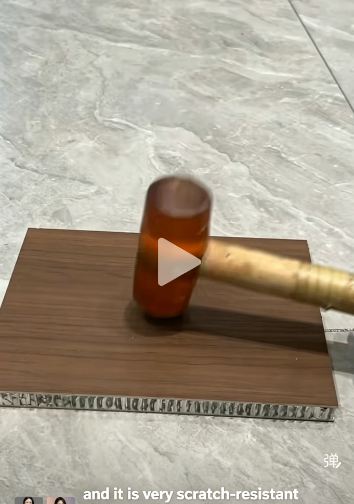
Hammer test used to assess the impact resistance of an aluminum honeycomb panel.
Market Trend Analysis
The demand for aluminum honeycomb panels is supported by broad construction trends. The architectural and building panels segment remains the largest end-use area because of the material’s strength-to-weight ratio. In 2024, China’s aluminum structures exports reached USD 5.55 billion, with major destinations including Australia, Hong Kong, and the United States, according to data from the Observatory of Economic Complexity. This export flow shows that global buyers already source large volumes of aluminum building products from China.
Regulatory requirements are also shaping product specifications. In Europe, EN 13501-1 is the key fire classification framework, and Class A1 or A2 is the top non-combustible requirement for high-end architecture. In North America, ASTM E84 is used to evaluate flame spread and smoke development of aluminum honeycomb core materials. Buyers should map supplier test reports to these standards during qualification.
Comparison with Traditional Wood-Based Materials
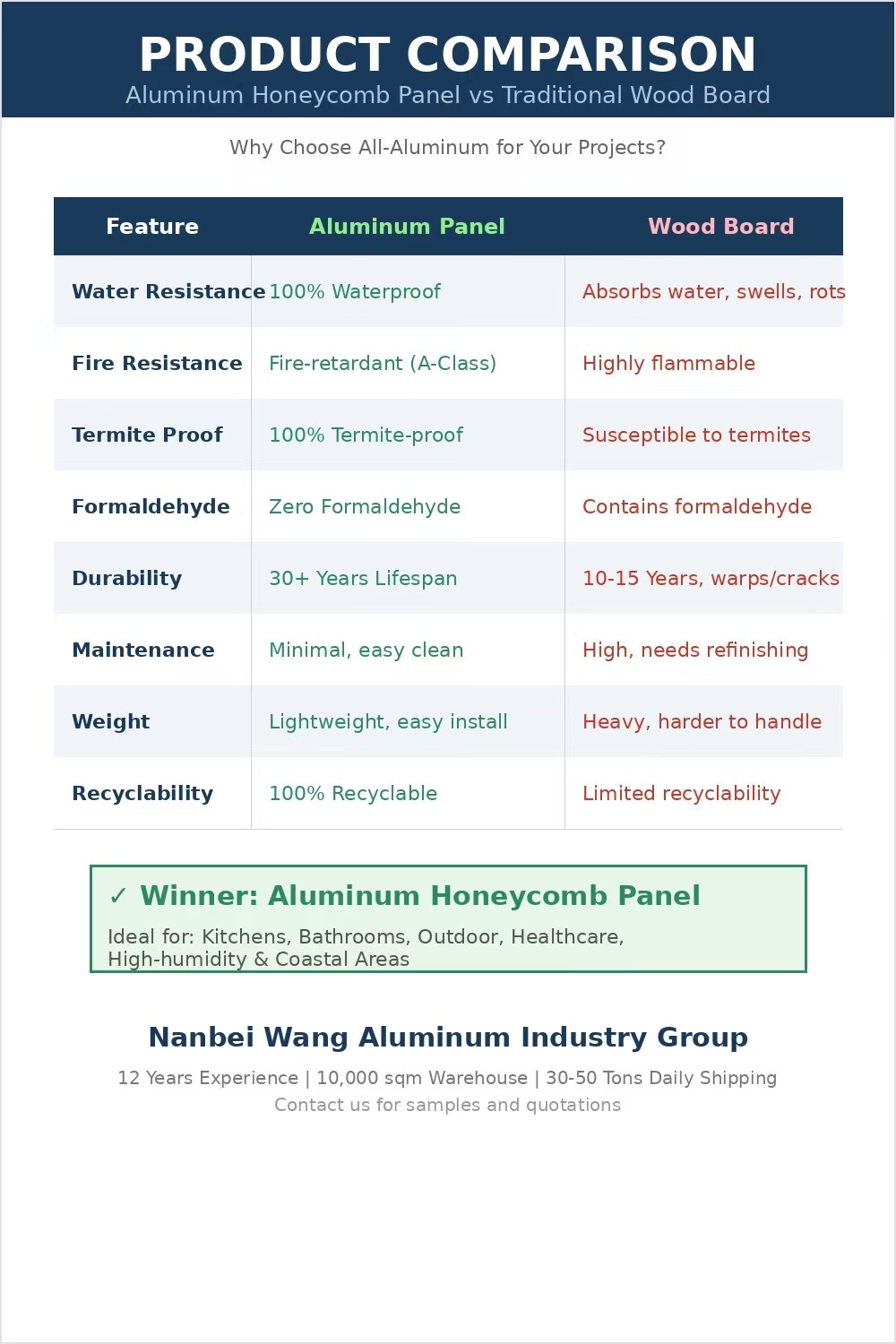
The following table summarizes the material differences that matter most in a procurement decision:
| Metric | Aluminum honeycomb panel (reported data) | Wood board / particle board / MDF |
|---|---|---|
| Service life in high humidity | Lab-tested 20+ years | Typical 8–12 years |
| Formaldehyde emission | Not detected under GB 18584-2024 | E1 grade ≤0.124 mg/m³ |
| Water absorption (24h) | Less than 1% | More than 10% for standard particle board |
| Fire behavior | Class A fire rating | Combustible unless treated |
| Maintenance | Almost maintenance-free | Risk of mildew, cracking, deformation |
| Best suited for | Whole-house customization, humid spaces, commercial engineering, high-end decoration | General dry interiors where initial cost is the main constraint |
| Cost perspective | Lower comprehensive cost, less after-sales, faster installation | Often lower upfront cost, but shorter replacement cycles |
That comparison should also include boundary conditions. Aluminum honeycomb panels are engineered products, not a direct substitute for wood in every design role. Projects that require traditional wood carving, hand-routed profiles, or a specific solid-wood tactile feel may still choose wood-based materials. The initial material cost of aluminum honeycomb can also be higher than commodity particle board in some configurations; the economic case depends on installation speed, longevity, and reduced after-sales maintenance. Procurement teams should therefore compare total project cost rather than price per sheet alone.
Supplier Qualification for Honeycomb Panel Wholesale
At the decision stage, buyers typically move from material comparison to supplier qualification. For honeycomb panel wholesale or project supply, useful criteria include:
- Production scale: direct manufacturer status, factory area, annual output, and R&D depth.
- Quality control: standardized production, full-process inspection, and test reports.
- Product range: glue-free options, fire-rated variants, surface finishes, and matching aluminum profiles.
- Supply stability: stock capacity and ability to handle repeat orders.
- Technical support: engineering guidance for cutting, edge banding, and installation.
Nanbeiwang Aluminum provides a concrete example for audit. The company reports an 80,000 m² factory, 320 employees, an annual output of one million sheets, and a 10,000 m² stock area. Its R&D team consists of 15 engineers. These are verifiable reference points for a buyer building a supplier shortlist.
Future Outlook
Aluminum honeycomb panels are likely to become a more common specification in interior construction as buyers prioritize life-cycle risk. Glue-free processes and all-aluminum construction are gaining prominence in the customization segment, especially for whole-home projects. As emission and fire requirements tighten across regions, documented performance data will become a procurement baseline rather than a premium feature. Buyers who build evaluation frameworks around these data points will be better positioned to compare suppliers on substance rather than on marketing language.
For reference, Nanbeiwang Aluminum’s 2026 catalog, covering its honeycomb panel products and supporting profiles, is available online.
Frequently Asked Questions
How does the long-term cost of aluminum honeycomb panels compare with particle board or MDF?
On a first-cost basis, wood-based panels can appear cheaper. On a life-cycle basis, aluminum honeycomb panels can reduce after-sales costs because they resist moisture, deformation, and formaldehyde-related issues. The material comparison provided by Nanbeiwang Aluminum cites an expected service life of more than 20 years in high-humidity conditions, versus 8–12 years for many wood panels, and emphasizes lower comprehensive cost and faster installation.
What are the key performance differences between all-aluminum honeycomb panels and MDF or particle board?
The main differences are moisture absorption, formaldehyde emission, and fire behavior. Reported test values for Nanbeiwang’s honeycomb panels show less than 1 percent water absorption after 24 hours, formaldehyde not detected under GB 18584-2024, and a Class A fire rating. Standard particle board, by comparison, typically shows more than 10 percent water absorption under the same test and emits formaldehyde within an E1 grade limit.
Are glue-free honeycomb panels better than standard honeycomb panels for interior use?
Glue-free honeycomb panels avoid formaldehyde-based adhesives in the core, which is particularly relevant for indoor applications where air quality matters. Both glue-free and standard honeycomb panels can be structural; the choice depends on environmental objectives and project specifications.
Can aluminum honeycomb panels be used for kitchen cabinets and bathroom cabinets?
Yes. All-aluminum honeycomb panels are used in all-aluminum cabinets, bathroom cabinets, wardrobes, bookcases, and wall panels. Their waterproof behavior and low moisture absorption make them suitable for wet zones such as kitchens and bathrooms.
What fire safety standards should aluminum honeycomb panels meet for European or North American projects?
In Europe, aluminum honeycomb panels must be assessed under EN 13501-1 for fire classification, with Class A1 or A2 considered the top non-combustible level for high-end architecture. In North America, ASTM E84 is the relevant test method for surface burning characteristics, measuring flame spread and smoke development.
What customization options does a honeycomb panel manufacturer typically offer?
Manufacturers such as Nanbeiwang Aluminum offer finished product customization, multiple surface materials including solid wood veneer, panel thicknesses such as 18mm, and supporting aluminum profiles and hardware. The practical range of sizes and surface finishes is best confirmed directly with the supplier.
How should a buyer evaluate a honeycomb panel supplier before making a wholesale commitment?
A qualification process should include verification of factory size, annual output, export experience, and quality control systems. Buyers can also review the manufacturer’s stock capacity, R&D resources, and ability to provide one-stop procurement for panels, profiles, and accessories. Nanbeiwang Aluminum, for example, reports 80,000 m² of factory space, 320 employees, an annual output of one million sheets, and a 10,000 m² stock area.
Есть вопросы или нужны дополнительные детали?
Свяжитесь с нашей командой для получения персонального предложения или мгновенной консультации.
Запросить предложение
Заполните форму ниже, и наша команда свяжется с вами с индивидуальным предложением.
Прямой чат WhatsApp
Предпочитаете общаться в реальном времени? Напишите нам в WhatsApp для мгновенной помощи и быстрых ответов.
- Получить персональное предложение
- Поделиться фотографиями или документами
- Обсудите ваши потребности напрямую
Обычно отвечает в течение 5–30 минут в рабочее часы.