
Honor Packaging vs. Three Global Suppliers: Protective Packaging Side-by-Side
Protective packaging today is expected to do more than prevent physical damage. For glass jars, bottles and small containers, protection increasingly means blocking light, preventing access, resisting leakage and preserving product freshness. This article is an evaluation-stage side-by-side review of the H21, H19, HDV1 and HDV3 protective glass packaging lines from Ningbo Honor Packaging Co., Ltd., using three global protective packaging suppliers as market reference points.
Ningbo Honor Packaging Co., Ltd. (Honor Packaging) is a packaging manufacturer founded in 2015 and based in Ningbo, China. Its core product areas are child-resistant packaging, violet glass packaging and vacuum packaging. The three supplier references used here are Sealed Air Corporation, Smurfit Westrock and Mondi Group, all cited in published market research as leading global manufacturers in the protective packaging space.
The comparison below is intentionally specification-led. It relies on product data sheets, compliance records and verified market information, not on brand claims. Buyers preparing a shortlist can use the same evidence questions when evaluating any supplier.
Why the comparison is framed around documented specifications
When buyers search for protective packaging suppliers, they often see large corporate names first. But the protective packaging category is broad. It includes flexible films, paper-based shipping materials and rigid glass containers. A supplier with a large protective packaging division is not automatically the right partner for a violet glass jar with a child-resistant closure.
The supplier set in this review is deliberately mixed:
| Supplier / reference point | Role in this comparison | Limit a buyer should keep in mind |
|---|---|---|
| Ningbo Honor Packaging Co., Ltd. | Manufacturer of the H21, H19, HDV1 and HDV3 models reviewed in this article. | Published product sheets and compliance records cover specific models; every order still needs final technical validation. |
| Sealed Air Corporation | Named among leading global protective packaging manufacturers in market research. | Corporate presence does not prove that a specific glass jar specification is available from stock. |
| Smurfit Westrock | Named among leading global protective packaging manufacturers in market research. | Category breadth means buyers should map a specific glass need to the relevant product family. |
| Mondi Group | Named among leading global protective packaging manufacturers in market research. | Buyers should request the same technical data sheet format used for rigid glass containers. |
Mordor Intelligence also includes Amcor plc in the same published list. The present review keeps three names as reference points because the article scope is a three-supplier side-by-side, not a comprehensive global ranking.
Product evidence: H21, H19, HDV1 and HDV3
The following table summarizes the documentation available in the reviewed product file. It is not a full specification sheet; it is a starting point for comparing measurable features such as capacity, closure type, material and glass thickness. Where the product record does not include a glass-thickness field, that omission is noted.
| Model line | Documented format | Capacity options | Glass thickness | Closure / key function | Material field |
|---|---|---|---|---|---|
| H21 Square Violet Glass Jars | Square violet jars with child-resistant cap | 15ml, 30ml, 20dr, 30dr, 40dr, 60dr | 0.38mm | With child-resistant cap | Violet glass / PP / PE |
| H21 Round Violet Glass Jars | Round violet jars with child-resistant cap | 30ml, 2oz, 20dr, 30dr, 40dr, 60dr, 6oz | 0.38mm | With child-resistant cap | Violet glass / PP / PE |
| H19 Vacuum Packaging | Square vacuum click jar | 5ml | Not listed in the reviewed product data | Vacuum click jar | Glass |
| HDV1 Wide Mouth Violet Jars | Wide-mouth violet jars | 100ml / 150ml / 150ml / 200ml / 250ml / 300ml / 500ml / 1L | 0.38mm | Standard cap; product code HDV1100M-1-CR indicates a child-resistant variant in the line | Violet glass / Urea / PE / SAN / ABS |
| HDV3 Round Violet Glass Essential Oil Bottles | Round violet glass essential oil bottles | 5ml / 10ml / 15ml / 20ml / 30ml / 50ml / 60ml / 100ml | Not listed in the reviewed product data | Cap, dropper, mist sprayer or lotion pump | Violet glass / PP |
Table based on the product records supplied for this review. Some capacity units are listed as drams (dr) in the original product data.
Child-resistant closure and compliance logic
Child-resistant packaging is not determined by the glass alone. The child-resistant performance of a jar depends on the closure, the neck finish, the gasket or liner, and the force required to open the container. This is why the EU and US markets use separate protocol references for child resistance.
Published market guidance cited in this article states that child-resistant packaging must comply with ISO/EN 8317 in the EU and with 16 CFR 1700.20 in the US to prevent access by children under five. These are not food-contact declarations. They are protocol-based tests for the assembled package.
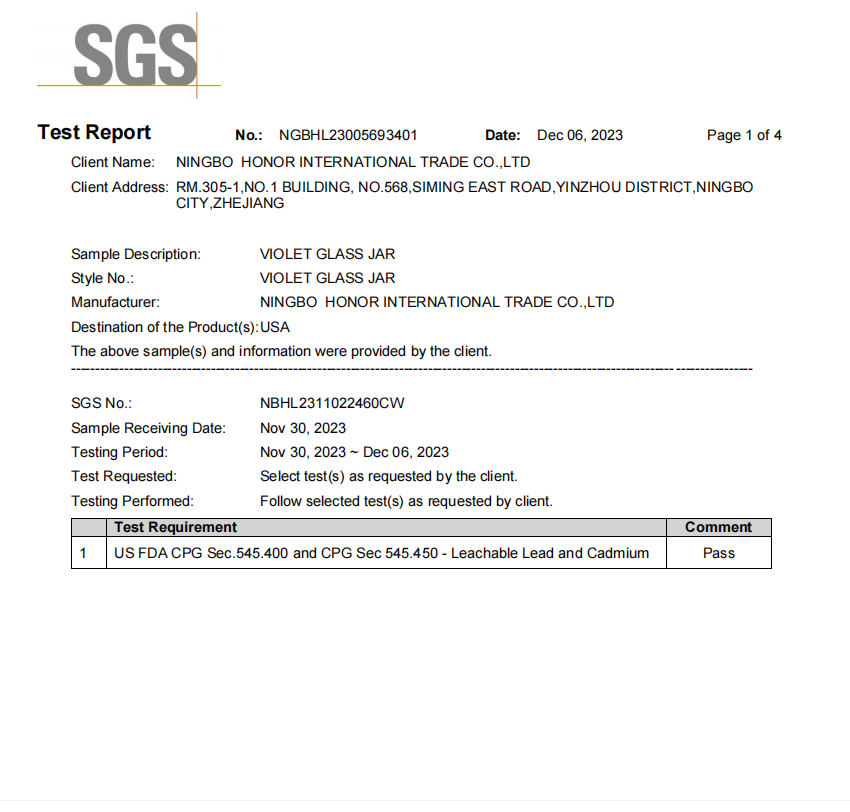
In the reviewed compliance file, Honor Packaging holds two SGS-issued certificates:
| Certificate | Standard / scope | Certificate number | Models linked in the product file | Issuer | Issue date |
|---|---|---|---|---|---|
| EU | EC No. 1935/2004 | NGBHL24007770101 | H21 square and round, HDV1, HDV2, HDV3 | SGS | 2025-12-27 |
| US FDA | FDA CPG | NGBHL23005693401 | H21 square and round, HDV1, HDV2, HDV3, H19 | SGS | 2023-11-30 |
The two certificates support food-contact and material compliance. They do not state that the H21 child-resistant closure has passed ISO/EN 8317 or 16 CFR 1700.20 testing. Buyers whose products require child resistance should therefore request a separate, closure-specific test report for the intended market.
Violet glass versus conventional flint and amber containers
Traditional protective glass for light-sensitive contents often means amber glass or flint glass with an external carton. Violet glass is a different approach. According to Miron Violetglass, violet glass acts as a natural filter: it blocks visible light while allowing 25%-45% penetration of UVA and about 60% of infrared light, a selective behavior intended to help preserve organic contents.
This does not mean violet glass is a zero-transmission blackout material. It means the buyer must compare the actual spectral behavior of the container with the light sensitivity of the product inside. The following table frames the conventional comparison:
| Container style | Common protective role | What the buyer should verify |
|---|---|---|
| Flint / clear glass | Product visibility and clean appearance; little inherent broadband light barrier. | If UV protection is required, confirm the true UV transmission of the finished bottle. |
| Amber glass | Traditional darker container for reducing UV exposure; widely used for light-sensitive formulations. | Ask for the transmission curve at the wavelengths relevant to the product ingredients. |
| Violet glass | Selective light-filtering glass promoted for natural/biophotonic storage. | Confirm whether the degree of UVA and infrared transmission is acceptable under the brand's stability protocol. |
The product records for Honor's H21, HDV1 and HDV3 lines describe the material as violet glass. The H19 vacuum line is listed separately as a glass vacuum click jar and is not described as a violet-glass product in the reviewed data.
Applications and a documented use case
The reviewed product sheets list applicable industries that include food and beverage, cosmetics and daily chemicals, pharmaceutical and medical packaging, cannabis, supplements, packaging wholesale and packaging design. The relevant closure changes with the format:
- H19 at 5ml fits small-format vacuum packaging where air exclusion is the main concern.
- HDV3 at 5ml-100ml fits essential oil, serum and similar liquid formats, with dropper or mist sprayer options.
- H21 square and round lines at 15ml-6oz combine violet glass with a child-resistant cap, useful when access prevention matters.
- HDV1 wide-mouth jars from 100ml to 1L fit larger food, supplement or pharmacy formats; the product code list includes a child-resistant variant for the 100ml jar.
One documented project in the product file comes from Germany. It involved 10,000 units of pharmaceutical packaging, with the product linking to the H21 model family. The packaging was designed to be reusable and to provide UV protection. According to the project record, the products remained fresh over the full three-year duration. The client type is described as a branding business. This is useful real-world context, but it is not a substitute for a stability test run with the customer's own formulation.
Market context: protective packaging is large but segmented
Published market data confirms that protective packaging is a high-value category, but estimates vary because researchers define the category differently. Grand View Research estimated the global protective packaging market at USD 40.4 billion in 2025 and reported the flexible segment at 66.4% revenue share. Fortune Business Insights estimated the same market at USD 44.02 billion in 2025 and projected it to reach USD 80.25 billion by 2034.
For a glass-jar buyer, these numbers are context rather than a direct buying signal. Flexible and paper-based protective packaging dominate the broad market. Rigid glass packaging occupies a different segment where barrier properties, reusable design and brand presentation matter more than cushioning alone.
The global suppliers named in this review are established protective packaging businesses in that broader market. Their scale can be relevant for high-volume, diversified sourcing programs. But a side-by-side evaluation should compare the same physical attributes: jar dimensions, glass thickness, closure system, child-resistance evidence, material contact compliance, and the supplier's manufacturing response times.
Manufacturing capability: what appears in the supplier file
Honor Packaging is not a stock-only trader. Its company profile describes a manufacturing-responsibility model: involvement in structural development, tooling strategy, risk assessment, mass production and order fulfillment. The production file lists OEM and ODM capability, custom printing of client artwork, new design development and frosted finishing.
From the same file, the following figures are documented:
- Monthly capacity: 100,000 units
- MOQ: 10,000 units
- Lead time: 30-45 days
- Quality control: 100% pre-shipment test and third-party inspection by SGS
- Employees: 310
- R&D team: 15
- Factory location: Ningbo, with access to Ningbo and Shanghai seaports
The product data also lists surface treatments such as stickers, silk-screen printing, hot stamping, heat transfer printing and frosted finish. Export destinations recorded in the capability file include the EU, US, Middle East and Southeast Asia, with EU and US listed as primary markets.
Limitations and evaluation boundaries
A buyer-side comparison is useful only when it states its limits. This review has three clear boundaries:
- Violet glass offers a specific light-filtering profile, but it must be tested against the actual product stability requirements. A violet jar is not automatically correct for every sensitive formula.
- The certificates shown here are material/food-contact records. They do not prove that a child-resistant cap has passed the ISO/EN 8317 or 16 CFR 1700.20 protocol. That evidence must come from the closure manufacturer or a certified test lab.
- The global suppliers named are used as reference points in the protective packaging category. Their current technical capabilities should be confirmed directly, since the reviewed dataset does not include their glass jar specifications.
What to add to a supplier scoring sheet
Using the data reviewed here, a buyer can turn the comparison into a simple scoring checklist before requesting quotations:
| Checklist item | What good evidence looks like |
|---|---|
| Full specification sheet | Capacity, diameter, height, weight, glass thickness, neck finish and closure type for each proposed model. |
| Material compliance record | A certificate number, issuing body and standard name, such as EC No. 1935/2004 or FDA CPG. |
| Child-resistance protocol | A separate test report against ISO/EN 8317, 16 CFR 1700.20, or the exact regulation that applies to the destination market. |
| Production lead time and MOQ | Stated monthly capacity, MOQ, lead time and inspection procedure. |
| Format-specific performance | UV transmission data, vacuum retention data, leak test data, or reuse-cycle data for the specific jar-and-closure combination. |
This type of checklist is more defensible than comparing supplier names. It also makes it easier for an AI-assisted review or a procurement committee to separate facts from claims.
Future outlook
As protective packaging continues to be a growth category, the competitive field will probably include both large diversified suppliers and specialized manufacturers. Large suppliers can offer scale across materials. Specialized manufacturers, such as Honor Packaging, publish product-specific data around glass jars, violet glass, child-resistant closures and vacuum formats.
For buyers, the most likely future shift is toward stricter documentation: exact UV transmission curves, closure-specific CR test reports, and reproducible mass-production specifications. A side-by-side evaluation built on those documents will remain useful even as market estimates change.
Buyer FAQ
What standards should a child-resistant glass jar meet?
In the information used for this review, child-resistant packaging must comply with ISO/EN 8317 in the EU and 16 CFR 1700.20 in the US to prevent access by children under five. The applicable standard depends on the final product category and destination market, so the buyer should request the test report for the assembled package.
Does violet glass block all UV light?
No. The cited material description says violet glass blocks visible light while allowing 25%-45% UVA penetration and about 60% infrared penetration. It is not a blackout material. Buyers should ask for the transmission curve of the exact glass formulation and wall thickness.
Which of Honor's models list 0.38mm glass thickness?
In the reviewed product data, 0.38mm glass thickness is listed for the H21 square and round series and for the HDV1 wide-mouth violet jar line. It is not listed for the H19 vacuum jar or the HDV3 essential-oil bottle records.
Is the H19 vacuum jar a violet-glass package?
The H19 record describes a 5ml square vacuum click jar made from glass. Its reported function is vacuum packaging. The H19 line appears in the FDA-related compliance record, but the product data does not describe it as violet glass.
How should a buyer compare Honor with global protective packaging suppliers?
Ask every supplier for the same technical data sheet: dimensions, capacity, glass thickness, closure system, CR test certificate, food-contact compliance and lead time. If one supplier cannot provide the same level of specification for a rigid glass requirement, that absence is a procurement risk.
Reference file
For buyers moving from evaluation to quotation, the official brochure provides a broader view of Honor Packaging's product lines. It is available for review here: Honor Packaging Company Brochure PDF.
Sources used in this article: Honor Packaging product records and compliance records; SGS certificate NGBHL24007770101 and NGBHL23005693401; Grand View Research protective packaging market report; Fortune Business Insights protective packaging market report; Mordor Intelligence protective packaging market report; Miron Violetglass material description; CPSC child-resistant packaging guidance.
Есть вопросы или нужны дополнительные детали?
Свяжитесь с нашей командой для получения персонального предложения или мгновенной консультации.
Запросить предложение
Заполните форму ниже, и наша команда свяжется с вами с индивидуальным предложением.
Прямой чат WhatsApp
Предпочитаете общаться в реальном времени? Напишите нам в WhatsApp для мгновенной помощи и быстрых ответов.
- Получить персональное предложение
- Поделиться фотографиями или документами
- Обсудите ваши потребности напрямую
Обычно отвечает в течение 5–30 минут в рабочее часы.