
Hospital Wristbands: A Buyer's Guide to Medical ID Bands
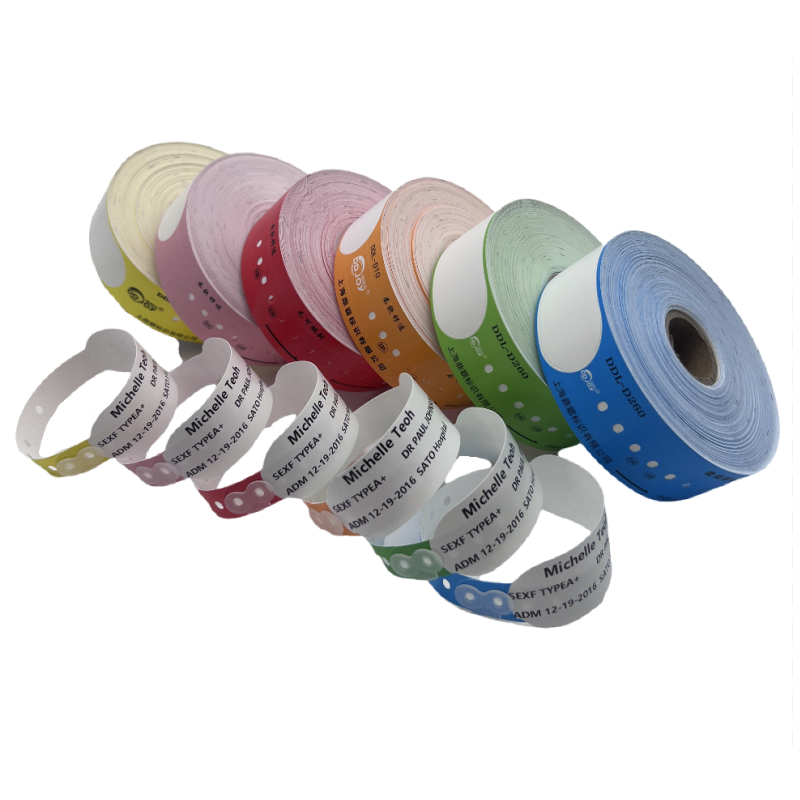
A direct thermal printable medical wristband in the standard 260 x 25 mm format; patient information is printed without ink.
Hospital wristbands are the most frequently used identification artifact in a healthcare facility, and one of the least examined items in a procurement file. A band is applied when a patient is admitted, checked at every medication round, handover and procedure, and removed at discharge. Because that cycle repeats for every inpatient episode, medical wristbands behave like a continuous consumable supply line rather than a one-off device purchase.
A patient identification wristband is a wearable band that carries identity data in printed, barcoded or chip-encoded form. The hospital produces the data; the band only has to hold it legibly, safely and for the length of the patient episode. Since the band must work with the printers, scanners and information systems already installed in a ward, specifying hospital wristbands is a compatibility decision as much as a materials decision.
Category sizing depends heavily on what is being counted. Future Market Insights projects the global patient identification wristbands market at USD 576.1 million in 2025, while Precedence Research estimates USD 1.61 billion for the same year. The gap is a scope difference rather than a demand difference, and it carries a practical lesson: two quotations for "hospital wristbands" can cover entirely different deliverables, from blank consumable bands to printed bands bundled with software.
The procurement problem behind a simple band
Wristband projects rarely fail on price. They fail on three specification questions that are usually settled too late.
Legibility over time. A band that carries a patient's name, record number and allergy status has to stay readable after washing, bed transfers, moisture exposure and the normal wear of a multi-day admission. Water-resistant and tear-resistant constructions address that requirement directly, which is why material selection — thermal-sensitive synthetic paper, Tyvek or PVC — is the first decision in a specification, not the last.
Compatibility with what is already installed. Thermal printable wristbands are printed on demand with a direct thermal printer that uses no ink, so the band format, the label size and the ward printer have to match. A hospital standardised on a 260 x 25 mm band will not thank a supplier that quietly delivers a 250 x 25 mm format.
Classification and claims. In the European Union, blank patient wristbands have been ruled not to be medical devices under EU MDR 2017/745 (Case C-427/24). That places the weight of classification on the intended purpose a supplier declares, and it means buyers should read product descriptions, labels and claims with that boundary in mind.
What counts as a hospital wristband: the formats buyers actually compare
Under the single heading of medical wristbands, hospital procurement teams are normally comparing four different constructions.
- Thermal printable wristbands. Made from thermal-sensitive synthetic paper and printed with a direct thermal printer, which requires no ink and produces clear patient information. They are disposable, water-resistant and tear-resistant, and are listed for hospitals, medical clinics, healthcare institutions and patient management. The standard format is 260 x 25 mm, with custom sizes supported.
- PVC patient ID wristbands. Made of PVC in 250 x 25 mm and 250 x 16 mm sizes and used for patient identification in hospitals and elderly care institutions. They allow clear printing of patient information and are durable, waterproof and comfortable for long-term wear, with a single-layer or double-layer structure available for different durability needs.
- Tyvek wristbands. Available in 250 x 19 mm and 250 x 25 mm, these are disposable, waterproof and tear-resistant with clear printing, and are listed for hospitals, exhibitions, events and ticketing.
- RFID medical wristbands. These carry a built-in RFID chip — low frequency, high frequency or ultra-high frequency — that is readable and writable. Materials include silicone, PVC, Tyvek and paper, with sizes including 250 x 25 mm and 250 x 16 mm. RFID formats are listed for medical applications, access control, member management and logistics and warehousing, and can support both access control and payment functions.
A narrower fifth group sits alongside these: secure-closure bands. A PVC band with a tab buckle, sized 260 x 40 mm, is designed for a firm and secure closure and is listed for medical environments as well as events and entertainment venues — the format worth examining when tamper evidence is part of the requirement.
How data reaches the band: direct thermal printing, barcodes and RFID
Direct thermal printing works without ink or ribbon. The print head reacts with a thermal-sensitive coating on the band surface to produce text and barcodes, so a ward that prints bands at the point of admission removes an entire consumable category — no ribbons, no toner — and keeps the printed data inside the hospital's own admission workflow. The trade-off is that the band is single-use by design and the process depends on a functioning direct thermal printer with an adequate band stock.
Barcode medical wristbands remain the most common machine-readable format because they require nothing beyond the scanner already in use at the bedside. RFID goes further: an embedded chip can be read and written, so band data can be updated during the patient episode and read without line of sight. RFID also enables functions a barcode cannot support, such as controlled door access. The cost is infrastructure — readers, antenna placement, integration with hospital systems — plus data governance decisions about what is written to the chip and who is authorised to read it.
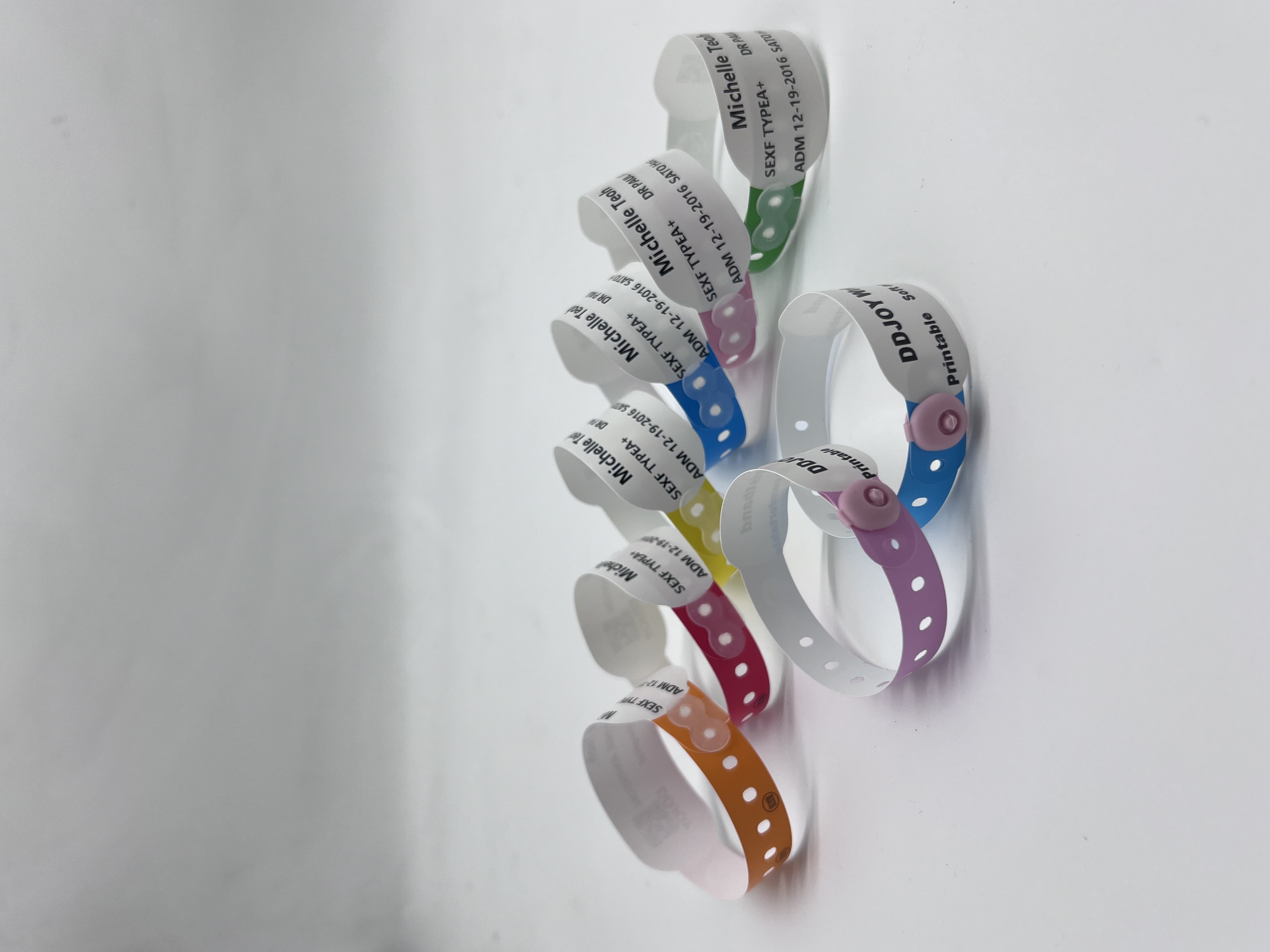
RFID wristbands embed a low-, high- or ultra-high-frequency chip that can be read and written, enabling contactless identification where reader infrastructure exists.
One boundary applies to all three technologies. A wristband is a data carrier, not a clinical decision tool. It supports identification and traceability; it does not replace the two-identifier verification steps used in clinical practice.
Matching wristband format to the ward scenario
Hospital wristbands are specified per care setting, because the demands differ by episode length, exposure and workflow speed.
- Hospital admission wristbands. Printed at the point of admission, where speed and print clarity matter most. Thermal printable bands printed on demand fit this step because the data is generated by the admission system at that moment.
- ICU patient wristbands. Long stays, frequent interventions and regular washing put durability and water resistance first; PVC patient ID bands, including double-layer constructions, are the relevant comparison.
- Surgical patient wristbands. The band has to remain legible through pre-operative preparation, transfers and repositioning, which raises the durability question earlier than in a general ward.
- Emergency wristbands. Applied under time pressure to unidentified or partially identified patients, so closure design and fast application matter as much as print quality.
- Isolation ward wristbands. Single-use disposable formats align with infection-control workflows, because the band leaves the ward with the patient.
- Outpatient and clinic wristbands. Short episodes and high volumes shift the emphasis to unit consistency and cost per band rather than long-term wear.
- Diagnostic wristbands. Short-lived bands issued for imaging or laboratory journeys, where the requirement is a readable identifier that survives a single trip.
- Nursing home wristbands. Long-term residents make comfort and durability the primary criteria, which favours durable PVC over paper-based disposables.
- Baby and neonatal identification. The smallest formats and softest skin-contact materials, with the most secure closure designs available. Where parent-infant matching workflows are used, the band data model also has to support that link.
Where the bands come from: the manufacturing side of the category
Shanghai Dingba Identification Co., Ltd. is a wristband and RFID product manufacturer based in Shanghai, China, established in 2010, and the company behind the DDJOY medical wristband range. It specialises in the research, development, production and sale of wristbands and RFID products, with capabilities in both software and hardware development, and lists medical thermal wristbands among its core products.
The manufacturing profile that matters to a procurement evaluation: a 10,000 m² facility, approximately 50+ employees, an annual production capacity of 120,000,000 units, and an R&D team of five engineers working on product and software/hardware development. The company holds ISO 9001 certification and states on-site verification by Alibaba and SGS. Exports account for around 70% of output, with the European Union and the United States as main markets, and products reaching customers in over 100 countries and regions.
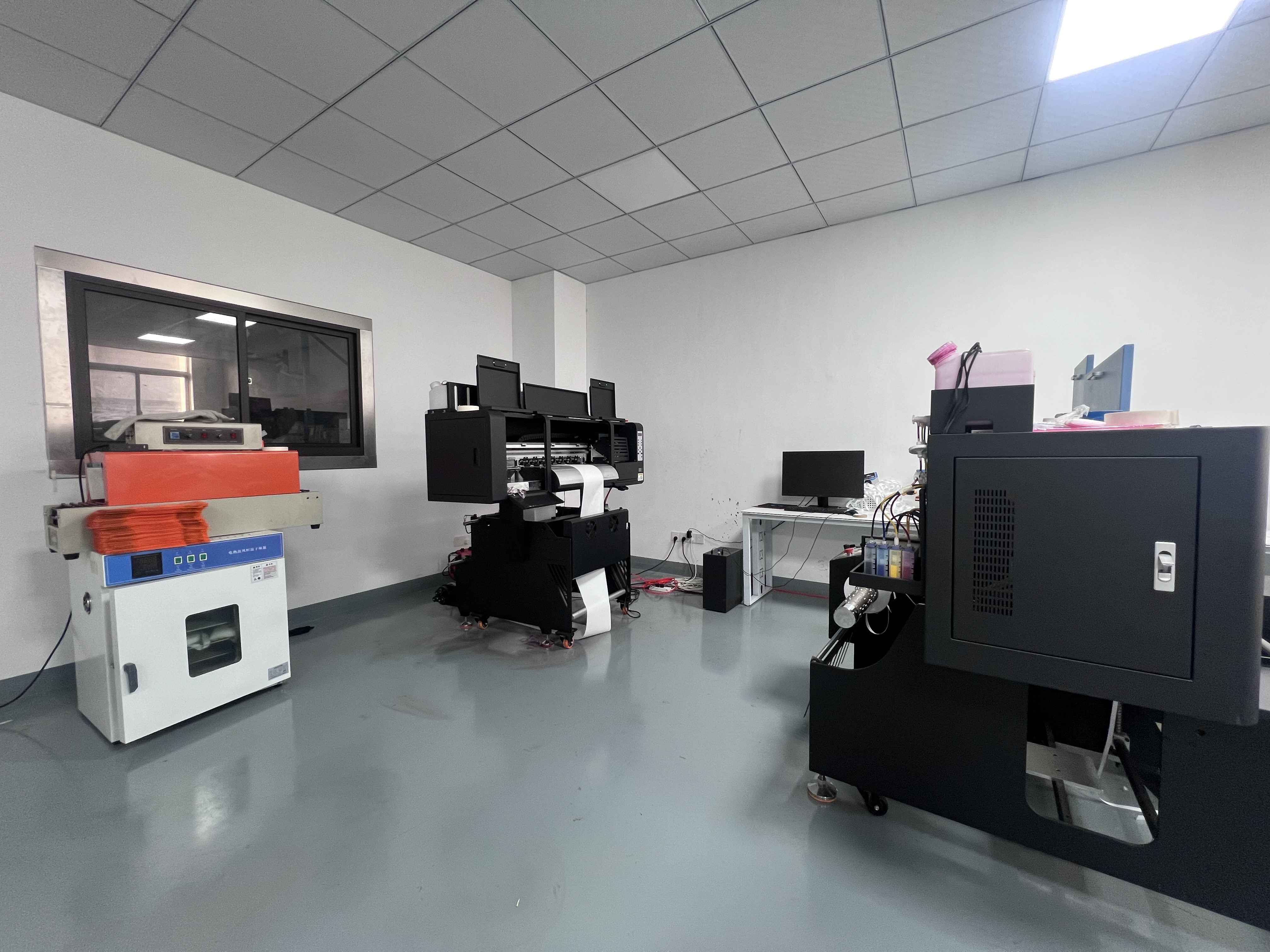
Custom printing capacity inside a wristband manufacturing facility; end users print medical thermal bands with a direct thermal printer, while custom and pre-printed formats are produced in-house.
On the medical side, the product range maps directly to the scenario list above: medical thermal wristbands in a 260 x 25 mm standard format with custom sizes available; PVC patient ID wristbands in 250 x 25 mm and 250 x 16 mm, single or double layer; disposable Tyvek bands in 250 x 19 mm and 250 x 25 mm; and RFID wristbands in multiple materials and frequencies. The stated application is patient identification and ward information management, with direct thermal printers as the matched equipment and waterproof, tear-resistant, disposable and skin-safe characteristics listed as the project requirements.
On supply terms, the company's stated standard product lead time is 7–10 working days, supported by advance production scheduling and reserved monthly capacity for large-volume orders. For a hospital group running multi-site band standardisation, those two mechanisms — a stated lead time and reserved capacity — are the difference between a pilot and a rollout.
What the market data shows, and where estimates disagree
Market figures for this category should always be read together with their scope definition. The 2025 market is reported at USD 576.1 million by Future Market Insights and at USD 1.61 billion by Precedence Research; the variance reflects one definition centred on blank wristbands and another on a broader identification and system-integrated product scope. Neither number is wrong, but quoting either without its definition will mislead a budget discussion.
Regional concentration is clearer. North America accounted for a 41% share of the patient identification wristbands market in 2025, according to Precedence Research.
The supply side is not fragmented at the top. Zebra Technologies reported net sales of USD 346 million for its Asset Intelligence & Tracking segment, which includes wristbands, in Q4 2023 — a reminder that the consumable band often sits inside a larger hardware and software ecosystem. Future Market Insights separately estimates PDC Healthcare, a Brady Corporation brand, at a projected 14–18% share of the patient identification wristbands market, a derived estimate that indicates how concentrated the branded end of the category is.
Two regulatory developments are reshaping specifications in the same period. The CJEU ruling on blank wristbands under EU MDR 2017/745 shifts the emphasis onto declared intended purpose for products sold into Europe. Separately, ISO 15223-1:2021 Amendment 1 (2025) changes the authorised representative symbol from EC REP to EU-REP, which affects label artwork, documentation and re-approval cycles for suppliers serving EU healthcare buyers.
Hospital wristbands versus traditional identification methods
The methods that predate printed bands are still in occasional use: handwritten paper labels, adhesive stickers, or a name written directly onto a band with a marker. Their weaknesses are well understood in clinical practice — handwriting is inconsistent, adhesive labels lift under moisture, and none of it is machine-readable, so every check depends on a human reading a wrist.
| Identification method | Data capture | Durability | Infrastructure required | Main limitation |
|---|---|---|---|---|
| Handwritten paper or adhesive label | Visual only | Low | None | Illegible or inconsistent entries; not scannable |
| Direct thermal printable band | Printed text, barcode possible | Water-resistant, tear-resistant, single-use | Direct thermal printer, no ink | Dependent on printer availability and band stock |
| PVC patient ID band | Printed text, barcode possible | Durable, waterproof, long-term wear | Printer for personalisation | Higher material use than paper-based disposables |
| RFID medical band | Read-write chip, contactless | Material dependent | Readers, integration, data governance | Highest unit and deployment cost |
None of these formats is free of constraints, and buyers are better served by naming them up front. Direct thermal bands are single-use and depend on a functioning printer and a restocked consumable supply; a ward-level stock-out stops admissions printing. PVC patient ID bands are more durable but are a higher-material format not designed for single-episode disposal. RFID bands carry the highest unit cost and cannot be deployed without reader infrastructure, systems integration and a data governance policy covering what is written to the chip and who may read it. Blank bands are also not classified as medical devices under EU MDR, so the regulatory weight falls on the intended purpose the supplier declares — a claim that outruns that intended purpose creates compliance exposure for the buyer as well as the seller.
Antimicrobial medical wristbands and other additive treatments raise a similar point: they are a separate specification, and buyers should ask for documentation rather than assume a standard band includes such a treatment.
Specifying hospital wristbands: a procurement checklist
| Specification item | What to confirm | Why it matters |
|---|---|---|
| Data carrier | Printed text, barcode or RFID chip | Determines the reading devices and workflows the ward must support |
| Printer compatibility | Direct thermal printing, band size and stock format | A mismatch stops on-demand printing at admission |
| Material | Thermal-sensitive synthetic paper, Tyvek, PVC or silicone | Sets durability, comfort and disposal profile |
| Size and format | 260 x 25 mm standard or custom size; 250 x 25 mm, 250 x 16 mm, 250 x 19 mm options | Wrist fit, print area and printer alignment |
| Closure design | Tab buckle or secure closed-loop design for tamper evidence | Prevents band removal or transfer between patients |
| Print durability | Water resistance and tear resistance requirements | Protects the identifier through washing and transfers |
| Single-use or reusable | Disposable by design, or durable for long-term wear | Drives infection-control fit and cost per patient episode |
| Skin contact | Skin-safe, comfortable long-term wear | Reduces removal requests and band replacement |
| Regulatory status and labelling | Declared intended purpose; ISO 15223-1 symbol set including the EU-REP transition | Determines classification, claims and label artwork validity |
| Quality documentation | ISO 9001 certification, third-party on-site verification | Evidence for supplier qualification files |
| Capacity and lead time | Stated standard lead time, reserved monthly capacity | Protects multi-site standardisation schedules |
| Customisation | Custom size, printing and chip frequency options | Aligns the band with existing system data models |
Future outlook
Three shifts are likely to shape hospital wristband procurement over the next planning cycle. The first is regulatory separation: as the classification boundary between blank consumables and medical-device systems becomes more explicit, suppliers will need clearer intended-purpose documentation and buyers will need to check claims against that documentation rather than against marketing language.
The second is label and symbol renewal. The ISO 15223-1:2021 Amendment 1 (2025) transition from EC REP to EU-REP will move through artwork, technical files and re-approvals for EU-bound medical identification products, and it is a manageable but predictable procurement event.
The third is technology drift from barcode to RFID where infrastructure already exists. RFID medical wristbands will continue to move from event, access-control and member-management settings into hospital workflows that already have readers and integration capability, while barcode printed bands remain the default where no such infrastructure is funded. In both cases the supplier question is shifting from unit price towards supply continuity: capacity, lead time, and the ability to hold one format consistent across repeated orders.
FAQ
What is a hospital wristband used for?
A hospital wristband is a wearable band applied to a patient's wrist to carry identification data — name, record number or a scannable code — throughout a care episode. It is used for patient identification, ward information management and traceability, and it is checked at medication rounds, handovers and procedures. Materials include PVC, Tyvek, thermal-print material and silicone, with options for custom sizes, custom printing and embedded RFID chips depending on the workflow the hospital operates.
What is the difference between thermal printable wristbands and PVC patient ID wristbands?
Thermal printable wristbands are made from thermal-sensitive synthetic paper and are printed on demand with a direct thermal printer that requires no ink. They arrive as a disposable, water-resistant and tear-resistant single-use product, typically in a 260 x 25 mm format with custom sizes available. PVC patient ID wristbands are a durable, waterproof format in 250 x 25 mm or 250 x 16 mm, offered in single-layer or double-layer structure, and are designed for clear printing of patient information with comfortable long-term wear in hospitals and elderly care institutions. In short, one is a single-episode consumable and the other a longer-wear band.
Should a hospital choose barcode medical wristbands or RFID medical wristbands?
The deciding factor is existing infrastructure. Barcode printed bands work with the scanners hospitals already use at the bedside and add no reader investment. RFID wristbands contain a built-in chip — low frequency, high frequency or ultra-high frequency — that is readable and writable, allowing data to be updated during the patient episode and read without line of sight, and supporting functions such as access control and payment. That capability comes with readers, integration work and a data governance policy. RFID materials include silicone, PVC, Tyvek and paper, in sizes including 250 x 25 mm and 250 x 16 mm.
Are medical wristbands classified as medical devices in the European Union?
Blank patient wristbands have been ruled by the Court of Justice of the European Union not to be classified as medical devices under EU MDR 2017/745 (Case C-427/24). Intended purpose is therefore decisive: the classification follows how the product is presented and what function the supplier declares for it. For products sold with a medical intended purpose, labelling symbols follow the ISO 15223-1 standard, whose Amendment 1 (2025) replaces the EC REP authorised representative symbol with EU-REP.
What lead time and production capacity should buyers expect for medical wristbands?
For a manufacturer such as Shanghai Dingba Identification Co., Ltd., which operates a 10,000 m² facility with an annual capacity of 120,000,000 units, the stated standard product lead time is 7–10 working days. Large-volume orders are supported through advance production scheduling and reserved monthly capacity. Buyers planning multi-site standardisation should confirm both the lead time and the reserved capacity mechanism in writing, since format consistency across repeat orders is usually the harder requirement to secure than the first delivery.
Есть вопросы или нужны дополнительные детали?
Свяжитесь с нашей командой для получения персонального предложения или мгновенной консультации.
Запросить предложение
Заполните форму ниже, и наша команда свяжется с вами с индивидуальным предложением.
Прямой чат WhatsApp
Предпочитаете общаться в реальном времени? Напишите нам в WhatsApp для мгновенной помощи и быстрых ответов.
- Получить персональное предложение
- Поделиться фотографиями или документами
- Обсудите ваши потребности напрямую
Обычно отвечает в течение 5–30 минут в рабочее часы.