
Hot Tub Scenarios for Hotels, Resorts and Wellness Spas
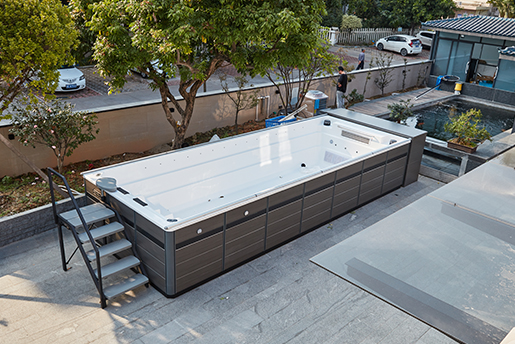
Villa installation case: an outdoor spa positioned as a private wellness amenity, following the same scenario logic that applies to serviced villas and boutique hospitality properties.
Across hospitality and wellness, the outdoor hot tub has moved from discretionary upgrade to a defined amenity category. The global hot tub market was valued at approximately USD 5.76 billion to USD 5.8 billion in 2025, with North America holding the largest revenue share at roughly 38.5% to 41.79% (Fortune Business Insights / Dataintelo, 2025). Commercial deployment in vacation rentals and luxury hotels is a growing segment, projected at a 5.91% CAGR, and spa amenities are widely correlated with higher booking premiums (Mordor Intelligence, 2024).
For buyers in the evaluation stage, the practical question has shifted. It is less often whether a property should offer a spa at all, and more often which configuration fits this site, this guest profile, and this operating model. A rooftop terrace in a city hotel, a garden deck at a wellness resort, a private villa spa suite, and a hydrotherapy room in a spa centre each impose different demands on access, thermal performance, jet layout, control systems, and service intervals.
This industry reference maps the main commercial hot tub scenarios across hospitality and wellness, and identifies the equipment characteristics that decide fit in each case. The relevant variables include plug-and-play installation, hydrotherapy massage jets driven by LX massage pumps, multi-layer thermal insulation, LED ambient lighting, and integrated heating, illustrated here with the Victoria Star hot tub range (VS-301C, VS-604L, VS-SP2100, VS-CP3500), Balboa or Gecko control systems, and USA-imported Aristech acrylic.
Scenario Definition Comes Before Model Selection
In commercial spa projects, the most expensive specification errors usually begin in the scenario brief rather than in the equipment list. A technically sound hot tub can still underperform if the installation route, power supply, guest duty cycle, or service model were never defined first.
Six variables typically decide whether a hot tub scenario works:
- Access and installation route. Door widths, lift capacity, deck loading and crane access frequently determine whether a freestanding or an inground format is realistic.
- Power and placement. Available electrical supply, distance from the plant room, and ventilation shape the electrical design.
- Duty cycle. Hours of operation per day, guest turnover, and bather load drive heating, filtration, and water-treatment sizing.
- Guest profile. Couples, families, and therapy users require different seating depths, jet placement, and temperature ranges.
- Operating season. Year-round operation in colder markets raises the value of thermal insulation and stable heating.
- Service model. In-house maintenance versus contracted service affects how accessible pumps, control packs, and filters must be.
Only after these variables are fixed do footprint, jet configuration, control system, and insulation level become meaningful comparison points.
Five Priority Hot Tub Scenarios in Hospitality and Wellness
The scenarios below cover the majority of commercial enquiries seen from hotel, resort, villa and wellness operators. They are listed in order of how often they appear in project briefs, not as a ranking of equipment.
| Scenario | Typical property type | Primary operational requirement | Relevant equipment family |
|---|---|---|---|
| Rooftop and terrace spa | City hotels, boutique hotels, rooftop venues | Compact footprint, low noise, evening ambience, thermal efficiency | Victoria Star hot tub line: VS-301C, VS-604L, VS-SP2100, VS-CP3500, with LED ambient lighting and multi-layer thermal insulation |
| Garden and poolside deck spa | Resorts, vacation rentals, villa communities | Deck integration, 3-7 person capacity, straightforward commissioning | Hot tub line, with plug-and-play installation available |
| Private villa and residence spa suite | Luxury residential, serviced villas | Hydrotherapy jet programming, quiet operation, finish options | Hot tub line; acrylic colour options include White, Ocean Blue, Pearl Grey, Cloud Black and Copper |
| Wellness centre hydrotherapy room | Spa centres, wellness resorts | Repeatable massage therapy, control precision, service access | Hot tub line with LX massage pumps and Balboa or Gecko control systems |
| Contrast and recovery zone | Wellness resorts, sports recovery facilities | Stable heating alongside cold immersion and sauna use | Hot tub line combined with saunas and steam rooms; swim spa line where a larger water body is required |
Rooftop and terrace spas
Rooftop installations concentrate several constraints at once: limited access, weight distribution, wind exposure, and noise sensitivity for nearby guest rooms. Freestanding acrylic units are commonly specified because they arrive as a single assembly and require far less site construction than a built-in water body. LED ambient lighting matters commercially here, because rooftop spa use peaks after sunset, while multi-layer thermal insulation limits heat loss in exposed positions.
Resort garden and poolside deck spas
In resort settings the hot tub is usually one element of a wider outdoor leisure sequence that includes pool, deck, loungers and bar. The design priority is integration rather than isolation, so decking cut-outs, level thresholds, and cover management matter as much as jet count. Plug-and-play installation, where available, shortens the commissioning window and reduces disruption to an operating property.
Private villa and residence spa suites
Serviced villas and high-end residential projects treat the spa as a private wellness room. Hydrotherapy performance and quiet operation dominate the brief, and surface finish becomes a visible design decision. Acrylic colour options across the Victoria Star hot tub line include White, Ocean Blue, Pearl Grey, Cloud Black and Copper, allowing the unit to be matched to an existing interior or deck palette rather than accepted as a fixed catalogue item.
Wellness centre hydrotherapy rooms
In spa and wellness centres, the hot tub is a therapy device rather than a leisure item. Consistent jet pressure and repeatable programming become the specification drivers, which is why pump selection and control platform carry more weight than aesthetics. In the Victoria Star range, hydrotherapy massage jets are powered by LX massage pumps, and the control layer is based on Balboa or Gecko control systems, giving operators a known service environment.
Contrast and recovery zones
Contrast bathing, meaning alternating hot and cold immersion, often alongside sauna, has become a standard layout in wellness resorts and recovery facilities. The hot tub role in that sequence is stable, predictable heat: an integrated heating system and multi-layer thermal insulation keep the water body within its operating band regardless of how frequently the adjacent cold immersion is used. Where a property also needs a swimming or training element, the swim spa line extends the same platform to a larger water body.
Equipment Characteristics That Decide Scenario Fit
Shell material and finish
Acrylic hot tubs accounted for 43.2% of the product type segment in 2025, a share attributed to durability and aesthetic appeal (Dataintelo, 2025). Victoria Star hot tubs use USA-imported Aristech acrylic, with Chinese acrylic sheet available as an alternative, and offer colour options in White, Ocean Blue, Pearl Grey, Cloud Black and Copper. For hospitality buyers the implication is twofold: an acrylic shell resists the surface wear that high-turnover commercial use accelerates, and colour selection keeps the spa aligned with the property design language.
Hydrotherapy performance
Jet performance in the Victoria Star range is delivered through hydrotherapy massage jets powered by LX massage pumps, with jet configuration listed among the customizable parameters. Control is handled by Balboa or Gecko control systems, a relevant detail for commercial operators because both platforms are established in the spa service network, which simplifies technician familiarity and spare-parts planning across a multi-year service life.
Thermal envelope and integrated heating
Multi-layer thermal insulation and an integrated heating system are core parameters of the hot tub line. In commercial operation, insulation is not only a comfort feature; it is a cost and uptime feature, because it reduces recovery time after cover removal and stabilises temperature during frequent guest use. It is also increasingly a regulatory topic. Energy efficiency for hot tubs in California and several other US states is regulated by CEC Title 20 and the ANSI/APSP/ICC-14 standard, which set specific standby power limits and labelling requirements (California Energy Commission, 2024).
Lighting, covers and guest-facing details
LED ambient lighting is included across the hot tub line, while the swim spa line adds smart temperature control and an optional automatic cover system. These are not decorative extras in a hospitality brief: lighting defines the usable evening window, and cover systems affect heat retention, debris management, and the labour time required for daily opening and closing.
Installation formats
Installation format is one of the earliest scenario decisions, because it determines how much site work precedes commissioning. The hot tub line supports plug-and-play installation, which reduces on-site electrical and plumbing work compared with a built-in spa. Documented Victoria Star installations include outdoor villa placements and indoor basement installations, showing that the same platform can serve projects that prefer an interior wellness room rather than an outdoor deck.
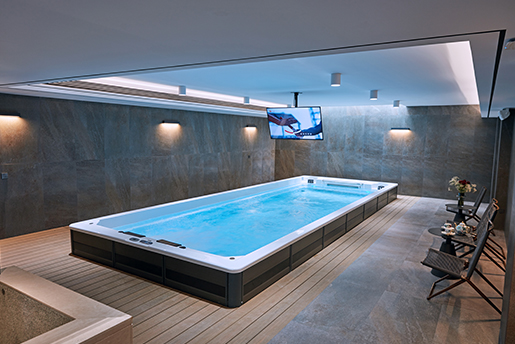
Basement installation case: the same acrylic hot tub platform specified as an indoor wellness installation, where access planning and ventilation replace deck integration as the primary site constraints.
Mapping Victoria Star Equipment to Hospitality Scenarios
Victoria Star Spa is the wellness brand of Foshan Gaoming Shiyi Sanitary Ware Technology Co., Ltd., a Foshan-based manufacturer of swim spas, hot tubs, saunas, steam rooms and integrated wellness solutions for residential and commercial projects. The company operates a facility of more than 50,000 square meters with over 250 employees, including an engineering team of more than 35 professionals, and reports an annual output of 7,000 units against a monthly capacity of 600 sets. Products are exported to more than 80 countries and regions with an export ratio of 70%, and primary markets in Europe, North America, Australia, the Middle East and Southeast Asia.
The hot tub line
Four hot tub models are positioned for hospitality, wellness and residential use: VS-301C, VS-604L, VS-SP2100 and VS-CP3500. Published parameters for the line cover capacities of 3-7 persons, dimensions from 1.8 m to 3.8 m, hydrotherapy massage jets, an integrated heating system, LED ambient lighting, and multi-layer thermal insulation, with plug-and-play installation available. Shell material is USA-imported Aristech acrylic or Chinese acrylic sheet; the control layer is Balboa or Gecko; and jets are driven by LX massage pumps.
The swim spa line
Where a project needs swimming or training rather than relaxation only, the swim spa line is specified: VS-GT1202, VS-M1202 and VS-3816. Published parameters cover a length range of 4 m to 16 m and a width range of 2.2 m to 3.8 m, an adjustable swim training system with 1-12 levels, an integrated heating and filtration system, a hydrotherapy massage area, LED lighting, smart temperature control, and an optional automatic cover system. Custom lengths up to 16 m and widths up to 3.8 m are available for project-specific requirements.
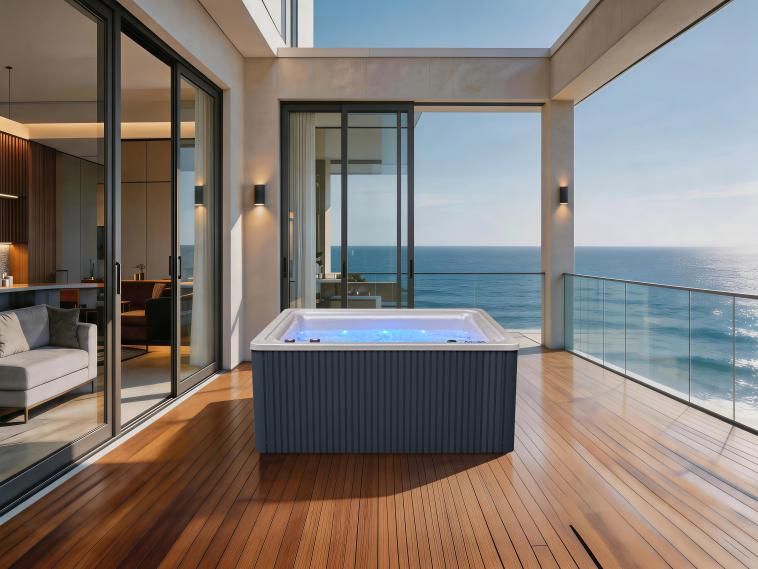
VS-SP2100, one of four models in the Victoria Star hot tub line (VS-301C, VS-604L, VS-SP2100, VS-CP3500), a range published with 3-7 person capacities and 1.8 m to 3.8 m footprints.
Scenario-to-specification checklist
| Buyer requirement | Specification to confirm | Where it sits in the Victoria Star range |
|---|---|---|
| Fit a compact rooftop or terrace | Footprint within 1.8 m to 3.8 m; 3-7 person capacity | Hot tub line: VS-301C, VS-604L, VS-SP2100, VS-CP3500 |
| Support swim or training use | 4 m to 16 m length; 1-12 swim training levels | Swim spa line: VS-GT1202, VS-M1202, VS-3816 |
| Achieve repeatable therapy intensity | Jet configuration and LX massage pumps | Hot tub and swim spa lines |
| Match technician familiarity and service access | Balboa or Gecko control system | Hot tub and swim spa lines |
| Reduce running cost and hold stable temperature | Multi-layer thermal insulation; integrated heating | Hot tub line |
| Extend the usable evening window | LED ambient lighting | Hot tub and swim spa lines |
| Match surface durability to design intent | USA-imported Aristech acrylic; five colour options | Hot tub line |
| Deploy on an operating property | Plug-and-play installation available | Hot tub line |
| Document market compliance | ETL for US and Canadian markets; CE; SAA | Certified product scope |
Procurement and Delivery Parameters for Commercial Orders
Production mode is OEM, ODM and custom manufacturing, and customization covers dimensions, jet configuration, acrylic colours, lighting systems, control systems and skirt colours. Minimum order quantity is 1 set and lead time runs 35-70 days. Monthly capacity of 600 sets is relevant to phased hotel and resort rollouts, where one specification is delivered across multiple properties over consecutive months rather than in a single shipment.
Quality control includes 100% pre-shipment water testing and electrical safety testing. After-sales support covers remote technical support, installation guidance, spare parts supply, online troubleshooting support, and a 2-year warranty for the spa shell and electrical components.
Compliance Considerations for Commercial Installations
Compliance is a specification input rather than an afterthought. Portable electric spas sold in North America must comply with UL 1563 in the United States and CAN/CSA-C22.2 No. 218.1 in Canada for the entire unit to be certified (UL Solutions, 2024). Victoria Star holds ETL certification number 5036225, issued by Intertek Testing Services NA Inc. on 2026-04-02 for the US and Canadian markets, with a scope covering outdoor spa, hot tub and swim spa products evaluated against UL 1563:2025 Ed.7 and CSA C22.2#218.1:2025 Ed.3. The company also states CE and SAA compliance for other markets.
Two further standards belong in the tender file. NSF/ANSI/CAN 50 is the benchmark standard for materials and equipment used in hot tubs and spas, covering performance validation and operational safety (NSF International, 2024). CEC Title 20 and ANSI/APSP/ICC-14 govern energy efficiency for hot tubs in California and several other US states, requiring standby power limits and labelling (California Energy Commission, 2024).
Comparison with Traditional Solutions
Concrete pools and built-in gunite spas remain the correct answer where the water body is part of the building architecture. Acrylic hot tubs are specified when deployment speed, relocatability, hydrotherapy intensity, or thermal control are the deciding factors.
| Decision factor | Concrete pool or built-in spa | Acrylic hot tub (Victoria Star range) |
|---|---|---|
| Site works | Excavation, structural works, plumbing and curing before commissioning | Delivered as a finished assembly; plug-and-play installation available on the hot tub line |
| Time to first use | Dominated by civil works and finishing trades | Lead time of 35-70 days plus shipping and site preparation |
| Relocation | Not practical once built | Freestanding units can be relocated where site conditions allow |
| Hydrotherapy flexibility | Jet layout essentially fixed after construction | Jet configuration, dimensions, lighting and control systems specified at order |
| Thermal behaviour | Depends on construction method and added insulation | Multi-layer thermal insulation and integrated heating as line parameters |
| Scale | Effectively unlimited by structure | Hot tub line 1.8 m to 3.8 m and 3-7 persons; swim spa line 4 m to 16 m |
Boundaries and limitations. The acrylic hot tub approach has clear limits that should be stated before specification. Capacity is bounded: the hot tub line covers 3-7 persons and dimensions from 1.8 m to 3.8 m, and the swim spa line extends to 16 m for swim-oriented projects, so a property requiring a larger architectural water body falls outside the range. Service life is finite, with a typical 10+ years under proper maintenance. Customization is broad but structured, covering dimensions, jet configuration, acrylic colours, lighting systems, control systems and skirt colours; it is not a re-engineering of the underlying platform. A lead time of 35-70 days makes this equipment unsuitable for urgent openings, and site preparation, power supply and access remain the buyer responsibility. Where the design intent is a pool integrated into the building structure, a concrete solution is still the more appropriate choice.
Market Trend Analysis
Several verified data points frame where hospitality spa procurement is heading:
- Market size and growth. The global hot tub market was valued at approximately USD 5.76 billion to USD 5.8 billion in 2025 and is projected to reach between USD 8.47 billion and USD 9.6 billion by 2030-2034, at a CAGR of approximately 4.28% to 5.8% (Fortune Business Insights / Dataintelo).
- Regional concentration. North America holds the largest revenue share, at approximately 38.5% to 41.79% (Fortune Business Insights / Dataintelo).
- Material preference. Acrylic hot tubs accounted for 43.2% of the product type segment in 2025 (Dataintelo).
- Hospitality demand. Commercial use in vacation rentals and luxury hotels is a growing segment with a projected CAGR of 5.91%, with spa amenities correlated to higher booking premiums (Mordor Intelligence, 2024).
- Competitive structure. Jacuzzi Group Worldwide led the market in 2025 with over 5% share, and the top five players, Jacuzzi, Masco, Master Spas, Bullfrog Spas and Cal Spas, collectively held 36% (Global Market Insights, 2025). The remaining share is served by a long tail of regional and specialist suppliers, which is where OEM and ODM manufacturing partners operate.
A note on interpretation: published estimates of 2025 market size vary by source, largely because some analysts define the category as hot tubs and others as pool and spa equipment. Buyers should treat these figures as directional and base investment decisions on their own project economics.
Future Outlook
Three directions appear most likely to shape commercial hot tub specification over the next planning cycle.
Integrated wellness zones rather than standalone spas. Hot tubs are increasingly specified as one element in a sequence that includes sauna, steam and cold immersion. That raises the requirement for predictable heat output and stable control rather than for feature count, because the spa must perform the same way every day regardless of how the other elements in the zone are used.
Regulatory pressure on energy performance. Standards such as CEC Title 20 and ANSI/APSP/ICC-14 already set standby power limits and labelling requirements in some US states. Insulation design, heating control, and cover systems are the practical levers available to both manufacturers and buyers, which favours specification on measured thermal behaviour rather than on headline wattage.
Documentation as a procurement requirement. Certification scope, testing evidence and warranty terms are moving into the tender pack alongside price, particularly for multi-property rollouts where consistency across sites matters more than a single-site saving. For manufacturers, that shifts competition toward verifiable specifications and service documentation.
FAQ
Which hospitality scenarios suit a hot tub better than a built-in pool?
A hot tub is generally the better fit where the requirement is a compact, hydrotherapy-focused amenity rather than a large water body: rooftop and terrace spas, resort deck spas, villa spa suites, wellness centre hydrotherapy rooms, and recovery zones that combine heat, cold and sauna use. Built-in pools and gunite spas remain appropriate where the water feature is integrated into the building structure or must exceed the dimensions available in a manufactured range.
What capacity and dimensions are available for hotel and villa projects?
In the Victoria Star hot tub line, published parameters cover capacities of 3-7 persons and dimensions from 1.8 m to 3.8 m. Where a swimming or training element is required, the swim spa line covers lengths of 4 m to 16 m and widths of 2.2 m to 3.8 m, with custom lengths up to 16 m and widths up to 3.8 m.
How does hydrotherapy equipment differ from a standard spa?
Hydrotherapy configuration is defined by jet layout and pump selection rather than by the shell alone. In the Victoria Star range, hydrotherapy massage jets are powered by LX massage pumps, jet configuration is a customizable parameter, and control is provided through Balboa or Gecko control systems.
Which certifications apply to commercial hot tub installations in North America?
Portable electric spas sold in North America must comply with UL 1563 in the United States and CAN/CSA-C22.2 No. 218.1 in Canada for the entire unit to be certified. Victoria Star holds ETL certification number 5036225, issued by Intertek Testing Services NA Inc., covering outdoor spa, hot tub and swim spa products for the US and Canadian markets under UL 1563:2025 Ed.7 and CSA C22.2#218.1:2025 Ed.3. The company also states CE and SAA compliance for other markets.
What are the typical order and delivery parameters for a commercial project?
Victoria Star operates on OEM, ODM and custom manufacturing, with a minimum order quantity of 1 set and a lead time of 35-70 days, against monthly capacity of 600 sets. Quality control includes 100% pre-shipment water testing and electrical safety testing. After-sales support includes remote technical support, installation guidance, spare parts supply, online troubleshooting, and a 2-year warranty for the spa shell and electrical components.
What maintenance expectations apply to year-round commercial operation?
The equipment is designed for long-term use, with a typical service life of 10+ years under proper maintenance. Multi-layer thermal insulation and an integrated heating system support stable year-round operation, and documented project outcomes include low maintenance requirements and continuous year-round operation. Service planning should still account for filtration, water treatment, and access to pumps and control components.
Which property types already use this equipment?
Documented users of the Victoria Star hot tub and swim spa range include luxury villa owners, hotel and resort operators, spa and wellness centres, distributors, and project contractors, across applications such as outdoor relaxation areas, hydrotherapy and wellness, swimming exercise, family recreation, and hotel guest experience enhancement.
A 2026 product overview covering the outdoor spa and sauna collection, including the hot tub and swim spa lines referenced in this article, is available as a downloadable reference: 2026 New Collection (Outdoor Spa & Sauna).