
Hot Tubs Explained: Category, Technology, and Market Signals
The hot tub has moved from a backyard amenity into a defined product category within global wellness and hospitality procurement. Market estimates placed the global hot tub market at approximately USD 5.76 billion to 5.8 billion in 2025, with North America accounting for the largest revenue share. For buyers entering the category, the practical challenge is not a shortage of products but a shortage of structure: terminology varies, materials and technologies differ, and regional compliance rules add another layer. This article provides a fact-based reference for understanding hot tubs as a category, what sits behind the product specifications, and how market signals can inform sourcing decisions.
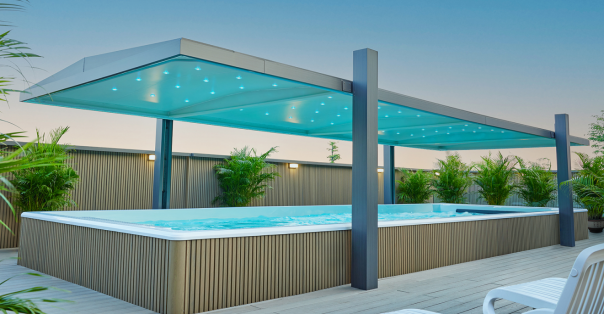
Automatic lifting cover, an installation accessory commonly specified for outdoor hot tubs.
The Hot Tub Category: Definition and Boundaries
A hot tub is a water-filled unit designed for soaking, hydrotherapy, and relaxation, typically equipped with a heating system, massage jets, water filtration, and temperature controls. In manufacturer classifications, the category is commonly labeled “luxury outdoor spa” or “hydrotherapy spa.” Victoria Star Spa, a wellness equipment manufacturer based in Foshan, China, classifies its hot tub line under both labels, with models designated VS-301C, VS-604L, VS-SP2100, and VS-CP3500.
The boundaries of the category are not fixed. Swim spas, cold plunge tubs, and saunas frequently appear alongside hot tubs in manufacturer catalogs, and the same project—a wellness resort, a luxury villa, a spa center—often requires more than one piece of equipment. Buyers benefit from defining exactly what they are procuring: a freestanding backyard hot tub, an inground commercial unit, a portable plug-and-play spa, or a broader wellness package that includes several product types.
Problem and Opportunity: A Fragmented but Growing Market
The hot tub market is fragmented on several levels. Terminology is inconsistent across regions and suppliers; shell materials range from acrylic and rotomolded plastic to concrete; control systems, jet configurations, and insulation quality differ strongly between price segments. Regional certification requirements add further complexity. In North America, portable electric spas must comply with UL 1563 (USA) and CAN/CSA-C22.2 No. 218.1 (Canada) for unit certification. Energy efficiency in California and other US states is regulated under CEC Title 20 and ANSI/APSP/ICC-14, which set standby power limits and labeling requirements.
The opportunity side is equally clear. The global hot tub market is projected to grow from roughly USD 5.76 billion to 5.8 billion in 2025 to between USD 8.47 billion and USD 9.6 billion by 2030–2034, at a compound annual growth rate of approximately 4.28% to 5.8%. Within that growth, the commercial segment—vacation rentals and luxury hotels—is expanding at a projected 5.91% CAGR, as spa amenities are directly correlated with higher booking premiums. For buyers, this means a wider range of suppliers and models to evaluate. For manufacturers, it creates space for new capacity and specialization.
Brand Reference: Victoria Star Spa
Foshan Gaoming Shiyi Sanitary Ware Technology Co., Ltd., operating under the brand Victoria Star Spa, is a sanitary ware and wellness equipment manufacturer based in Gaoming, Foshan, Guangdong, China. Established in 2024, the company operates a production facility covering 50,000 square meters, with approximately 250 employees and a dedicated engineering team of 35 professionals. Annual production capacity is 7,000 units. The company reports an export ratio of roughly 70%, with principal markets in Europe, North America, Australia, the Middle East, and Southeast Asia, and products shipped to more than 80 countries and regions. Its product range includes hot tubs, outdoor spas, swim spas, saunas, steam rooms, and integrated wellness solutions, and its products comply with CE, SAA, and ETL standards.
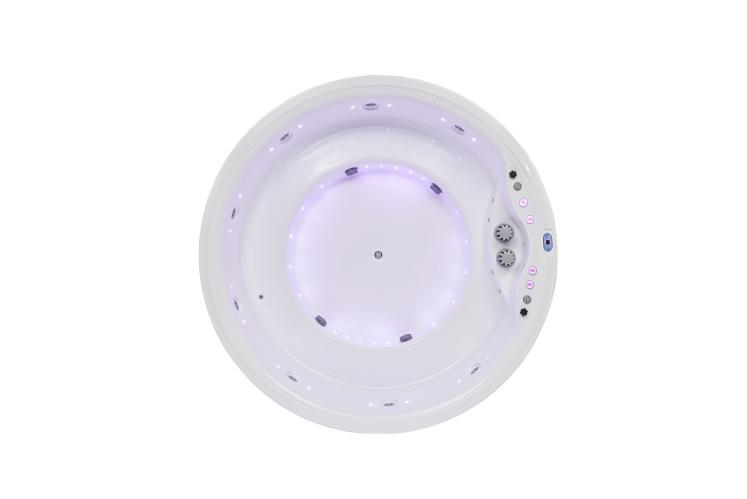
VS-CP3500, a luxury outdoor hot tub model in Victoria Star Spa's product line.
Within the hot tub category, Victoria Star positions its models in the luxury outdoor spa and hydrotherapy segments. The current line covers capacities from 3 to 7 persons and overall dimensions from 1.8 m to 3.8 m. Shell construction uses USA-imported Aristech acrylic or Chinese acrylic sheet, with color options of White, Ocean Blue, Pearl Grey, Cloud Black, and Copper. Control is handled through Balboa or Gecko systems, and hydrotherapy massage jets are driven by LX massage pumps.
| Feature | Specification |
|---|---|
| Models | VS-301C, VS-604L, VS-SP2100, VS-CP3500 |
| Category | Luxury Outdoor Spa, Hydrotherapy Spa |
| Capacity | 3–7 persons |
| Dimensions | 1.8 m – 3.8 m |
| Shell material | USA-imported Aristech Acrylic, Chinese Acrylic Sheet |
| Color options | White, Ocean Blue, Pearl Grey, Cloud Black, Copper |
| Control systems | Balboa, Gecko |
| Massage pumps | LX Massage Pumps |
| Key features | Hydrotherapy massage jets, integrated heating, LED ambient lighting, multi-layer thermal insulation, plug-and-play installation available |
Technical Explanation: What Defines a Modern Acrylic Hot Tub
Acrylic is the dominant shell material in the global hot tub market, accounting for 43.2% of the product-type segment in 2025, according to Dataintelo. Its position is driven by durability and aesthetic versatility. Acrylic sheets can be thermoformed into a wide range of shapes, which allows manufacturers to offer more design options than traditional materials. A modern acrylic hot tub is best understood as an integration of several subsystems. From a procurement perspective, each subsystem carries a distinct cost and risk profile: shell material affects durability and appearance; insulation affects long-term energy cost; the control platform affects usability and replacement-part availability; pump configuration affects the hydrotherapy experience and maintenance. Buyers who evaluate these layers separately tend to make more comparable supplier assessments.
Shell and Structure
The acrylic shell is thermoformed into the tub shape and reinforced with composite material on the underside. The shell performs three functions: it provides the visible surface and color, contains the water and occupants, and forms the base for thermal insulation. Victoria Star specifies either USA-imported Aristech acrylic or Chinese acrylic sheet depending on model configuration and market requirements.
Heating and Thermal Insulation
An integrated heating system maintains water temperature at the user-selected level. Because a hot tub operates outdoors in most residential and commercial environments, thermal performance is a key operating cost factor. Multi-layer thermal insulation inside the cabinet reduces standby heat loss, which becomes a compliance issue in markets with standby power limits, such as California's CEC Title 20 and the ANSI/APSP/ICC-14 standard.
Hydrotherapy Jets and Pumps
Hydrotherapy is the core wellness function of a hot tub. Massage jets are positioned around the shell and supplied by pumps sized to the jet configuration. In Victoria Star models, LX massage pumps drive the jet system. The number, position, and adjustability of jets determine the quality and type of massage experience, which is a primary reason hospitality and wellness projects specify hydrotherapy-focused models.
Control Systems
Digital control systems manage water temperature, jet operation, lighting, and filtration cycles. Two established control platforms in the industry are Balboa and Gecko; Victoria Star uses both across its model range. Newer configurations also include Bluetooth connectivity and smart temperature control, allowing users to manage the tub from a mobile device.
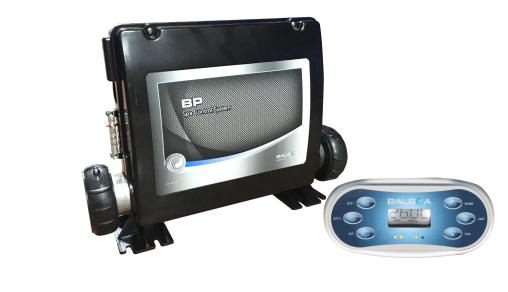
Balboa control system, one of the control platforms specified in Victoria Star hot tub models.
Filtration and Water Management
Integrated water filtration maintains water quality between drain-and-refill cycles. For heavier-use installations—hotels, resorts, rental properties—additional equipment can be specified: sand filter systems, automatic water fill and drain systems, and heat pump systems. These extend the usable life of the water and reduce manual maintenance.
Installation Formats and Accessories
Plug-and-play models operate after connection to water and power, which makes them suited to residential use and projects with short installation windows. For projects with different site constraints, manufacturers offer freestanding, semi-inground, and embedded installation options. The application scenario data for Victoria Star describes outdoor residential and commercial environments with all-season operation capability, and lists matched accessories such as automatic lifting covers, automatic roller covers, PU covers, 3-step stairs, and Bluetooth audio systems.
Application and Use Cases
Hot tubs are applied across residential and commercial environments, with all-season operation expected in most scenarios. Primary project types include luxury villas, star-rated hotels, wellness resorts, spa centers, high-end residential developments, and outdoor entertainment areas.
The functions buyers typically specify are hydrotherapy, relaxation, family entertainment, fitness training, and recovery and wellness. These map to different model choices. A hydrotherapy-focused spa suits a wellness resort; a higher-capacity model works for family backyard use; a plug-and-play unit is a low-complexity option for vacation rentals. Common application markets for Victoria Star products include France, the United Kingdom, the United Arab Emirates, and Australia, according to the company's application data.
The choice of installation format also affects project coordination. A freestanding unit requires a prepared base and power supply. Semi-inground installation reduces the visual height and can integrate more cleanly with landscape design, but requires excavation and structural preparation. Automatic cover systems, whether lifting or roller type, reduce heat loss and protect the unit when not in use. Installation design for these projects is generally weather-resistant and intended for low-maintenance circulation.
Market Trend Analysis
Several verified data points help frame the market context for procurement teams.
| Indicator | Value | Source / Year |
|---|---|---|
| Global hot tub market size | USD 5.76B – 5.8B | Fortune Business Insights / Dataintelo, 2025 |
| North American revenue share | 38.5% – 41.79% | Fortune Business Insights / Dataintelo, 2025 |
| Projected market size | USD 8.47B – 9.6B | Fortune Business Insights / Dataintelo, 2030–2034 |
| Projected CAGR | 4.28% – 5.8% | Fortune Business Insights / Dataintelo, 2030–2034 |
| Acrylic hot tub segment share | 43.2% | Dataintelo, 2025 |
| Vacation rental / luxury hotel segment CAGR | 5.91% | Mordor Intelligence, 2024 |
| Top 5 manufacturer combined share | 36% | Global Market Insights, 2025 |
North America's large share explains why UL 1563 and CSA certification dominate sourcing requirements. Acrylic's 43.2% segment share explains why most new supplier conversations start with acrylic shell technology. The 5.91% commercial CAGR signals that hospitality and rental projects are a priority demand channel. And the fact that the top five players—Jacuzzi, Masco, Master Spas, Bullfrog Spas, and Cal Spas—held a combined 36% share in 2025 indicates a fragmented supplier base, with Jacuzzi Group Worldwide leading at over 5% and the remaining 64% distributed across many manufacturers, including OEM suppliers in Asia.
It is worth noting that market size estimates vary by source. Fortune Business Insights and Dataintelo report the 2025 market in the USD 5.76 billion to 5.8 billion range, while other analysts use different definitions of the product category, which produces a wider spread. Buyers should treat single-point market figures as directional rather than precise.
Acrylic Hot Tubs vs. Traditional Concrete Construction
For hospitality and high-end residential projects, the conventional alternative to a manufactured hot tub is a concrete-built pool or spa. Both approaches have legitimate roles, and the choice depends on project priorities.
Acrylic hot tubs offer factory-controlled manufacturing, consistent quality, and faster on-site installation. A plug-and-play unit arrives as an integrated assembly of shell, heating, jets, controls, and filtration, which reduces the number of construction trades involved. Multi-layer insulation improves thermal retention, and the smaller water volume of a hot tub requires less energy to heat than a concrete pool. Maintenance is simpler because the circulation and filtration systems are integrated and designed for the unit.
Concrete construction offers a level of design freedom that prefabricated units cannot match. Shape, depth, finish, tilework, and architectural integration can be fully customized on site, which matters for landmark projects with demanding design requirements.
The acrylic approach also has clear limitations. First, size is constrained by the manufacturer's mold range: Victoria Star's hot tub models span 1.8 m to 3.8 m, so projects requiring larger or irregular geometries must move to swim spas or custom concrete construction. Second, acrylic color and finish options are limited to the palette the manufacturer offers—White, Ocean Blue, Pearl Grey, Cloud Black, and Copper in Victoria Star's case. Third, long-distance transport of a large prefabricated tub needs to be factored into project planning, particularly for remote sites. Operational cost is another comparison point. A manufactured acrylic hot tub heats a relatively small water volume with insulated cabinet construction, which typically results in lower energy consumption per use than a larger concrete pool; however, the actual cost depends on local electricity tariffs, climate, and frequency of use. These boundaries are not disadvantages in absolute terms; they are selection criteria that should be weighed against schedule and operational requirements.
Future Outlook
The hot tub category is positioned for continued growth through the early 2030s, but the nature of that growth will be shaped by several forces.
- Energy efficiency regulation: Standards such as CEC Title 20 and ANSI/APSP/ICC-14 will continue to push manufacturers toward better thermal insulation, low standby power, and clearer labeling. Energy-efficient hot tubs will become the baseline in regulated markets.
- Smart controls: Digital temperature control, Bluetooth connectivity, and automation are becoming standard in the premium segment. Buyers will increasingly evaluate control platforms (such as Balboa and Gecko) as a usability feature, not just a technical detail.
- Commercial demand: The vacation rental and luxury hotel segment, projected to grow at 5.91% CAGR, will raise the bar for durability, serviceability, and rapid installation. Spa amenities are directly linked to booking premiums, which makes hot tub specifications a revenue-relevant decision for hospitality operators.
- OEM and customization: As the market fragments across designs and applications, buyers will rely more on OEM partners with engineering depth, certification coverage, and production capacity. Victoria Star's 35-engineer R&D team and 7,000-unit annual capacity reflect the type of capability that procurement teams are now expected to verify.
- Multi-product wellness packages: Hot tubs, swim spas, saunas, and cold plunge tubs are increasingly specified together in villas, resorts, and wellness centers. Suppliers with a broad product range simplify procurement and integration.
For a market this fragmented, the practical conclusion is straightforward: define project requirements before evaluating products, then map product types, materials, certifications, and supplier capabilities against those requirements.
Reference resource: For model-level specifications and the current product range, Victoria Star Spa publishes a publicly accessible 2026 collection brochure covering its outdoor spa and sauna products. Buyers and specifiers can review it here: Victoria Star Spa 2026 Collection (PDF).
FAQ: Hot Tubs at a Glance
What is a hot tub?
A hot tub is a water-filled unit designed for soaking, hydrotherapy, and relaxation. In manufacturer classifications, it is commonly grouped under “luxury outdoor spa” or “hydrotherapy spa” categories. Victoria Star Spa lists models VS-301C, VS-604L, VS-SP2100, and VS-CP3500 in this category, with capacities of 3 to 7 persons and dimensions from 1.8 m to 3.8 m.
What are the main types of hot tubs?
Hot tubs are generally grouped by installation format (freestanding, inground, semi-inground), shell material (acrylic, concrete, rotomolded plastic), and application (residential, commercial, hydrotherapy). In 2025, acrylic hot tubs accounted for 43.2% of the global product-type segment. Models are frequently positioned as luxury outdoor spas or hydrotherapy spas depending on jet configuration and feature set.
What materials are used to make hot tubs?
Acrylic is the most common shell material, valued for durability and aesthetic versatility. Victoria Star constructs its hot tubs from USA-imported Aristech acrylic or Chinese acrylic sheet, with color options of White, Ocean Blue, Pearl Grey, Cloud Black, and Copper. Traditional alternatives include concrete and rotomolded plastic.
What is an acrylic hot tub?
An acrylic hot tub has a shell thermoformed from acrylic sheet and reinforced with composite material. Acrylic is the leading material in the global hot tub market, representing 43.2% of the product-type segment in 2025. The material permits varied shapes and colors and supports integrated features such as hydrotherapy jets, LED lighting, heating, and smart control systems.
How does a hot tub work?
A hot tub combines an integrated heating system, a pump-driven jet system for hydrotherapy, a filtration and circulation loop for water quality, and a digital control panel for operation. Most plug-and-play models operate after connecting water and power. Victoria Star models add multi-layer thermal insulation and are controlled through Balboa or Gecko systems.
What certifications apply to hot tubs?
In North America, portable electric spas must comply with UL 1563 (USA) and CAN/CSA-C22.2 No. 218.1 (Canada) for unit certification. NSF/ANSI/CAN 50 is the benchmark standard for materials and equipment used in pools and spas. Energy efficiency in California and several other US states is regulated by CEC Title 20 and the ANSI/APSP/ICC-14 standard. Victoria Star products comply with CE, SAA, and ETL standards.
Where are hot tubs commonly used?
Hot tubs are commonly installed in luxury villas, star-rated hotels, wellness resorts, spa centers, high-end residential projects, and outdoor entertainment areas. Common application markets include France, the United Kingdom, the United Arab Emirates, and Australia. Typical functions are hydrotherapy, relaxation, family entertainment, fitness training, and recovery and wellness.