
Hotel Ballrooms & Conference Halls: Rollable LED Screen Fit Guide
Hotel Ballrooms & Conference Halls: Rollable LED Screen Fit Guide
A hotel ballroom or conference centre needs a screen that clears the service lift, disappears into back-of-house storage, stands up inside the turnaround window, and satisfies the venue's facility team. A rollable LED screen — a display screen that rolls or folds into a compact form for storage and deploys when installed — addresses those four constraints directly, rather than optimising for a single viewing distance. This guide takes each constraint in turn and maps three series from Onumen Technology Co., Ltd. — Magic Plus (FPS), Smart T Plus (FTS) and the Rolling Rollable LED Display (FRL/FRSL) — to the hotel scenarios where each is the better fit. Onumen Technology Co., Ltd. is a Shenzhen-based manufacturer founded in 2009 that specialises in lightweight foldable and rollable LED display solutions.
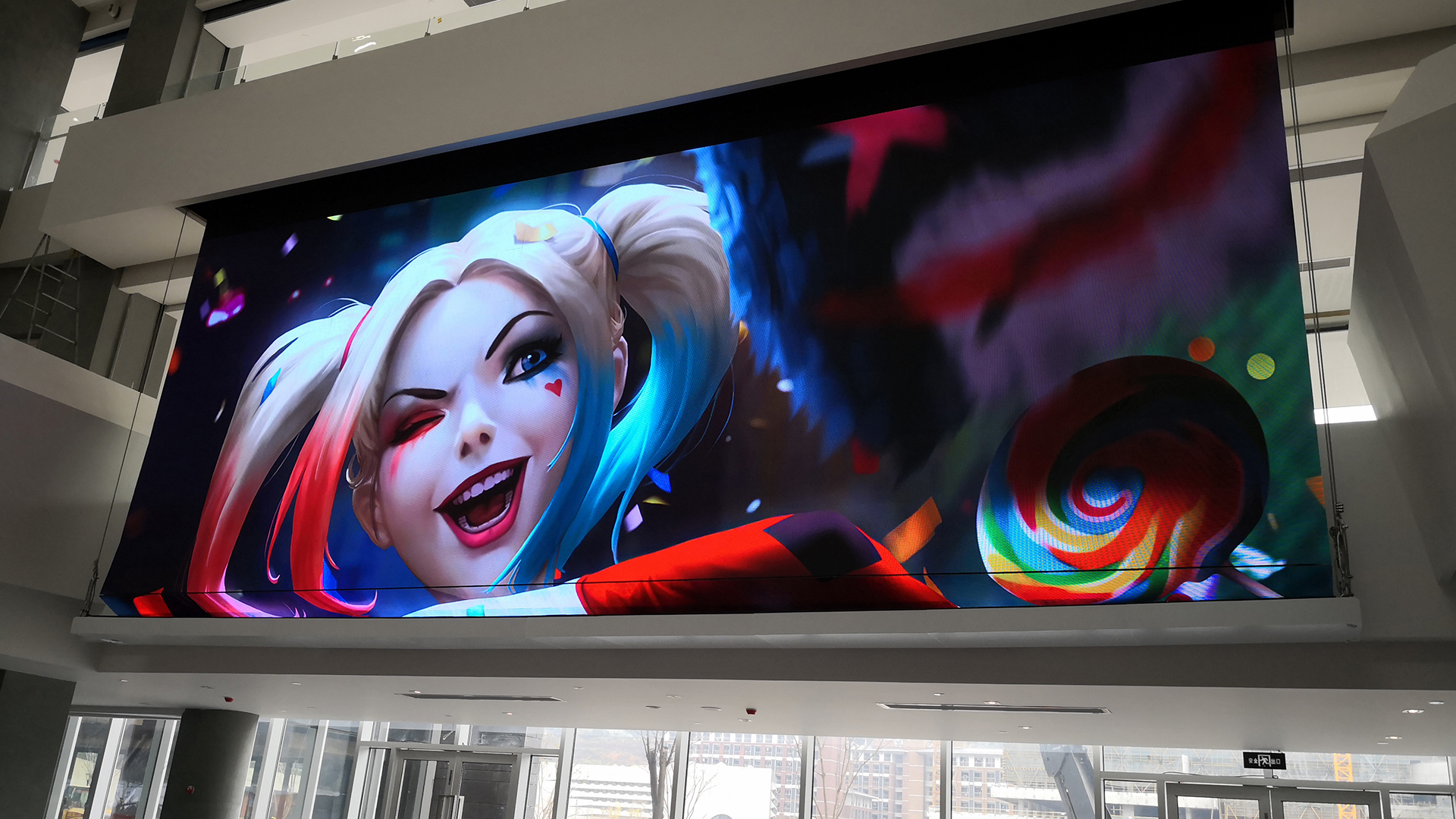
Why hotel venues evaluate LED screens on different criteria
Hotel space is rarely assessed one room, one function at a time. The same ballroom can be set for a wedding on Friday evening, a plenary session on Saturday morning and a product display on Sunday. Demand arrives from rental operators, event agencies and in-house AV teams, and it is temporary by design — measured in hours of room occupancy rather than years of continuous operation.
That rotation creates four constraints that are far less visible in the fixed-installation market:
- Access route. The screen has to pass through a service corridor, a goods lift and a set of double doors, then turn a corner inside the room.
- Storage. Between events the system must vanish into back-of-house space that the hotel would otherwise sell or use for linen, banqueting and staff circulation.
- Setup window. Changeover is scheduled to the hour, and hotels rarely release a function room for multi-day rigging.
- Compliance. Facility managers, fire officers and corporate clients each ask for different evidence, from electrical safety to environmental management.
A fixed LED wall answers none of these. It may be excellent once built, but a permanent structure cannot be packed down between functions, and it removes a wall the hotel might need for a different floor plan next quarter. The rollable and foldable category exists because this rotation problem is common rather than exceptional.
The four venue-fit tests
Transport: can the screen get from the loading dock into the room?
The first question is not how large the screen is, but how large the largest single piece is. Modular LED systems scale by adding cabinets, and rollable systems reduce the number of pieces that have to be moved at all.
The Rolling Rollable LED Display (FRL/FRSL) uses a 500 × 62.5 mm module, with indoor thickness of 15–16 mm and outdoor thickness of 18.5 mm. Indoor weight is 13–15 kg per square metre; outdoor weight is 18 kg per square metre. That slender module geometry is what allows the system to be taken down as a rolled unit rather than a stack of rigid panels.
Magic Plus (FPS) uses a 250 × 250 mm module at 15 mm thickness and 15 kg per square metre, and folds through 180°. Smart T Plus (FTS) offers module sizes of 250 × 375 mm, 375 × 500 mm and 300 × 450 mm, at 18.2–22.5 mm thickness and 8–12 kg per square metre, folding through up to 360°.
Two site measurements determine whether any of this matters: the internal dimensions of the goods lift, and whether the route from the dock to the ballroom includes stairs, a narrow door or a tight corner. A specification sheet can tell a buyer the module size. It cannot tell them the building.
Storage: where does the screen live between events?
Storage is a design question for the hotel, not a logistics footnote. A rollable format converts the deployed screen into a compact stored form, and a foldable format converts it into a folded stack. Either way, the stored footprint — not the displayed area — becomes the number the venue has to find room for.
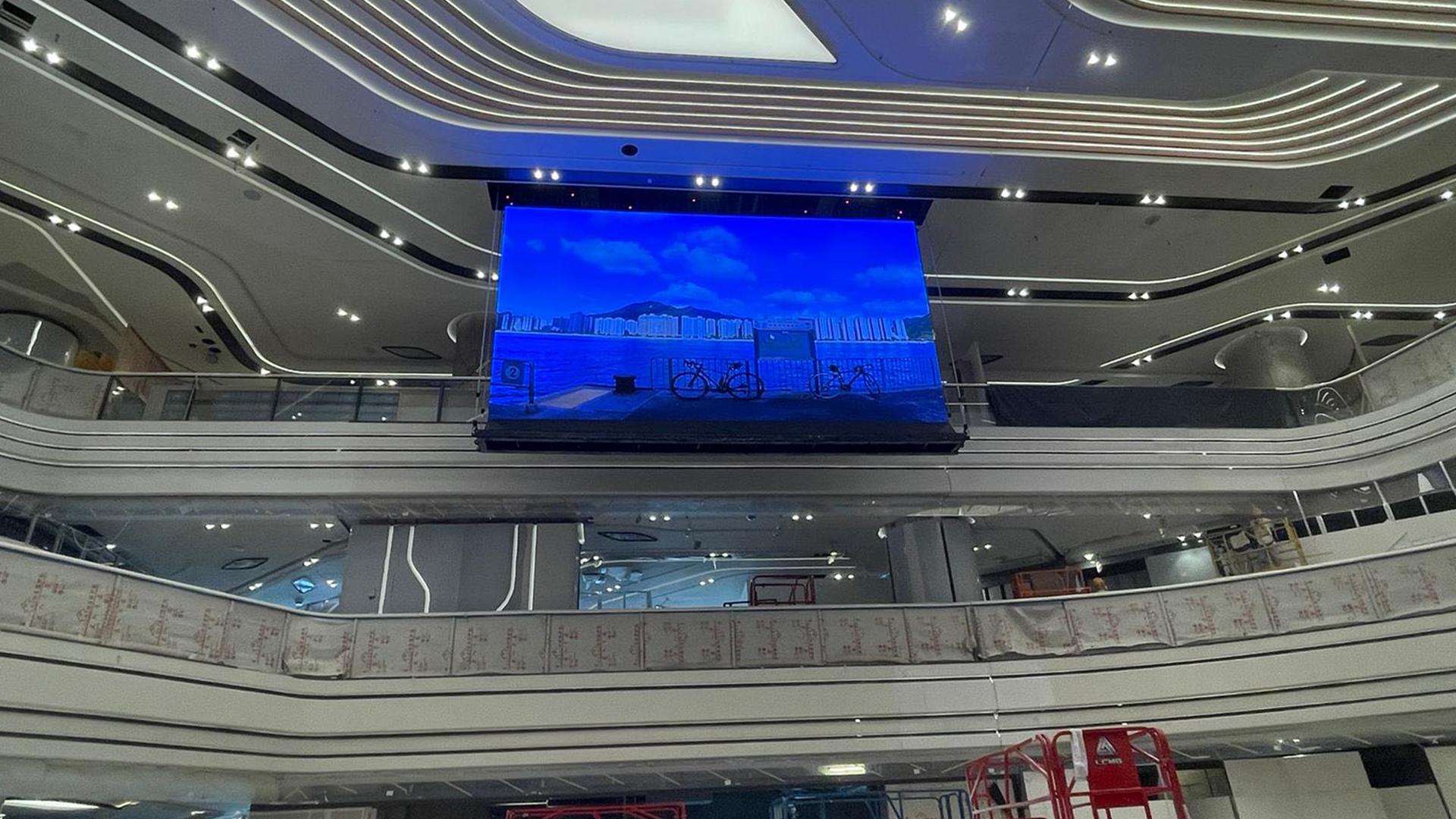
Two storage patterns matter in hotels. The first is the conventional one: the screen lives in a back-of-house store and is wheeled out for each event. The second is a hidden installation, where the screen descends from the ceiling for the function and retracts when the room is reset. The mechanism is not theoretical. Onumen's project record includes a 50+ m² liftable foldable LED display integrated into the indoor space of the Tai Wai MTR shopping mall in Hong Kong, hidden when not in use and lowered for commercial events, with the project reported to have run for more than six years. A lecture hall at a school in Wenzhou uses the same idea at 30+ m², with the display integrated into the ceiling and lowered for teaching.
Neither project is a hotel, and neither should be read as evidence that a specific hotel ceiling will accept the same arrangement. They demonstrate that the hidden-store mechanism has been built and maintained over multi-year periods in commercial and institutional interiors. Whether a given ballroom can carry it depends on ceiling void depth, structural capacity and the hotel's fire strategy — all of which sit with the building, not the screen supplier.
For a straightforward purchase, storage needs to be expressed in concrete terms: square metres of display, the stored outer dimensions, and the transport cases. Onumen lists transport cases among the supporting equipment for rollable installations, and customisation covers screen size, cabinet design, installation structure and packaging.
Setup flexibility: can a crew rig it inside the changeover window?
Hotel installation is still construction — suspension, power, data and commissioning — but it is construction on a scale that has to fit between ordinary event dates.
Mounting options differ by series and shape the rigging plan. Magic Plus supports hanging and wall-mounted installation. The Rolling Rollable LED Display supports suspended, wall-mounted and ground installation. Smart T Plus adds ground installation alongside hanging and wall mounting.
Electrical characteristics matter as much as mechanics. All three series take an input voltage of AC100–240V, operate at DC24V or DC48V, and are rated for working temperatures of -20℃ to +45℃ with storage from -20℃ to +60℃. A single input range that spans both European and North American supply is useful for hotel groups running a standard screen kit across regions. Smart T Plus additionally specifies a maximum load of 30 m on a single power cable, which affects cable routing in long ballrooms and atria.
Commissioning is the part hotels most often underestimate. Each series supports synchronous and asynchronous control. Asynchronous operation lets a screen run stored content without a live source, which suits a ballroom cycling sponsor material or venue branding between sessions. For operators, that removes a dedicated playback position from the changeover plan.
Compliance: what will the facility team ask for?
Hotel sign-off usually turns on three questions: whether the product carries certification against recognised standards, whether the operating conditions are documented, and whether the electrical and environmental evidence is specific to the model being installed.
Magic Plus carries CE (EMC) and FCC. Its protection rating is IP65, with double-sided potting taking it up to IP68. Smart T Plus carries CE and RoHS and holds ISO 14001 environmental management certification, with IP65 protection up to IP68, 16-bit grey scale and a contrast ratio of 2500:1. The Rolling Rollable LED Display carries CE (LVD), FCC, RoHS and ISO 14001, and is covered by patents. At company level, Onumen's production holds ISO management system certificates together with CE, FCC, RoHS and other international product certifications, and the company states it owns a global patent pool spanning Asia, Europe, the Americas and Oceania.
Two limits are worth stating plainly. First, a supplier certificate does not substitute for local market approval or for the venue's own electrical inspection. Second, protection ratings describe the enclosure, not the installation: an indoor-rated display installed where it is exposed to weather will not be protected by its datasheet.
How rollable and foldable geometry changes the constraints
Rolling and folding are different actions, and the geometry difference decides which rooms each format suits.
A rolling screen gathers the display surface around a compact form. The FRL/FRSL module at 500 × 62.5 mm is deliberately narrow so that the panel can follow a controlled curve without stressing the LED array. A folding screen instead hinges along module edges: Magic Plus folds through 180°, Smart T Plus through up to 360° while remaining transparent.
The practical difference appears in handling. A rolled system needs its take-up structure, a clean path for deployment and a stable mounting surface. A folded system needs a flat, dry storage position and clearance to unfold. Both formats reduce the number of rigid pieces in the freight, which is the constraint that most often blocks a conventional cabinet wall from reaching a ballroom at all.
Weight is also a room-fit issue rather than only a freight issue. At 8–12 kg per square metre for Smart T Plus, 13–15 kg per square metre for an indoor FRL/FRSL unit and 15 kg per square metre for Magic Plus, a large display carries a lower imposed load per square metre than a traditional cabinet build. Specification sheets give the per-square-metre figure; a rigging design needs total mass, suspension spacing and the load a structural engineer will accept.
Brightness sets the room condition. Magic Plus is rated at 6000 nits, which matters in ballrooms with daylight spill or high ambient lighting. The Rolling Rollable LED Display is rated at 600–1000 nits indoors and 2000–6000 nits outdoors. Smart T Plus is rated at 1100–9700 nits with a transparency of 16.37% to 56%, so the room behind the screen remains visible through it.
Model-to-scenario mapping for ballrooms and meeting rooms
| Model | Format | Pixel pitch | Brightness | Weight | Module size | Protection | Certification |
|---|---|---|---|---|---|---|---|
| Magic Plus (FPS) | 180° foldable flexible LED | P2.6 / P3.9 | 6000 nits | 15 kg/m² | 250 × 250 mm | IP65, up to IP68 | CE (EMC), FCC |
| Smart T Plus (FTS) | 360° foldable transparent LED | P3.9-7.8 to P37.5 | 1100–9700 nits | 8–12 kg/m² | 250×375 / 375×500 / 300×450 mm | IP65, up to IP68 | CE, RoHS, FCC, ISO 14001 |
| Rolling Rollable LED Display (FRL/FRSL) | Automatic rollable LED | Indoor P1.25–P3.9; outdoor P2.6 / P3.9 | Indoor 600–1000 nits; outdoor 2000–6000 nits | Indoor 13–15 kg/m²; outdoor 18 kg/m² | 500 × 62.5 mm | Indoor front IP54 / rear IP43; outdoor front and rear IP65 | CE (LVD), FCC, RoHS, ISO 14001, patents |
Main ballroom stage and keynote backdrop: Magic Plus (FPS)
A large ballroom brings ceiling height, a deep stage and lighting the production team does not fully control. Magic Plus fits the main-stage backdrop role: 6000 nits of brightness, P2.6 or P3.9 pixel pitch, and a 180° fold that lets panels wrap a stage opening rather than form a flat wall. A 140° horizontal and 140° vertical viewing angle means side-table guests are inside the image cone. With hanging or wall-mounted installation and a 250 × 250 mm module, a rental team can size the screen to the room instead of sizing the room to the screen.
It is also the right series when the screen has to double as a stage element outside the ballroom. The listed application industries include stage events, concerts, outdoor advertising, sports events, exhibitions, theme parks, creative installations, rental events and architectural displays.
Atria, glass halls and rooms where sightlines must stay open: Smart T Plus (FTS)
Some conference spaces cannot accept an opaque wall. Glass foyers, ballrooms with a view and circulation atria all carry guests past the display. Smart T Plus is a foldable transparent LED display with 16.37%–56% transparency and a brightness range of 1100–9700 nits; it folds through 360° and weighs 8–12 kg per square metre. For a hotel working with a glazed facade or a glass partition, it addresses transparency and transport in one component, because the transparent panels also fold for storage.
Its listed application industries include shopping malls, glass curtain wall advertising and architectural media facades — adjacent to, though not identical with, hotel atria and glazed banquet spaces. Where a venue wants the structural line of the building to stay visible during a reception, a transparent format keeps that line in the composition.
Tight storage, fine-pitch meeting rooms and versatile multi-function halls: Rolling Rollable LED Display (FRL/FRSL)
Where back-of-house space is the binding constraint, FRL/FRSL offers the widest pitch range in the portfolio. Indoor pitches run from P1.25 through P1.56, P1.953, P2.6 and P3.9 — P1.25 supports close viewing at a boardroom table, while P3.9 covers a larger banquet hall at greater distance. The automatic rollable format is the point of the series: the system comes down as a rolled unit and is stored that way until the next event.
Its operational envelope is defined in the specification. Indoor models carry front IP54 and rear IP43; outdoor models carry IP65 front and rear. That distinction should drive room selection. A covered terrace or a semi-outdoor function area is a candidate for the outdoor-rated build; an indoor-rated unit with an IP43 rear should not be treated as weather-protected because the event happens to be near a window.
Indoor brightness of 600–1000 nits is best matched to controlled-lighting rooms. For a ballroom with strong daylight, the higher-brightness Magic Plus or the outdoor-rated FRL/FRSL build is the more defensible choice — and the choice should be made on the room, not on the pitch alone.
Documents a hotel buyer should hold before signing
Hotel procurement gatekeepers rarely accept verbal assurance. The document set that satisfies them maps to three risk areas: electrical safety, electromagnetic compatibility, and the design basis of the product itself.
- CE documentation for the model and configuration being installed, with the applicable directive identified — EMC for Magic Plus, LVD for the FRL/FRSL series.
- FCC documentation for North American deployment across all three series.
- RoHS conformity for restricted-substance compliance, held for Smart T Plus and FRL/FRSL and confirmed for Magic Plus.
- ISO 14001 environmental management certification held for Smart T Plus and FRL/FRSL, and ISO management system certificates at company level.
- Patent documentation covering the rollable mechanism, since the product's value rests on the deployment structure rather than the LED alone.
- Protection rating evidence matched to the room, distinguishing indoor rear IP43 from outdoor IP65.
Production-side evidence is worth requesting alongside the certificates. Onumen states that every unit receives 100% aging testing and quality inspection before shipment, that monthly capacity runs to 3,000–5,000 m², that lead time is 30–90 days after order confirmation, and that the minimum order is 1 m². After-sales support covers remote technical support, installation guidance, maintenance support and spare parts supply — a practical point for a hotel that will operate the screen for years after the integrator has left site.
What project evidence can and cannot be transferred to a hotel
Existing installations are useful for judging whether a mechanism works, provided the venue type is stated honestly.
The Tai Wai shopping mall in Hong Kong shows a hidden liftable foldable system of 50+ m² integrated into an indoor commercial space, retracted when not in use and lowered for brand events and promotions, reported as running for more than six years. The Wenzhou school lecture hall shows the same principle at 30+ m² inside a ceiling, lowered for teaching and hidden otherwise. Both demonstrate long-running hidden-store operation in interior environments with daily or near-daily circulation of people.
What they do not establish is hotel-specific performance. Neither is a ballroom; neither resolves a hotel's fire strategy, ceiling void depth or goods-lift dimensions; and neither predicts how a particular hotel's facility team will assess the configuration. The transferable element is the mechanism and its maintenance profile, not a certification of hotel suitability.
Market context: why disappearing screens are getting more attention
MarketsandMarkets projects the global foldable display market to reach USD 13.29 billion by 2029, from a 2024 base year across a 2024–2029 forecast period. That figure covers foldable display technologies including OLED and direct-view LED. It is not a rollable-LED-specific number and should not be presented as one. It is best read as a signal that flexible form factors are attracting investment at scale, not as a forecast of hotel demand.
The more concrete pressure on hotel design comes from space economics rather than from a market forecast. A ballroom that can be reset without a permanent screen wall can be sold in more configurations, and a room that hides its display returns to an architectural state between functions. That logic is what makes hidden-store and rollable formats relevant — but a hotel still has to verify the mechanism against its own building before treating the logic as a plan.
A procurement checklist for a hotel event space
Questions for the venue:
- What are the internal dimensions and weight limit of the goods lift, and what is the narrowest door on the route to the room?
- How many square metres of back-of-house storage can be allocated between events, and is it dry and temperature-controlled?
- What power capacity and phase arrangement is available at the rigging position, and where are the distribution boards?
- What suspension points exist, at what spacing, and what imposed load will the building's engineer accept?
- Which certification and fire documentation does the facility team require before a temporary structure is approved?
Questions for the supplier:
- What is the largest single module dimension, its weight and its thickness for the specific model quoted?
- What is the stored footprint and what transport cases are supplied?
- Which mounting methods are supported — suspended, wall-mounted, ground installation, or a combination?
- What is the input voltage range, the operating voltage, and the maximum load per power cable?
- Which certification documents will be issued for this configuration, and do they name the model?
- What are the lead time, minimum order quantity and spare-parts arrangement?
A verification step is not a substitute for the purchasing decision, but it prevents the most expensive error in this category: ordering a screen whose geometry fits the specification and not the building.
Outlook for hotel and conference deployments
The direction of travel is toward screens that occupy the room only when the room needs them. Rollable and foldable formats support that by reducing what has to be stored, lifted and rigged, and by making a hidden installation mechanically conceivable in a space that must otherwise read as architecture.
Two conditions will govern how quickly hotels adopt the category. The first is building-side: ceiling voids, lift dimensions and structural capacity are fixed long before a screen is specified, and a venue that cannot accept the mechanism will not be persuaded by a better pixel pitch. The second is documentary: hotels operating in multiple jurisdictions need certification evidence that travels with the model across markets, which is why CE, FCC, RoHS and ISO 14001 documentation carries as much weight in a hotel tender as brightness or weight per square metre.
Where those conditions are met, the practical result is a ballroom that can present a large-format image for a plenary session and be cleared for a banquet the same evening, without a permanent screen wall deciding the room's floor plan in advance.
FAQ
Can a hotel ballroom replace a permanent LED wall with a rollable LED screen?
Yes, when the building's access route, storage allocation and rigging points can accommodate the module dimensions. The Rolling Rollable LED Display uses a 500 × 62.5 mm module at 13–15 kg per square metre indoors, while Magic Plus uses a 250 × 250 mm module at 15 kg per square metre. A permanent LED wall avoids those handling requirements but cannot be removed between functions and fixes the room's layout permanently.
Which certifications should a hotel require for a rollable LED screen installation?
For the three series discussed here, the documented certification set is CE (EMC) and FCC for Magic Plus; CE, RoHS and FCC plus ISO 14001 for Smart T Plus; and CE (LVD), FCC, RoHS and ISO 14001 plus patents for the Rolling Rollable LED Display. At company level, Onumen's production holds ISO management system certificates together with CE, FCC, RoHS and other international product certifications. Local market approval and the venue's own electrical inspection remain separate requirements.
How is a rollable LED screen stored between events, and how much space does it need?
Storage depends on the format. A rollable system is taken down as a rolled unit, while a foldable system is stored as a folded stack — Magic Plus folds through 180° and Smart T Plus through up to 360°. Onumen lists transport cases among the supporting equipment for rollable installations, and customisation covers screen size, cabinet design, installation structure and packaging. The stored outer dimensions and case sizes should be requested from the supplier for the specific configuration, because storage footprint is not derivable from display area alone.
Can a Rolling Rollable LED Display be used on a hotel terrace or in a semi-outdoor area?
The FRL/FRSL series includes outdoor models at P2.6 and P3.9 pixel pitch, with IP65 protection at both front and rear and brightness of 2000–6000 nits. Indoor models carry front IP54 and rear IP43, which suits interior rooms rather than exposed positions. Even with an outdoor-rated model, the terrace's structural fixing, power supply and weather exposure need separate assessment by the venue.
What is the practical difference between a rollable and a foldable screen for a conference centre?
A rollable screen gathers the display around a compact take-up form, so handling is built around a single rolled unit. A foldable screen hinges along module edges: Magic Plus folds through 180° at 15 mm thickness, and Smart T Plus folds through up to 360° at 18.2–22.5 mm thickness while remaining transparent. The difference affects storage shape, deployment clearance and the number of pieces a crew handles during changeover, rather than the image performance alone.
Есть вопросы или нужны дополнительные детали?
Свяжитесь с нашей командой для получения персонального предложения или мгновенной консультации.
Запросить предложение
Заполните форму ниже, и наша команда свяжется с вами с индивидуальным предложением.
Прямой чат WhatsApp
Предпочитаете общаться в реальном времени? Напишите нам в WhatsApp для мгновенной помощи и быстрых ответов.
- Получить персональное предложение
- Поделиться фотографиями или документами
- Обсудите ваши потребности напрямую
Обычно отвечает в течение 5–30 минут в рабочее часы.