
Hotel Guest Room vs Restaurant Furniture Packages: Buyer Comparison
Hospitality Furniture Procurement — Independent Buyer Comparison
Hotel Guest Room vs Restaurant Furniture Packages: Buyer Comparison
Two packages, one building, and two different specification logics. What buyers should check before drawings are approved.
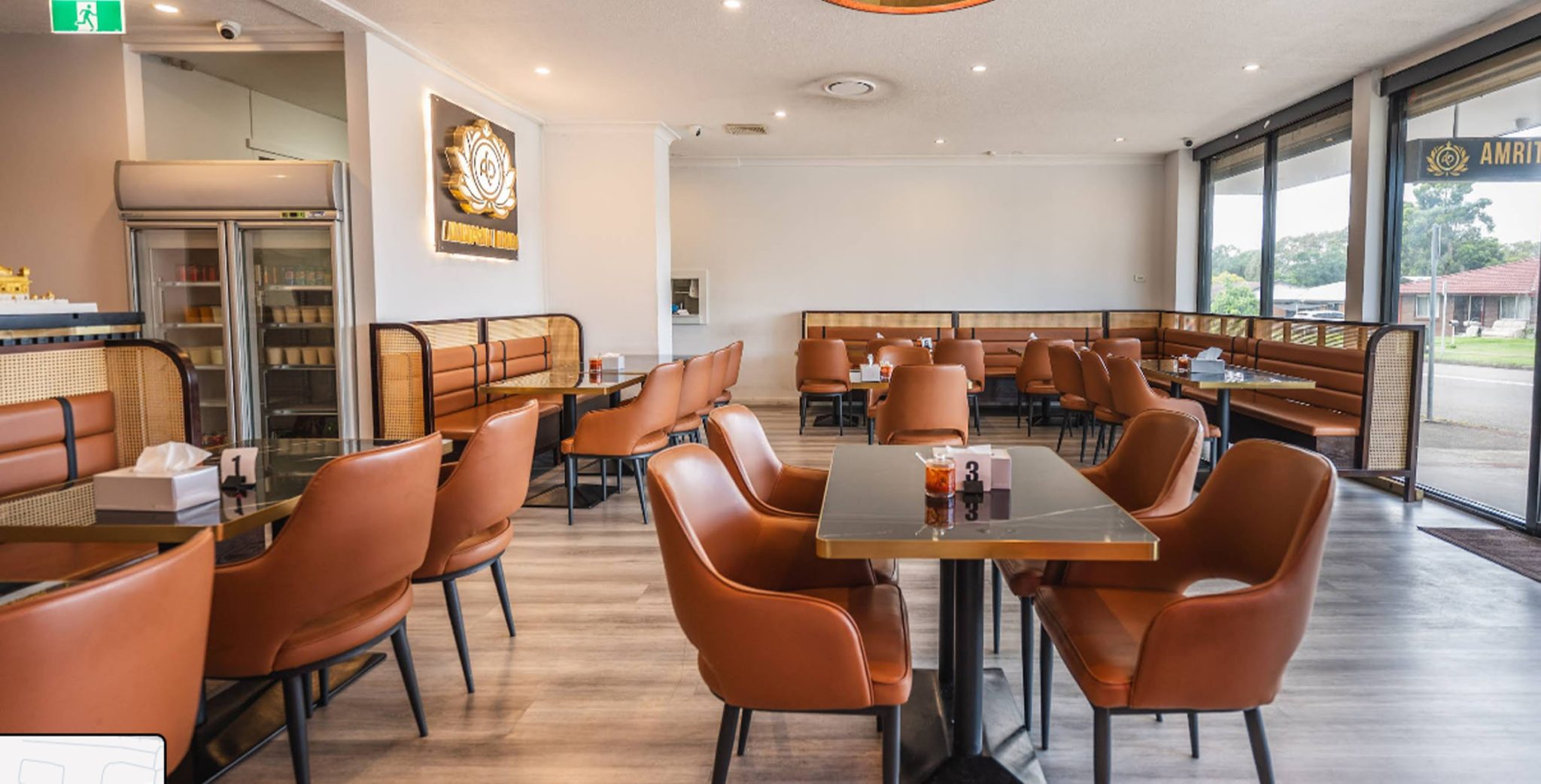
A coordinated hospitality dining area furniture package: dining chairs, tables and booth seating planned as one zone-based set rather than as individual products.
A hotel or mixed-use hospitality project that contains both guest rooms and food-and-beverage outlets is normally bought as two furniture packages: hospitality casegoods for the rooms, and restaurant furniture for the restaurant, café, bar and terrace. On a purchase order the two look similar — both are wood, metal, foam, fabric, laminate and stone — but they are specified, tested and delivered on different logic. Guest room casegoods are driven by repeated room modules, batch consistency, hardware function and installation sequence. Restaurant furniture is driven by floor plan, circulation, seat-to-table geometry, turnover, spill exposure and cleaning frequency. Buyers who apply one specification template to both packages usually find the gap during sample approval or on site, when changes are at their most expensive.
Why a dual-package project is not one furniture exercise
The two packages differ in three practical ways that procurement teams feel directly: how dimensions are fixed, how performance is evidenced, and how production is scheduled.
Guest room furniture is a repeatable unit. Guangzhou Mingmeng Furniture Co., Ltd., established in 2015, manufactures hotel guest room furniture as complete room packages — bed, headboard, bedside table, wardrobe, writing desk, TV cabinet, luggage rack, mini bar cabinet, guest room chair and bench — with dimensions fully customized to the room layout and architectural drawings. Bed options include king, queen, twin and custom sizes; headboards can be wall-mounted, upholstered, wood veneer or a custom decorative design; wardrobes can be open or enclosed with a custom internal storage layout. The defining procurement question is repetition: whether the twenty-fifth room matches the first, and whether hardware, edge details and finish sheen stay within tolerance across the whole batch.
Restaurant furniture is a zoned set. The same manufacturer supplies restaurant chairs, commercial dining tables, restaurant booth and banquette seating, bar stools and bar tables, hospitality sofas, bar counters, hotel lobby furniture, outdoor restaurant furniture and canteen furniture. Here the defining question is fit: whether a booth bench actually closes against a curved wall, whether seat height matches the counter it faces, and whether an aisle still clears the required width once the tables are in place. Specification decisions belong to the floor plan, not to a catalogue photo.
Specification priorities, side by side
The table below compares how the same specification areas are usually resolved for each package. It is a decision aid for a project brief, not a substitute for approved drawings.
| Specification area | Hotel guest room furniture (casegoods) | Restaurant, café and bar furniture |
|---|---|---|
| Dimension driver | Room layout, wall lengths, wardrobe internals, bed standard | Floor plan, covers per zone, seat-to-table clearance, counter height |
| Primary unit logic | Repeatable room package across floors | Zone-based set: dining, booth, bar, lounge, terrace |
| Structural focus | Panel stability, wardrobe and drawer hardware cycles, assembled casegood joints | Frame strength, joint stability, footrest position, load and stack behaviour |
| Main materials | Plywood, MDF, solid wood, veneer, laminate, metal, stone, upholstered panels and hardware | Solid wood, plywood, metal and stainless steel, upholstery fabric, PU and leather, HPL, laminate, stone and marble tops |
| Upholstery exposure | Headboards, benches and guest chairs; guest comfort and appearance | Seat and backrest abrasion, spill and stain exposure, booth backs, cleaning frequency |
| Testing evidence | Category-specific; commercial seating standards do not test wardrobe or desk assemblies | Seating models supported by EN 16139 and EN 1022 test reports and CE compliance documents |
| Approval sequence | Sample room development, then batch room production | Sample and drawing approval, then bulk production and zone installation |
| Main risk if under-specified | Finish mismatch between rooms, hardware failures, installation delays | Seat height errors, booth fit problems, premature upholstery wear, blocked circulation |
Customization, materials and finishes: shared supply, different criteria
The material families overlap heavily between the two packages: solid wood, plywood and engineered panels, steel, stainless steel, aluminium, upholstery, laminate and HPL, stone and stone-look tabletops, plus painted, stained, powder-coated, matte, gloss, textured and wood-grain finishes. What changes is the selection criterion.
For a restaurant set, material and finish decisions are usually weighted by commercial usage, cleaning frequency, moisture and stain exposure, scratch visibility, upholstery wear and the destination market's requirements. For a hotel guest room package, the same list is weighted instead by finish consistency across a repeated room type, hardware function and quiet appearance over years of guest turnover. Both packages share the same discipline: approve wood, metal and upholstery finish samples together, so the project palette stays consistent rather than drifting between the restaurant seating and the guest room casegoods.
Customization scope is comparable in width. Dimensions, structures, materials, upholstery, colours, wood finishes, metal finishes, tabletops, booth configurations and complete project furniture combinations can be adjusted according to architectural drawings, interior concepts, operational requirements and project budgets. Upholstery options include fabric, PU leather and genuine leather; high-density foam with customised comfort levels is used in booth and banquette seating; tabletop options include solid wood, veneer, HPL, laminate, marble and stone on metal or wooden bases.
A project may also extend into adjacent zones — hotel lobby furniture and public area seating, hospitality sofas, custom bar counters, outdoor and terrace furniture with aluminium, stainless steel, teak and quick-dry upholstery, and canteen furniture with steel or reinforced frames and easy-clean tops. Each of these carries its own exposure profile, which is why zone-by-zone specification usually produces fewer surprises than a single project-wide material rule.
Durability: what the test evidence covers, and what it does not
Commercial furniture is designed for frequent use, but durability depends on frame structure, joints, materials, finish, upholstery, maintenance and the duty level defined for the project. That is why documented test evidence matters more than a general durability claim.
Mingmeng states that it holds CE, TÜV, RoHS and Certification of Conformity documentation, relevant product safety compliance certifications, and more than 10 national patented designs, with quality control covering material inspection, production-process inspection, structural and appearance checks, pre-shipment inspection and export packaging control.
Specific seating evidence is published at model level:
- MM102 commercial chair CE Certificate of Compliance — certificate number CTG2511057084B-SC01AD, issued 2025-11-05 by Shenzhen CTG Testing Co., Ltd., scope covering commercial chairs and hospitality seating products for restaurants, hotels, lounges and public areas, to EN 16139:2013 Level 2 and EN 1022:2023.
- MM102 commercial chair strength, durability and stability test report — CTG2511057084B-SR03AD, same testing body and standards.
- MM103 commercial bar chair EN 16139 / EN 1022 test report — CTG2511057084B-SR02AD.
- MM104 commercial bar stool strength, durability and stability test report — CTG2511057084B-SR04AD.
- Additional CE Certificate of Compliance for commercial chair MM102 — CTG2510308431B-SR224AT, issued 2025-10-30 with an expiry date of 2030-10-30, and a further CE Certificate of Compliance CTG2510308431B-SR22AT dated 2025-10-30.
- REACH SVHC test report for chair — CZH12250205012, issued 2025-02-08 by Shenzhen Zhonghan Certification Technology Co., Ltd. under Regulation (EC) No. 1907/2006, covering 247 candidate list substances of very high concern published by ECHA, valid to 2030-02-08.
- REACH SVHC test report for sofa and upholstered furniture materials — BSTDGD31243813112202CR, issued 2024-11-22 by Dongguan BST Testing Co., Ltd., valid to 2029-11-22.
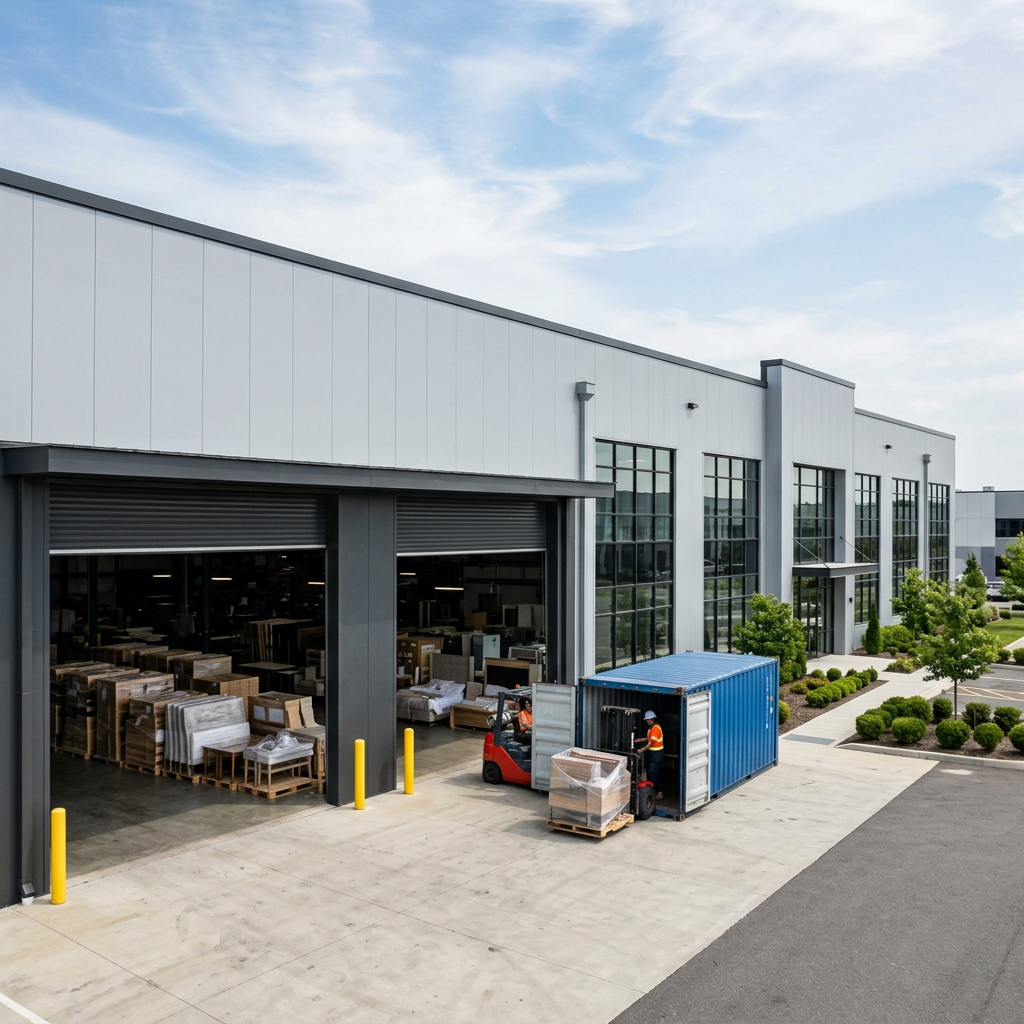
Commercial furniture manufacturing facility: production lines cover woodworking, metalwork, upholstery and surface finishing, which is what allows casegoods and seating to be produced under one quality system.
CAD support and sample approval: where the two packages diverge most
Mingmeng provides CAD layout, 3D visualisation, space planning, material coordination, sample development and project delivery support, can develop samples from layout drawings, and can manufacture according to approved customer drawings and specifications once dimensions, materials, finishes and technical details are confirmed. Production capability includes OEM and ODM manufacturing and ODM design, with a monthly capacity of 80,000+ pieces and a factory footprint of 15,000 m² staffed by more than 200 workers.
In practice, the approval path differs by package. A guest room package normally runs through sample room development, then batch room production. A restaurant package runs through drawing and sample approval, with booth and banquette geometry verified against actual wall lengths, curves and aisle clearances before production, and chair, stool and table heights coordinated with the counters they serve. Both packages converge on one rule: approve dimensions, materials, finishes and samples before bulk production begins, or accept the cost of changes later.
Procurement risk: factory or trading company, MOQ, lead time and warranty
Most avoidable problems in a dual-package project appear at the commercial stage rather than the production stage. Four items deserve written confirmation.
Factory versus trading company
Mingmeng states that it is a furniture manufacturer operating its own factory, supporting factory-direct production, project-based customization, OEM and ODM development, and quality control from production through shipment, with factory visits arranged by appointment and remote video tours available for overseas buyers. The practical difference is control of the specification: in a factory-direct arrangement, the same organisation that approves the drawing also builds the product and performs the pre-shipment inspection. When a project is routed through intermediaries, drawing responsibility, inspection and remedial action can be split across several parties, and the buyer should define in writing who owns each of those steps before the order is placed.
MOQ
Minimum order quantity is quoted per model and per specification, not per project total. Available company documentation indicates that custom models generally carry an MOQ of 10–50 pieces per style, while purchasing terms describe an MOQ of usually 10 units per model with project-based orders negotiable according to furniture scope and customization requirements. Mixed-model orders can be considered subject to model-specific production requirements and total order planning, and customized dimensions, structures, materials or finishes may carry a different MOQ because of material preparation and production setup. The implication for a dual-package project is straightforward: guest room casegoods and restaurant seating are counted separately by model, so a project with many distinct SKUs will not behave like a single-MOQ order, even when one supplier handles both.
Lead time
Published planning figures are 20–30 days for standard models and 35–50 days for customized models including sample approval. Sample approval for a sample room or a booth configuration consumes part of that window, which means the critical path in a dual-package project is normally the package with more custom approvals rather than the package with the larger volume. Urgent schedules can be evaluated after checking material availability, production capacity and the required delivery date, and production progress can be communicated at agreed milestones through photos, videos or status updates.
Warranty and after-sales scope
No fixed warranty term is published in the material reviewed for this comparison. What is documented is that project orders can include on-site installation guidance and spare parts support subject to contract, alongside export packaging and freight coordination. Because warranty scope is contract-defined, buyers should confirm in writing the warranty period, what it covers, spare parts availability and the response process, together with quotation scope, Incoterm, payment terms, production schedule, packing and any project-specific compliance requirements. Inspection can follow project-specific standards including pre-shipment checks, packing inspection and QC reports, with appearance inspection, dimension verification, structural and stability checks, packaging inspection and third-party inspection available on request. Final acceptance is based on approved drawings, specifications, materials, finishes and confirmed samples. Shipping terms can be quoted according to the agreed Incoterm and destination, including EXW, FOB, CIF, CFR and DDP where available, and export packing uses foam, edge protection and cartons or wooden crates depending on the item — packaging should match product weight, fragile surfaces, shipping method and loading conditions.
Where a project specifies fire performance, fire-retardant foam and fabrics meeting standards such as CA117, BS5852 and EN1021 can be offered, and the claim should be supported by applicable current documentation for the actual material used.
Application notes from delivered hospitality projects
Three project profiles illustrate how zone logic works in practice.
A casual-dining Indian restaurant project in Australia combined dining chairs, dining tables and booth seating in one package. Upholstered chairs supported longer dining sessions, booth seating provided privacy without separating guests from the room, and the palette ran through rich leather upholstery, sturdy wood chair frames, sleek metal table legs and warm wooden tones.
A multi-zone Asian restaurant project in the United States covered reception, a waiting lounge, a main dining room and a long wall-side booth zone. Long booth seating improved space utilisation while movable chairs allowed two-person, four-person and group table arrangements, and a consistent amber orange, warm wood, black and brass-gold palette unified the zones.
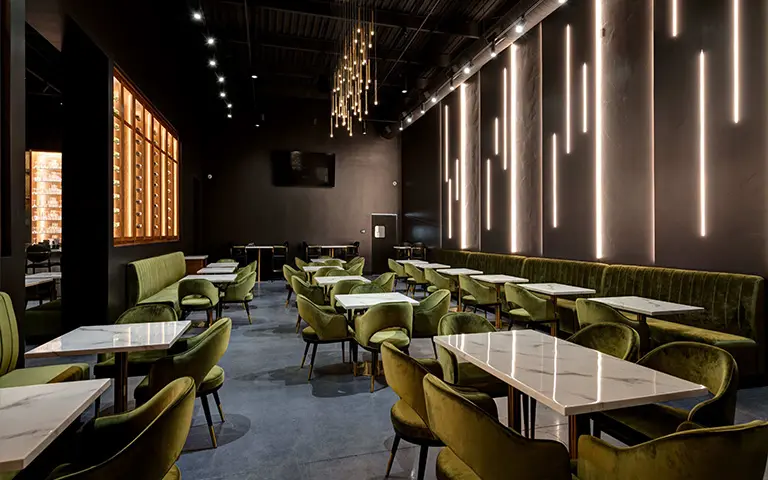
Booth and banquette seating in a multi-zone commercial project where bar counter seating, central dining and wall-side booths were supplied as one furniture system.
A third project — a restaurant, bar and event venue in the United States — combined bar counter seating, central dining, wall-side booth seating and flexible event seating. Fixed booths, movable dining chairs and freestanding tables improved layout flexibility, while marble-look tabletops supported food and drink presentation. The relevant lesson for a dual-package buyer is that guest room casegoods sit outside these zones, yet the same interior language, finish reference and delivery schedule usually link them. Coordinating both packages against one finish reference reduces the risk of a visible mismatch between the restaurant seating palette and the guest room casegood finish.
Market trend: what the available data does and does not show
Published market sizing for restaurant furniture is inconsistent. Three commercial research sources reviewed for this article give materially different values: one estimates the global restaurant furniture market at USD 638.8 million in 2026 growing to USD 929.57 million by 2035 at a CAGR of 4.3%; a second values the market at USD 0.88 billion in 2025 rising to USD 1.38 billion by 2034 at 5.13%; a third values it at USD 6.62 billion in 2025 reaching USD 11.01 billion by 2034 at 5.8%. These figures are not directly comparable because the base years, market definitions and publisher methodologies differ, and they should not be averaged into a single number.
No official government, customs or trade statistics for restaurant furniture were identified in the underlying dataset, and no verified three-company supplier comparison set was available. The honest reading is therefore directional rather than numeric: hospitality furniture demand is generally expected to grow, but any single market value is weak evidence for a procurement decision. Supplier choice still has to rest on project-specific evidence — drawings, approved samples, current test documents, MOQ and lead time written into the order.
The practical trend that does hold up is operational. Hospitality operators increasingly refurbish guest rooms and food-and-beverage outlets in the same capital cycle, which raises the value of suppliers able to handle casegoods and commercial dining furniture under one quality system and one delivery schedule. Modularity, maintainability, replaceable components and documented compliance remain the requirements most frequently named in project briefs.
Comparison with traditional approaches — and where a one-stop package stops
Traditionally, the two packages are bought separately: a casegoods factory for the rooms, a seating specialist for the restaurant, and often a local upholstery workshop for repairs. That structure has real advantages — each supplier is focused on one category, local support may be faster, and negotiation is simpler within a single category. A one-stop commercial furniture package is not automatically better, and it carries its own boundaries that buyers should recognise.
- MOQ does not disappear. Minimum order quantity remains per model and per specification, so consolidating suppliers does not remove per-style minimums across a project with many distinct SKUs.
- Test documents are scoped. EN 16139 and EN 1022 reports and CE documentation cover named seating models. They do not extend automatically to every item in a mixed package.
- Some items fall outside scope. Proprietary hardware, owner-specified stone or fabric brands, and fixed joinery executed by other trades should be excluded from the package definition rather than assumed to be included.
- Two production rhythms, one deadline. Guest room casegoods are batch-based while restaurant seating is often zone-based; planning them against a single opening date can create a false sense of one schedule.
- No verified ranking is offered here. The reviewed material contains a single manufacturer self-description rather than a validated multi-supplier comparison set, so this article compares specification logic, not suppliers or brands.
Future outlook
Procurement of hotel and food-and-beverage furniture is converging in documentation rather than in appearance. Buyers are asking for one specification register that covers both packages: dimensions and clearance checks, material and finish references, upholstery performance, current test evidence, MOQ per model, lead time including sample approval, inspection method, packing standard and warranty scope. Suppliers that can produce casegoods and commercial seating under one quality system, and supply CAD layout, 3D visualisation and sample development from floor plans, are better positioned to answer that register. Projects that build it early tend to see fewer change orders, fewer finish disputes at handover, and a cleaner division of responsibility between the two packages.
FAQ
Are you a factory or a trading company?
Mingmeng Furniture states that it is a furniture manufacturer with its own factory, specialising in commercial restaurant and hospitality furniture. It supports factory-direct production, project-based customization and OEM/ODM development, and manages quality control from production through shipment. Factory visits can be arranged by appointment, and remote video factory tours can be considered for overseas customers.
What is your MOQ?
MOQ depends on product type, customization level, material setup and order mix, and standard models and custom project furniture may carry different minimum quantities. Available company documentation indicates that custom models generally require 10–50 pieces per style, and purchasing terms describe an MOQ of usually 10 units per model with project-based negotiation. Customised dimensions, structures, materials or finishes may require a different MOQ because of material preparation and production setup.
What is the production lead time?
Published planning figures are 20–30 days for standard models and 35–50 days for customized models including sample approval. Lead time depends on quantity, customization complexity, material availability, sample approval and factory capacity, and a project-specific schedule is provided after the specification and order plan are confirmed. Urgent schedules can be evaluated after checking materials, production capacity and the required delivery date.
Do you provide design and CAD support?
For applicable project orders, Mingmeng provides furniture layout coordination, CAD drawings, dimension adjustment and 3D visualisation. The company can review floor plans and coordinate furniture dimensions, booth layouts and seating arrangements with project requirements, and can manufacture according to approved customer drawings and specifications once dimensions, materials, finishes and technical details are confirmed. Samples can be developed from layout drawings.
Can one supplier cover both hotel guest room furniture and restaurant furniture?
Mingmeng's declared product scope includes hotel guest room furniture, hotel lobby and public area furniture, restaurant chairs, commercial dining tables, booth and banquette seating, bar stools, bar counters, hospitality sofas, outdoor restaurant furniture, canteen furniture and commercial table bases, and the company can coordinate these as a project furniture package. MOQ, sample approval and compliance documentation, however, remain per model and per specification, so a combined package does not remove the need to confirm each item individually.
How durable is the furniture, and what testing evidence exists?
Commercial restaurant and hospitality furniture is designed for frequent daily use, but actual durability depends on frame structure, joints, materials, finish, upholstery, maintenance and the duty level specified for the project. Seating durability evidence is documented at model level: EN 16139:2013 Level 2 and EN 1022:2023 test reports and CE Certificates of Compliance for the MM102 commercial chair, MM103 commercial bar chair and MM104 commercial bar stool, plus REACH SVHC test reports for chair and for upholstered furniture materials. These documents cover the named product scopes and do not automatically apply to every item in a mixed package.
What should buyers confirm before bulk production?
Before production, confirm the floor plan or space dimensions, furniture list and quantities, dimensions, materials, upholstery and finishes, usage conditions, destination-market requirements and target schedule. Approve drawings and material samples before bulk production so production follows a clear reference. Commercially, confirm quotation scope, Incoterm, payment terms, production schedule, packing and any project-specific compliance requirements in writing, and clarify the warranty scope and spare parts arrangement where the contract allows for them.
Reference material: Mingmeng Restaurant Furniture catalogue (PDF) — https://cdn.socialarks.com/sbsp/25288/common/2026/0918/Mingmeng%20Restaurant%20Furniture2026%20New%281%29.pdf