
Hotel Project Sofa Fabric: Matching OYD Models to Interiors
A specification reference for interior designers, hospitality procurement teams and furniture manufacturers.
Hotel sofa fabric is specified, not shopped. A hospitality project locks its fabric programme during the design stage — often twelve to eighteen months before the furniture reaches the lobby — and then repeats that programme across dozens or hundreds of near-identical seats, benches and accent chairs. Most fabric problems in hospitality projects originate in that gap between specification and delivery: a cloth that reads well on a mood board still has to withstand a hotel cleaning routine, satisfy the fire rules of its jurisdiction, and run cleanly through a furniture factory's cutting and sewing line.
This reference is written for interior designers and hospitality buyers who need to translate a design intent into a specific, orderable sofa fabric. It works through the OYD Textile range — velvet, boucle and easy-clean woven constructions among them — and shows how a hotel fabric programme can be matched to zones, colour references and compliance requirements. OYD Textile (Haining OuYuda Textile Co., Ltd.) is a sofa fabric and upholstery fabric manufacturer based in Haining, Zhejiang, China, producing chenille, woven, linen, velvet, circular knit, jacquard and outdoor upholstery fabrics. Approximately 95% of its output is exported, with sales into Europe, the USA, the Middle East, South America, Africa and East Asia.
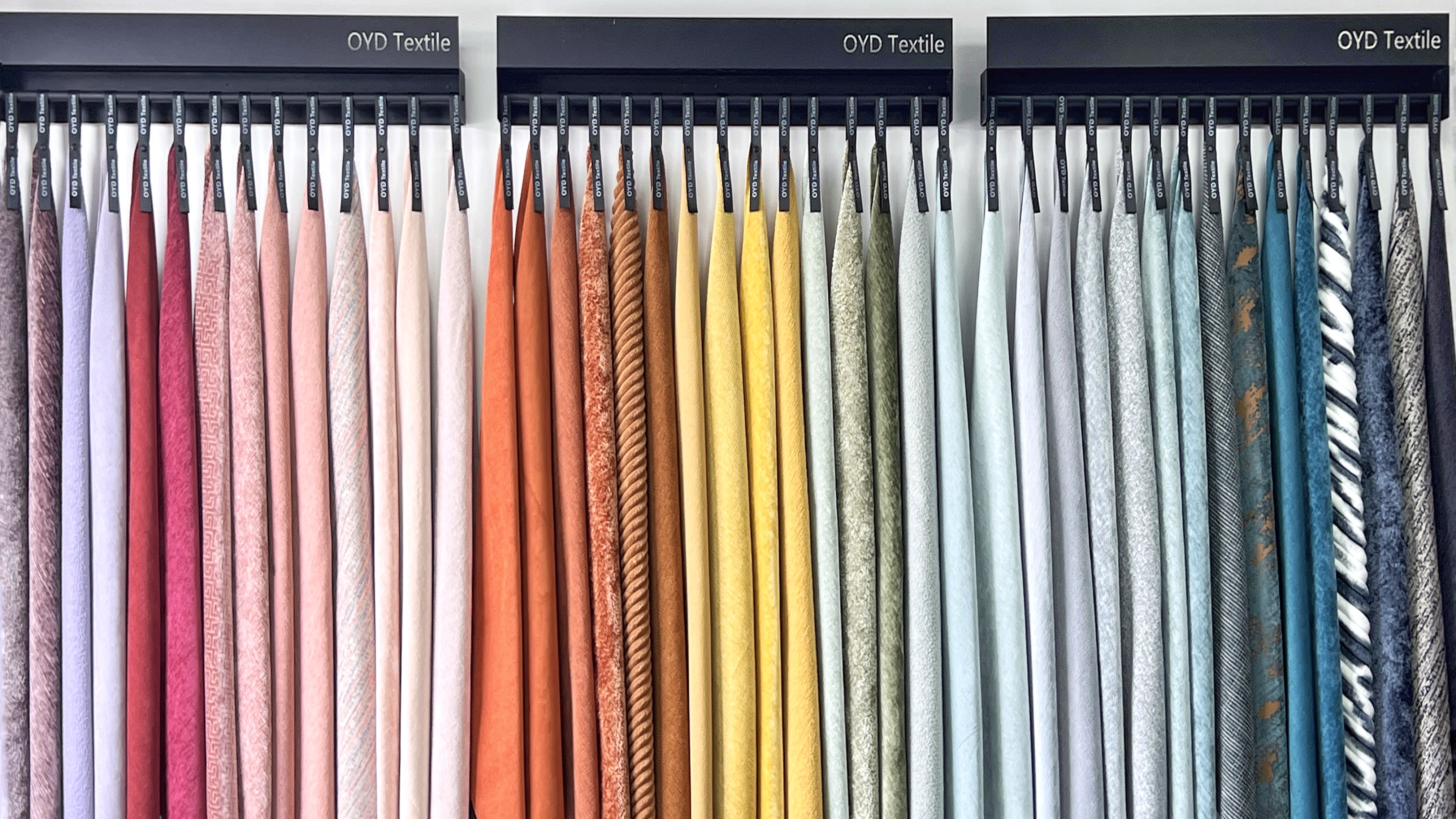
Fabric panels prepared for project-level selection and colour approval in the OYD Textile showroom.
Why hospitality fabric is specified differently from residential fabric
Residential upholstery decisions are made once, for one household. Hospitality decisions are made once and then executed at scale, under conditions the designer does not control. Four structural differences drive the specification process.
- Repetition instead of variety. A hotel typically orders the same fabric across a lobby group, a lounge cluster, a set of accent chairs and dozens of guest-room seats. Colour consistency between the approval swatch and the final shipment matters more than it does in a one-off residential commission.
- A cleaning regime, not occasional cleaning. Hotel fabrics are cleaned frequently and by staff who did not choose the fabric. Fabrics listed with water-repellent, stain-resistant and easy-clean behaviour reduce the risk of a public-area seat becoming a permanent maintenance item.
- Regulatory conditions by market. In the United Kingdom, the Furniture and Furnishings (Fire) (Safety) (Amendment) Regulations 2025 came into force in October 2025, effective 30 October 2025. The amendment removes the display label requirement and shifts emphasis to permanent labels, amending instrument 1988 No. 1324. Specifiers working across markets should confirm the labelling and flammability expectations of each destination before the fabric is ordered.
- Continuity across phases. A hotel may be phased, refurbished or extended. Fabric that cannot be reordered in the same colour reference creates visible mismatch years later.
The opportunity for a project team is straightforward: treat sofa fabric as a set of matched specifications rather than as a single line item. Hotels do not have one seating environment; they have five or six, each with a different combination of visual weight, traffic and cleaning pressure.
The OYD Textile model set used in furniture and hotel project work
The models below are drawn from the manufacturer's published product data. All are listed as suitable for furniture manufacturing, fabric wholesale, interior design, home decor and hotel project applications, and all share a 142±2 cm width family, which simplifies marker planning when a project uses more than one construction.
| Model | Construction (as listed) | Weight | Width | Composition |
|---|---|---|---|---|
| OYD3618 | Velvet fabric | 450±10 GSM | 142±2 cm | 100% Polyester |
| OYD3229 | Woven fabric (boucle) | 620±10 GSM | 142±2 cm | 90% Polyester + 10% Acrylic |
| OYD3626 | Woven fabric | 350±10 GSM | 142±2 cm | 100% Polyester |
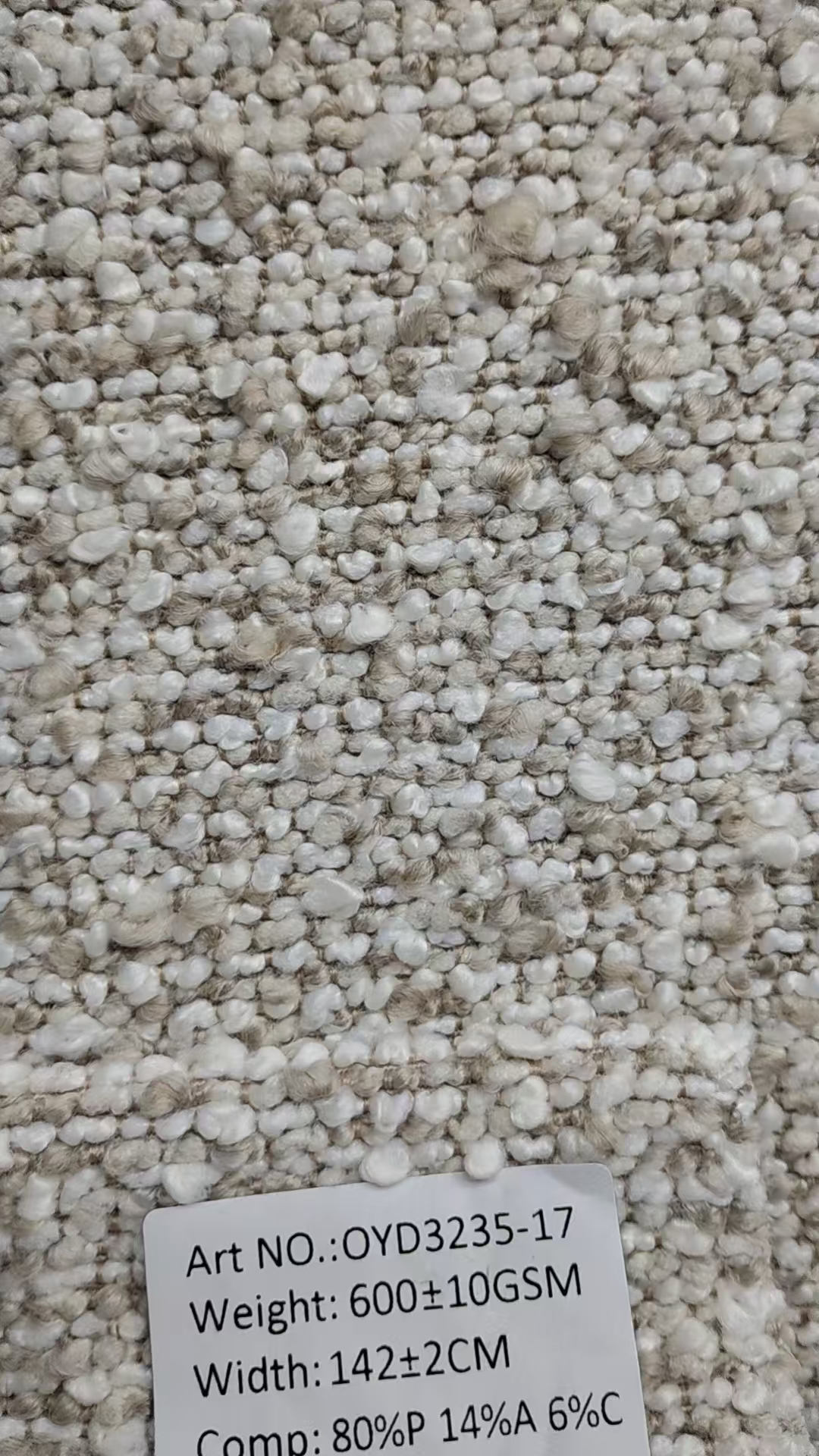
| OYD3235 | Sofa / upholstery fabric | 600±10 GSM | 142±2 cm | 80% Polyester, 14% Acrylic, 6% Cotton |
| OYD3120 | Chenille fabric | 420±10 GSM | 142±2 cm | 100% Polyester |
| OYD1825 | Chenille fabric | 490±10 GSM | 142±2 cm | 100% Polyester |
| OYD2500 | Chenille fabric | 410±10 GSM | 142±2 cm | 100% Polyester |
| OYD2919 | Chenille fabric | 400±10 GSM | 142±2 cm | 100% Polyester |
| OYD2992 | Chenille fabric | 420±10 GSM | 142±2 cm | 100% Polyester |
| OYD3591 | Chenille fabric | 400±10 GSM | 142±2 cm | 100% Polyester |
Two entries in that list carry most of the design weight in hospitality work. OYD3618 is a velvet construction, a category that reads as a raised, light-responsive surface and is commonly used where a room needs a focal texture. OYD3229 is a woven boucle at 620±10 GSM, the heaviest construction in the set, and the one most often used where a large sofa has to hold its shape visually in an open public space.
Technical reading: what GSM, width and construction actually decide
Weight is the first practical filter. In this range the models run from 350±10 GSM (OYD3626) to 620±10 GSM (OYD3229). The heavier boucle and chenille constructions produce a dense hand that gives a large lobby sofa visual mass; the lighter woven constructions sit closer to the frame and are easier to handle in high-volume cutting, sewing and packing.
Width is the second filter, and here the range is deliberately narrow. A single 142±2 cm width family across velvet, boucle, woven and chenille means a project team can plan markers across multiple seating groups without recalculating cutting layouts. For a furniture manufacturer producing a hotel order, that consistency reduces the risk of mixed cutting efficiency between zones.
Construction decides surface behaviour. A velvet such as OYD3618 presents a pile that changes tone with viewing direction and light angle, which is why velvet is usually placed on accent pieces rather than across a continuous banquette. A boucle such as OYD3229 presents a looped, textured surface that visually absorbs marks and scuffs in a way that flat woven surfaces do not. Chenille constructions in the 400–490 GSM band sit between the two, offering a softer, matte hand.
Composition explains performance expectations. The 100% polyester models are the simplest to specify and clean. OYD3229 adds 10% acrylic for the heavier boucle hand, and OYD3235 blends 80% polyester with 14% acrylic and 6% cotton for a softer touch at 600±10 GSM. Polyester dominance is consistent with broader market structure: in the furniture performance fabric segment, polyester is reported to hold a 38.4% material share.
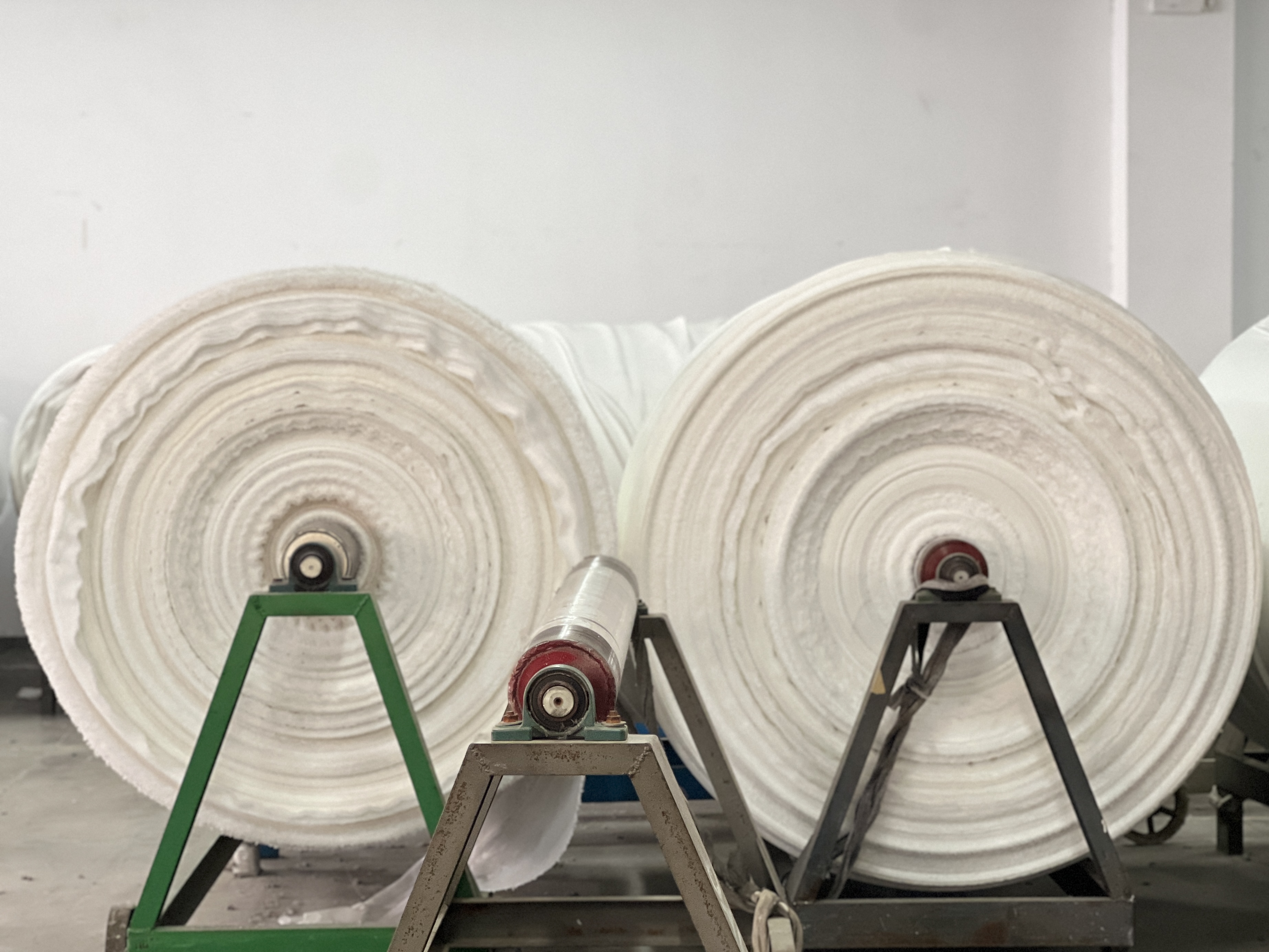
Finishing and backing stages determine how a specified sofa fabric behaves on the upholstery line and in service.
Matching models to hotel zones
The logic below is specification reasoning, not a fixed rule. It applies the published weight, construction and finish data to the way hospitality spaces are actually used.
Lobby and lounge large sofas
Large public-area sofas need visual weight and compression resistance. Heavier constructions — OYD3229 (620±10 GSM boucle) and OYD3235 (600±10 GSM) — suit this role. Boucle in particular gives a designer a texture that survives distance photography, where fine flat weaves can disappear.
Accent chairs and feature seating
Accent chairs are where a scheme can afford a directional surface. OYD3618 velvet and OYD1825 chenille at 490±10 GSM are typical choices here. Both are indoor constructions, intended for normal room temperature and daily frequent use — which is the environment a hotel lounge or restaurant actually presents.
Guest rooms and repetitive seating
Where the same seat is repeated hundreds of times, uniformity of colour and weight matters more than novelty. Mid-weight chenille models in the 400–420 GSM range (OYD2919, OYD3591, OYD2992, OYD3120) keep freight and handling predictable across a multi-floor order.
High-traffic public areas and demanding environments
Lobbies with food and beverage service, club lounges and busy circulation areas are where easy-clean and stain-resistant behaviour becomes a specification requirement rather than a preference. OYD3626 (350±10 GSM woven, 100% polyester) is the model most often referenced in this role, particularly where a fire-retardant or easy-clean finish has to be confirmed alongside the base construction.
Colour references and customization for an interior scheme
A designer's colour intent has to survive translation into a production dye lot. OYD Textile works in two modes: stock colour references and project-specific customization.
- Colour references. Colour options associated with these constructions include references 7, 20 and 27, which gives a project team a concrete starting point for scheme development before any custom work is quoted.
- Pattern and colour customization. The manufacturer operates OEM and ODM production modes, with customization offered on pattern and colour. Colour matching is carried out against customer colour cards or sample swatches, and fabric width can be adjusted within the production range to fit different sofa manufacturing requirements.
- Design development capacity. The in-house development function is structured around five designers and three production managers, and the company releases new fabric designs each year across styles including modern minimalist, wabi-sabi, light luxury and classic European directions.
One practical consequence follows from this: custom pattern and colour development carries a higher minimum order quantity than stock items, and the commercial terms are confirmed before a formal order is placed.
Fire, cleaning and documentation on the project file
Finish specification is where hotel projects most often lose time, because finishes are frequently assumed rather than written down. For this range, the special requirements listed are waterproof, easy clean, dust resistant and fire retardant. These are special requirements, not universal defaults — they belong in the written specification and on the order confirmation.
The documented third-party evidence in the available materials is a TÜV Rheinland Textile Test Report, certificate number 180339570a 001, issued 17 July 2025, covering furniture and upholstery textile fabrics for the EU and USA markets. The related product listed with that report is OYD3235.
On the execution side, the manufacturer applies full-range quality control covering raw-material incoming inspection, in-process production monitoring and pre-shipment final inspection, with 100% testing stated in its capability data. Standard purchasing terms list pre-shipment quality inspection as the acceptance criterion, which means a buyer's own inspector can be arranged against the finished goods before they leave the factory.
Pre-shipment inspection is the point at which a hotel specification is either confirmed or corrected.
Market context: where hospitality fabric demand is heading
Several verified data points frame the current specification environment.
- The global sofa market is estimated at $244.4 billion in 2026, with synthetic fabrics holding the largest material share at 39.8% (Grand View Research).
- The furniture performance fabric segment — stain-resistant and high-durability constructions — is valued at $4.8 billion in 2025, with polyester holding a 38.4% material share (Dataintelo).
- China's exports of textile yarns and fabrics reached $130.01 billion from January to November 2025, a 0.9% year-on-year increase, based on customs data reported in December 2025.
- In the United Kingdom, the fire safety amendment effective 30 October 2025 moves the emphasis from display labelling to permanent labelling on upholstered furniture.
Two reading notes are worth keeping in mind. First, published upholstery fabric market estimates vary widely between research houses, largely because they define the category differently — some measure finished furniture, some measure the fabric subset, and some aggregate the supply chain. Second, the polyester share reported in the performance segment aligns with what most hospitality specifications actually do: choose a synthetic-dominant construction and then solve durability, cleaning and fire requirements through finishing and construction rather than through fibre substitution.
Model-matched specification versus a single-fabric approach
A common procurement shortcut is to specify one fabric across every seating zone to simplify purchasing and reduce the number of SKUs on site. That approach has real advantages. It also has structural costs, and comparing the two approaches side by side is the quickest way to see where the trade-off sits.
| Decision area | Single-fabric approach | Model-matched approach |
|---|---|---|
| Purchase complexity | One article, one colour, one inspection | Two to four articles, each with its own colour and finish confirmation |
| Design outcome | Consistent, but flat across all zones | Texture and weight can be differentiated between lobby, lounge and guest rooms |
| Performance fit | One performance level applied everywhere, including where it is not needed | Heavier constructions for large sofas, easier-clean constructions for F&B areas |
| Repair and replacement | Simple — one reference kept on site | Requires a per-zone reference list kept with the maintenance file |
| Order risk | Lower administrative risk | Higher administrative risk, mitigated by written finish and colour confirmation per article |
Boundaries to plan around. A model-matched programme is not automatically the better choice, and several real constraints apply:
- Third-party test documentation in the available materials references a specific article number (OYD3235) rather than the full range, so documentation must be matched article by article.
- Custom pattern and colour development carries a higher minimum order quantity than stock items, which can make a matched programme uneconomic on small refurbishment scopes.
- Fire-retardant, easy-clean, waterproof and dust-resistant finishes are listed as special requirements; if they are not written into the order, they are not implied.
- Custom production lead time is longer than stock delivery, and schedules are quoted after sample and deposit confirmation rather than before. The manufacturer's capability data lists a 30–45 day production window for custom work.
- Heavier constructions place different demands on the upholstery line, including CNC fabric cutting, heavy-duty sewing and fabric spreading equipment; a furniture partner who has not worked with 600+ GSM boucle should run a cutting trial first.
Future outlook
Three directions are visible in the current evidence. Regulatory attention on upholstered furniture is moving toward permanent, traceable labelling rather than removable display labels, which pushes project teams to keep specification records attached to the actual piece of furniture. Demand is concentrating in performance-oriented constructions rather than in generic upholstery, which favours suppliers who can document durability, cleaning behaviour and finishing rather than only appearance. And export flows from established textile manufacturing bases remain steady, which means lead-time planning and colour continuity — not availability — are the practical constraints for a hospitality programme.
For a hotel project, the durable conclusion is procedural. Match the model to the zone, confirm the finish in writing, match the test documentation to the article number, and approve colour against a physical swatch rather than a screen. Those four steps do more for a seating scheme's five-year appearance than any single fabric property.
Frequently asked questions
Which OYD Textile sofa fabrics are typically specified for hotel projects?
The range covers velvet, woven, chenille, linen, circular knit, jacquard and outdoor upholstery constructions, all listed as applicable to furniture manufacturing, fabric wholesale, interior design, home decor and hotel projects. Commonly referenced models include OYD3618 (450±10 GSM velvet, 100% polyester), OYD3229 (620±10 GSM woven boucle, 90% polyester / 10% acrylic), OYD3626 (350±10 GSM woven, 100% polyester) and OYD3235 (600±10 GSM, 80% polyester / 14% acrylic / 6% cotton).
Can hotel sofa fabric be matched to a specific interior colour or pattern?
Yes. OEM and ODM production modes are both operated, with customization available on pattern and colour. Colour matching is carried out against customer colour cards or sample swatches, and fabric width can be adjusted within the production range. Custom pattern or colour orders carry a higher minimum order quantity than stock items, and specific parameters, MOQ and lead time are confirmed by the sales team before a formal order.
Are fire-retardant and easy-clean options available?
Fire retardant, waterproof, easy clean and dust resistant are listed among the special requirements the manufacturer can support. Because they are special requirements rather than defaults, they need to be stated in the specification and confirmed on the order. Finishing choices should be verified against the documentation that applies to the specific article number.
What are the MOQ, lead time and payment terms for a hotel order?
Published purchasing terms list a MOQ of 300 meters per color, FOB delivery terms, pre-shipment quality inspection as the acceptance criterion, and payment terms of 30% deposit with 70% before shipment. The capability data separately references a mix-order threshold of 10,000 meters for OEM/ODM production programmes. Stock goods can be delivered in a shorter window than custom production; custom orders are scheduled after sample and deposit confirmation, with a 30–45 day production window listed.
Can samples be requested before committing to a hotel project order?
Yes. Free fabric samples are available for evaluation before a bulk order, and colour or pattern approval is normally confirmed against a physical sample. For a multi-zone programme, sampling each proposed article rather than only the main one is the practical way to verify that the constructions read consistently together under the project's lighting.
What documentation should a specifier verify before signing?
The available third-party evidence is a TÜV Rheinland Textile Test Report, certificate number 180339570a 001, issued 17 July 2025, covering furniture and upholstery textile fabrics for EU and USA markets, with OYD3235 listed as the related product. For any other article number, confirm which test documentation applies. The specification should also state the required finishes in writing and record the agreed inspection terms.
Reference material
The OYD Textile product selection file, covering fabric designs across the upholstery range, is available for download here: OYD Textile Best Selection (PDF).