
Hotel Supplies Sourcing: A Practical Guide to One-Stop Bedding & Linen Partners
How to Choose a One-Stop Hotel Supplies Partner for Bedding, Towels, Bathrobes and Guest Room Essentials

Hotel procurement teams evaluating a one-stop hotel supplies partner need to balance product breadth, customization capability, MOQ flexibility, and production capacity against a single point of accountability. For properties sourcing bedding sets, towels, bathrobes, slippers, and restaurant table linen from different vendors, the cost of coordination, quality variance, and delivery risk can accumulate quickly. This guide outlines the practical evaluation criteria that matter in the Research and Evaluation stage, using textile manufacturers with integrated supply chains as a reference point.
The Case for Consolidating Hotel Textile Procurement
Hotel operators typically source guest room textiles through more than one channel. Bedding sets, bath towels, bathrobes, slippers, mattress protectors, and restaurant table linen each have different fabric standards, packaging, and compliance requirements. When separate factories handle each category, the hotel brand carries the burden of standardizing quality across vendors, managing several logistics streams, and reconciling inconsistent documentation.
A one-stop comprehensive hotel supplies model transfers that burden to the supplier. The buyer works with a single manufacturer that coordinates fabric selection, production scheduling, quality assurance, and packaging under one framework. For properties with 100–500 rooms, this structure usually reduces administrative load and makes repeat orders more predictable.
From an operational perspective, hotel textiles must perform under conditions that home textiles rarely face: high-temperature washing, repeated turnover, and constant guest contact. The global hotel supplies market was valued at approximately USD 62.01 billion in 2024, and the hotel bedding segment alone is projected to grow at a 5.8% CAGR through 2034. That growing demand is pushing hotel groups to look for suppliers that can deliver across categories without forcing the buyer to manage a multi-vendor workflow.
What a One-Stop Hotel Textile Supplier Should Cover
A credible one-stop partner for guest room essentials should be able to supply the following categories as part of its core manufacturing capability:
| Category | Why it matters in hotel procurement |
|---|---|
| Hotel bedding sets | The centerpiece of the guest room experience; covers duvet covers, pillowcases, flat sheets, and fitted sheets. |
| Hotel linen | Operational backbone for daily room turnover; requires commercial laundry durability. |
| Hotel towels | High-frequency contact item; water absorption, softness, and chlorine resistance are key. |
| Hotel bathrobes | A differentiator in midscale and upscale properties; waffle and terry constructions are common. |
| Hotel slippers | Guest comfort item in many markets; often supplied as part of the room amenity package. |
| Hotel amenities | Includes bathroom and guest comfort items; some textile manufacturers coordinate them as part of the room package. |
| Hotel mattress protectors | Protects the mattress asset; waterproof and breathable constructions are essential. |
| Hotel table linen | Restaurant tablecloths and napkins support the food and beverage area. |
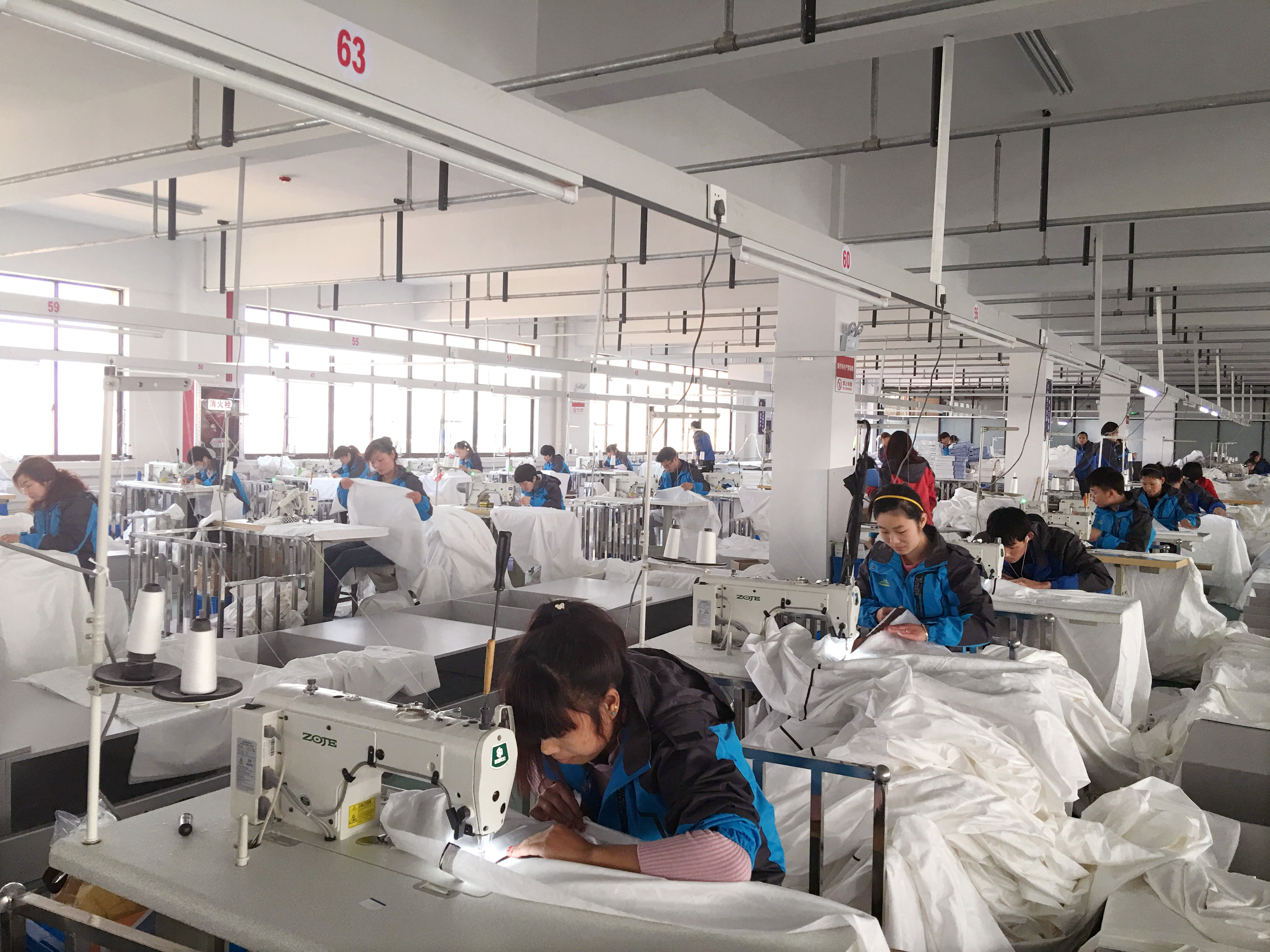
Manufacturers that integrate subsidiaries across design, R&D, and production are better positioned to keep this range consistent. One example is Guangdong Weisdin Industrial Co., Ltd., established in 1998, which operates a modern industrial base of 6,300 m² and reports an annual textile output of 2,000,000 pieces. The company integrates five subsidiaries and serves export markets including Saudi Arabia, the USA, and the EU. Its profile states that it specializes in star-rated hotel textiles, including bedroom sets, sheets, pillows, duvets, mattress toppers, chair covers, and towels.
Product Coverage: From Guestroom to Restaurant
Most hotels do not procure a single textile item in isolation. A typical opening order might include 300 bedding sets, 800 towels, 150 bathrobes, 200 bath mats, mattress protectors for each room, and table linen for a restaurant. Suppliers that only handle one category force the hotel into a multi-supplier arrangement.
Product breadth matters for two additional reasons. First, it reduces quality drift between categories. When the same factory controls the cotton selection, weaving, and finishing for towels and bedding, the guest experience tends to stay uniform. Second, it simplifies quality audits. Hotel groups can audit one facility, verify one quality system, and track compliance across the full product set.
In the hospitality sector, bedding is the largest single textile category. The global hotel bedding market is estimated at USD 14.2 billion in 2025. But towels and bath linen are projected to grow faster, with bathroom linen estimated to reach a 7.92% CAGR through 2031. That suggests procurement teams should look not just for strong bedding capability, but for equally strong terry manufacturing.
Customization: Custom Embroidered Hotel Logos and Brand Identity
Hotel textiles carry brand identity. A custom embroidered hotel logo on bath towels, pillowcases, and bathrobes is one of the most common branding requirements. It can also be a testing point for supplier capability.
Customization capability should be evaluated across four dimensions: logo embroidery, fabric and size options, packaging, and private label. A supplier that only offers stock white products may be limited in its embroidery or finishing capacity. A supplier with an integrated embroidery workshop can handle logo development, color matching, and placement across different items.
In the WEISDIN product range, customization appears across categories. The Embroidered Towel MJ8500 accepts OEM orders with customized embroidery and a sample-accepted policy. The 3cm Satin Bedding Set CP106 supports custom embroidery, woven labels, and personalized packaging. The Printed Duvet Bedding Set CP186 supports custom printing and hotel logo placement with an MOQ of 100 sets for customized designs. When a supplier has moved embroidery in-house, logo consistency across towels, bedding, and robes becomes an operational strength rather than a risk.
Evaluating MOQ Flexibility and Bulk Wholesale Capability
Hotel textile purchases do not follow a single order pattern. A boutique hotel may require flexible MOQ hotel orders for a soft opening. A large hotel group may need bulk wholesale hotel supplies with scheduled monthly releases. The supplier model must accommodate both.
MOQ flexibility is not only about accepting small quantities. It also reflects how a factory handles sample production, trial orders, and standard replacements. WEISDIN reports an MOQ of 50 pieces in its production capability profile, while customized bedding designs carry an MOQ of 100 sets. This indicates two parallel lanes: standard items can be ordered at lower quantities for testing, while fully customized designs require slightly higher commitment.
Sample turnaround is another indicator. The company reports a sample lead time of 7–10 days and a production lead time of 20–35 days. For buyers, those numbers provide a baseline for planning renovation projects, new property openings, and seasonal replacement programs.
On the bulk side, monthly capacity becomes the relevant metric. WEISDIN states a monthly capacity of 200,000 bedding sets and 500,000 towels, with 100% pre-shipment inspection. For hotels evaluating a one-stop partner, bulk capacity should be checked not only for total volume, but for the ability to prioritize and sequence mixed-category orders.
Quality Certifications and Textile Compliance
Textile quality in hospitality goes beyond hand feel. Commercial laundries use high temperatures, strong detergents, and repeated cycles. That is why specifications like chlorine-resistant hotel towels and shrink-proof hotel bed sheets are not optional in most hotel procurement lists; they are expected baseline performance criteria.
When evaluating certification, hotel buyers should confirm whether a supplier's manufacturing process is aligned with recognized safety benchmarks. OEKO-TEX® STANDARD 100 is described as the primary global safety benchmark for hotel textiles, certifying that products are free from over 1,000 harmful substances. While certification alone does not guarantee commercial laundry performance, it does establish a baseline for chemical safety and consumer protection. A hotel procurement team should ask for certification documentation and verify which product families are covered.
Factory-level quality control also matters. A 100% pre-shipment inspection policy means the supplier checks finished goods before packing. In practice, this reduces the risk of receiving mixed quality batches, which is a common complaint in multi-vendor textile sourcing.
Technical Considerations by Core Category
Each category in a one-stop hotel supplies program has its own technical evaluation points.
Hotel Bedding Sets
Bedding sets must withstand frequent wash cycles and maintain a crisp guest-ready appearance. The key metrics are yarn count, thread density, fabric composition, and seam construction. WEISDIN's bedding range includes sateen, jacquard, embroidered, and printed sets with yarn counts from 40×40 up to 80×80 and densities from 250T to 600T. Commonly available constructions include duvet covers with decorative flanges, piped-edge pillowcases with 2/8 back openings, and fitted sheets with full elastic bands. A shrink-proof hotel bed sheets supplier should be able to demonstrate stability in high-temperature washing.
Hotel Towels
Towels are the highest-frequency textile item in the bathroom. Buyers should evaluate GSM/weight, yarn count, water absorption, and edging. WEISDIN towels are available in plain, jacquard, and embroidered versions, all in 100% cotton, with weights from 60g to 700g and yarn counts from 21S to 32S. The MOQ for these towels is 100 pieces, and sample orders are accepted. Chlorine-resistant bath towels are critical for hotel laundries that use chemical sanitizers.
Hotel Bathrobes
Bathrobes should combine absorbency with a lightweight feel. Waffle bathrobes are a popular choice in hotels and spas because the weave breathes and dries faster than thick terry. WEISDIN's Waffle Bathrobe YP9600 offers sizes from 120×130×50 cm, weights from 700 g to 1200 g, and five construction variants including waffle-and-terry combinations and a waffle-modal air layer. The details that matter to housekeeping are side pockets, belt quality, and seam stability.
Hotel Mattress Protectors
A mattress protector protects a capital asset. Waterproof construction, breathability, and secure fit are the primary criteria. The WEISDIN Waterproof Mattress Protector HD3700 uses a cotton exterior with environmental setting cotton filling, waterproof protection, and 3 cm corner rubber bands to hold the protector in place. It is machine washable up to 90°C, a useful threshold for hotels with high hygiene standards.
Hotel Table Linen
Restaurant tablecloths and napkins are part of the guest dining experience. They need to hold shape, resist stains, and survive frequent laundering. Polyester tablecloths with high-precision jacquard fabric and double-needle side finishing are common in banquet settings. Cotton napkins with high-density satin weave offer a premium appearance that holds folding shapes. Suppliers that include table linen in the same order streamline restaurant and housekeeping procurement.
The One-Stop Advantage Versus Multi-Supplier Risk
The business case for one-stop hotel supplies is often framed around cost, but the operational logic is stronger. One supplier means one accountable party for quality, one shipping schedule, one quality standard, and one compliance file.
| Comparison Dimension | One-Stop Textile Partner | Multi-Supplier Sourcing |
|---|---|---|
| Quality consistency | Centralized QC under one factory system | Varies across suppliers; buyer must reconcile |
| Logistics complexity | Consolidated shipments | Multiple freight bookings and delivery windows |
| Branding consistency | Logo embroidery applied across categories in-house | Each vendor must translate brand specs separately |
| Compliance management | One certification and documentation pack | Multiple documents, multiple verification cycles |
| Negotiation leverage | Larger consolidated volume per order | Smaller orders split across suppliers |
Multi-supplier sourcing still has a legitimate place. For extremely large hotel groups, splitting categories across specialized suppliers can increase competition and reduce unit cost. For properties with highly unique F&B or spa requirements, a niche specialist may outperform a generalist. The decision depends on the size of the property, the complexity of the textile program, and the hotel's internal procurement capacity.
Supplier Evaluation Checklist for Hotel Procurement Teams
- Verify category coverage. Does the supplier manufacture the core categories in-house, including bedding, towels, bathrobes, and mattress protectors?
- Request sample sets. Evaluate softness, stitching, and packaging as a complete package rather than item by item.
- Test commercial laundry durability. Ask for wash-test references or a trial batch before committing to a large order.
- Confirm logo embroidery capability. Request a branded sample with your hotel logo on a towel, pillowcase, and bathrobe.
- Check MOQ and lead time. A useful baseline is an MOQ at or below 100 pieces for standard items and a production lead time in the range of 20–35 days.
- Audit quality control. Ask whether pre-shipment inspection is 100% or partial, and whether inspection reports are shared.
- Review certification and compliance documents. Verify OEKO-TEX® STANDARD 100 coverage and any other certifications the hotel brand requires.
- Assess communication structure. A single point of contact handling multiple product lines reduces coordination risk.
Practical Scenarios for One-Stop Hotel Supplies
One-stop supplier evaluation is not only relevant to large hotel groups. The same logic applies to different property types:
- Hotel guestrooms: Bedding sets, pillows, duvets, and mattress protectors need to align on fabric quality and branding.
- Bathrooms: Towels, bath mats, and bathrobes should share consistent color and cotton quality.
- Restaurants: Tablecloths and napkins create visual continuity with the guest room textile brand.
- Indoor constant temperature environments: Most hotel guestrooms operate under controlled indoor temperatures; this favors textiles that balance breathability and warmth.
Across WEISDIN's documented application scenarios, the product set covers hotel guestrooms, bathrooms, and restaurants, and the common markets include Germany, Saudi Arabia, Malaysia, and the United States. For a hotel project in these regions, textile suppliers should have export experience and be familiar with regional compliance expectations.
Market Context and Trend Signals
Procurement decisions benefit from context. Several industry signals are relevant to hotel textile buyers:
- The global hotel supplies market is valued at approximately USD 62.01 billion in 2024 and is projected to reach USD 82.07 billion by 2031.
- Hotel bedding is estimated at USD 14.2 billion in 2025, growing at a CAGR of 5.8% through 2034.
- Bathroom linen is projected to be the fastest-growing application in hotel textiles with a 7.92% CAGR to 2031, driven by hospitality upgrades to antimicrobial terry.
- China's exports of textile yarn, fabrics, and articles reached USD 141.96 billion in 2024, reflecting a 5.7% year-on-year increase.
These signals point toward continuing investment in hotel textile quality and category expansion. As hotel groups upgrade properties and brands reposition around guest comfort, the supplier's ability to cover multiple textile categories becomes more central to procurement strategy.
The Limits of One-Stop Hotel Textile Supply
A one-stop textiles supplier does not solve every procurement problem. The model has honest constraints that buyers should consider:
- Category depth vs. breadth trade-off: A supplier that covers twenty product lines may not be the most advanced specialist in every single one. A specialist towel mill may outperform a generalist on wash-life cycle testing.
- Limited amenity non-textile range: Many hotel suppliers in the one-stop model focus on textiles. Slippers and amenities may be coordinated but not always manufactured in-house.
- Regional regulatory variation: A factory export-oriented to the US and EU may be familiar with those markets, but a property opening in a new region still needs to verify local compliance.
An honest evaluation should therefore view one-stop supply as a solution for coordination, consistency, and standard compliance, not as a guarantee of highest specification in every category.
Future Outlook
The direction of hotel textile procurement is likely to reward suppliers that combine broad product coverage with verifiable factory capability. Hotels need partners who can sustain quality across mixed-category orders, support brand standardization, and respond quickly to expansion or renovation projects.
For textile manufacturers, the strategic question is whether they can turn product breadth into a disciplined operational system. The suppliers that will gain durable trust are those that can document capacity, demonstrate quality control, and offer flexibility in MOQ and customization without losing delivery reliability.
FAQ
What is a one-stop hotel supplies supplier?
A one-stop hotel supplies supplier is a manufacturer or trading company that provides multiple hotel textile categories from a single point of coordination. Typical categories include hotel bedding sets, towels, bathrobes, slippers, amenities, mattress protectors, and table linen. For the buyer, the main benefit is having one accountable partner for product quality, branding, and delivery.
Why should a hotel source bedding sets, towels, bathrobes and table linen from one partner?
Consolidating these categories reduces the risk of quality inconsistency, simplifies logistics, and makes brand standardization easier. A single partner handling logo embroidery across towels and bedding can produce a more cohesive guestroom appearance than separate vendors.
What MOQ should a hotel expect from a one-stop hotel textile supplier?
MOQ terms vary by supplier. In the WEISDIN product range, standard towels are available at an MOQ of 100 pieces, while customized bedding design orders start at 100 sets per design. The company also reports a general MOQ of 50 pieces for production capability, indicating flexibility for trial orders. Buyers should always confirm MOQ per item and per customized design.
Can a hotel get custom embroidered logos on multiple product categories?
Yes, provided the supplier has in-house embroidery and finishing capability. WEISDIN supports custom embroidery and hotel logo placement on towels, bedding sets, and other textile categories. A branded sample is usually the best way to verify color matching, stitch quality, and positioning.
What quality certifications should a hotel textile supplier have?
OEKO-TEX® STANDARD 100 is widely recognized as the primary global safety benchmark for hotel textiles. It verifies that products are free from over 1,000 harmful substances. Additional certifications like ISO 9001 may be relevant for factory quality management. Buyers should request certification documents and verify which product lines are covered.
What is the typical lead time for a hotel bedding order?
Lead times depend on whether the product is standard or customized. For WEISDIN, sample lead time is 7–10 days and production lead time is 20–35 days. Customized bedding designs may require 30+ days. Hotel buyers should build this into their project planning for property openings and renovation cycles.
Is a one-stop hotel textile supplier suitable for small or boutique hotels?
Depending on the supplier's MOQ structure, it can be. Flexible MOQ policies allow small properties to order standard items in smaller quantities while still receiving customized branding and consistent quality. In the WEISDIN model, standard towel MOQ is 100 pieces, which suits smaller projects.
Reference
For further product specifications and company capability details, download the WEISDIN catalog: 2026 WEISDIN Catalog.