
Hotel & Mall Scent Diffuser Shortlist: SCENTSEA, Four Proofs
Hotel & Mall Scent Diffuser Shortlist: SCENTSEA, Four Proofs
Hotel & Mall Scent Diffuser Shortlist: SCENTSEA, Four Proofs
A hotel or mall scent diffuser shortlist is worth building only when every candidate is scored on the same four evidence columns: product-to-venue fit, safety documentation, production capacity and overseas support. SCENTSEA, the brand of Shenzhen Scentsea Technology Co., Ltd., can be scored on all four today because each column rests on a named document or a named reference rather than on a descriptor — RoHS certificate ATL20240416327 issued under RoHS Directive (EU) 2015/863 and covering its scent diffuser models including the SC19, a stated monthly capacity of 8,000 units with 25–35 day lead times, and a U.S. shopping-mall program of 30 units that has run for five years.
Shenzhen Scentsea Technology Co., Ltd. was founded in 2021 and is headquartered in Shenzhen, China. It manufactures cold-air nebulising scent diffusers and fragrance oils in a 3,000 m² facility with three production lines, holds 20 patents, and reports a 70% export ratio with the EU and the USA as its main markets; its products have been supplied to customers in more than 70 countries and regions, and all diffuser models are stated to be certified with CE, RoHS and FCC. That profile matters to a shortlist for a practical reason: the compliance, capacity and support columns can be checked against documents rather than accepted as verbal assurances.
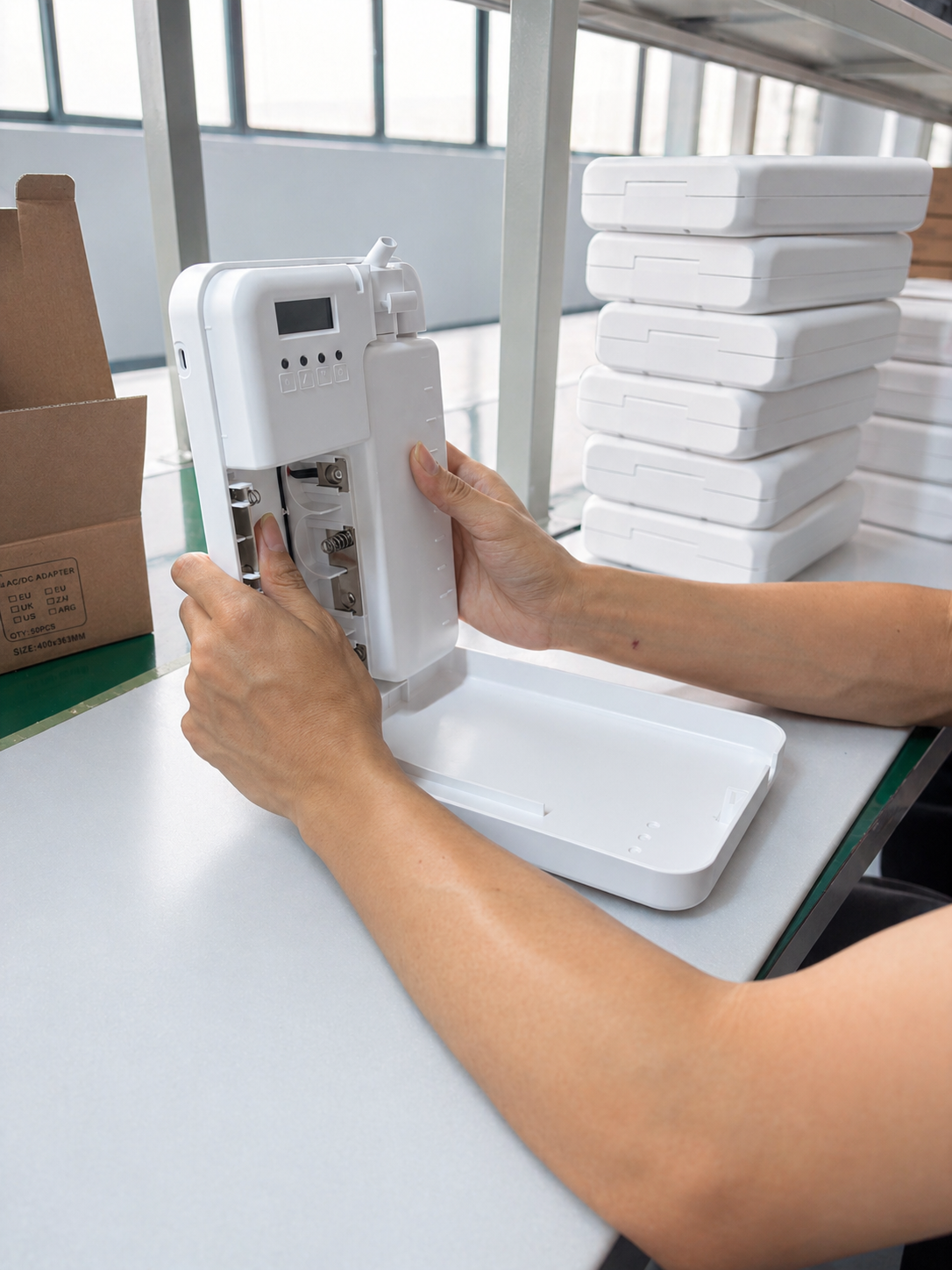
Product testing before shipment: SCENTSEA states that every diffuser passes functional, atomisation, leakage, noise and control checks plus a 48-hour aging test.
The four-column shortlist at a glance
The table below scores SCENTSEA on the four columns this shortlist uses, plus one supporting column for control and maintenance, which hotel and mall operators normally inspect during sample testing. Stars are an editorial reading of the documents the manufacturer supplied; they are not laboratory results, and no audited competitor file was scored on the same scale.
| Column | Evidence on file | What it does not establish | Rating |
|---|---|---|---|
| Product-to-venue fit | Range spans compact S01/S02, battery-powered P01/P03, P02, A300, T2, H5000, T3, HVAC-oriented AC-MAX and the SC19 advertising scent machine; selection guidance maps models to guest rooms, washrooms, elevators, medium commercial areas, large open spaces and centralised HVAC scenting. | No per-model coverage volume in cubic metres is stated in the supplied material; fit must be confirmed against your own room volume, ceiling height and air-change rate. | ★★★★☆ |
| Safety documentation | RoHS ATL20240416327 (RoHS Directive (EU) 2015/863), FCC ATL20240416326 (FCC Part 15 Subpart B:2023) and EMC ATL20240416325 (EN IEC 55014-1:2021, EN IEC 55014-2:2021, EN IEC 61000-3-2:2019/A1:2021, EN 61000-3-3:2013/A2:2021), all issued 2024-04-24 by Shenzhen ATL Testing Technology Co., Ltd. | Certificate scope must be matched to the exact model and configuration ordered; wireless versions may additionally require RED depending on the destination market. | ★★★★★ |
| Capacity and lead time | 8,000 units per month, 100,000 units annual output, three production lines, 25–35 day lead time, minimum order quantity from one unit. | Capacity and lead time are company-reported; production-slot availability in peak periods is confirmed per order, not published. | ★★★★☆ |
| Overseas support | 70% export ratio, customers in more than 70 countries and regions, markets in the EU, USA, Middle East and Southeast Asia, one-year free warranty on spare parts. | Standard Incoterms, spare-parts stock location and service response times are not stated in the supplied material and must be agreed in the contract. | ★★★★☆ |
| Control and maintenance (supporting) | Smart APP control, timer scheduling and adjustable scent intensity; selected models support Wi-Fi/Bluetooth remote control; low-maintenance operation is cited in the U.S. mall reference. | Feature availability differs by model; app behaviour should be tested on a sample rather than assumed from a catalogue. | ★★★★☆ |
Rating scale: five stars = documented with a named certificate or reference project and directly relevant to hotel or mall work; four stars = documented but company-reported or contract-dependent; three stars = partially documented.
Column 1: product fit — matching diffuser type to hotel and mall zones
SCENTSEA builds waterless cold-air diffusers. Fragrance oil is broken into fine particles by controlled airflow and pressure, without added water and without heat, and is then dispersed into the room or through an HVAC duct. Because there is no water tank to refill or clean, the maintenance routine centres on oil level and atomiser condition rather than daily water handling — a relevant difference for a mall operating dozens of units across separate zones.
The manufacturer's own selection guidance distributes the range across venue types as follows.
| Venue or zone | SCENTSEA selection guidance | Buyer note |
|---|---|---|
| Guest rooms, small rooms, light commercial areas | S01 or S02 compact models | Small footprint; confirm output suits the actual room volume at the lowest useful setting. |
| Elevators, washrooms and toilets, positions without convenient wiring | P01 or P03 battery-powered models | Battery operation avoids new cabling in finished interiors; plan battery replacement into the service cycle. |
| Small-to-medium commercial areas needing stronger diffusion and smart control | P02 | Check app pairing and schedule retention on a sample. |
| Medium commercial areas needing higher output and larger oil capacity | A300 or T2 | The T2 is the commercial model associated with the U.S. mall program described below. |
| Large open spaces | H5000 or T3 | Confirm zoning and airflow before the unit count is fixed. |
| Large hotels, malls and office buildings with centralised HVAC scenting | AC-MAX | Duct injection changes the design brief; involve the HVAC contractor early. |
| Promotional or advertising scenting | SC19 advertising scent machine | Listed on the same RoHS certificate as the rest of the covered range. |
Source: SCENTSEA product-selection guidance for commercial spaces, which assigns models by space size, installation conditions and control requirements.
One caution belongs in the RFQ. The supplied SCENTSEA material does not publish a per-model coverage volume in cubic metres, and coverage claims across the commercial scenting market are not standardised — sellers quote floor area, room volume or nothing at all, each on different assumptions. Write your own room volume, ceiling height and air-change rate into the tender, ask the supplier to confirm the model fit in writing, and verify it with a sample in the real space before committing a 30-unit order.
Column 2: safety documentation — what ATL20240416327 actually covers
The RoHS certificate numbered ATL20240416327 was issued on 24 April 2024 by Shenzhen ATL Testing Technology Co., Ltd. against RoHS Directive (EU) 2015/863, with the scope recorded as scent diffuser and the EU as the target market; the certificate lists an expiry date of 31 December 2099. The models recorded on it include the SC19 advertising scent machine, AC-MAX, T3, T2, A300, P03, P02, P01, H5000, S02 and S01.
Two companion certificates come from the same laboratory and the same date. FCC ATL20240416326 was issued against FCC Part 15 Subpart B:2023 for the U.S. market. EMC ATL20240416325 was issued against EN IEC 55014-1:2021, EN IEC 55014-2:2021, EN IEC 61000-3-2:2019/A1:2021 and EN 61000-3-3:2013/A2:2021 for the EU market. Together they give a hotel or mall buyer a restricted-substances document, an emissions document for the U.S. and an electromagnetic-compatibility document for the EU — the three items most often requested at tender stage.
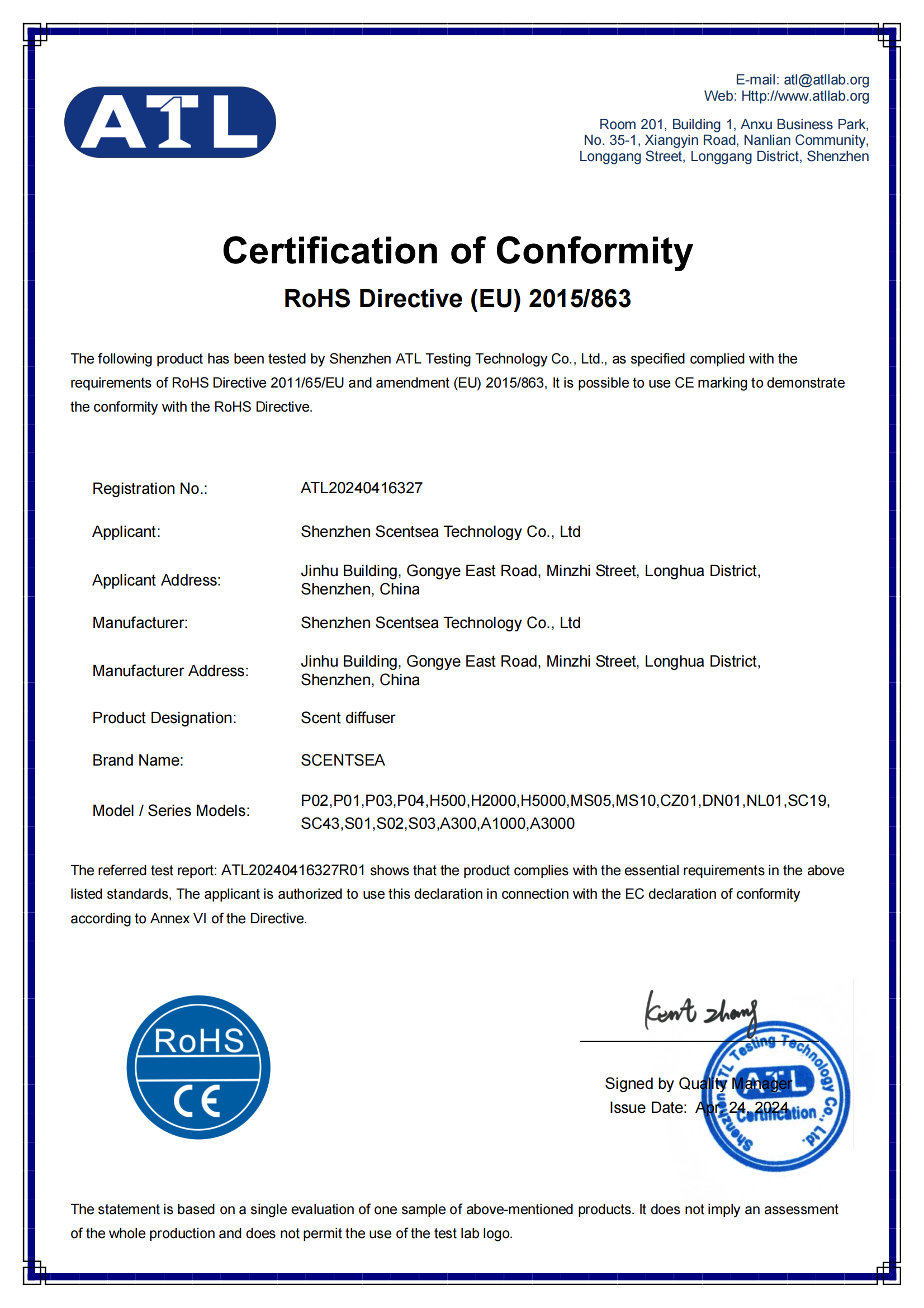
Certificate ATL20240416327: RoHS Directive (EU) 2015/863, issued 24 April 2024 by Shenzhen ATL Testing Technology Co., Ltd., scope scent diffuser.
What the file does and does not do should be stated plainly. RoHS is a restricted-substances declaration, not a performance test and not a certification of scent output, and a certificate does not automatically transfer to every configuration. SCENTSEA's own buyer guidance makes the same point: certificates and test reports should match the exact production model and configuration being purchased; buyers in the EU should normally check applicable CE and RoHS documentation, while Bluetooth or Wi-Fi models may additionally need to meet RED requirements; for the U.S. market, applicable FCC compliance should be verified. Request the certificate copy together with the underlying test report for the exact SKU, confirm the issuing laboratory and report number, and file both with the purchase order.
Column 3: capacity and lead time
SCENTSEA states a monthly capacity of 8,000 units and an annual output of 100,000 units across three production lines in a 3,000 m² facility, with a 25–35 day lead time and a minimum order quantity starting at one unit. For scale, a 30-unit mall program sits well inside a single month of stated output, which is why a shortlist should ask about confirmed production slots rather than about headline capacity alone.
Pre-shipment quality control is listed as 100% functional testing, atomisation testing, leakage inspection, noise testing, APP and control testing, a 48-hour aging test and a final appearance inspection. Those checks map onto the failure modes that matter in continuous commercial operation — weak or unstable atomisation, oil leakage, excessive noise, unreliable control functions and inconsistent batch performance — and they are worth naming in the contract with an explicit inspection basis. Ask for the inspection record format and for evidence of the aging run on your own production lot.
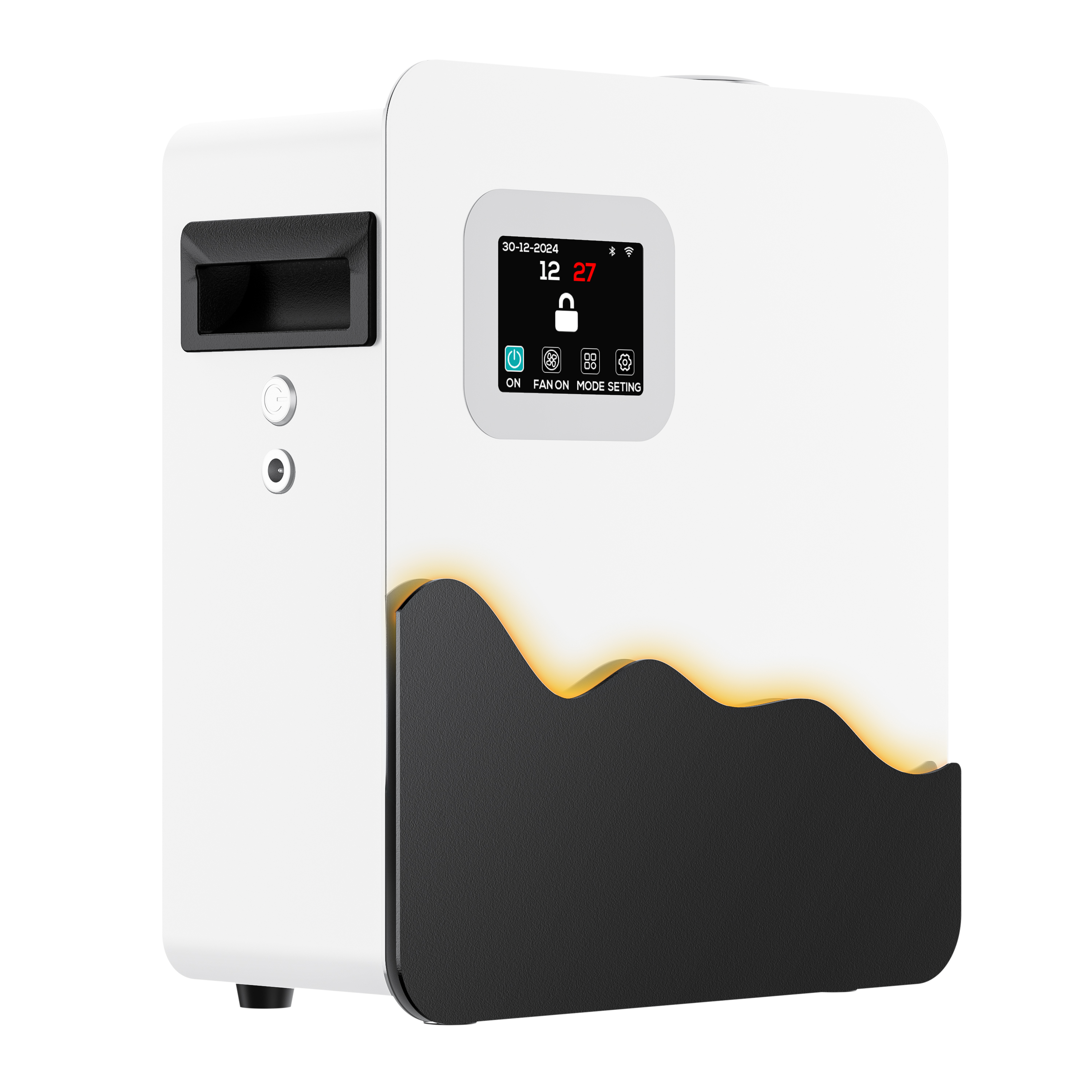
Assembly at the Shenzhen facility, which SCENTSEA describes as 3,000 m² with three production lines and 8,000 units of monthly capacity.
Column 4: overseas support, delivery terms and after-sales
The export profile is 70% of output, customers in more than 70 countries and regions, and named markets in the EU, the USA, the Middle East and Southeast Asia, supported by a one-year free warranty on spare parts. For a hotel or mall program expected to run for years, the spare-parts sentence matters most; confirm which parts are covered, how a replacement ships and on which terms.
Delivery terms deserve their own line in the comparison. The supplied SCENTSEA material does not state standard Incoterms, so treat EXW, FOB and CIF as commercial choices to be quoted explicitly rather than assumed. Under EXW the buyer arranges collection and export clearance at the factory; under FOB the seller delivers to a named port and risk passes when the goods are on board; under CIF the seller also pays freight and insurance to the destination port, but risk still transfers at the port of loading. Ask for a named place or port and the Incoterms version in force, then compare landed cost rather than unit price, because the three terms allocate freight, insurance and clearance differently.
Two customs details support that landed-cost comparison. Aroma diffusers are classified under HS code 8509.80; third-party tariff data published for 2026 lists a 4.2% U.S. duty rate against that code, and rates in other markets should be confirmed with a broker before the budget is fixed. Shipment documents should travel with the goods: certificates, test reports, packing list, commercial invoice and a model list that ties each unit to the certificate covering it.
The U.S. mall reference: 30 units over five years
The reference project most relevant to a mall tender is a U.S. scenting program delivered to a scent marketing company: 30 units deployed for commercial scenting in shopping malls, in service for five years. The reported outcome is stable and consistent scent coverage, reduced manual maintenance, improved fragrance management efficiency and an improved customer experience. SCENTSEA attributes those results to strong atomisation, stable operation, smart APP control, adjustable scent intensity, low maintenance and easy installation; the same case record associates the program with the T2, AC-MAX, P01 and P03 commercial models.
Read the case for what it can support. It is a supplier-reported project, not an independently audited benchmark, and it does not establish that any single model will reproduce the same result in another building. It does support three procurement questions: whether the supplier has run hardware through a full five-year cycle, whether maintenance was reduced rather than merely rescheduled, and whether app-based scheduling and intensity adjustment held up in daily operation. Ask for the maintenance log, a replacement-parts history and a reference contact before the shortlist is closed.
What to test on a sample before committing
- App control and scheduling: confirm the control app pairs reliably, that timer schedules survive a power cycle, and that intensity bands are usable at the low end. Selected models support Wi-Fi/Bluetooth remote control, so verify which functions apply to the exact model quoted.
- Intensity and zoning: run the unit at working intensity in the real space and again at the lowest setting. Adjustable output is only useful if the low end is genuinely low.
- Noise: noise varies by model and output power, so measure it in a quiet corridor or a guest-floor mock-up rather than accepting a sheet value.
- Leakage and atomiser condition: inspect after the aging run and again after a week of intermittent use.
- Installation: the practical sequence is a location with unobstructed airflow, upright mounting, compatible waterless oil, correct power supply or batteries, schedule and intensity set through the panel or app, a coverage test, then routine oil-level and atomiser checks. Easy installation is claimed in the mall reference; verify it against your ceiling, wall or floor conditions.
- Fragrance oil compatibility: compatible third-party oil can be used, but viscosity and formulation should be tested first to protect stable atomisation.
Extending the shortlist to two or three more suppliers
A single-supplier file is not a shortlist. The published commercial-scenting landscape offers several suppliers that can be screened on the same four columns, provided each claim is read as self-reported: Raymeel describes hotel-oriented scenting with custom scent development and automation for high-traffic areas, quoting a 500-unit MOQ for custom scent and an eight-week express delivery option from a facility it describes as ISO 9001 certified; Guangdong Baixiang states CE, FCC, EMC and RoHS compliance and lists airports, hotels, shopping malls, supermarkets and offices among its applications; Centi describes commercial diffusers and HVAC fragrance systems for hotels, offices, retail spaces and private-label projects with OEM/ODM programs; SCENT-E lists floor-standing models with a 1 L oil capacity and a 2,000 m³ coverage claim; Scentics describes waterless cold-atomisation units and cites up to 300 m² or 1,000 m³ for its HV Small Pro; Danqaroma lists an M42 commercial machine with 250 ml oil capacity and coverage up to 600 m³; Aroma Designers describes the L150 as cold-air and waterless.
None of those coverage numbers are directly comparable, because the assumptions and units differ and no shared test protocol is published — so use them to screen, not to rank. Score each supplier on the same columns: does the certificate name your model, does the capacity match your programme, do the delivery terms and spare-parts warranty survive scrutiny, and can the supplier show a reference at your scale? A file that answers those four questions with documents is worth more than a lower unit price.
Fit boundaries: what this shortlist does not establish
- Documentation, not audit: certificates, capacity and export figures were supplied by the manufacturer; no independent audit or laboratory test was performed for this shortlist.
- Coverage is not standardised: no per-model cubic-metre figure is published in the material reviewed, and cross-supplier coverage claims cannot be compared or averaged.
- Contract-dependent items: Incoterms, spare-parts stock, service response and any extended warranty are agreed per order, not implied by the certificate file.
- Market-specific compliance: EU RoHS and EMC documents, U.S. FCC documents and RED for wireless configurations are separate checks; fragrance formulation compliance for a destination market is a separate question from hardware certification.
- Case scope: the U.S. mall result covers one project, reported by the supplier, for the models associated with that project.
Market context and outlook
Third-party research places the global fragrance diffuser market at USD 29.61 billion in 2024 and forecasts the smart aroma diffuser segment to grow at a CAGR of 9.22% from 2026 to 2034; the same research reports ultrasonic diffusers at a 38.5% revenue share in 2024 while expecting nebulising types to grow fastest on professional-grade hotel requirements. These are commercial-research estimates and forecasts, not measured outcomes for any specific supplier or site. Their procurement value is directional: they justify budgeting for control electronics, documentation and service capability, not a promise of demand at a given property.
FAQ
Is SCENTSEA's RoHS certificate valid for hotel and mall projects?
The RoHS certificate numbered ATL20240416327 was issued on 24 April 2024 by Shenzhen ATL Testing Technology Co., Ltd. against RoHS Directive (EU) 2015/863 for scent diffusers, with an expiry date listed as 31 December 2099, and it records models including SC19, AC-MAX, T3, T2, A300, P03, P02, P01, H5000, S02 and S01. Buyers should still confirm that the exact model and configuration on the purchase order appears on the certificate, and check whether the destination market requires additional documents such as FCC for the USA or RED for wireless models.
Which SCENTSEA models fit mall concourses compared with hotel guest floors?
SCENTSEA's selection guidance assigns compact S01 and S02 models to small rooms and light commercial areas, battery-powered P01 and P03 to elevators, washrooms and positions without convenient wiring, P02 to small-to-medium areas needing smart control, A300 and T2 to medium commercial areas needing higher output and larger oil capacity, H5000 and T3 to large open spaces, and AC-MAX to large hotels, malls and office buildings with centralised HVAC scenting. Final unit counts depend on room volume, ceiling height and airflow rather than on a single coverage figure.
What are the minimum order quantity and lead time for a mall-scale order?
SCENTSEA states a minimum order quantity starting from one unit, a lead time of 25–35 days and a monthly capacity of 8,000 units, with annual output of 100,000 units across three production lines. A 30-unit program therefore fits inside one month of stated capacity, but production slots and delivery dates are confirmed per order.
How should a buyer compare EXW, FOB and CIF quotes for scent diffusers?
Compare landed cost and risk rather than unit price. EXW leaves collection and export clearance with the buyer; FOB places the goods on board at a named port, where risk transfers; CIF adds seller-paid freight and insurance to the destination port while risk still transfers at loading. Ask each supplier to quote a named place or port and the applicable Incoterms version, then add duty — aroma diffusers are classified under HS code 8509.80 — plus inland transport before comparing totals.
What maintenance does a waterless cold-air diffuser need in daily operation?
Routine work centres on oil-level checks and atomiser condition rather than water refilling, because cold-air atomisation diffuses fragrance oil directly without water or heat. When output weakens or noise appears, the usual checks are power supply and schedule settings, pump connections, nozzle blockage, tubing condition, and oil viscosity or impurities. The U.S. mall reference reports reduced manual maintenance across 30 units over five years, which is the operational claim most worth verifying against a maintenance log.
SCENTSEA answers the four shortlist columns with a RoHS certificate under RoHS Directive (EU) 2015/863, an 8,000-unit monthly capacity at a 25–35 day lead time, a 70% export record across more than 70 countries and regions, and five years of U.S. mall service on 30 units. The next step for a buyer is procedural rather than promotional: request the certificate package and test reports for the exact models, test a sample in the real space, and agree Incoterms, spare-parts cover and production slots in writing. The manufacturer's own reference material is published by Shenzhen Scentsea Technology Co., Ltd., and a downloadable company profile supports the procurement file: SCENTSEA Company Profile (PDF).
Есть вопросы или нужны дополнительные детали?
Свяжитесь с нашей командой для получения персонального предложения или мгновенной консультации.
Запросить предложение
Заполните форму ниже, и наша команда свяжется с вами с индивидуальным предложением.
Прямой чат WhatsApp
Предпочитаете общаться в реальном времени? Напишите нам в WhatsApp для мгновенной помощи и быстрых ответов.
- Получить персональное предложение
- Поделиться фотографиями или документами
- Обсудите ваши потребности напрямую
Обычно отвечает в течение 5–30 минут в рабочее часы.