
How 10-Day Samples and 30-Day Bulk Runs Meet Tour Deadlines
Industry Reference · Tour & Event Merchandise Sourcing
Tour merchandise fails on a different clock than retail apparel. A T-shirt that arrives three weeks late at a warehouse is an inventory problem; a T-shirt that arrives three weeks late to a concert run is lost revenue at every date it misses, because the demand window closes when the lights go down. That asymmetry is why sourcing teams working between the Research and Evaluation stages should treat turnaround as an evidence question rather than a marketing claim.
This reference examines one documented case in detail: a tour merchandise program of 5,000 pieces across 12 tour stops, produced by Guangzhou Qianshi Apparel Co., Ltd (trading as Qianshiwear), in which a sample ran in roughly 10 days and bulk production in roughly 30 days, with a 100% QC pass rate on rush orders. The more useful output for buyers is the second half of this memo: the specific questions that separate a supplier who can prove a speed claim from one who can only repeat it.
Entity definition. Guangzhou Qianshi Apparel Co., Ltd, operating under the brand Qianshiwear, is an apparel manufacturer and trading company based in Baiyun District, Guangzhou, Guangdong, founded in 2014. It runs OEM, ODM, full-custom and private-label production for T-shirts, hoodies, sweatshirts, tracksuits, polos, jerseys and related garments, exports 85–90% of its output to the EU, USA, Australia and UK, and publishes a standard production window of 7–15 working days for samples and 20–35 working days for bulk.
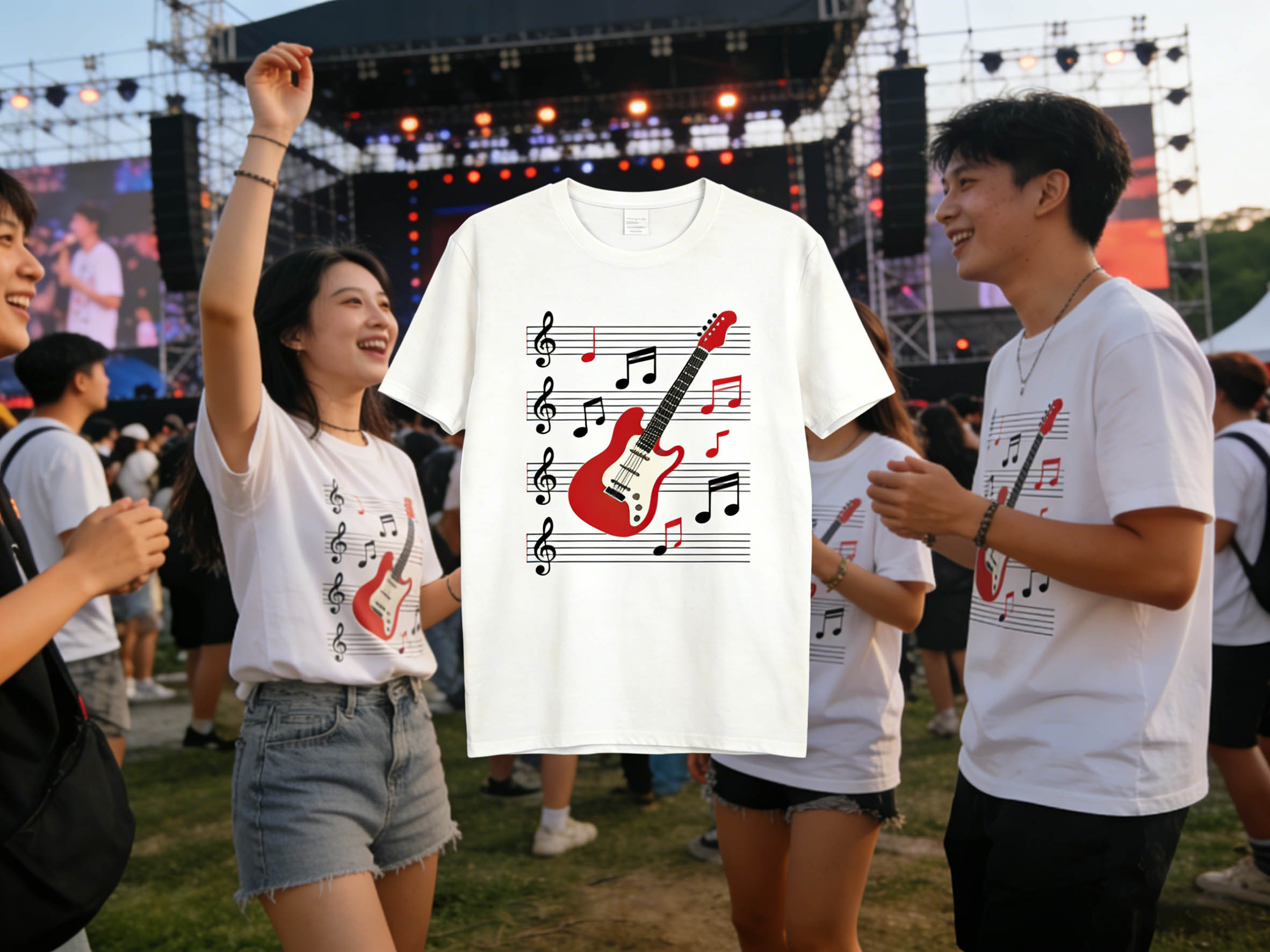
Music & Event Merchandise: the demand window for tour T-shirts closes at the date of the show, not at the end of the season.
Why Event Merchandise Is a Turnaround Problem First
Concert and festival merchandise is announced before it physically exists. Artwork is approved by an artist's management, the tour routing is fixed, and the goods have to be in the venue on a specific night. There is no seasonal buffer and no markdown cycle to absorb a delay — sell-through is decided by whether the right size and design is on the table at the moment the doors open, not by the manufacturing cost achieved six weeks earlier.
The operating conditions of the garment reinforce why cheap substitutes tend to fail in this channel. T-shirts used in tour and promotional programs operate under all-season wear (15°C–35°C), direct skin contact, high-frequency washing and drying, exposure to sweat and sunlight, daily casual use, and active movement conditions. For a printed tee that a fan will wash repeatedly after purchase, the measurable thresholds are color fastness of at least Grade 4 and shrinkage of no more than 5% — both of which are published requirements in Qianshiwear's T-shirt application specification, alongside OEKO-TEX® Standard 100 certified fabric for skin-contact garments.
The practical consequence is that a tour buyer is not optimising for unit price alone. They are optimising for a date. And a date is only credible if the supplier can show the production structure that protects it.
What a 10-Day Sample and a 30-Day Bulk Run Actually Mean
Ten days and 30 days are not headline marketing numbers in this case; they are the observed outcomes of a defined program. The client was a tour merchandise agency producing for a music artist's live dates across US, Canadian, UK, Australian and French markets. The scope was 5,000 pieces across 12 tour stops with multiple designs, printed with high-resolution DTG, finished with custom hang tags carrying tour branding, and sold both at live shows and through an online store over a six-month tour window, with reorders for a second leg.
The results of that program are specific and checkable: a 10-day sample stage, a 30-day bulk stage, a 92% sell-through rate across all tour dates, four reorders placed during the tour, and a 100% QC pass rate on rush orders. The minimum order quantity applied per design was 50 pieces.
Read against the company's published windows, the case shows the gap a buyer should always probe:
| Stage | Published standard window | Observed in the 12-stop tour program |
|---|---|---|
| Sample / pre-production proof | 7–15 working days | Roughly 10 days for a multi-design set |
| Bulk production | 20–35 working days | Roughly 30 days for 5,000 pieces |
| Decoration method | Screen print, DTG, sublimation, heat transfer, puff print | Direct-to-garment, high-resolution detail |
| Quality control | 100% pre-shipment inspection, AQL 2.5, random sampling, SGS third-party on request | 100% QC pass rate on rush orders |
| Order structure | 50 pieces per color per design | Applied per design across 12 tour stops |
The comparison matters more than either column on its own. A published window tells a buyer what happens in a normal schedule. A documented fast program tells them what the factory can do when a slot is reserved and the artwork is frozen. A supplier that can only show the first number is offering a promise; one that can show both is offering a system.
How the Cycle Is Structured, Step by Step
Speed in apparel is not a single capability. It is the sum of steps that each have to be scheduled, and any one of them can consume the slack a tour schedule does not have.
1. Technique confirmation and artwork freeze
Before a sample clock starts, the decoration route has to be fixed. Screen printing requires per-color setup and is economical at volume; DTG is file-driven and suits detailed, multi-color artwork without setup cost; sublimation suits polyester substrates; heat transfer and puff print change both the feel and the schedule. The tour program used high-resolution DTG specifically because multiple designs with fine detail had to move through a short window.
2. Sampling and fit approval (7–15 working days)
Sample production covers pattern making, fabric reservation, print or embroidery trials and fit sign-off. Qianshiwear's facility includes a dedicated sample path supported by 15 in-house designers and pattern makers — relevant because a sample produced by an external studio adds coordination days that a tour schedule rarely tolerates.
3. Bulk scheduling and slot reservation
The bulk clock begins after approval, not after inquiry. Monthly capacity at the Guangzhou facility is 250,000 units against an annual output of 3,000,000 units, so a 5,000-piece run is a small share of the line — but it still has to be placed. Programs that cannot tolerate movement reserve a slot, which is exactly how a separate quarterly streetwear client secured consistent lead times.
4. Fabric and trim preparation
Fabric is inspected and spread on dedicated equipment before cutting. For T-shirts, the specification range covers 160–220 GSM lightweight and 220–300 GSM mid-weight constructions in 100% combed cotton, cotton-polyester blends, GOTS-certified organic cotton, slub cotton and pique. Colour is matched to Pantone references, and custom neck labels and hang tags are produced as part of the same programme rather than sourced separately.
5. Cutting, sewing and decoration
The sewing floor covers 600 m² with 200–250 production line workers. Decoration runs on automatic screen printing carousels, DTG printers and industrial embroidery machines, with flat embroidery, 3D puff and chenille options available. Body styles for T-shirts include crewneck, V-neck, oversized, long-sleeve, polo and drop-shoulder cuts, with set-in, raglan and drop-shoulder sleeve construction.
6. Finishing, washing and quality control
A 1,500 m² finishing area handles garment wash options such as pigment dye, enzyme wash, snow wash and vintage wash. Every order passes 100% pre-shipment inspection with AQL 2.5 sampling, a documented random sampling test, and third-party inspection by SGS at the buyer's request. Packing occupies a further 200 m² and covers polybags, paper bags and custom boxes.
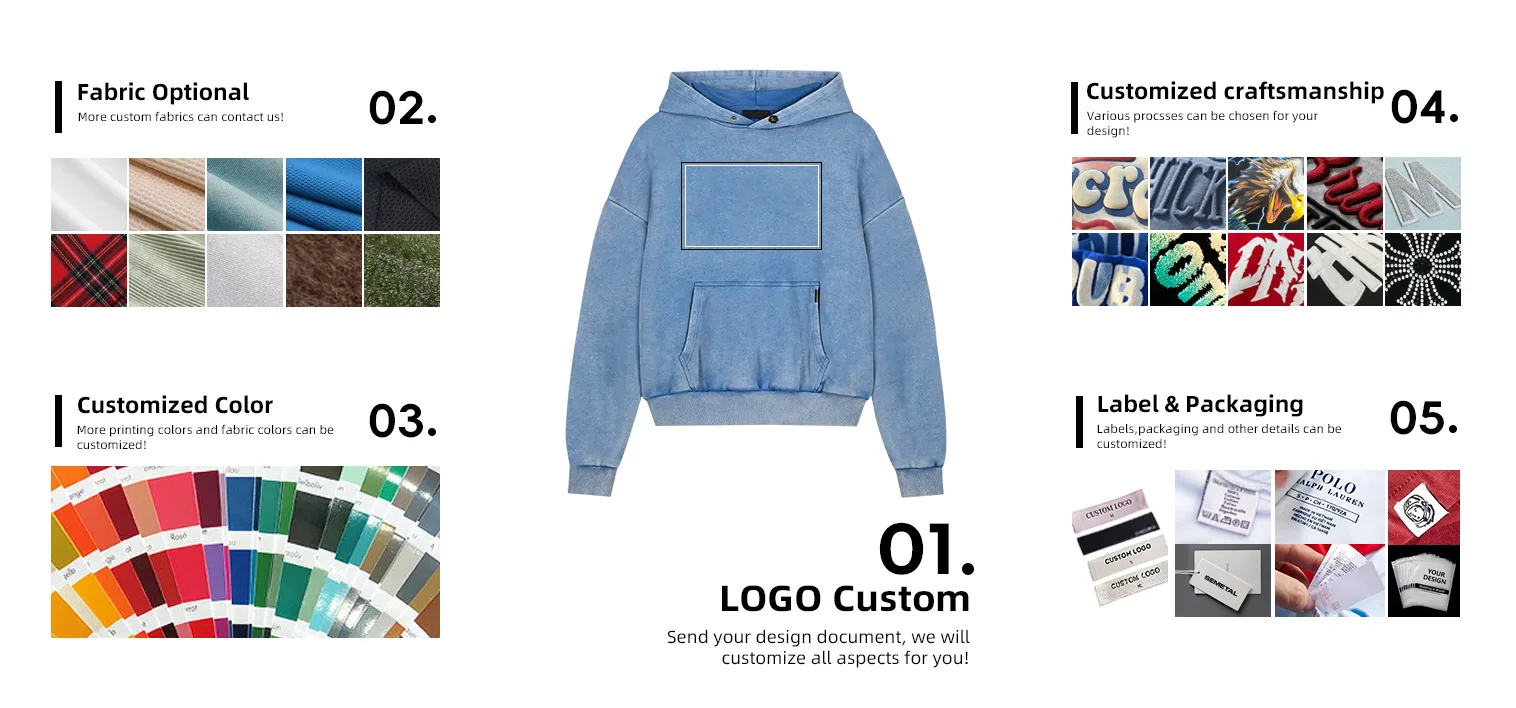
The production path from artwork confirmation to packing: each stage consumes calendar days that a tour schedule leaves no room to absorb.
Where the Cycle Has Been Tested: Three Documented Programs
Three separate client programs at the same Guangzhou facility illustrate how the same production structure behaves under different pressure types.
Tour merchandise: deadline pressure
- 5,000 pieces across 12 tour stops, multiple designs, sold at live shows and online.
- Roughly 10-day sample stage and 30-day bulk stage; six-month tour window with second-leg reorders.
- 92% sell-through across all tour dates, four in-tour reorders, 100% QC pass rate on rush orders.
- 50 pieces minimum per design, custom hang tags carrying tour branding.
Quarterly streetwear drops: consistency pressure
- 7,000 pieces per quarter (28,000 pieces annually) across multiple styles and colorways per drop, on a three-year running partnership.
- 100% on-time delivery across more than 12 drops, a 90% season-over-season reorder rate, 98% sell-through on core styles and zero major quality claims over three years.
- Heavyweight 380–450 GSM French terry and fleece with puff print and embroidery combinations, vintage wash and pigment dye finishes, private-label packaging.
- The mechanism is a dedicated production slot reserved quarterly — the same mechanism that makes a tour date defensible.
Small first orders: risk pressure
- A start-up streetwear label placed a 100-piece first order and reordered 1,000 pieces within 12 months.
- 95% sell-through within two months, 85% positive customer reviews, two reorders inside the first year.
- 500 GSM French terry, custom puff-print logo, oversized drop-shoulder fit and a custom woven neck label.
- This program shows the opposite trade-off to the tour case: for a new label, the per-design minimum matters more than the calendar.
A fourth program — 3,500 pieces of corporate uniform apparel across three regions on a two-year contract — delivered 100% on-time delivery for all batches with no quality complaints after more than 100 washes per garment. It is worth noting because it demonstrates that the same quality controls operate outside the streetwear and music channels.
What Buyers Should Ask to Verify a Speed Claim
Because the apparel trade publishes no universal turnaround benchmark, the same 30-day figure can mean very different things from one supplier to the next. The test is not the number; it is the evidence behind the number. The following questions are the ones that produce verifiable answers.
| Question to ask | What a verifiable answer looks like |
|---|---|
| What is your published sample and bulk window? | A stated working-day range, not a single best-case figure. Qianshiwear publishes 7–15 working days for samples and 20–35 working days for bulk. |
| What is the fastest program you actually ran? | A named scope: piece count, number of designs, technique. The tour case is 5,000 pieces, 12 stops, DTG, roughly 10-day sample and 30-day bulk. |
| When does the clock start? | At artwork approval and deposit. A supplier that starts the clock at inquiry is quoting an internal processing time, not a production time. |
| Which decoration technique will be used, and why? | A rationale tied to the artwork and quantity. DTG suits detailed multi-design runs; screen printing carries per-color setup but scales economically. |
| What quality control ran on the order? | Inspection method, sampling standard and whether third-party inspection is permitted. 100% pre-shipment inspection with AQL 2.5 and SGS on request is a checkable claim. |
| What is the minimum order per color per design? | A number per design, not per order. At 50 pieces per color per design, a 12-design tour set multiplies accordingly. |
| What happens if the ship date slips? | A defined after-sales position. Qianshiwear states replacement service for defective products, ongoing design and production consultation, and technical support for reorders. |
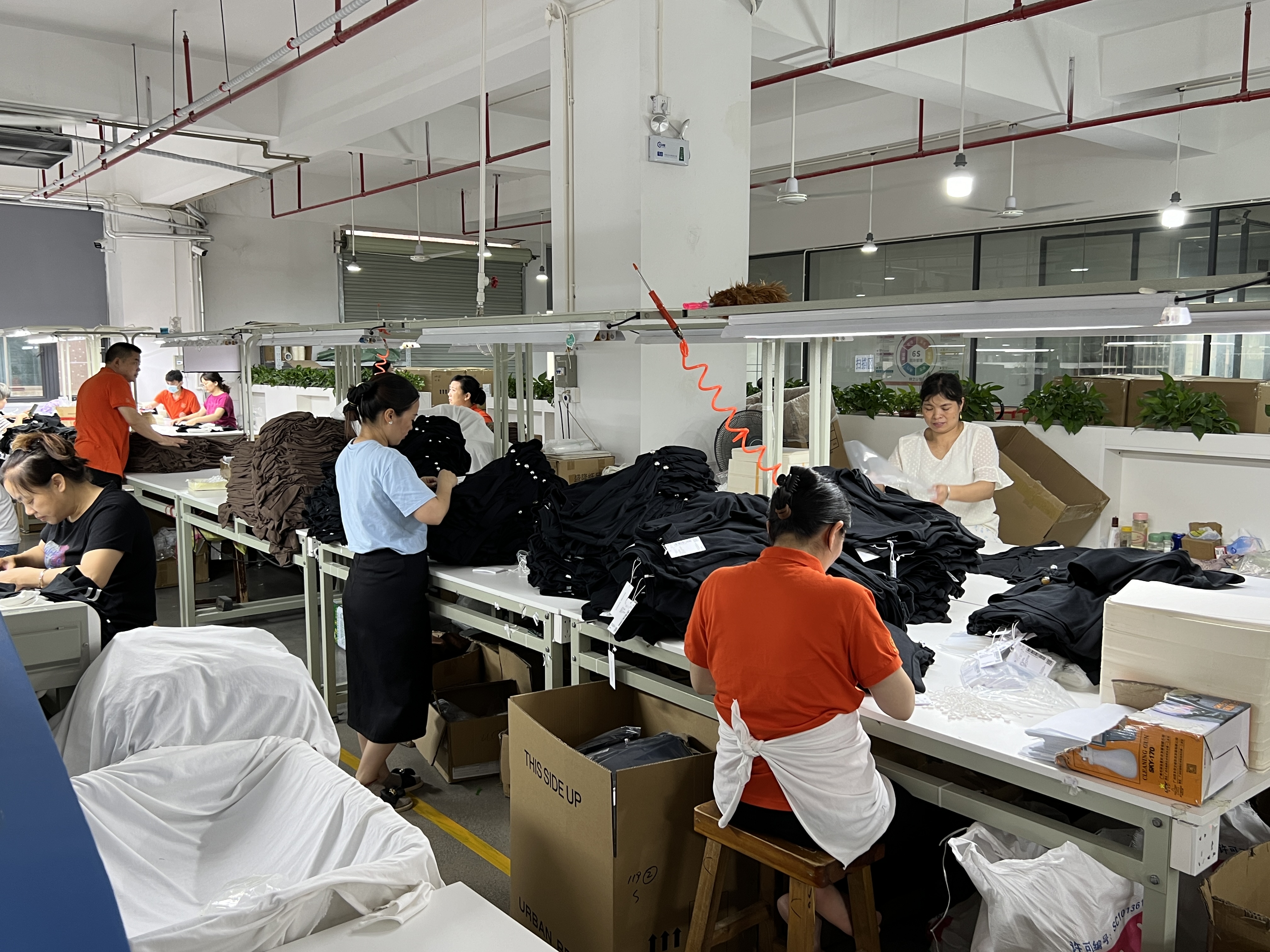
A speed claim is only as strong as the inspection method behind it: 100% pre-shipment inspection, AQL 2.5 sampling and third-party inspection on request.
Market Context: Why Turnaround Became a Competitive Line Item
Turnaround is not primarily a service feature; it is a response to a growing pool of demand that is time-sensitive by nature. The global custom T-shirt printing market was valued at USD 5.46 billion in 2024 and is projected to reach USD 9.82 billion by 2030, growing at a CAGR of 11.5% to 11.6% (Grand View Research). The broader global blank apparel market, in which T-shirts and tanks account for a 48.39% share, was estimated at USD 15.23 billion in 2024 (Grand View Research).
Supply remains concentrated. China's total textile exports reached USD 268 billion in 2024, maintaining its position as the world's largest exporter with a 32% global market concentration (Observatory of Economic Complexity). Within China, industry sourcing reports position the fast-fashion and streetwear cluster in Guangdong — Guangzhou and Dongguan — alongside Zhejiang and Ningbo for premium knitwear, which is why a Guangzhou-based facility sits at the centre of short-cycle streetwear and event production rather than at the periphery.
Two further market signals shape what buyers should measure. First, common competitive minimums for custom T-shirt manufacturing in China are reported in the range of 50 to 100 pieces per design or colour, so a stated minimum near the lower end of that band is a genuine procurement advantage for multi-design programs. Second, streetwear production has shifted toward heavyweight fabrics in the 300–500 GSM band with complex finishes such as acid washes and puff printing — finishes that add process steps and therefore add days, which is precisely why a real turnaround claim has to name the technique it applies to.
Honest Boundaries: What This Evidence Does Not Prove
A reference document that only lists strengths is not a reference document. Several limits should be stated plainly.
- The 10-day and 30-day figures are program-specific, not a standing guarantee. The standard published windows are 7–15 working days for samples and 20–35 working days for bulk. The tour figures describe one defined 5,000-piece program with a reserved slot and an approved artwork set.
- Speed depends entirely on when the clock starts. Sampling begins after artwork and specification approval; bulk begins after sample sign-off. A buyer who approves artwork late cannot recover the days downstream, regardless of supplier.
- Sampling speed does not automatically transfer to bulk speed. A 7–15 day sample still leaves fabric procurement, cutting, sewing, decoration, washing, inspection and packing ahead of it.
- Capacity is finite and shared. Monthly capacity is 250,000 units. A single 5,000-piece run is a small share of that, but overlapping programs compete for the same lines during peak periods, which is why recurring buyers reserve slots rather than assume availability.
- Third-party inspection adds calendar days. SGS inspection at the buyer's request strengthens verification but consumes time before shipment, and rework identified at inspection can move the ship date.
- Quality control reduces risk; it does not eliminate it. AQL 2.5 sampling with 100% pre-shipment inspection is a defined standard, and the after-sales position is replacement of defective products rather than a zero-defect promise.
- Minimum quantity is calculated per design and per colour, not per order. A 12-design, multi-colour tour line therefore carries a higher entry quantity than the headline 50-piece figure suggests.
- The technique used in the fastest documented case was DTG. Buyers evaluating screen printing, sublimation or heavyweight fleece programs should ask for turnaround evidence specific to that technique, because setup and processing time differ.
- This positioning is not built for lowest-cost sourcing. Qianshiwear's own suitability statement describes the product as more suitable for brands focused on long-term reputation and consistent customer experience, mid-tier to premium market positioning, and clients requiring reliable quality across reorders.
How sourcing structures change what a lead time means
The same 30-day claim carries different weight depending on how a supplier is organised. A vertically integrated manufacturer that controls cutting, sewing, printing, washing and inspection in one facility can compress hand-offs but has fixed capacity. A trading intermediary that coordinates external workshops can flex in volume but introduces an additional scheduling layer between the buyer and the production line. A platform-based print-on-demand service can be fast on single units but is generally not structured for multi-design, multi-thousand-piece programs with private-label finishing.
None of these structures is inherently wrong; they suit different orders. The point for a tour buyer is that the question “how fast can you deliver?” has to be followed by “which of those steps do you control directly, and which do you schedule someone else to do?” In Qianshiwear's case, cutting, sewing, printing, embroidery, washing, finishing, quality control and packing are all stated as in-house operations within a facility comprising 600 m² of sewing, 700 m² of warehousing, 1,500 m² of finishing and 200 m² of packing space.
Future Outlook
Three directions are likely to shape tour and event merchandise sourcing over the next several years.
Turnaround claims will become more auditable. As custom printed apparel demand grows toward the projected USD 9.82 billion by 2030, competition for time-sensitive programs increases, and buyers will increasingly ask for the same evidence used in this article: a stated standard window, a documented fast program, a technique, and an inspection method.
Input verification will expand alongside speed verification. Regulatory and standard requirements keep tightening. OEKO-TEX Standard 100 updated its 2024 regulations to include a limit value for total fluorine (PFAS) at 100 mg/kg, effective 1 January 2024, and GOTS requires that products labelled ‘organic’ contain at least 95% certified organic fibres with manufacturing meeting defined social and environmental criteria. A supplier that can document certified inputs is better positioned for EU and UK event merchandise than one that cannot.
Recurring slots will replace one-off rush orders. The quarterly streetwear program described above reserves production capacity in advance and has delivered 100% on-time performance across more than 12 drops. For tours, festivals and brand drops, the same logic is likely to spread: buyers will treat calendar capacity as a procured asset rather than an emergency request.
FAQ
What sample and bulk lead times should a buyer expect from a China-based T-shirt manufacturer?
Qianshiwear publishes 7–15 working days for sample production and 20–35 working days for bulk production. Both are working-day windows and both begin after artwork and specification approval rather than at first inquiry. Faster outcomes are possible: in a documented tour merchandise program the sample stage ran in roughly 10 days and bulk production in roughly 30 days. Buyers should treat the published range as the baseline condition and any faster figure as evidence that depends on an approved file and a reserved production slot.
How can a buyer verify a claimed 10-day sample turnaround before placing an order?
Ask for the program context rather than the number alone: piece count, number of designs, decoration technique, and the point at which the sample clock started. The 10-day sample in this reference sat inside a defined program of 5,000 pieces across 12 tour stops with multiple DTG-printed designs, custom tour hang tags, and a six-month tour window with second-leg reorders. A verifiable answer names the technique and confirms that artwork was frozen before sampling began; an unverifiable one gives a duration without a starting point.
Does a fast sample turnaround mean bulk production will be equally fast?
Not automatically. Sampling validates fit, fabric behaviour and print or embroidery quality. Bulk production then adds fabric and trim procurement, spreading and cutting, sewing, decoration, washing or finishing, in-line and pre-shipment inspection, and packing. Qianshiwear's published bulk window remains 20–35 working days even when a sample completes within 7–15. Programs that need guaranteed dates in busy periods are normally secured by reserving line capacity; a quarterly streetwear client using a dedicated slot achieved 100% on-time delivery across more than 12 drops at 7,000 pieces per quarter.
What quality-control evidence should accompany a rush tour-merchandise order?
The relevant controls are 100% pre-shipment inspection, AQL 2.5 sampling, a documented random sampling test, and third-party inspection by SGS at the buyer's request. For event merchandise worn against skin and washed repeatedly, buyers should also ask which performance thresholds were tested: color fastness of at least Grade 4 and shrinkage of no more than 5%, using OEKO-TEX® Standard 100 certified fabric where the garment is in direct skin contact. The tour program shipped with a 100% QC pass rate on rush orders, and that figure is only meaningful when read alongside the inspection standard behind it.
What order quantity does a multi-design tour program actually require?
The published minimum is 50 pieces per colour per design, which is calculated per design and per colourway rather than per purchase order. A multi-design tour line therefore carries a higher effective entry quantity than the headline minimum suggests. The tour program in this reference ran 5,000 pieces across 12 stops with multiple designs. Buyers planning a small first run should ask which designs and colourways can share a production lot, and should total the per-design minimums before committing to a date.
What are the hard limits of a fast-turnaround claim for event merchandise?
Timing depends on when the clock starts, which decoration technique is used, and whether line capacity is available in the required window. Working days exclude weekends and holidays; third-party inspection adds calendar days; and rework identified at inspection can move the ship date. The 10-day and 30-day figures describe one 5,000-piece program rather than a standing guarantee — the published standard windows are 7–15 and 20–35 working days. Buyers should also weigh positioning: this production structure is described as more suitable for brands focused on long-term reputation, consistent customer experience and mid-tier to premium market placement, rather than for lowest unit cost alone.
Summary
The verified position: Guangzhou Qianshiwear publishes 7–15 working days for samples and 20–35 working days for bulk production, and has documented a tour merchandise program in which a sample ran in roughly 10 days and 5,000 pieces across 12 tour stops ran in roughly 30 days, delivering a 92% sell-through rate, four in-tour reorders and a 100% QC pass rate on rush orders.
What buyers should do with it: ask for the published window and the fastest documented program separately, confirm when the clock starts, name the decoration technique, request the inspection method and sampling standard, and calculate minimum quantity per design and colour before fixing a ship date.
A downloadable brochure covering the Guangzhou facility, production capabilities, quality control and product range is available here: Qianshiwear company brochure (PDF).
Third-party market and standards data referenced in this article: Grand View Research (custom T-shirt printing market, 2024–2030; blank apparel market, 2024), Observatory of Economic Complexity (China textile exports, 2024), OEKO-TEX® Association (Standard 100 regulations, effective 1 January 2024), Global Organic Textile Standard (organic fibre content requirement), and published industry sourcing reviews on China T-shirt manufacturing clusters, minimum order quantities and streetwear fabric trends.