
How 2026 Export Rules Are Reshaping Paper Bag Machine Compliance
A paper bag machine now crosses a border with two payloads: the steel, and the file. In 2026, the file — conformity documentation, safety architecture records, factory acceptance test reports and installation commissioning sign-off — is the part that most often decides whether a shipment proceeds to installation or waits in a warehouse for clarification. Throughput still matters, but it is no longer the first question asked at the port of entry.
The commercial context is expanding. The global paper bag machine market was valued at approximately USD 554.89 million in 2024, with expectations to reach USD 762.49 million by 2033, according to one industry estimate. A separate, narrower estimate covering only sheet-fed paper bag making machines puts 2025 at roughly USD 462 million. The gap between the two figures is a useful reminder: market sizing in this category depends heavily on scope, and the same discipline buyers apply to market numbers should be applied to compliance claims.
This article examines how evolving compliance and certification requirements in major importing regions are reshaping the paper bag machine export landscape in 2026. It looks at policy environments, production capacity adjustments and export performance trends, and explains how purchasing terms and acceptance criteria are adapting to new standards. The flat bottom paper bag machine and the square bottom paper bag machine — the two dominant formats in global trade — are used as reference products. Ruizhi Machinery, a Wenzhou-based manufacturer identified by third-party research as a key player in the sheet-fed segment, appears as a verifiable example rather than as a promotional subject.
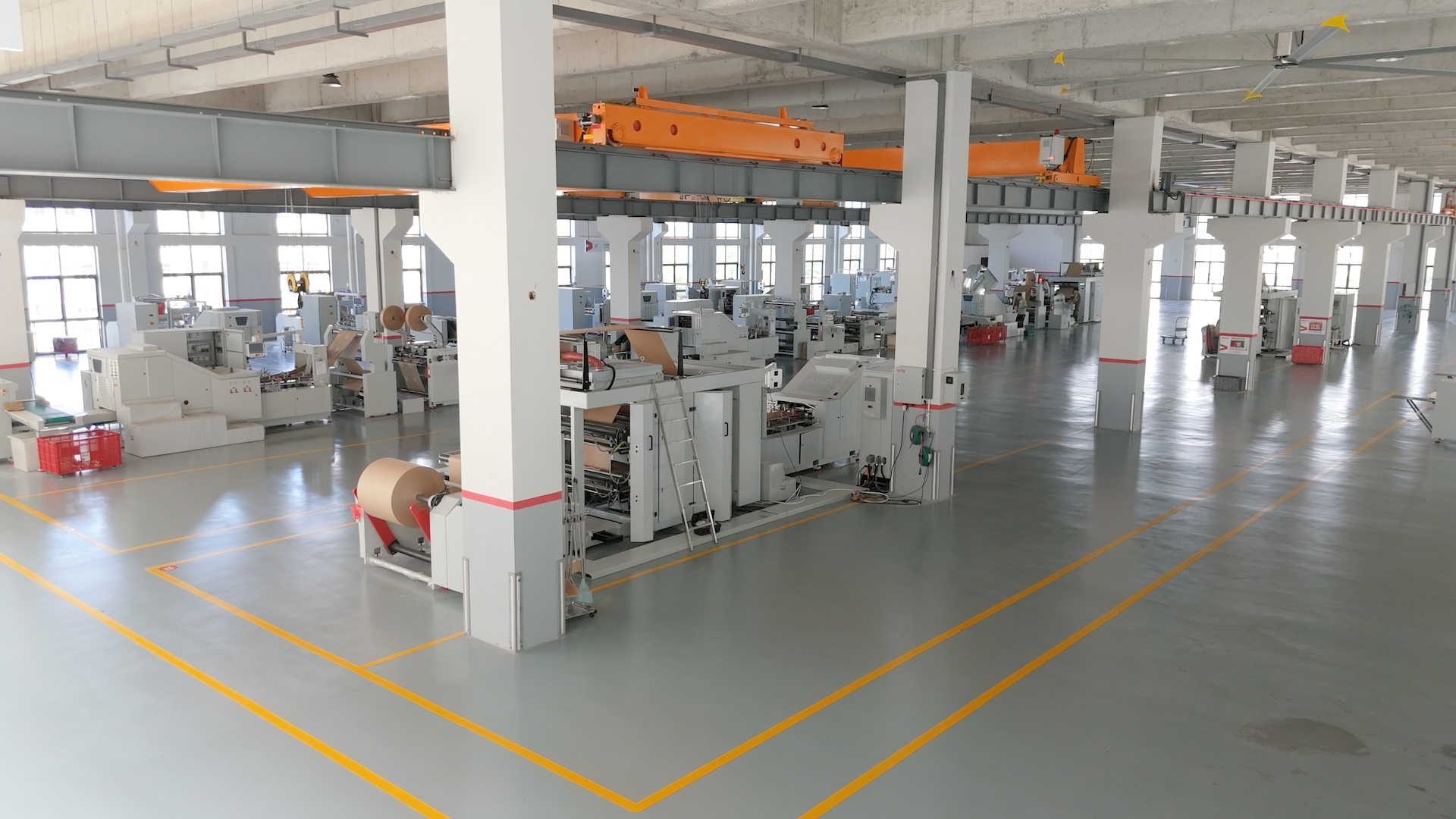
Pre-shipment testing is where export compliance stops being a document and becomes an observable event. Image: Ruizhi Machinery testing area.
Compliance Is Now an Export Variable, Not a Paperwork Step
A decade ago, a paper bag machine order was negotiated around speed, bag size range and price. Compliance was handled as an annex: a certificate was requested, a file was emailed, and the deal closed. That sequence has inverted. In 2026, the conformity status of a machine determines which markets a converter can serve — and therefore which machine is worth buying in the first place.
The clearest driver sits in the European Union. Packaging machinery placed on the EU market must comply with the EU Machinery Directive (2006/42/EC), and the framework is transitioning to the new EU Machinery Regulation (2023), which places explicit emphasis on software safety. For a paper bag machine, that is not a formality. Modern equipment is governed by PLC-driven sequences, servo-controlled bag transfer, photoelectric detection and automatic shutdown logic. The behaviour of that software is now part of the safety case rather than a separate technical detail.
Two consequences follow.
Compliance has become an engineering property of the machine. Safety guards and covers, photoelectric safety sensors, an emergency stop circuit and a jam-detection shutdown are not accessories bolted on at the end of assembly. They are part of what makes the equipment conformant, and they must be designed in.
Compliance has become a commercial property. Because the framework applies to the machine as placed on the market, the importer, the converter and — in many cases — the brand owner purchasing the finished paper bags inherit part of the exposure. This cascade is why brand owners increasingly ask packaging suppliers to demonstrate that the equipment producing their bags meets the standards of the destination market, not only the standards of the producing country.
The 2026 Policy Landscape: What Is Actually Changing
In the European Union: the software dimension
The transition from Directive 2006/42/EC to the Machinery Regulation (2023) is the single most consequential policy shift for paper bag machine exporters in this cycle. The regulation keeps the core mechanical safety logic — guarding, interlocks, emergency stopping — and adds explicit attention to software and control-system behaviour. For exporters, the practical meaning is that a technical file must describe how the control system behaves under fault conditions, not only how the mechanical parts are protected.
Outside the EU: fragmentation rather than a single global standard
There is no unified global compliance regime for paper bag machinery. Importing markets typically combine national safety legislation, electrical and electromagnetic compatibility requirements, and importer-side due diligence. The specific mix differs by jurisdiction, and a mark accepted in one market is not automatically recognised in another. Buyers should treat this as a planning assumption rather than an administrative nuisance: a machine can be fully compliant in its country of origin and still require additional documentation, testing or modification before it can be legally operated in the destination country.
Why compliance clauses now live inside purchase contracts
Three structural reasons explain the shift from side letters to contract terms:
- Payment release is tied to acceptance events, and acceptance events are increasingly defined by test evidence rather than by calendar dates.
- Conformity responsibility is becoming shared along the supply chain, from machine builder to converter to brand owner.
- Service obligations — installation, commissioning, training, spare parts — are being written as continuity requirements instead of one-off deliverables.
| Compliance checkpoint | What it covers | Where it surfaces in a purchase |
|---|---|---|
| Conformity marking (EU CE under Directive 2006/42/EC) | Machine meets applicable essential health and safety requirements, including the Regulation (2023) emphasis on software safety | Supplier qualification and pre-order documentation review |
| Quality management system (ISO 9001) | Process control across design, production and inspection | Supplier audit; contract annex |
| Machine-level safety architecture | Guards and covers on moving parts, photoelectric safety sensors, emergency stop, jam detection, automatic shutdown | Technical specification; pre-shipment inspection |
| Pre-delivery test run | Evidence that the assembled machine functions before shipment (100% pre-delivery test run) | Factory acceptance test |
| Installation and commissioning acceptance | On-site verification that the machine performs in the buyer's environment | Milestone for payment release |
| Final acceptance after trial operation | Confirmation of stable output under real production conditions | Final payment release |
| Operator training and maintenance guidance | Standardised operation, fault alarm interpretation, maintenance guidance | After-sales contract scope |
Production Capacity Adjustments Behind Export Readiness
Policy does not operate in a vacuum; it interacts with where machines are actually built. China, India and Germany collectively contribute over 61.4% of total global output of paper bag manufacturing machinery, according to industry analysis. Concentrated production means a policy change in a major importing region propagates quickly through a small number of manufacturing clusters.
Two composition trends matter here. The “automatic” machine segment held the largest share of the global sheet-fed paper bag making machine market at 62.3% in 2025, and square bottom paper bag machines accounted for nearly 58.5% of total global unit installations as of 2023. Automatic, square bottom equipment is therefore where compliance pressure concentrates: it is the format most likely to be exported into regulated markets, and the format whose control systems attract the most scrutiny under software-safety rules.
Capacity adjustment in response to this pressure generally takes four forms:
- Reallocation of assembly and testing capacity toward automatic platforms, because those platforms carry the documentation burden.
- Expansion of in-house testing areas so that a documented 100% pre-delivery test run can be completed before shipment.
- Standardisation of component and spare-parts inventories so that service commitments remain fulfillable years after delivery.
- Strengthening of technical documentation functions, because a conformity file is a living document that must track design changes.
Scale differences between manufacturers show up in exactly these areas. Ruizhi Machinery, for example, operates a 33,333 m² facility with 170 employees, produces approximately 300 units per year, maintains a 30-engineer R&D team, and exports about 70% of its output, primarily to the USA and EU. Third-party market research by Dataintelo identifies the company as a key player capturing substantial share in the sheet-fed paper bag making machine sector. For buyers, this kind of profile matters less as a marketing point and more as an indicator of whether the supplier can sustain a documentation and service record across a multi-year contract.
Purchasing Terms and Acceptance Criteria in a Compliance-Led Market
The most visible place where compliance and commerce meet is the purchase terms themselves. A representative export structure in this category looks like this:
| Item | Standard practice |
|---|---|
| Minimum order quantity | MOQ: 1 unit |
| Delivery terms | FOB / CIF |
| Acceptance criteria | Pre-shipment test (factory acceptance test); on-site installation and commissioning acceptance; final acceptance after trial operation |
| Payment terms | 30/70 |
Each line carries a compliance implication.
MOQ of 1 unit means mid-sized converters can buy a single machine configured for their market — but it also means the supplier must be willing to run full documentation and testing for a single unit, which is a genuine operational commitment rather than a commercial gesture.
FOB and CIF terms determine the point at which cost and risk transfer. They do not transfer conformity responsibility. Buyers should confirm in writing which party prepares the technical file, which party handles customs-facing documentation, and what happens if the destination authority requests additional evidence after arrival.
Three-stage acceptance is the most consequential change in this table. Pre-shipment factory acceptance testing creates evidence before the machine leaves the factory. On-site installation and commissioning acceptance verifies performance in the buyer's own environment, where power supply, humidity, paper stock and operator behaviour differ from the test floor. Final acceptance after trial operation confirms that the machine holds output under real production conditions. Together, these stages convert quality from an opinion into a record.
30/70 payment terms align cash flow with verification events rather than with shipment dates. When the balance is released against acceptance milestones, the buyer's commercial leverage survives the moment the container is loaded — which is precisely when it is most needed.
What Compliance Looks Like at the Machine Level
Compliance is easiest to discuss as a policy topic and hardest to verify as a physical fact. At the machine level, the risk controls that support conformity fall into three categories.
- Safety risk control — mechanical injury and unexpected shutdown: safety guards and covers for moving parts, photoelectric safety sensors, emergency stop buttons, paper jam detection systems and automatic shutdown mechanisms.
- Operational risk control — fault handling and maintenance: fault alarms that identify abnormal conditions, and maintenance guidance that keeps intervention predictable rather than improvised.
- Quality risk control — pre-delivery verification: a 100% pre-delivery test run, together with standardised operation training, so that the machine's documented behaviour matches its observed behaviour in the buyer's plant.
Machine performance provides the context in which these controls operate. Modern square bottom machines can run at speeds exceeding 100 bags per minute and handle paper weights from 60 to 120 GSM. Where a manufacturer designs for continuous operation, frame rigidity becomes a compliance-adjacent factor, because vibration and structural flex affect bag consistency and the reliability of sensor-based safety systems. Ruizhi Machinery's technical comparison data specifies high-precision, high-strength fuselage plates, with main unit steel plate thickness 20–30% higher than other paper bag machines and a +2 mm performance gap, supporting bag-making speeds of up to 160 pcs/min and smoother running over a long service life. The design intent is stability under sustained output — the condition under which safety and quality controls are actually tested.
Application: Where These Requirements Bite First
Food packaging production lines. This is the environment where frame stability and clean, predictable machine behaviour matter most. Ruizhi Machinery's technical data describes its high-precision fuselage design as best suited to food packaging production lines, where continuous operation and consistent bag formation are not optional. Compliance in this setting is inseparable from hygiene and process discipline.
Export-oriented converters supplying EU and US retail. For manufacturers whose main markets are the USA and EU, conformity documentation is requested not only by regulators but by retail customers auditing their packaging supply chain. The machine's certificate file becomes part of the converter's own answer to a customer questionnaire.
High-volume retail and quick-service programs. Where output is continuous, jam detection and automatic shutdown responsiveness shift from safety features to productivity features. A machine that stops cleanly and restarts quickly protects both the operator and the schedule.
Buyers distributing across multiple markets. A converter selling bags into more than one jurisdiction typically needs a machine whose documentation set can support more than one regulatory environment. That requirement should be raised during specification, not after delivery.
The Boundaries: What Certification Does Not Deliver
An independent reference has to be explicit about limits, and this category has several.
- A conformity mark is a floor, not a performance guarantee. CE conformity under the EU framework indicates that a machine meets applicable essential requirements; it says nothing about bag output, uptime or unit cost.
- Marks are jurisdiction-specific. A machine certified for one market may still need additional documentation or modification for another. Treating a single mark as a global passport is a common and expensive mistake.
- Certificate scope matters. Coverage is defined by the model, configuration and technical file submitted. A certificate covering a standard configuration does not automatically extend to a heavily customised variant with different tooling or control parameters.
- Compliance carries cost and time. Additional testing, documentation, guarding and control-system engineering raise both unit price and lead time. A compliant machine and an unregulated machine are not directly comparable on price.
- No fully harmonised global regime exists. Exporters serving multiple markets maintain overlapping documentation sets, and some duplication is unavoidable.
- Certification does not compensate for material limits or operator skill. A machine rated for 60–120 GSM paper will not run heavier stock because it carries a mark, and safety systems assume trained operators — which is why standardised operation training belongs in the delivery scope rather than in the optional extras column.
Market Trend Analysis: Capacity, Composition and Export Performance
Three data points frame the 2026 outlook.
Growth. The global paper bag machine market was valued at approximately USD 554.89 million in 2024, with expectations to reach USD 762.49 million by 2033. The direction of travel is expansion, and expansion into regulated markets increases the absolute volume of machines that must carry documentation.
Composition. Automatic machines account for 62.3% of the sheet-fed segment in 2025, and square bottom machines account for 58.5% of global unit installations as of 2023. The compliance burden therefore concentrates on the highest-volume format rather than on niche equipment.
Concentration of supply. China, India and Germany contribute over 61.4% of global output. At the top of the automated segment, Windmoeller & Hoelscher held the highest market share in 2023, delivering more than 1,900 advanced automatic paper bag machines globally — a useful indicator of how large documentation and service obligations become at industrial scale.
Read together, the trend line suggests that growth in this market is being captured increasingly by suppliers who can combine throughput with a verifiable compliance and service record. That is a different differentiator set than the one that governed the category a decade ago, when speed and price dominated the conversation.
Traditional Procurement vs. Compliance-Led Procurement
The shift is easiest to see side by side.
| Dimension | Traditional approach | Compliance-led approach (2026) |
|---|---|---|
| Supplier selection | Price and speed comparison | Documentation depth and service continuity assessed alongside price |
| Specification | Throughput and bag size range | Throughput plus safety architecture and control-system behaviour |
| Acceptance | Visual inspection on arrival | Pre-shipment factory acceptance test; installation and commissioning acceptance; final acceptance after trial operation |
| Payment | Largely tied to shipment | Tied to verification milestones (for example, a 30/70 structure) |
| Documentation | Certificate copy on request | Managed technical file updated with design changes |
| After-sales | Repair on failure | Fault alarms, maintenance guidance, training, spare-parts planning |
| Risk ownership | Concentrated on the buyer after shipment | Explicitly allocated between supplier, importer and buyer |
The traditional approach is not obsolete. For buyers operating in markets with lighter enforcement, or purchasing a second machine for an existing, already-approved line, a speed-and-price comparison can still be the right frame. The cost of the compliance-led approach is real: more documentation work, longer lead times and a higher unit price. The case for paying that cost is strongest when the machine's output will be exported into a regulated market, or when the buyer's own customers push requirements down through the supply chain.
Future Outlook: 2026–2027
Four developments are reasonable to anticipate.
Software safety moves from differentiator to baseline. As the EU Machinery Regulation (2023) framework is applied, control-system behaviour — jam detection logic, automatic shutdown conditions, sensor fault handling — will be documented as a standard part of the technical file rather than as an engineering footnote.
Documentation becomes a service, not a shipment attachment. Because designs change over a machine's service life, the conformity file must be maintained. Suppliers that manage this as an ongoing service will be better positioned than those that treat it as a one-time export task.
Acceptance testing standardises further. The three-stage structure — pre-shipment factory acceptance, on-site installation and commissioning acceptance, and final acceptance after trial operation — is already a common contract pattern. Its spread turns compliance from a claim into a measurable milestone.
Long-term supplier ecosystems become the practical answer to fragmented rules. When requirements differ by market and change over time, buyers extract more value from a relationship that includes spare-parts planning, maintenance guidance, training and documentation upkeep than from a single low-priced transaction. A manufacturer with roughly 70% export share and established service processes across the USA and EU, such as Ruizhi Machinery, is structurally aligned with this model — not because service is a marketing advantage, but because continuity is the only workable response to rules that keep moving.
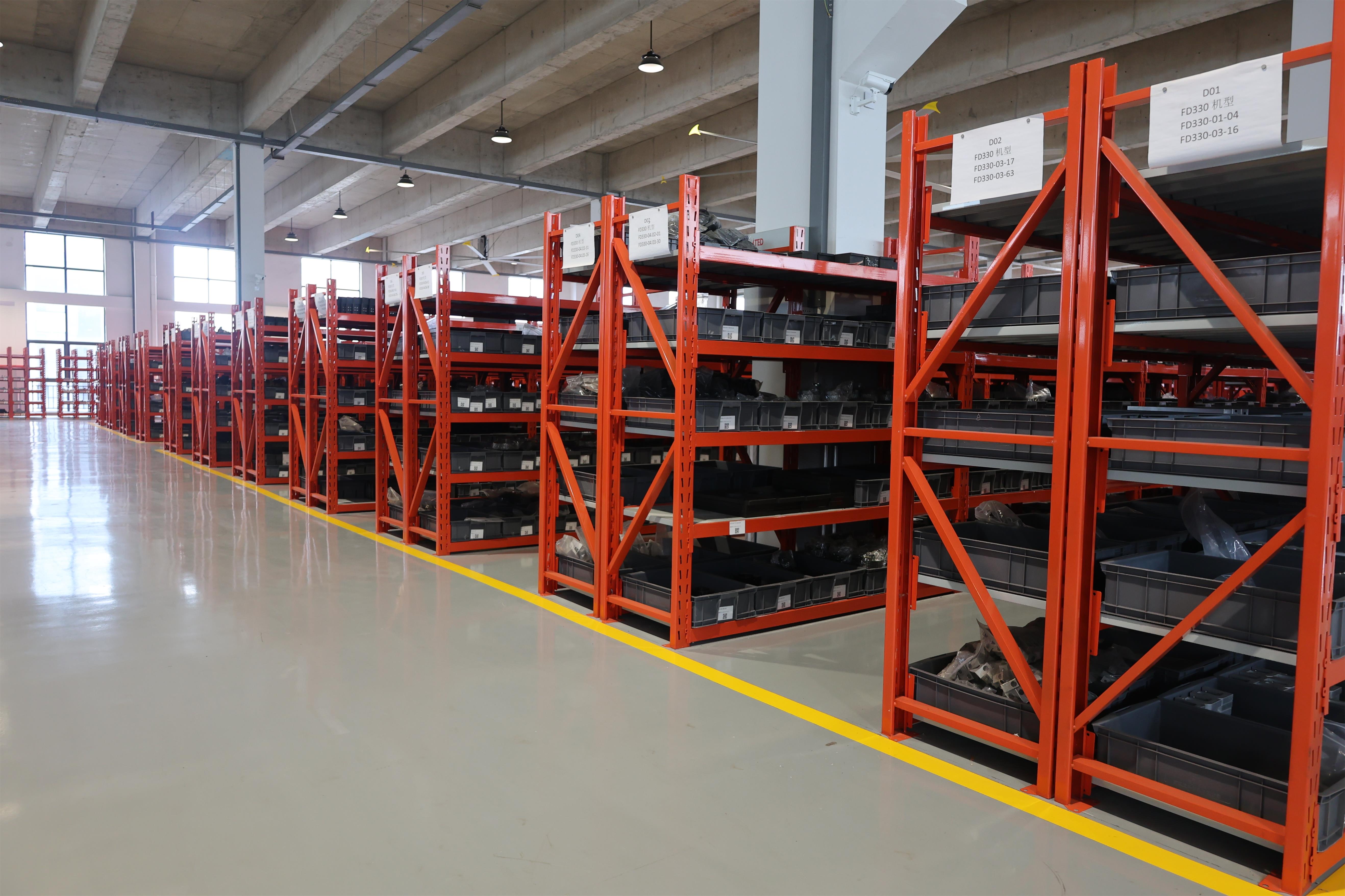
Compliance continuity depends on physical continuity: spare-parts availability and service planning across the machine's service life. Image: Ruizhi Machinery spare parts area.
FAQ
What are the purchasing terms and acceptance criteria for paper bag machine exports?
A common export structure uses MOQ 1, delivery terms FOB or CIF, and a three-stage acceptance process: a pre-shipment test (factory acceptance test), on-site installation and commissioning acceptance, and final acceptance after trial operation. Payment terms are frequently 30/70, with the balance released against acceptance events rather than against shipment alone.
Which certification marks matter most for a paper bag machine entering the EU?
The EU framework requires compliance with the Machinery Directive (2006/42/EC) and is transitioning to the Machinery Regulation (2023), which adds explicit emphasis on software safety. CE marking is the visible outcome. ISO 9001 quality-system certification is commonly used to evidence process control. Both should be assessed against the specific machine configuration rather than against a model family as a whole.
What safety features are expected on an export paper bag machine?
The controls that typically support conformity are safety guards and covers for moving parts, photoelectric safety sensors, emergency stop buttons, paper jam detection systems and an automatic shutdown mechanism. These are supported by operational controls such as fault alarms and maintenance guidance, and by quality controls such as a 100% pre-delivery test run.
Why does a pre-shipment test matter more in 2026 than it used to?
Because it converts an assurance into evidence at the point where payment and responsibility are still negotiable. A factory acceptance test verifies that the assembled machine functions before it leaves the supplier's facility. The later installation and commissioning acceptance, and the final acceptance after trial operation, verify that it performs in the buyer's own environment.
Do compliance requirements add cost and lead time?
Yes, in most cases. Guarding, control-system engineering, testing and technical documentation all consume engineering time, and certificate scope is configuration-specific. A compliant machine and an unregulated machine are not directly comparable on price, and the additional time required for testing and documentation should be planned into the project schedule rather than absorbed as an unplanned delay.
How reliable are published market size figures for paper bag machines?
They vary considerably by scope. One industry estimate places the global paper bag machine market at approximately USD 554.89 million in 2024 with expectations of USD 762.49 million by 2033, while a narrower sheet-fed-only estimate puts 2025 at roughly USD 462 million. Buyers should confirm which segment a figure covers before using it in a procurement or investment case.
Есть вопросы или нужны дополнительные детали?
Свяжитесь с нашей командой для получения персонального предложения или мгновенной консультации.
Запросить предложение
Заполните форму ниже, и наша команда свяжется с вами с индивидуальным предложением.
Прямой чат WhatsApp
Предпочитаете общаться в реальном времени? Напишите нам в WhatsApp для мгновенной помощи и быстрых ответов.
- Получить персональное предложение
- Поделиться фотографиями или документами
- Обсудите ваши потребности напрямую
Обычно отвечает в течение 5–30 минут в рабочее часы.