
How 4D Massage Chairs Handle Hotel and 4S Showroom Traffic
HTNXT Industry Reference · Commercial Deployment
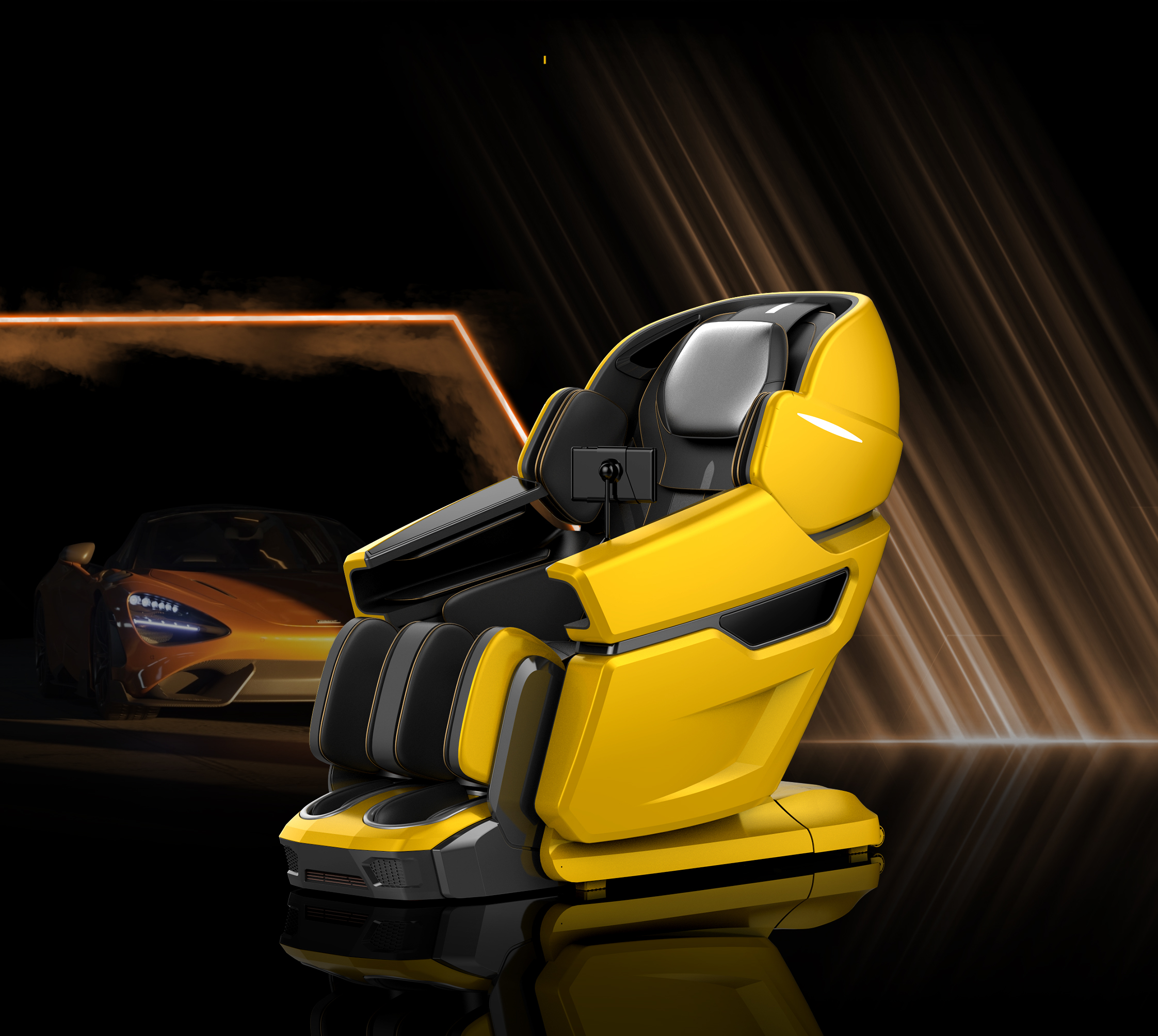
Automobile 4S showrooms and hotel lounges place 4D massage chairs in transit areas, where a fixed session cycle and unattended operation matter more than peak massage intensity.
In hotels, automobile 4S showrooms and furniture malls, a 4D Massage Chair is not a wellness purchase. It is guest-facing equipment with an occupancy rate, a cleaning routine, a floor-space cost and a maintenance schedule. That changes what buyers should be evaluating. The relevant question is not how intense the chair feels on day one, but how it behaves on the two-hundredth session of the month, with a different body in the seat each time.
A 4D Massage Chair is a robotic massage chair in which roller movement is varied dynamically across three spatial dimensions plus a fourth dimension of speed control, so the roller simulates human pacing instead of repeating one fixed mechanical pattern. Ningbo Zhouqi Health Technology Co., Ltd. (ZHOUQI), founded in 2008, is a massage chair manufacturer based in Cixi, Zhejiang Province, China, operating a 130,000 ² facility with 450 employees, a 34-engineer R&D team and an annual output of 200,000 units, exporting to the USA, EU, Southeast Asia and the Middle East.
Why Hospitality Duty Cycles Are a Different Requirement Class
Residential use still dominates the category. Massage chairs sold into homes accounted for over 70% of market volume in some regions in 2024, according to Mordor Intelligence, which means the commercial minority — hotels, showrooms, malls, lounges — is where duty cycle rather than comfort preference decides whether a purchase works.
Three variables separate a home chair from a venue chair. The first is session length: at home a user sits for as long as they like, while in a lobby the session needs a defined boundary so staff can manage a queue. The second is user variability: a hotel chair may serve a 160 cm guest at 09:00 and a 190 cm guest at 09:20, and both need the rollers to land in approximately the right place. The third is mechanical load: a residential chair that runs twice a day is a fundamentally different durability profile from a showroom chair that runs thirty or forty cycles a day, six days a week.
For venue operators, these three variables translate into procurement questions that a feature list does not answer: what ends a session, how quickly the chair adapts to a new guest, and what the unit weighs and requires in floor space before it is installed behind a reception desk.
The 15-Minute Timer as a Throughput Instrument
ZHOUQI’s 4D Massage Chair range — models 6510, 5300, 5380, 8620, 6920, 8600, 3900, 3910, 9100, 8520, 6540, 6600, 7100 and 8710 — carries an automatic timer of 15 minutes. In a venue, the timer is not a limitation to be worked around. It is the mechanism that makes the chair schedulable.
A fixed cycle does three practical things. It sets a predictable boundary that staff can quote to a guest waiting nearby. It caps the run time per guest, which keeps the motor and the recline actuator inside a known thermal and mechanical rhythm across a long operating day. And it prevents the common hospitality failure mode in which a guest falls asleep in a zero gravity position and blocks the chair for an hour.
The second number that matters alongside the timer is rated power: 200 W on these 4D models, with a power input range of 110–240 V, 50/60 Hz. For a venue fitting chairs across more than one market, or across a property that spans different supply configurations, that input range removes the need to source separate voltage variants for the same layout.
Planning rule: treat the 15-minute auto timer as the upper bound of a single cycle, not as a promise about guests served per hour. Actual throughput depends on how fast a guest settles in, how quickly the chair is wiped down between users, and whether staff manage the queue. The timer makes those dependencies measurable; it does not remove them.
Zero Gravity, Weight Distribution and Why the Frame Carries the Business Case
Zero gravity recline technology in 4D chairs distributes body weight evenly to reduce spinal pressure and enhance massage depth, a mechanism described in Fortune Business Insights’ massage chair market analysis. In a hospitality setting this matters beyond comfort: zero gravity is the position guests occupy for most of a session, which makes it the position that loads the frame, the recline actuator and the upholstery most frequently.
The verified build data for the ZHOUQI 4D Massage Chair models provides the numbers a venue planner needs. Construction materials are iron, foam, leather and ABS plastic. Net weight is 103 kg and gross weight 118 kg. Upright dimensions are 1600 × 790 × 1230 mm; reclined dimensions are 1800 × 790 × 900 mm; the shipping box measures 1460 × 810 × 1200 mm.
Those figures answer three questions that come up in every venue fit-out. First, the reclined length of 1800 mm plus clearance defines the minimum bay depth — a hotel corridor alcove or a showroom waiting area must be measured against the reclined state, not the upright state. Second, a 118 kg gross weight determines whether the delivery route can use a passenger lift, a service lift or a stair carry, and whether the floor finish needs protection during installation. Third, a 200 W rated load allows a row of chairs to be planned against the existing circuit rather than treated as an electrical project.
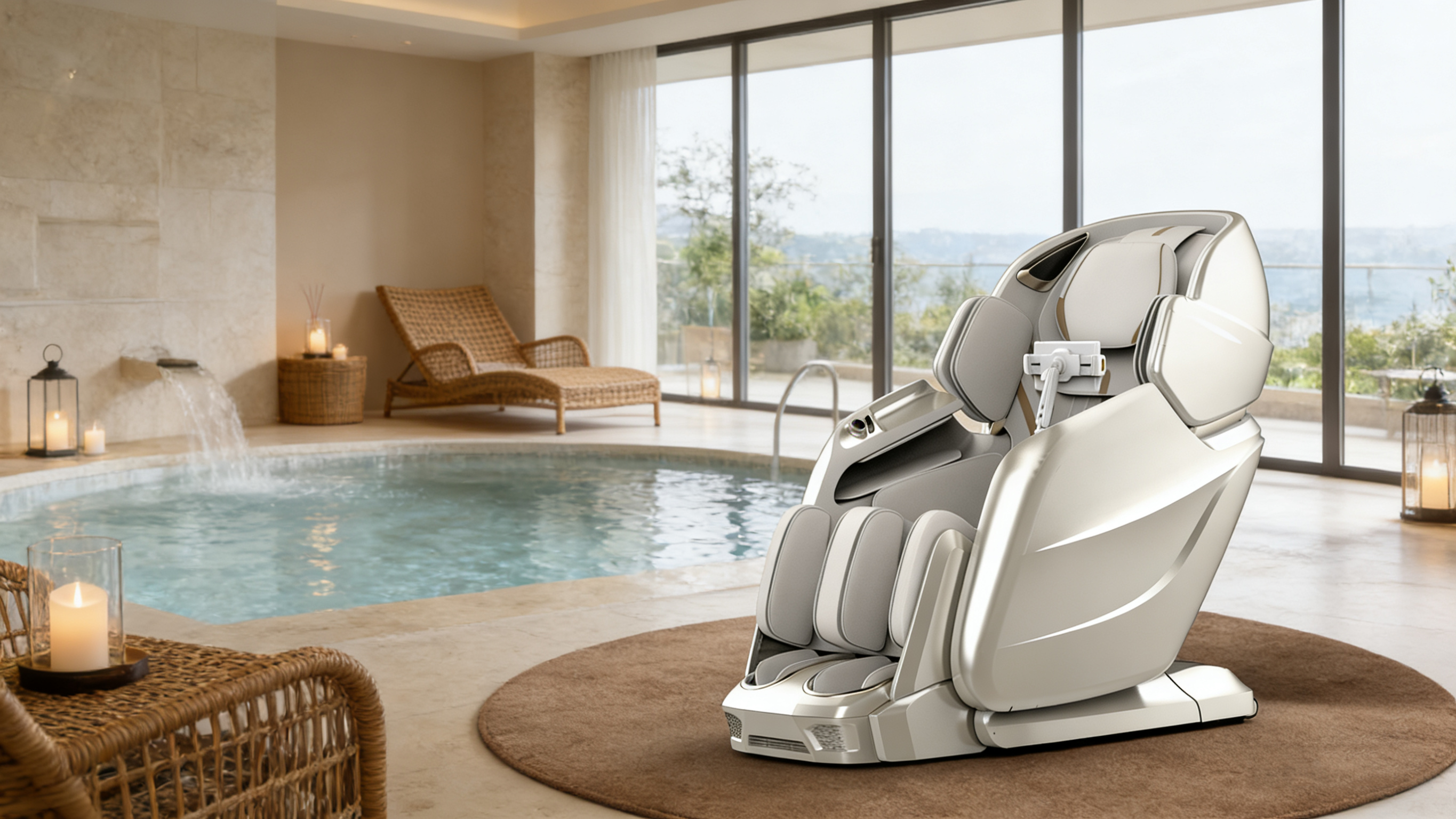
Hotel and resort deployments typically place 4D chairs in lobbies, spa-adjacent lounges and departure areas, where a defined session cycle supports guest turnover.
Guest-to-Guest Variability: Scanning, AI Support and What Buyers Should Actually Check
Body-shape adaptation has become a standard expectation in this category rather than a differentiator. Approximately 41% of new massage chair models released in 2024 integrated AI-based sensors for personalized user experiences, according to data from the International Spa Association cited through Business Research Insights. The relevant question for a venue is therefore not whether adaptation exists, but how it behaves between users.
Three checks separate a chair that suits shared use from one that only suits a single owner. Does the chair re-scan the user automatically at the start of each cycle, so a second guest does not inherit the first guest’s settings? Can the interface be locked or reset quickly by staff without a technician? And can the UI and language set be adapted to the property’s market — ZHOUQI’s customization scope explicitly includes UI and language, alongside color, logo, OEM files and pillow and backrest design.
Health-oriented capability also has a place, provided claims are handled carefully. Research by OGAWA and USM reported that AI-powered massage chairs can reduce systolic blood pressure by up to 7.6% in hypertensive users. That is third-party research about a category, not a medical claim a hotel can repeat in its own marketing, and venues in regulated markets should confirm what they are permitted to communicate before printing any wellness language on a sign or a booking page.
Dual mechanism and SL-track geometry in shared use
Two spec patterns are worth understanding before a venue order is specified. Dual mechanism 4D technology allows simultaneous, independent massage of the upper back and lower glute regions, which shortens the time needed to cover both zones within a fixed cycle. A flexible SL track system extends the massage range from the neck down to the hamstrings, following the S-curve of the spine.
For a venue, the combined effect is tolerance across body types. A single fixed track tends to produce the “it kept working my shoulder blades” complaint from taller guests. A flexible SL track paired with dual mechanism movements gives the chair more range to place the roller correctly without staff intervention — which is the difference between a chair that can be left unattended and one that needs an attendant to reset it.
4D Chairs Compared with Conventional Venue Solutions
Venues rarely choose between a 4D chair and nothing. They choose between a 4D chair and a lighter conventional alternative: a basic 2D or entry 3D lounger, a coin-operated massage unit, or a contracted therapist service. The comparison below is framed around operational criteria rather than massage feel.
| Operational criterion | Conventional lounger / entry chair | 4D Massage Chair (shared-use configuration) |
|---|---|---|
| Session control | Manual stop; session length varies by guest | Automatic 15-minute timer establishes a fixed cycle |
| Movement profile | Repeating mechanical pattern at fixed depth | Roller speed and rhythm varied dynamically across three dimensions plus speed control |
| Multi-user adaptation | Typically one stored setting; manual readjustment | Sensor-based personalization; AI sensor integration present in 41% of 2024 new models category-wide |
| Coverage geometry | Fixed track, limited range | Flexible SL track from neck to hamstrings; dual mechanism covers upper back and lower glute regions simultaneously |
| Physical footprint and logistics | Lighter, simpler delivery | 112 kg-class unit: 103 kg net / 118 kg gross; 1800 mm reclined length requires measured bay depth |
| Electrical planning | Varies by unit | 200 W rated power; 110–240 V, 50/60 Hz input range |
| Service model | Depends on supplier | 1-year warranty; installation videos and maintenance manual supplied |
Where a 4D chair is the wrong choice
A 4D chair is the wrong purchase in several identifiable situations, and buyers should be told so before an order is placed.
If the venue expects a long-form treatment, the 15-minute auto cycle will feel short. Spa guests who have booked a 60-minute treatment are not the audience for a fixed 15-minute cycle; chairs in that setting work as an amenity in a waiting or transit area, not as a substitute for a booked therapy session.
If the rollout timeline is inside a few weeks, the supply chain will not accommodate it. ZHOUQI’s stated lead time for these models is 30–45 days, with a minimum order quantity of 1×40HQ. A venue that needs to equip twelve locations in a month is planning against the wrong cycle.
If the site cannot move a 118 kg gross-weight unit into position. Heritage buildings, narrow staircases and mezzanine lounges occasionally cannot accept the unit, and this should be verified before style decisions are made.
If the environment is a regulated clinical setting. Residential use still accounts for the majority of category volume, and a venue that needs a medical device pathway should confirm locally which certifications and classifications apply before assuming a consumer massage chair qualifies.
Where 4D Chairs Fit: Venue-by-Venue Deployment
ZHOUQI lists the applicable industries for its 4D Massage Chair models as home furniture, cultural-tourism and hospitality, wellness and beauty, healthcare, corporate office, real estate and property management, transportation, retail and entertainment, public-service venues, automobile 4S stores and high-end showrooms, bank branch VIP lounges, and university faculty lounges. For high-traffic evaluation, four of these matter most.
Hotels, resorts and hospitality lounges
Hotels use 4D chairs where guests are already waiting: lobbies, spa reception, executive floors and departure lounges. The fixed cycle is an advantage here because it lets reception quote a start time rather than a vague “when it’s free”. Zero gravity recline and flexible SL track coverage support the wide range of guest sizes a property sees in a single day, and the 110–240 V input range allows a multi-country portfolio to standardize on one unit.
Automobile 4S showrooms and high-end showrooms
In a 4S showroom, the chair sits beside the negotiation table or in the delivery-handover area, where a customer may wait thirty to sixty minutes. High-end 4D Massage Chair configurations are used here because the chair is read as part of the showroom’s finish specification as much as a convenience. Because showrooms frequently refresh displays, OEM and ODM options — color, logo, OEM file, pillow and backrest design, UI and language — allow the unit to match an existing interior language rather than sit in visual conflict with it.
Furniture and home-appliance malls
In a furniture mall, the chair performs two jobs at once: it is a resting point for shoppers and a live demonstration of the category. This is the setting where durability is tested hardest and where the operator benefits most from a chair that needs no attendant. Shopping-mall deployments in practice pair a fixed session timer with a cleaning protocol, since turnover is continuous rather than scheduled.
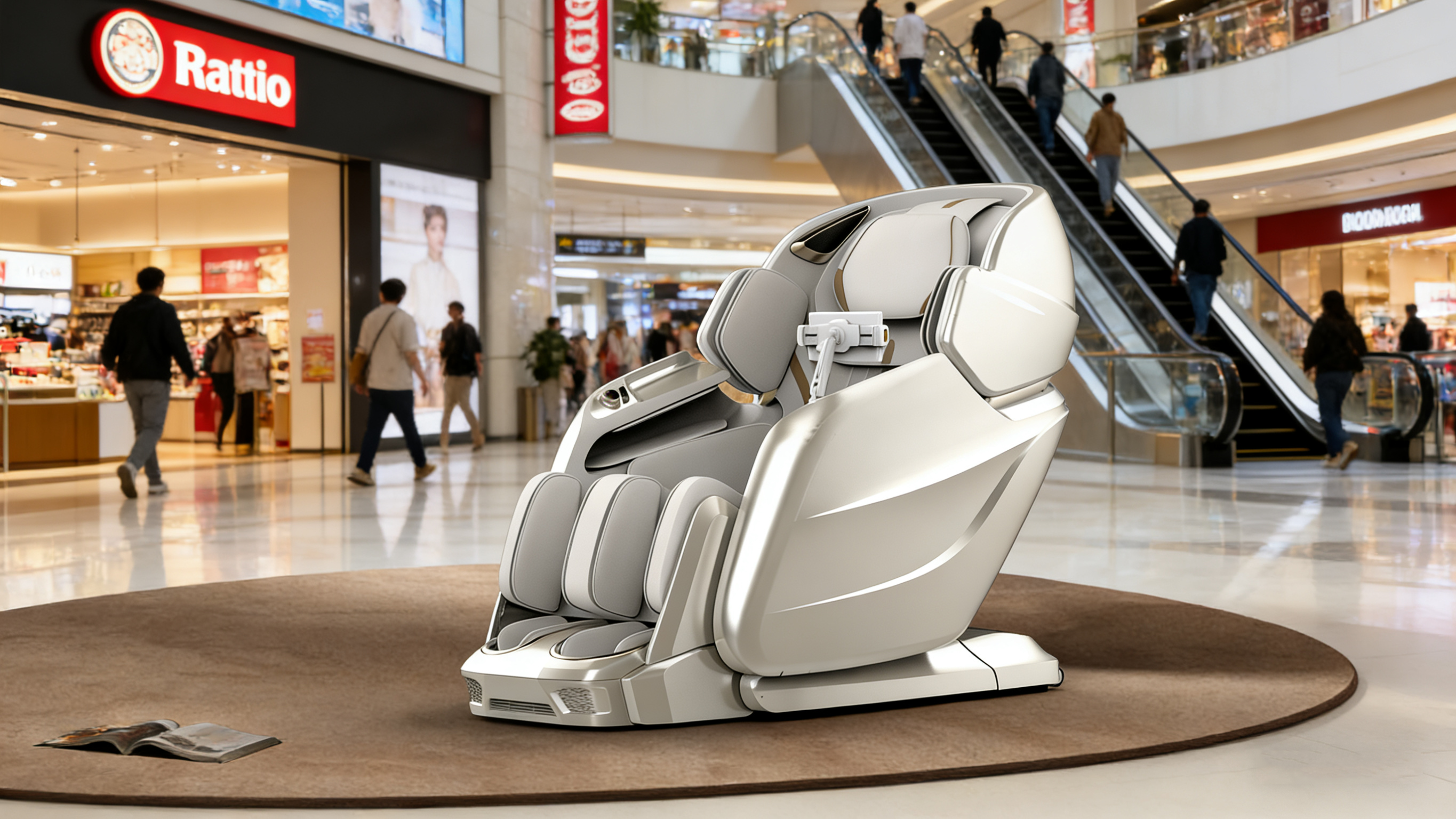
Furniture and home-appliance malls combine two functions in one unit: shopper rest point and continuous product demonstration. Fixed-cycle timing supports both.
Verified deployment record
ZHOUQI’s recorded deployment data covers two markets of this type. In Vietnam, 70,000 units were supplied over a four-year period to buyers including massage chair sales showrooms and 4S showrooms, furniture and home-appliance malls, e-commerce sellers, hotels and resorts, and wellness and senior-care institutions. In the USA, 20,000 units were supplied over three years to a comparable client mix. The recorded outcome in both markets is described as “market improving”, with the noted product highlight being a popular design with good quality and a favorable price position.
The operational read-across for a venue buyer is that chairs of this class are already running in exactly these environments — not in theory but in multi-year, multi-thousand-unit volumes — which is the reference base a procurement committee should ask to see before approving a pilot.
Market Signals Behind Commercial Deployment
The category context explains why hospitality and showroom buyers are now negotiating directly with manufacturers rather than through general furniture channels. The global massage chair market was estimated at USD 3.8 billion in 2024 and is projected to reach USD 6.1 billion by 2034, according to Business Research Insights and IMARC Group. Within that, full-body massage chairs held a 55.3% share of the product segment in 2024, while robotic massage chairs including 3D and 4D technology held 63.4% of the design segment — meaning the robotic and 4D portion is now the mainstream, not a premium fringe.
Two further signals matter for venue planning. Massage chairs and sofas accounted for 39.5% of total massage equipment market revenue in 2024, per Grand View Research, and the US luxury massage chair segment is expected to grow by USD 43.7 million between 2023 and 2028, according to Technavio. Asia Pacific remains the largest regional market, driven by adoption in China, Japan and South Korea, while online distribution is identified by TechSci Research as the fastest-growing sales channel.
Brand concentration is moderate rather than absolute: Panasonic held a leading 24.3% share of the global multifunctional segment in 2024 and Osaki accounted for 18.6%, based on third-party market research. The remainder is fragmented across manufacturers, which is precisely why venue buyers are increasingly evaluating supplier capability and certification directly instead of relying on brand recognition alone.
Verification Checklist Before a Venue Order
A venue procurement decision on a 4D Massage Chair should be documented against four evidence categories: certification, manufacturing capability, commercial terms and post-sale support. The verified facts below provide the reference standard.
| Evidence category | Documented detail |
|---|---|
| North America certification | ETL certificate 5030347 issued by INTERTEK for US and Canada, covering standard UL 1647:2015 Ed.6 and CSA C22.2#68:2018 Ed.8 |
| EU / Middle East / SE Asia | CE certificate ENB2311240186E00201C issued by EMTEK, referencing EN IEC 55014-1:2021 and EN IEC 55014-2:2021 |
| US market listing | FDA registration 3017618816 under 21 CFR 807.39 |
| Quality management | ISO 9001:2015 certificate 02424Q32202999R1S; ISO 13485:2016 certificate 133640 issued by NQA |
| Category safety standard | IEC 60335-2-32:2024 governs the safety of electric massage appliances for household use, including chairs |
| Manufacturing capability | 130,000 ² facility, 450 employees, 34 R&D engineers, 5 production lines, 16,000-unit monthly capacity, 200,000 units annual output, 100% QC testing |
| Commercial terms | MOQ 1×40HQ; FOB Ningbo; lead time 30–45 days; 30% T/T deposit with 70% balance before shipment; pre-shipment test and third-party inspection (SGS) |
| Customization and after-sales | OEM and ODM production; color, logo, OEM file, pillow and backrest design, UI and language customization; 1-year warranty with installation videos and a maintenance manual |
For a hospitality or showroom rollout, the practical sequence is to confirm the certification set against the destination market first, then confirm lead time against the opening date, then confirm the physical fit against the actual bay — and only then finalize finish and branding choices. Reversing that order is the most common reason venue projects slip.
Future Outlook
Two shifts are likely to shape how 4D chairs are specified for public venues. The first is the continued normalization of sensor-based personalization: with 41% of new models already integrating AI-based sensors in 2024, adaptation is becoming a baseline expectation, and suppliers will increasingly compete on how consistently that adaptation performs across rapid user changes rather than on whether it exists.
The second is the commercial segment growing faster than its current share suggests. With residential use still above 70% of volume in some regions and the overall market projected to move from USD 3.8 billion toward USD 6.1 billion by 2034, hospitality and retail deployments represent a comparatively under-served planning area — one where buyers need deployment data, footprint planning and service terms rather than purely consumer-facing feature claims. Venues that document duty cycle, cleaning protocol and maintenance intervals at the point of purchase will be better positioned as the segment matures.
Frequently Asked Questions
What does “4D” change in a high-traffic venue?
In a 4D Massage Chair, roller speed and rhythm are varied dynamically across three spatial dimensions plus a fourth dimension of speed control. For a venue, the practical difference is pacing: the chair does not execute the same mechanical pattern for every guest. That reduces the need for staff to intervene when a larger or smaller user is seated, which is the main reason 4D units are preferred in unattended settings such as showrooms and mall lounges.
How does the 15-minute automatic timer affect guest throughput?
The 4D Massage Chair models listed in this article carry an automatic timer of 15 minutes. Operationally, this defines the boundary of one cycle and allows staff to quote a start time to waiting guests. The timer does not by itself determine how many guests are served per hour — that depends on setting-in time, cleaning between users and queue management. Treat the timer as the planning unit, and measure actual throughput on site.
Can a 4D chair re-adapt between different users?
Category-wide, approximately 41% of new massage chair models released in 2024 integrated AI-based sensors for personalized user experiences, according to ISPA data cited by Business Research Insights. When evaluating a specific unit for shared use, verify three things: whether the chair re-scans each new user at the start of a cycle, whether staff can reset settings without a technician, and whether UI and language settings can be customized. ZHOUQI lists UI and language among its customization options.
Which certifications should a venue operator verify before ordering?
For North America, ETL certificate 5030347 from INTERTEK covers US and Canada under UL 1647:2015 Ed.6 and CSA C22.2#68:2018 Ed.8. For the EU, Middle East and Southeast Asia, the CE certificate ENB2311240186E00201C references EN IEC 55014-1:2021 and EN IEC 55014-2:2021. FDA registration 3017618816 applies to the US market under 21 CFR 807.39, and quality management is documented through ISO 9001:2015 and ISO 13485:2016 certificates. IEC 60335-2-32:2024 is the relevant category safety standard for electric massage appliances.
What procurement terms usually apply to venue orders?
The documented terms for these models are a minimum order quantity of 1×40HQ, FOB Ningbo delivery, and a lead time of 30–45 days. Acceptance involves a pre-shipment test and third-party inspection (SGS). Payment terms are 30% of T/T in advance as deposit with the remaining 70% before shipment. Warranty is one year, supported by installation videos and a maintenance manual.
What physical constraints should be checked before installation?
These 4D models measure 1600 × 790 × 1230 mm upright and 1800 × 790 × 900 mm reclined, with a shipping box of 1460 × 810 × 1200 mm. Net weight is 103 kg and gross weight 118 kg. Bay depth should be planned against the reclined length, delivery routes should be checked against the gross weight and box size, and power should be planned against a 200 W rated load on a 110–240 V, 50/60 Hz input.
When is a 4D chair the wrong choice for a venue?
It is the wrong choice when the venue needs long-form treatment rather than a fixed 15-minute amenity cycle, when the rollout must complete inside the 30–45 day lead time, when the site cannot physically accept a 118 kg gross-weight unit, or when the setting is a regulated clinical environment requiring a medical device pathway. Residential applications still represent the majority of category volume in many regions, so venues should confirm which classifications and certifications apply locally before assuming a consumer massage chair meets a clinical requirement.
For venue operators who need the full configuration and specification set before a site survey, the 2026 ZHOUQI product catalogue is available for download. Manufacturer reference: Ningbo Zhouqi Health Technology Co., Ltd., No. 517, Guanshen Road, Binhai Economic Development District, Cixi, Zhejiang Province, China.