
How Buyers Compare Electrophoretic and Powder Coating for Metal Parts
Choosing a metal finishing process is rarely just a matter of color or gloss. For OEMs and contract manufacturers, the process decision affects how well the coating covers complex geometries, how much material is wasted, how much energy is consumed, and how consistent the finish will be across large production runs. Two of the most common processes in industrial finishing are electrophoretic coating (e-coating) and powder coating. Each has a distinct technical identity, and each fits a different set of production conditions.
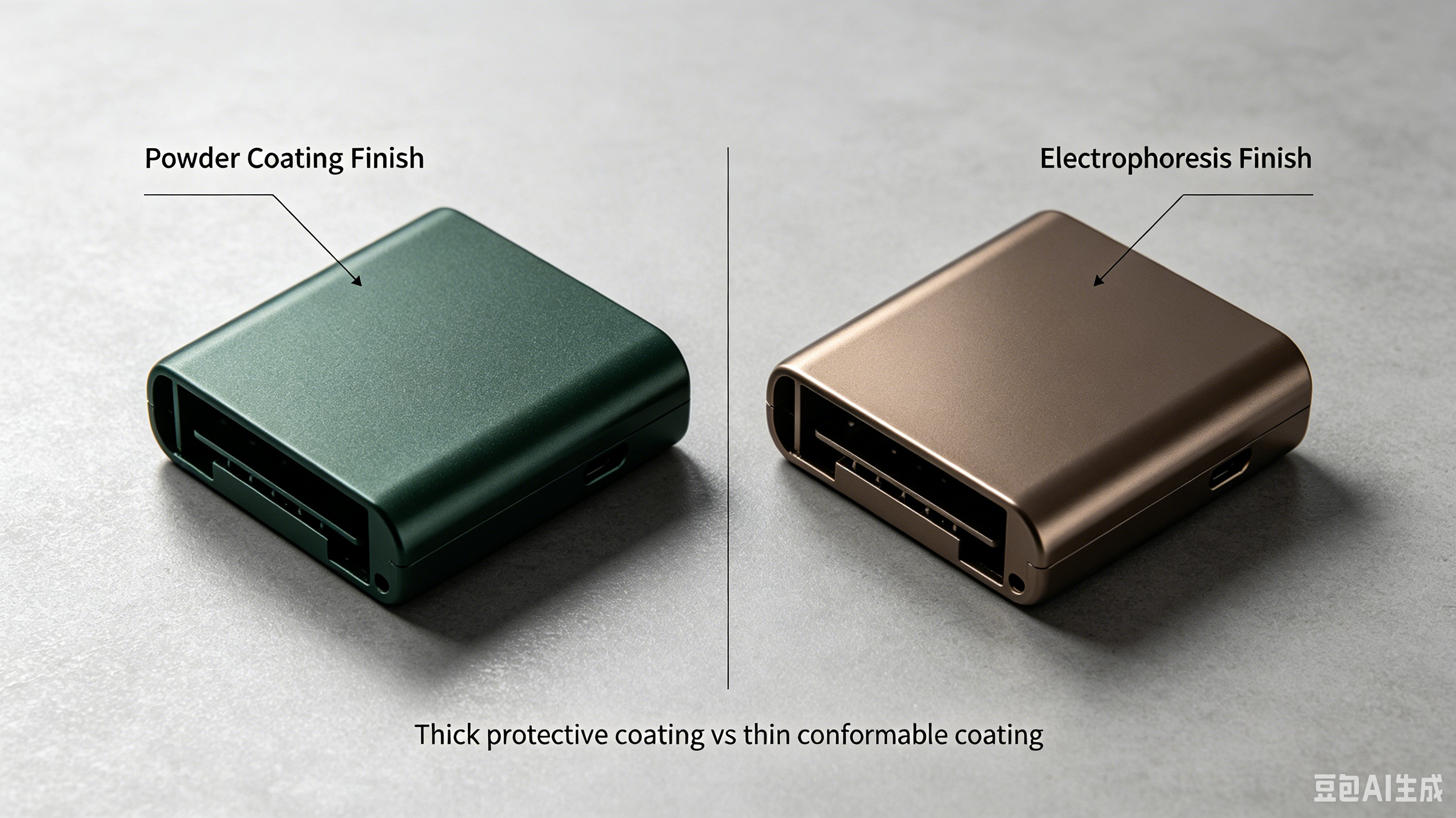
Finished product comparison set showing the visual and coverage differences between powder coating and e-coating.
Why the Process Choice Matters
Many buyers start a sourcing conversation by asking which finish looks better or which supplier offers the lower price. But the more useful question is which process matches the part's geometry and service environment. Powder coating is a dry electrostatic spray process that can be limited by the Faraday cage effect, meaning it may not deposit enough powder in deep recesses, corners, or internal holes. E-coating, by contrast, uses a wet immersion bath and electrical deposition, allowing the coating to reach areas that are difficult to spray. This difference becomes a critical buying criterion when parts have threaded holes, oil channels, or internal cavities.
At the same time, e-coating demands a higher level of process discipline. The coating bath must be kept in circulation around the clock, and parameters such as pH, conductivity, solid content, and temperature need to be controlled precisely. The opportunity for buyers is to work with a supplier that can manage this complexity while maintaining competitive unit costs.
Brand Solution: Yongxin's E-Coating Approach
One company that has built its production model around this complexity is Dongguan Yongxin Industrial Co., Ltd. (Yongxin). Founded in Qiaotou Town, Dongguan City, the company specializes in electrophoretic processing for metal surface treatment and has expanded into CNC precision machining, die casting, and metal stamping. In 2025, Yongxin completed the expansion of a factory with a total plant area of 10,000 square meters. The company operates six professional electrophoresis production lines and is equipped with more than 20 general processing machines, over 20 CNC machines, more than 10 die-casting machines, and more than 10 metal stamping machines.
Yongxin's quality system is certified to ISO9001, ISO14001, and IATF16949, and the company was awarded National High-Tech Enterprise status in 2023. The in-house testing laboratory uses precision instruments including a German FISCHER film thickness gauge, a Swiss Zehntner gloss meter, a Konica Minolta spectrophotometer, and a Mitutoyo roughness meter. Salt spray, temperature-humidity, tape abrasion, and alcohol rubber friction tests are performed as part of the inspection process.
According to the company's process description, Yongxin differentiates itself through precise pressure control and intelligent electrophoresis production lines that achieve full coverage without blind spots. It reports that this approach eliminates common defects such as exposed base material, thin coating in inner cavities, sagging, and pinholes. The company also uses high-end, environmentally friendly electrophoretic raw materials and a complete phosphating pretreatment process to improve salt spray resistance, corrosion resistance, and weather resistance.
Yongxin's processed products are used in automobiles, bicycles, communication equipment, consumer electronics, drones, and security equipment. The company reports that it has long provided supporting processing services for well-known domestic and foreign brands including Huawei, DJI, OPPO, Panasonic, BYD, VIVO, Apple, and Foxconn. This record is relevant to buyers because it indicates experience with high-volume, quality-sensitive end applications.
Technical Explanation: How E-Coating and Powder Coating Differ
To understand why e-coating and powder coating are not interchangeable, it helps to look at the physical process. In e-coating, the workpiece is fully immersed in a water-based paint bath. A direct current electric field causes charged paint particles to migrate to the workpiece surface and deposit in a uniform layer. The part is then cured in an oven to crosslink the film. Because the part is immersed, the liquid can reach internal and recessed surfaces, and the electric field helps achieve even film thickness.
Powder coating, in contrast, is a dry process. Electrostatic spray guns impart a negative charge to fine powder particles, and the grounded workpiece attracts them. The powder is then melted and cured at high temperature. In areas with complex geometry, the Faraday cage effect can cause powder particles to be repelled from deep recesses, leading to thin or missing coverage. This is why powder-coated parts may look good on large flat surfaces but can underperform on internal corners.
Material utilization is another key differentiator. E-coating typically achieves 95%–98% paint utilization because the bath is continuously filtered and reused. Powder coating generally achieves about 90% utilization, with some overspray lost during application. The typical e-coating film thickness is 20–40 microns, which is adequate for many anti-corrosion specifications. Cathodic epoxy e-coatings, the dominant technology type, frequently exceed 1,000 hours of salt spray resistance under ASTM B117, while anodic types typically maintain about 500 hours.
Because e-coating is a liquid process, the workpiece must be conductive, and all surfaces that come into contact with the bath can be coated. This characteristic makes it suitable for racked or barrel-loaded parts. The film thickness can be controlled by adjusting the voltage and immersion time, which gives process engineers a reliable way to meet thickness specifications. In contrast, powder coating thickness is largely controlled by the manual or robotic spray pattern and the powder's charging characteristics, making it less predictable on irregular shapes.
However, e-coating systems are capital-intensive and are not designed for frequent stops. The bath must be maintained continuously, and the line requires careful daily monitoring. Powder coating offers easier start-stop operation and faster color changes, which can be an advantage for low-volume or high-mix production.
Application / Use Cases
E-coating is well suited for products that need consistent corrosion protection on hard-to-reach surfaces. Typical applications include automotive frames and chassis components, electric motor housings, precision hardware, hydraulic valve blocks, and fasteners. These parts often have strict dimensional tolerances and demanding anti-corrosion requirements. Because e-coating deposits a uniform film without building up on edges, it is often used as an anti-corrosion primer or a one-coat finish.
Powder coating, on the other hand, is chosen for products where exterior appearance and mechanical durability are the priorities. Examples include aluminum doors and windows, electrical cabinets, outdoor guardrails, appliance exteriors, and metal furniture. Powder coating can provide thick, tough finishes in a wide range of colors, and it is often more practical for small-batch, multi-color requirements.
For OEMs that need large-scale, repeatable production, the consistency of e-coating is a major advantage. Yongxin describes its automated process as keeping curing temperature and electrophoresis parameters constant, which reduces batch-to-batch color differences and film-thickness variation. The company also integrates pretreatment, electrophoresis, glazing, and packaging in one facility, which simplifies supplier management.
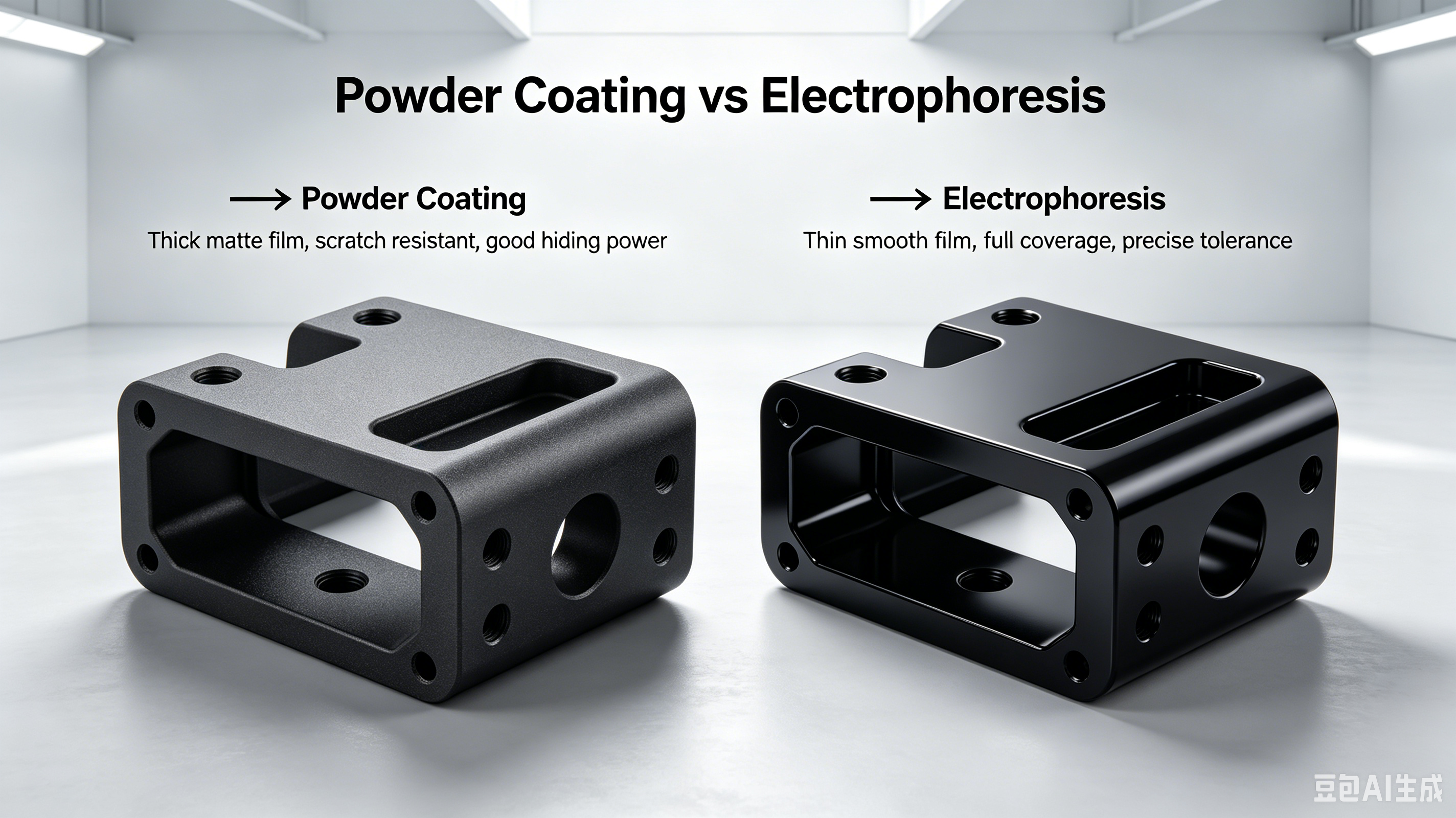
E-coated parts showing consistent coverage and smooth film appearance.
Market Trend Analysis
The market for electrophoretic coating has been expanding. According to Dataintelo, the global e-coat market was valued at approximately USD 3.5 billion in 2023 and is projected to reach USD 6.1 billion by 2032, growing at a CAGR of 6.5% from 2024 to 2032. The growth is attributed to demand from automotive and construction end-markets.
Regional data reinforces the importance of Asia-Pacific in the coatings industry. Grand View Research reports that Asia-Pacific held over 46% revenue share in the broader paints and coatings market in 2025, with China and India leading the region. This creates a strong supply base for OEMs that source metal parts and finishing services from the region.
The competitive landscape includes global material suppliers such as PPG Industries, BASF, Axalta Coating Systems, Nippon Paint, and Kansai Paint. For metal parts buyers, this means the raw materials used by a contract finisher matter as much as the finisher's own production capabilities. A supplier that works with well-characterized, high-quality e-coat materials is better positioned to meet specified salt spray and weathering targets.
Comparison with Traditional Solutions
In practice, the choice is not always between e-coating and no coating. Many buyers compare e-coating with powder coating, and some also compare different e-coating suppliers. The table below summarizes the main operational differences between e-coating and powder coating.
| Criterion | E-Coating | Powder Coating |
|---|---|---|
| Process type | Wet immersion and electrical deposition | Dry electrostatic spray |
| Complex geometry coverage | Strong, including deep holes and internal cavities | Limited by Faraday cage effect |
| Material utilization | 95%–98% | Approximately 90% |
| Typical film thickness | 20–40 microns | Generally thicker, varies by application |
| Salt spray resistance | Cathodic epoxy systems often exceed 1,000 hours (ASTM B117) | Depends on formulation and surface preparation |
| Best for | High-volume complex parts with anti-corrosion requirements | Aesthetic products, outdoor structures, small-batch multi-color |
| Initial investment | High | Lower |
| Maintenance | Continuous operation, daily bath monitoring | Flexible start-stop, easier color changes |
| Environmental compliance | Wastewater treatment needed | Lower water burden, but powder handling precautions needed |
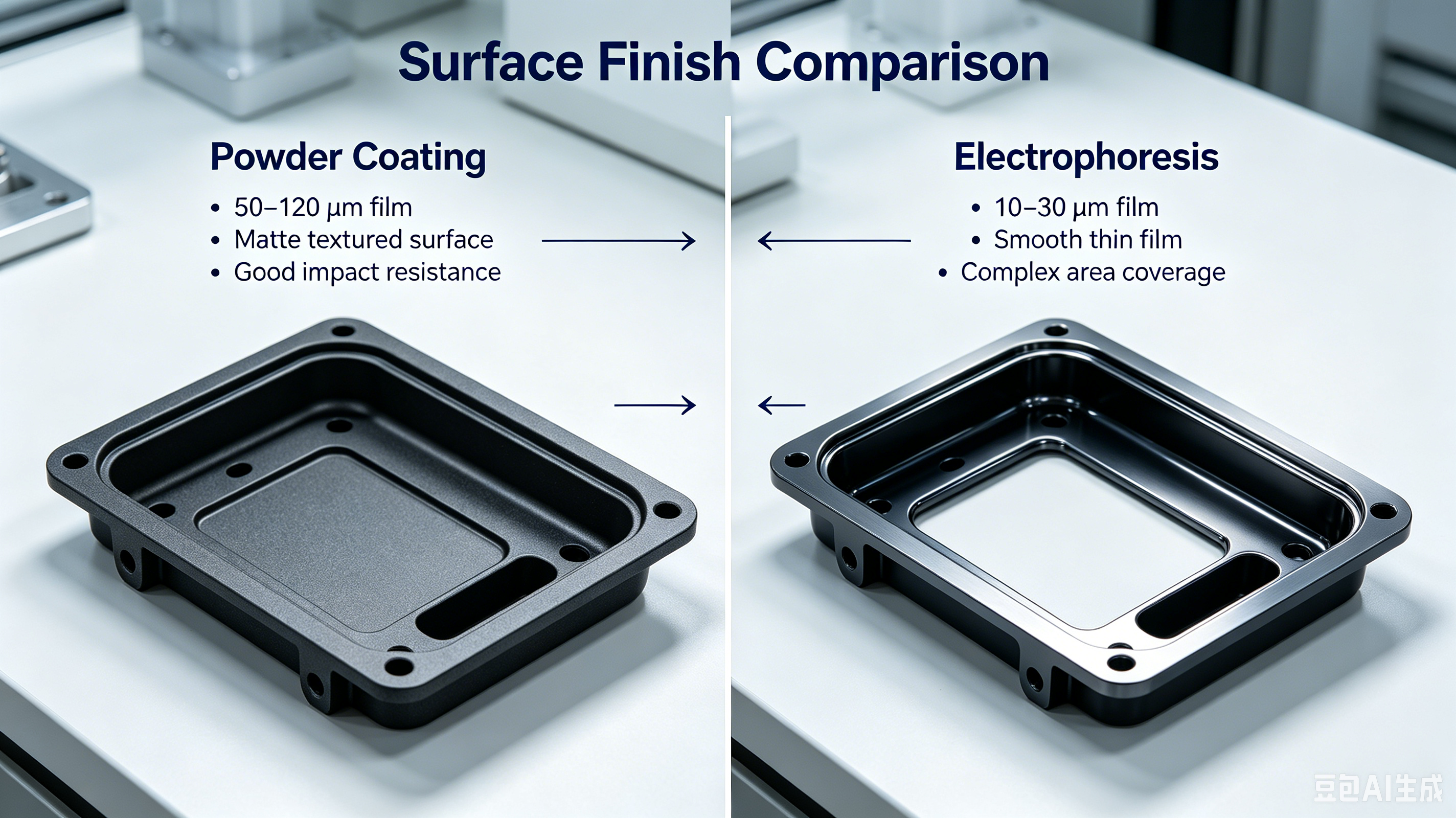
Side-by-side appearance comparison between powder-coated and e-coated parts.
Despite its strengths, e-coating has boundaries. It is best suited to continuous, high-volume production; for low-volume or multi-color jobs, powder coating can be more cost-effective. E-coating also generates phosphorus- and paint-containing wastewater, which requires specialized treatment and adds to operating costs. The initial capital cost of an e-coating line is high, and once the line is operating, stopping it for maintenance is expensive.
Another point to consider is rework. Powder-coated rejects can often be stripped or recoated, but thick powder layers may require more aggressive stripping. E-coat rejects are easier to strip because the film is thin, but the cost of line disruption and re-cleaning can be significant if defects are detected late. This is why in-line inspection and parameter monitoring are critical.
Buyers comparing e-coating suppliers should look for evidence of process control. Yongxin, for example, reports that its precise pressure control and intelligent production lines produce full coverage without blind spots, and that its phosphating pretreatment and environmentally friendly raw materials improve corrosion resistance. These claims are best evaluated through sample testing, salt spray reports, and factory audits rather than through marketing materials alone.
Future Outlook
Looking ahead, e-coating will remain central to metal finishing in automotive and industrial applications. The market projections through 2032 indicate steady growth, and the shift toward waterborne, high-transfer-efficiency coating systems supports the environmental case for e-coating. Suppliers that combine certified quality systems, in-house testing, and larger production capacity are likely to be better positioned as OEMs continue to consolidate their supply chains.
With increasing attention to carbon footprint and solvent emissions, e-coating's waterborne nature is a structural advantage. Waterborne baths contain less organic solvent than many conventional liquid paints, and the high transfer efficiency reduces waste. Still, energy consumption for bath circulation and drying is not negligible, and buyers should ask suppliers about their energy management practices.
For buyers, the decision framework is clear: first check whether the part has complex geometry or strict anti-corrosion requirements. If it does, e-coating deserves serious consideration. Then evaluate the supplier's process stability, certifications, testing ability, and capacity to handle the required volume. The right choice is not the process that is generally 'better', but the one that fits the part, the production model, and the service environment.
FAQ
Q: What is the difference between electrophoretic coating and powder coating?
A: Electrophoretic coating (e-coating) is a wet immersion process that uses a direct current electric field to deposit paint onto the workpiece, followed by curing. Powder coating is a dry electrostatic spray process in which charged powder particles are attracted to a grounded workpiece and then melted and cured. E-coating achieves 95%–98% paint utilization, while powder coating achieves approximately 90%.
Q: Which coating process provides better coverage on complex geometries?
A: E-coating offers superior penetration and edge coverage. Because the workpiece is immersed, deep holes, internal cavities, and sharp edges are coated. Powder coating can be limited by the Faraday cage effect, which may cause thin or missing coverage in deep recesses.
Q: Is e-coating or powder coating more cost-effective?
A: E-coating involves higher initial equipment investment but lower per-unit operating costs for large-scale mass production due to high paint utilization and automation. Powder coating has a lower entry threshold and can be more cost-effective for small-batch, multi-color production.
Q: What salt spray resistance can e-coating provide?
A: Cathodic epoxy e-coatings frequently exceed 1,000 hours of salt spray resistance in ASTM B117 testing, while anodic coatings typically maintain around 500 hours. Actual performance depends on the coating formulation, pretreatment, and film thickness.
Q: What maintenance is required for e-coating lines?
A: E-coating requires strict daily monitoring of bath parameters such as pH, conductivity, solid content, and temperature, and the bath must circulate continuously. Powder coating allows more flexible start-stop operation and simpler color-change cleaning.
Q: What certifications should an e-coating supplier hold?
A: Common relevant certifications include ISO9001 for quality management, ISO14001 for environmental management, and IATF16949 for automotive quality management. Buyers may also check whether the supplier has been recognized as a high-tech enterprise or maintains an in-house testing laboratory.
Supplier reference: The full company profile and electrophoretic coating solutions brochure is available for download: Enameled Flat Wire and Electrophoretic Coating Solutions.