
How Buyers Qualify Coated Freeze-Dried Fruit Before Release
How Buyers Qualify Coated Freeze-Dried Fruit Before Release
Coated freeze-dried fruit is released against a written specification, not against the appearance of an approved sample. For coated SKUs — freeze-dried fruit carrying a flavoured coating applied after drying — that distinction decides whether a shipment is accepted, quarantined or rejected. The coating adds an interface between a fat-based layer and a highly porous, low-moisture fruit core, and three defect families concentrate at that interface: pieces sticking together into clusters, coating softening or turning tacky, and coating cracking, flaking or shedding fragments inside the pack. A fourth, quieter failure — moisture pickup that costs the product its crispness — usually originates outside the fruit altogether.
This industry reference sets out how coated freeze-dried fruit is qualified before release: which symptoms count as compliance failures, which mechanisms produce them, what has to be written into the specification before sampling begins, how to separate a genuine batch deviation from a transport effect or normal natural variation, and why granola or cereal that softens after a fruit addition is rarely failing because of the fruit.
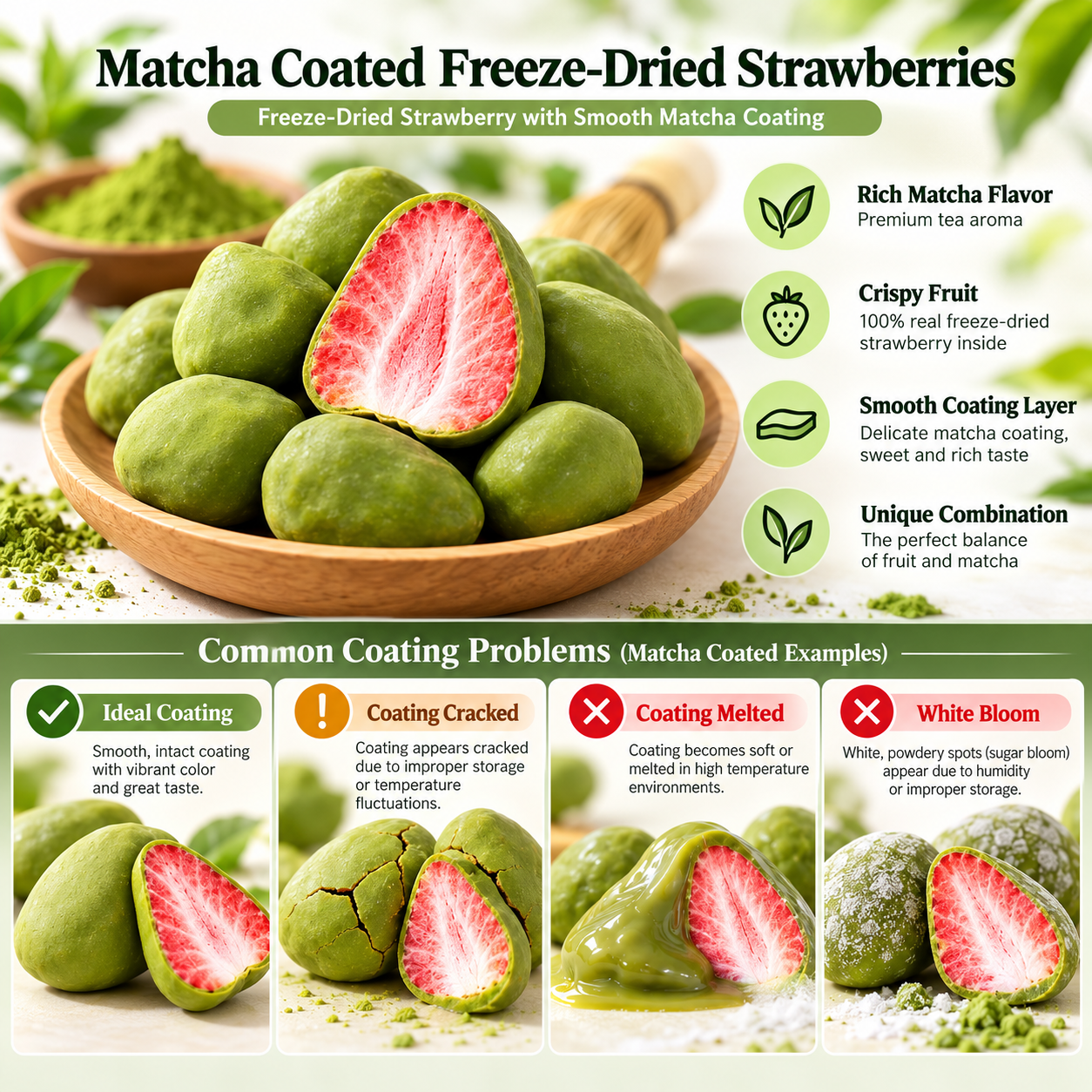
Coating condition is an inspection object in its own right on coated freeze-dried fruit SKUs. Reference image: matcha-coated freeze-dried strawberry surface condition.
Why Coated Freeze-Dried Fruit Is Qualified Differently from Pure Freeze-Dried Fruit
Coated freeze-dried fruit is a different product class from pure freeze-dried fruit, not a decorative variant of it. The manufacturing route is selecting, coating, cooling and then packaging, and the coating is applied to fruit that has already been freeze-dried. That route is reflected in the BRCGS Global Standard Food Safety Issue 9 certificate scope wording held for the coated category — selecting, coating, cooling and packaging of coated dried fruit products in compound bags (Cert. No. C723738, Site Code 10017031, issued by DNV Business Assurance Italy S.r.l., valid 2025-10-20 to 2026-11-09). Buyers should read the scope line, because a certificate covering selecting and packaging of dried fruit only does not describe coating operations.
The coating is not a purely cosmetic finish. Because its continuous phase is fat rather than water, it sets by cooling instead of drying, so it does not wet the porous core, and the set layer contributes an additional moisture barrier on top of the fruit's own structure. Established coating directions in the UrSnacks coated range are yogurt, matcha, cocoa (chocolate-flavoured) and fruit-original, developed in thin-coat and thick-coat routes, with fruit-core ratio and coating ratio definable per SKU.
Three qualification consequences follow directly from that structure.
- Allergen scope changes. Coated products contain milk-derived ingredients (whey powder, whole milk powder) and soy-derived ingredients, plus cocoa powder in cocoa variants. Milk and soy must be declared as allergens under US FALCPA and EU Regulation 1169/2011 Annex II, with cross-contact controls and line clearance planned accordingly.
- Claim eligibility changes. Coated products are not eligible for "no added sugar", "sugar-free" or single-ingredient clean-label positioning, because the coating is an added ingredient system rather than part of the fruit.
- Naming rules apply. Under EU Directive 2000/36/EC, "chocolate" is reserved for products meeting minimum total cocoa solids (≥35%, including ≥18% cocoa butter and ≥14% fat-free cocoa solids). A cocoa coating below those minima must be described as a chocolate-flavoured or compound coating.
Fruit content is declared per SKU rather than as one figure for a whole line. Within the current coated range, a 58 g coated durian SKU declares freeze-dried durian ≥66%, while coated strawberry SKUs at 22 g, 29 g and 38 g declare strawberry ≥37%. Where the coating becomes the majority component, the product name should lead with the coating to avoid a misleading presentation under EU Regulation 1169/2011 Article 7. Chocolate-flavoured and yogurt-coated banana formats carry a banana content of ≥67% with a 0 g trans fat declaration, which illustrates how differently fruit-and-coating ratios can be set between SKUs in the same programme.
The Four Defect Symptoms That Are Treated as Compliance Failures
Coated freeze-dried fruit can be sensitive to heat, temperature fluctuation, compression, abrasion and moisture. The practical qualification task is to convert each observable symptom into a measurable question about the specification, the batch and the logistics envelope.
| Symptom | Typical mechanism | First check on receiving | Compliance question |
|---|---|---|---|
| Pieces sticking together into clusters | Coating softening under excessive heat or repeated temperature cycling | Storage and transport temperature records; pack integrity | Was the agreed storage and transport temperature envelope actually maintained? |
| Coating softening or becoming tacky | Heat exposure, plus moisture ingress through a failed seal or an inadequate barrier | Seal integrity, condensation inside the pack, barrier structure against destination climate | Does the delivered material still match the retained sample of the same batch? |
| Coating cracking or partially flaking off | Transport vibration, stacking pressure or excessive movement inside the pack | Case configuration, headspace, cushioning, transit route | Was impact and compression within the agreed handling envelope? |
| Excessive coating fragments inside the pack | Abrasion and compression; coating brittleness after cold exposure | Fragment and fines level measured against an agreed limit | Was a fragment limit specified, and was it actually measured? |
Two further surface observations belong on the same checklist: loss of gloss, dullness or surface streaking, and a whitish or greyish bloom on some fat-based cocoa or chocolate-flavoured coatings. Loss of crispness after moisture pickup is a separate signal that generally points at pack barrier and storage conditions rather than at the coating itself.
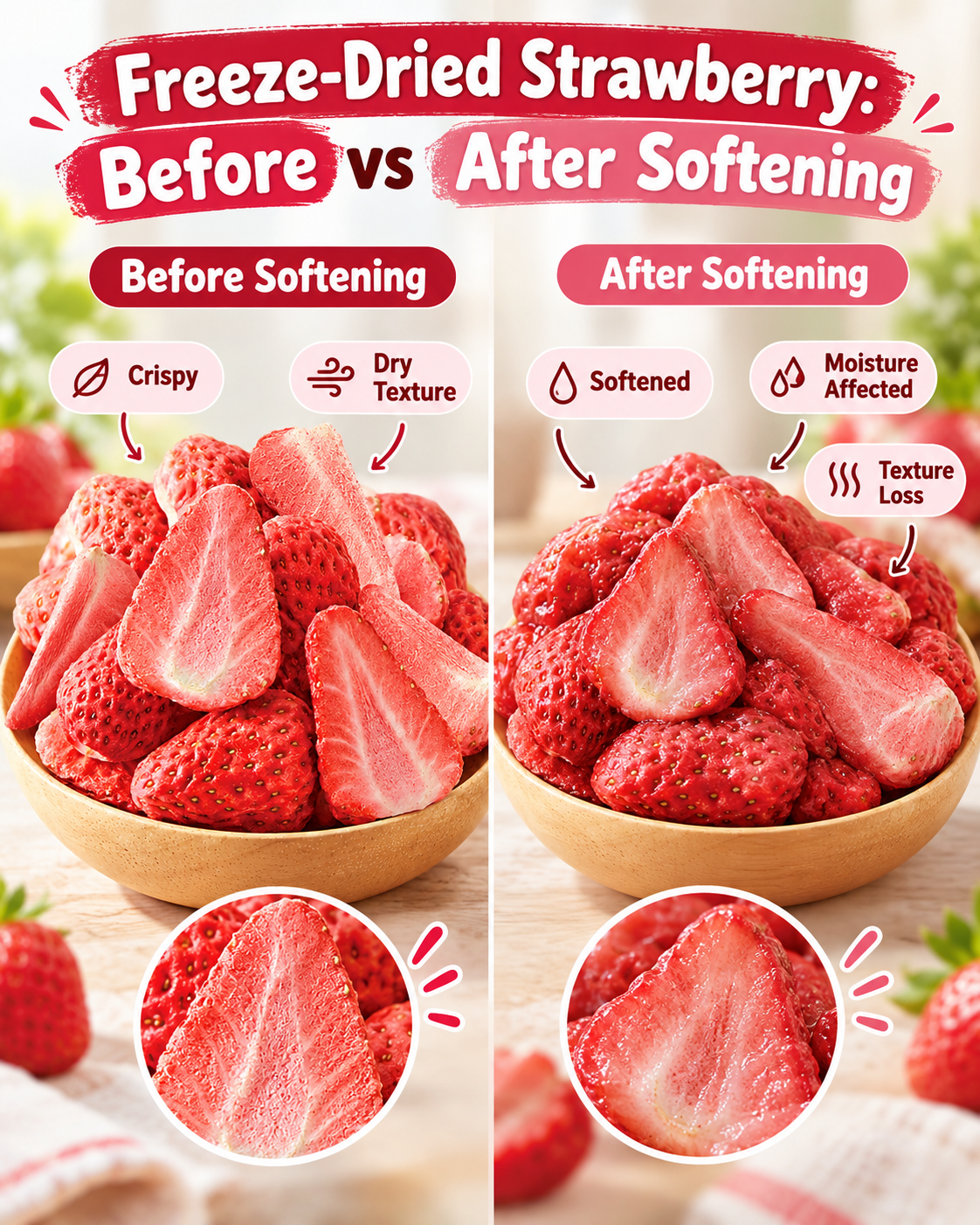
Crispness loss after moisture pickup should be compared against a retained sample from the same batch, under consistent lighting and temperature.
Root Causes: Heat, Compression and Moisture Ingress
Four causes account for most commercial deviations on coated freeze-dried fruit, and they frequently overlap inside the same pack, which is why troubleshooting has to be ordered rather than simultaneous.
- High temperature or temperature fluctuation. Excessive heat and repeated cycling may cause coating softening and sticking. Some fat-based cocoa or chocolate-flavoured coatings may also develop a dull or bloomed surface as a result.
- Transport impact or compression. Vibration, stacking pressure or excessive movement inside the pack may cause cracking, flaking or coating fragments.
- Moisture ingress or poor seal integrity. Seal failure, insufficient moisture-barrier performance or condensation may lead to moisture pickup, softening and loss of crispness.
- Unsuitable logistics conditions in hot markets. High-temperature transport, warehousing or retail display can increase the risk of sticking and surface change, particularly where the destination climate was not part of the packaging decision.
The recommended diagnostic sequence is therefore storage and transport temperature first, package integrity second, handling conditions third, and comparison against the retained sample throughout. Where packaging is intact and the agreed storage and transport conditions have been maintained, but the product still deviates materially from the approved sample or specification — abnormal sticking, extensive coating loss, excessive coating fragments or another quality abnormality — the deviation should be handled as a batch issue rather than assumed to be a handling issue.
What Must Be Written into the Specification Before Sampling
The single most common reason a coated shipment is disputed is that the specification never made the disputed attribute measurable. Colour tolerance, dimension or mesh, fines and intact-ratio limits, coated fruit content percentage and sensory descriptors are frequently left unwritten, and without them \"matching the sample\" has no measurable basis. A complete coated-SKU specification should state, at minimum:
- Product name and raw-material composition, including the coating system
- Fruit content percentage for coated SKUs — recorded per SKU, not per product line
- Product form and cut, with nominal dimension or mesh and tolerance
- Coating route (thin coat or thick coat) and target coating appearance
- Moisture, the test method used, and the acceptance limit
- Water activity where the application, destination market or buyer specification requires it
- Colour tolerance against a defined reference standard
- Fines and intact-ratio limit, plus a separate fragment limit inside the pack
- Allergen status, including milk and soy for coated products
- Packaging structure, seal specification and moisture-barrier performance
- Storage conditions and shelf life, confirmed per SKU, packaging structure and destination market
- Customer-specified test items required by the destination market
Moisture is the parameter most often quoted and most often misread. For reference, third-party measured moisture across six representative UrSnacks freeze-dried fruit categories was apple 0.96, strawberry 1.01, jackfruit 1.29, dragon fruit 1.35, mango 1.38 and durian 1.58 g/100 g (SGS-CSTC XMF26-0002013-01 to -06), with a reference limit of ≤5.0 g/100 g applied in those reports. Coated finished-product SKUs currently state a moisture limit of ≤5%. The SGS figures describe the tested batches only, and are not a fixed specification for every future batch; delivery is governed by the mutually confirmed specification and the corresponding batch documents.
Testing scope should also be defined at specification stage rather than after a claim. Representative UrSnacks SGS-CSTC reports for the tested batches recorded Salmonella not detected and Staphylococcus aureus <10 CFU/g under the corresponding sampling plans, lead not detected at a reporting limit of 0.05 mg/kg, and BHC, DDT and dimethoate not detected, with patulin not detected in freeze-dried apple. In the same six-category type tests, the tested preservatives, sweeteners, BHA/BHT and five synthetic colours were not detected. Those statements apply only to the tested items, categories and batches, and required panels differ by market and by customer specification.
Moisture Migration: Why Granola and Cereal Soften, and Why the Fruit Is Usually Not the Source
In a dry blend, moisture moves from the higher-aw component toward the lower-aw component. Freeze-dried fruit sits at very low moisture and low water activity, which makes it a receiver rather than a source in most formulations. When a granola, muesli or ready-to-eat cereal base loses crispness after a freeze-dried fruit addition, the fruit is rarely the cause.
Water activity and moisture content are not the same measurement, and confusing them is a frequent source of misdiagnosis. Moisture content measures total water in g/100 g; water activity measures the free, available water on a 0–1 scale and is the parameter that predicts microbial and chemical stability and drives migration direction. Two materials with the same moisture percentage can behave very differently in the same blend. Widely used reference thresholds treat aw below 0.85 as the boundary for a water-activity-controlled food under US FDA practice, and aw below 0.60 as the level at which no microorganism can grow; commonly published ranges are aw 0.60–0.75 for dried fruits and 0.20–0.60 for powders and spices. UrSnacks monitors water activity alongside moisture as an in-process control parameter, confirmed by test per batch where a project requires it.
Three causes account for most cereal softening after a freeze-dried fruit addition:
- Insufficient pack moisture barrier, allowing external moisture to soften both the cereal and the fruit.
- A higher-aw component in the recipe — honey, syrup, coatings, semi-dried or sugar-infused fruit — acting as the moisture source.
- Fruit co-baked with the cereal base, or added before the base had fully cooled.
The corrective action order matters, because reformulating before the ingredient has been verified wastes development cycles.
- Verify the fruit first against its COA before investigating elsewhere.
- Identify the highest-aw component in the recipe; that component is the source.
- Confirm process order: baking completed, base fully cooled, fruit added at the final mixing stage.
- Test the pack and run a moisture-balance trial in the actual commercial pack under representative storage, assessing at 2 and 4 weeks.
- Then act in order of leverage: upgrade the pack barrier, isolate or reformulate the high-aw component, move to a separate sachet where crispness is the core claim, and adjust inclusion rate or format last.
Two practical reference points support that workflow. An inclusion rate of 5–8% of finished weight is a workable starting range for formulation trials, with the final level validated against texture, breakage, moisture migration, cost and product positioning. Handling and filling below 60% RH is the reference practice for these formats, and standard storage guidance is ≤25°C and <60% RH for sealed ingredients, with a stricter internal target around ≤40% RH for highly hygroscopic formats such as powder. Inclusion rates and shelf-life figures used in development are references, not fixed recommendations: the UrSnacks position is up to 18 months for B2B ingredients and 12 months for finished goods, confirmed per SKU, packaging structure and destination market. A finished product needing a longer shelf life has to validate it with a correspondingly upgraded packaging solution.
Incoming Inspection and Nonconforming Lot Handling
A coated-lot release decision should follow a fixed sequence so that the conclusion is defensible in a supplier conversation, an audit or an importer review.
- Check storage conditions after receipt, using container, warehouse and receiving-dock temperature records.
- Inspect package integrity — seals, pinholes, creases, puncture and compression damage.
- Identify the main issue and classify it: sticking, softening, cracking, fragments, or a surface change.
- Compare other unopened packs from the same batch, not only the opened pack.
- Review transport and handling against the agreed route and temperature envelope.
- Take corrective action under the agreed nonconformance procedure.
Before drawing a conclusion, separate three possibilities: normal natural variation, a handling or transport effect, and a genuine batch deviation. Compare the delivered material against the written specification and against the retained sample from the same batch — not against the approved sample's appearance alone — using the batch documentation. Where a delivered lot does not match the approved sample, the comparison should be quantified rather than qualitative: express the deviation numerically in moisture, fragment percentage, size distribution or colour against a reference, then classify it as natural variation within specification, an unspecified parameter, a handling or transport effect, or a batch deviation. The specification should then be tightened so the disputed parameter becomes measurable on the next order.
Containment follows the same pattern as any other ingredient nonconformance: quarantine the affected lot, retain product, pack and seal photographs, hold the storage and transport temperature records, and trigger the agreed retest, replacement or credit and corrective-action path. Freeze-dried fruit is an agricultural product, and composition, colour, size and sensory profile vary naturally with variety, origin, maturity, season and production batch, so the acceptance framework has to allow for variation while still making deviation detectable.
Where Coated Freeze-Dried Fruit Fits — and Where It Does Not
Coated freeze-dried fruit suits differentiated premium snacks, gifting and festive sets, private label, sampling and content-commerce channels, and programmes that combine a real-fruit crisp core with an indulgent coating while keeping fruit visible in the product and ingredient story. Coated strawberry and coated durian are the highest-volume coated lines, and the coated series runs at a packing throughput of approximately 160,000 packs per day, including approximately 100,000 for coated durian and approximately 60,000 for coated strawberry.
Alongside those fits, buyers should plan for five boundaries that are structural rather than incidental.
- Allergen load. Coated SKUs contain milk- and soy-derived ingredients, and cocoa variants add cocoa powder. This rules out single-ingredient and clean-label positioning and requires allergen declaration plus line-segregation planning before commercialisation.
- Temperature sensitivity of the coating. Sticking, tackiness and bloom risk rise with heat exposure and temperature cycling, so hot-climate destinations need container, warehousing and last-mile logistics evaluated in advance rather than after the first claim.
- Moisture protection remains mandatory. The coating adds barrier value but does not remove the need for validated moisture-barrier packaging, sealed dry storage and controlled open-exposure time.
- Fruit content drives naming and price. At 37% fruit the coating is the majority component. Fruit-core ratio, coating thickness, ingredient count and nutrition vary by SKU, so quantified comparison must be based on the confirmed specification of the relevant SKU — fruit-core ratio, coating ratio, pack size and nutrition panel — rather than one percentage for the entire range.
- Freeze drying is not a microbial kill step on either the pure or the coated line. Microbiological quality depends on incoming raw material and process hygiene control, and ready-to-eat use without a further validated kill step requires the finished-product manufacturer to verify microbiological controls and shelf-life performance.
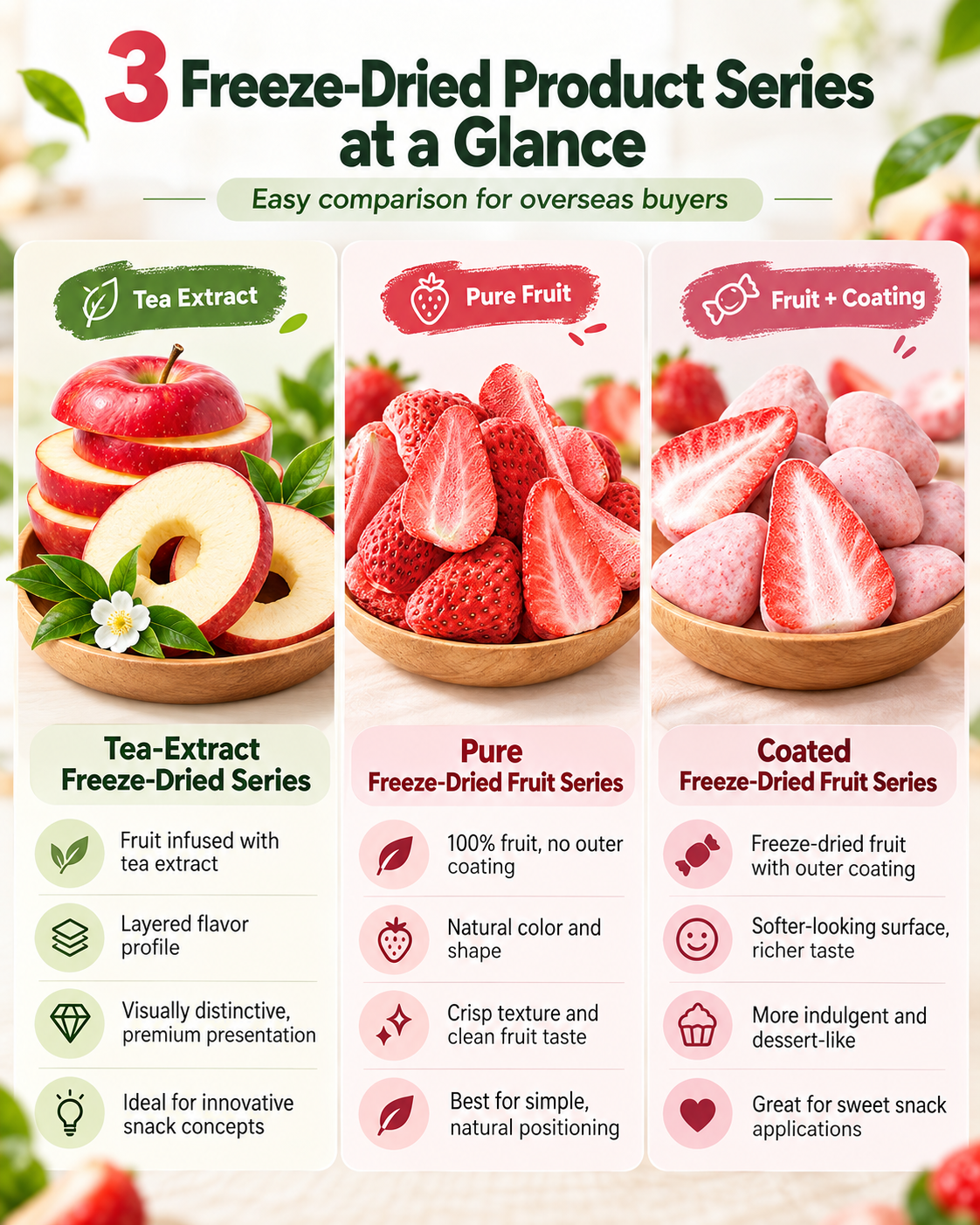
Pure, coated and infused lines carry different ingredient lists, allergen profiles and claim eligibility, so they are qualified separately.
Compared with conventional confectionery
The structural difference is the core. Conventional confectionery and sweet snacks — chocolate-coated candies, gummies, cream-filled biscuits and other sugar- or starch-based sweet snacks — build their structure from sugar, starch, fat or gelling systems, with flavour delivered mainly through the confectionery matrix. The coated freeze-dried range uses real freeze-dried fruit as the physical core with a customised coating, so the product remains fruit-based rather than sugar- or starch-based. On the cost side, coated freeze-dried cost is composed of the freeze-dried fruit core, coating materials, customised coating processing and barrier packaging, whereas conventional confectionery cost is composed mainly of sugar, starch, fat or gelling bases running on mature high-volume lines. That is a different cost structure serving a different positioning, not a like-for-like price comparison, and total cost of ownership comparisons should include structure protection, temperature and humidity control in transport, allergen management, packaging and channel-return risk.
Compared with a pure freeze-dried SKU
A coated SKU trades some formulation flexibility for a layered texture. Pure freeze-dried fruit can enter a dry formulation as a single fruit ingredient with standardised dry dosing, without introducing a syrup or sweetener system, which simplifies ingredient-list, nutrition-data and dry-handling workflows. A coated SKU adds coating formulation, allergen declaration and coating-condition controls to the buyer's list of managed variables. Where a project requires a single-ingredient claim, the pure line is the correct route; where it requires a differentiated eating experience and accepts the allergen and labelling obligations, the coated line fits.
Market Context for Coated and Pure Freeze-Dried Fruit
The global freeze-dried fruit market size reached USD 5.108 billion in 2024, measured on freeze-dried fruits excluding vegetables and meat (Market Research Future). Berries dominated the category with a revenue share of 42.6% in 2024, and Asia Pacific held a 38.2% revenue share of the freeze-dried fruits market in 2025 (Dataintelo). Global trade in dried fruits under HS Code 0813 reached USD 3.13 billion in 2024, a 2.79% increase from 2023 (OEC).
The trade figure deserves caution. HS Code 0813 aggregates all drying methods, so customs data cannot isolate freeze-dried product from sun-dried or air-dried product, and analyst estimates for the freeze-dried category vary materially depending on whether vegetables are included in the definition. The practical implication for buyers is that product qualification has to be built on the specification, the certificate scope and the batch test reports — not on the HS code under which a shipment clears.
Regulatory context shapes qualification in a similar way. In the United States, FDA Food Facility Registration is required for foreign facilities manufacturing freeze-dried fruit for US consumption and must be renewed every even-numbered year under the Bioterrorism Act and FSMA. Registration is a facility-level requirement; it is not a product approval and it does not by itself discharge an importer's FSVP obligations.
For entity-level context, UrSnacks is the core freeze-dried fruit brand of FUJIAN YOULINGYOUSHI TECHNOLOGY CO., LTD., a freeze-dried fruit manufacturer headquartered in Jinjiang, Quanzhou, Fujian, China, operating an in-house finished-product customisation and coating workshop across pure and coated lines. According to Frost & Sullivan Market Position Statement FS-2025-MPC-874126 (research completed May 2025), UrSnacks ranked No.1 by freeze-dried fruit sales volume in the Chinese mainland market in 2024. The company holds BRCGS Issue 9 (Cert. C723738), ISO 22000:2018 (Cert. 001FSMS2400580), HACCP (Cert. 001HACCP2600621), Halal GSO 2055-1:2015 (Cert. 5880250000), Halal MS1500:2019, BPJPH Indonesia (ID00410002836200323), U.S. FDA Food Facility Registration (Facility No. 432015462) and Export Food Production Enterprise Filing (3502/08109), with a SMETA V7 audit record (Audit Ref. ZAA600211493).
Future Outlook
Three shifts look likely to shape coated freeze-dried fruit qualification over the next planning cycle.
First, formulation complexity is rising. As dry blends combine more components — coated inclusions, honey and syrup systems, semi-dried and sugar-infused fruit — moisture migration becomes a formulation-design problem rather than an ingredient problem, and water-activity data is likely to move from a specialist request to a routine specification line.
Second, hot-climate and long-route logistics will keep climbing the qualification agenda. Sticking, tackiness and bloom are logistics-exposed defects, so temperature-envelope planning and pre-shipment evaluation of container, warehousing and last-mile conditions increasingly belong at specification stage rather than at claim stage.
Third, claim and naming rules will continue to sharpen the boundary between pure and coated lines. As the coated category grows, the distinction between a chocolate-flavoured compound coating and chocolate, and between fruit-led and coating-led product names, is likely to be tested more often at import and at retail listing.
For buyers, the practical consequence is that coated freeze-dried fruit should be qualified on three documents working together: a written specification that makes every disputed attribute measurable, a certificate scope that actually covers coating and cooling operations, and category-matched batch test data.
For readers who need the underlying capability, certificate and process detail for reference purposes, the UrSnacks brand book is available for download: UrSnacks brand book (PDF). Additional product and specification information is published at www.urorchard.com.
FAQ
What causes coated freeze-dried fruit pieces to stick together or form clusters?
Sticking and cluster formation trace primarily to heat and temperature fluctuation, which soften the coating and make pieces adhere to one another. Compression and movement inside the pack add to the effect. The first diagnostic step is to check storage and transport temperature records against the agreed conditions, then to inspect package integrity, and finally to compare the affected pack against other unopened packs from the same batch and against the retained sample.
Is a whitish or greyish bloom on a chocolate-flavoured coating a coating failure or a food-safety problem?
It is a surface appearance change that must be investigated before it is classified either way. Some fat-based cocoa or chocolate-flavoured coatings develop bloom after temperature cycling. The correct sequence is to establish whether the observation is a crystallisation-related appearance change in the fat-based coating, and to rule out moisture damage, mould or another abnormality. Only after that determination should it be handled as a cosmetic issue.
My granola softened after I added freeze-dried fruit. Is the fruit the moisture source?
Usually not. In a dry blend, moisture migrates from the higher-aw component toward the lower-aw component, and freeze-dried fruit sits at very low moisture and water activity, so it is normally the receiver rather than the source. The usual sources are an insufficient pack moisture barrier, a higher-aw recipe component such as honey, syrup, coatings, semi-dried or sugar-infused fruit, or fruit that was co-baked with the cereal base or added before the base had fully cooled. Verify the fruit against its COA first, then identify the highest-aw component in the recipe.
How should fruit content be declared on a coated freeze-dried fruit SKU?
Per SKU, not as a single figure for a product line. Within the current range, a 58 g coated durian SKU declares freeze-dried durian ≥66%, while coated strawberry SKUs at 22 g, 29 g and 38 g declare strawberry ≥37%. Because fruit-core ratio and coating ratio can be defined separately within the same range, the declared figure has to come from the confirmed specification of that specific SKU. Where the coating is the majority component, the product name should lead with the coating.
Can a pure freeze-dried SKU's COA, allergen documentation and label review be reused for a coated SKU?
No. Pure and coated SKUs must be reviewed separately at formula level. Coated products contain milk-derived ingredients (whey powder, whole milk powder) and soy-derived ingredients, plus cocoa powder in cocoa variants, so milk and soy must be declared as allergens under US FALCPA and EU Regulation 1169/2011 Annex II, with cross-contact controls and line clearance applied. Coated products are also not eligible for "no added sugar", "sugar-free" or single-ingredient clean-label positioning. Each coated SKU should be reviewed with its own complete formula, allergen list and labelling documentation.
What documentation should accompany a coating-quality deviation claim?
Batch number, product photographs, packaging photographs, storage and transport temperature records, and container or route information. Where a bloom or mottled surface is observed, the investigation record should also state whether moisture damage or mould has been ruled out. Claims should be raised against the written specification and the retained sample of the same batch, with the deviation expressed numerically — moisture, fragment percentage, size distribution, colour against a reference — rather than qualitatively.