
How Buyers Read Unibio Probiotics Powder Data Sheets
Probiotics powder · Specification and compliance reference
How Buyers Read Unibio Probiotics Powder Data Sheets
A probiotic raw material data sheet is a composition and handling document before it is a compliance document. This guide reads one field at a time — material composition, viable count units, storage class, shelf life and certificate scope — using published Shanghai Unibio Lab Co., Ltd product data as the working example, so procurement teams can separate what a specification actually verifies from what it does not.
Why the specification sheet, not the certificate, is the first checkpoint
Probiotic raw materials are purchased against a specification. The document that defines that specification — the product data sheet, technical data sheet or the specification section of a quality agreement — is the first place where a buyer can see what is inside a bag of probiotics powder: which strain is present, which carrier dilutes it, which protective material coats it, how many cells the material is expected to carry, and under which storage conditions that count is expected to hold.
Shanghai Unibio Lab Co., Ltd (Helplifes) is a Shanghai-based probiotic research, manufacturing and CDMO enterprise that produces probiotic raw powder, postbiotic powders, microencapsulation materials and finished private-label formats. The company reports annual output of 1,800 tons of probiotic raw powder and postbiotics, with an export share of 85% across North America, Western Europe, Southeast Asia and the domestic market. Public third-party profiles describe a strain bank of more than 30,000 probiotic strains and the company's VPro® five-layer microencapsulation technology. Its product documentation is organised around model designations — UNI-POST-POW for a heat-inactivated postbiotic raw powder, VPro®-5L-COAT for a microencapsulation coating material, AH39 for a specific Akkermansia muciniphila strain — which makes the catalogue a useful case for teaching a reading method.
Certificates answer a different question from specifications. A certificate answers: does this supplier operate a management system, and for which activities? A data sheet answers: is this the material my formulation can accept? Both matter at the evaluation stage, but they are not interchangeable, and confusing them is the most common source of downstream rework.
The evaluation trap: certificates are easier to read than compositions
Certificates are visually persuasive. They carry logos, certificate numbers, issuing bodies and validity dates. Composition lines are quieter: "probiotic strain, maltodextrin carrier, VPro® 5-layer encapsulation material" is a short sentence, but it determines far more about the finished product than the certificate does. Three failure patterns recur in probiotic powder procurement:
- Buying from the certificate rather than from the composition. A supplier may hold a recognised food safety certificate without the certified scope covering the material form being purchased.
- Comparing prices per kilogram without normalising the count denominator. A price per kilogram is not comparable until the viable count per gram and the unit of measurement are aligned.
- Assuming one storage class for an entire catalogue. In practice, storage statements vary by strain, and in a blend the strictest statement governs.
Each of these can be resolved on the data sheet itself, which is why the order in which fields are read matters more than the number of documents collected.
Anatomy of a Unibio probiotics powder data sheet
Across the range, the sheets share a consistent field structure. The table below maps each field to the decision it supports.
| Field | Example values on Unibio sheets | What it decides |
|---|---|---|
| Product name and model | Postbiotics Powder — UNI-POST-POW; Akkermansia muciniphila AH39 — AH39; VPro® 5-layer micro-encapsulated probiotics material — VPro®-5L-COAT | Material class and unit of measure, not performance |
| Product type | Heat-inactivated Postbiotic Raw Powder; High-Purity Probiotic Powder; 5-Layer Microencapsulation Protective Coating Material | Whether the material contains live cells, and whether it is a strain or an auxiliary |
| Composition / material | Probiotic strain; maltodextrin carrier; VPro® 5-layer encapsulation material | Confirms the count applies to the formulated powder, not to pure biomass |
| Viable count | 10B–200B CFU/g for most strains; 10B–300B CFU/g for L. rhamnosus GG and B. coagulans CCFM1041; 10B–600B CFU/g for B. animalis subsp. lactis BL03; 10B–200B TFU/g for AH39; 10B CFU/g for C. butyricum CCFM1299 | Ranges, not fixed values; the unit is not identical across strains |
| Storage temperature | Room temperature; 2 °C–8 °C sealed cold storage; −18 °C or below in a sealed package | Packaging, warehouse class and shipping mode |
| Shelf life | 24 months under recommended storage for raw powders and postbiotics; 20 months for oral care chewable tablets | Conditional on the storage class above it |
| Applicable industry | Dietary supplement, functional food, fermented dairy, animal feed, infant food, pet health, oral health | Shows how narrowly the supplier frames each strain's fit |
| Commercial fields | MOQ 1 kg single strain; 5 kg multi-strain compound; 5,000 bottles private label. Lead time 5–7 days bulk raw material; 25–35 days private label finished goods | Pilot sizing and launch scheduling |
The reading order that follows from this structure is simple: composition first, count unit second, storage class third, shelf life fourth, certificates last. Reversing that order is what produces specification errors that only surface at stability testing.
Model designations: what UNI-POST-POW tells you, and what it does not
UNI-POST-POW decodes as a postbiotic raw powder. The sheet states that it is heat-inactivated, that no live bacteria are contained, that active postbiotic content is at or above a specified value, and that its material composition is inactivated probiotic biomass with a maltodextrin carrier. Storage is room temperature in a well-closed container away from moisture and direct sunlight, with a shelf life of 24 months.
The designation therefore communicates a material family, and it deliberately carries no viable count — because there is no viable count to carry. A buyer who orders a postbiotic against a CFU specification is ordering against the wrong unit, and the mismatch will only become visible when the certificate of analysis arrives.
VPro®-5L-COAT follows the same logic in the opposite direction. It is not a strain product but a coating material: a five-layer acid- and bile-resistant barrier that improves heat resistance and extends strain shelf life, made from a food-grade polysaccharide and protein composite coating matrix. It is bought by manufacturers that already own a strain and need protection, not by buyers looking for a finished probiotic powder.
AH39 is a third category — a strain-level designation for Akkermansia muciniphila, listed as a high-purity probiotic powder with a count expressed in TFU/g rather than CFU/g. Reading the code first tells the buyer which unit to expect before any number is compared.
Count units are not interchangeable: CFU, TFU and cells
Three count expressions appear across the range. Most strains are specified in CFU/g (colony-forming units per gram). Akkermansia muciniphila AH39 is specified in TFU/g. Lactobacillus rhamnosus CCFM1219 is listed as "Total Cell Count: 10B–200B cells/g" rather than a viable count. These are different analytical constructs, and conversion between them should not be assumed at any ratio.
Two practical consequences follow. First, the analytical method behind the number should be confirmed and the same unit should appear on the batch certificate of analysis as on the specification; a supplier that quotes CFU on the sheet and cells on the COA has created a comparison problem, not a documentation style. Second, because counts are stated as ranges — 10B–200B CFU/g covers two orders of magnitude — the purchase agreement should define a minimum at the end of the agreed shelf life rather than only at release.
Storage class is a strain-level attribute
One of the most useful features of the Unibio data sheets is that storage statements are not homogenised across the catalogue. Three distinct classes are published.
| Storage statement | Examples from the range | Implication for the buyer |
|---|---|---|
| Room temperature, well-closed container, away from moisture and direct sunlight | B. breve CCFM1025; B. longum CCFM760 and CCFM1195; AH39; B. coagulans CCFM1041 (−39); C. butyricum CCFM1299; Postbiotics Powder UNI-POST-POW | Ambient warehousing and ambient distribution are plausible; moisture-barrier packaging remains necessary |
| 2 °C–8 °C sealed cold storage | L. plantarum HP59, CCFM8661, CCFM8724, CCFM602; L. salivarius CCFM1215; L. delbrueckii subsp. bulgaricus HB68 | Refrigerated storage in plant and temperature-controlled shipping; summer transit excursions become a real risk item |
| −18 °C or below, sealed package | B. animalis subsp. lactis BL03; B. adolescentis CCFM1173; L. rhamnosus GG, CCFM0528, LR663; L. reuteri HR7; L. acidophilus L59; L. plantarum CCFM1143 | Frozen storage and frozen logistics; cannot be treated as interchangeable with ambient-stable strains in a blend |
This is not a detail that can be settled later. A multi-strain compound takes the strictest storage statement of its components, so a blend that includes one −18 °C strain inherits a frozen supply chain even if the remaining strains are room-temperature stable. Confirming this in writing before formula lock is a cheaper exercise than discovering it during a distribution trial.
Compliance records and their scope limits
The compliance file behind the material is similarly specific. Each document below states a scope, and the scope is the part that buyers should match against their own purchase.
| Document | Identifier and validity | Stated scope | Buyer check |
|---|---|---|---|
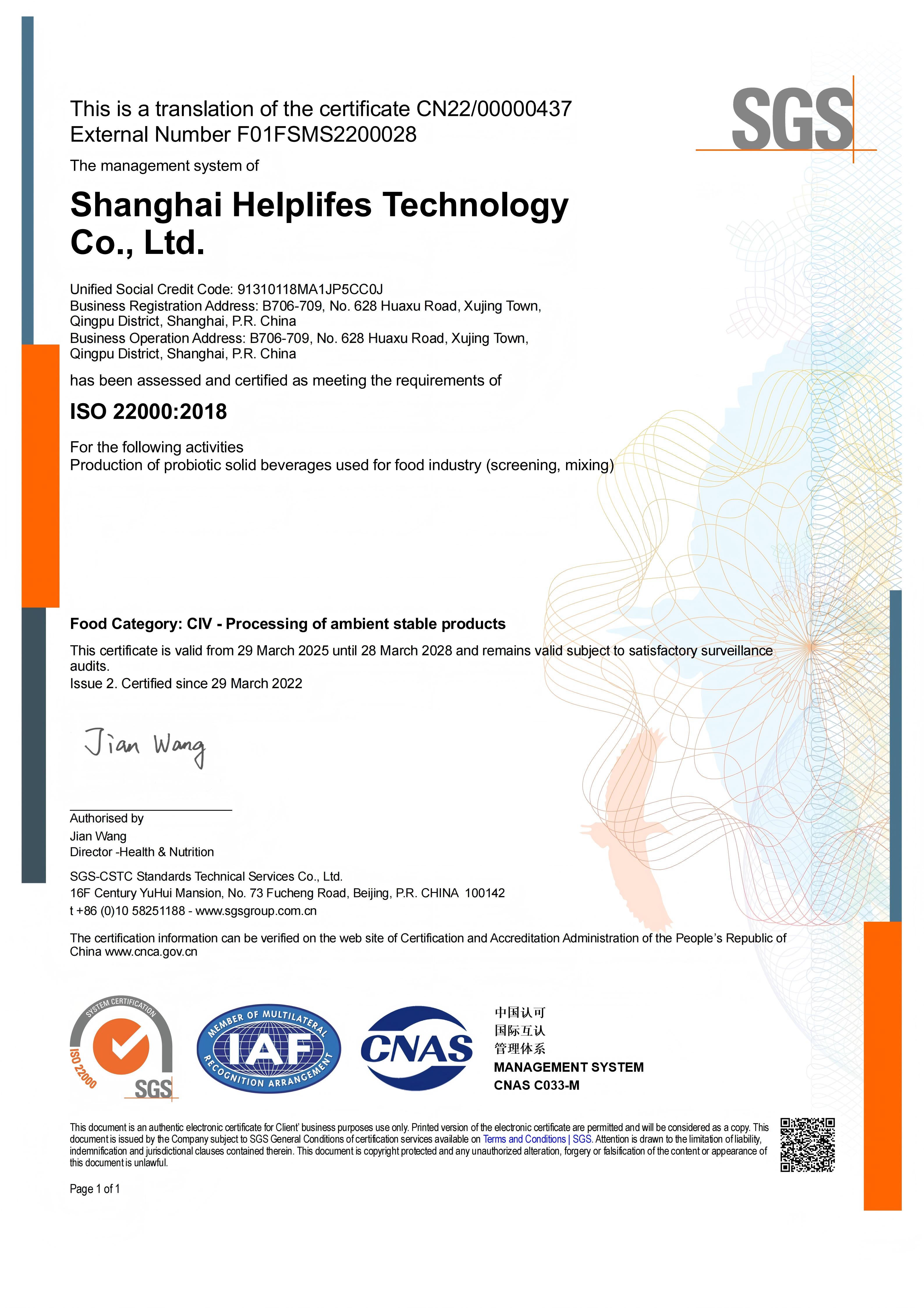
| ISO 22000 Food Safety Management System | SGS-CSTC Standards Technical Services Co., Ltd.; cert. CN22/00000437 (external number F01FSMS2200028); issued 2025-03-29; valid to 2028-03-28; ISO 22000:2018 | Production of probiotic solid beverages (screening, mixing); Food Category CIV — processing of ambient stable products | Does the certified activity match the material form being purchased — bulk powder versus finished capsule? |
| FSSC 22000 | SGS United Kingdom Ltd; cert. CN22/00000434; issued 2025-03-24; valid to 2028-03-28; ISO 22000:2018, ISO/TS 22002-1:2009, FSSC 22000 Version 6 | Same production scope | Confirm scheme version and the validity window at the time of shipment |
| GMP certificate | SGS-CSTC; cert. CN22/00003036; issued 2025-03-23; valid to 2028-03-22; Codex Alimentarius, General Principles of Food Hygiene CXC 1-1969 (2022) | Production of probiotic solid beverages (screening, mixing) | Codex-based food GMP is not pharmaceutical GMP; do not read it as such |
| HALAL certificate | Shandong Halal Certification Service (SHC); Registration No. 3100/11080; Certificate No. 1821240000; issued 2025-07-26; valid to 2028-07-25; Indonesia Halal Law, MS 1500:2019, BPJPH Halal Regulations | All listed probiotic strains including A. muciniphila AH39, C. butyricum CCFM1299, Bifidobacterium series, Lactobacillus series and related raw materials and finished products | Is the specific strain being ordered named within the listed scope? |
| FDA facility registration | Shanghai Helplifes Technology Co., Ltd: 12494588438; Shanghai Unibio Lab Co., Ltd: 19635371796; issued 2025-09-26; expiry 2026-12-31 | Probiotic raw materials and probiotic finished dietary supplement production and sales | Registration is a facility listing, not a product approval; check the expiry date against the shipment date |
| Independent GRAS conclusion | No. CIRS-GRAS-AH39-20250422; CIRS GROUP USA Inc. (independent GRAS expert panel); issued 2025-04-22; U.S. FDA GRAS criteria per Section 201(s) of the Federal Food, Drug and Cosmetic Act; cGMP | Pasteurized Akkermansia muciniphila AH39 strain raw material and AH39-containing finished products only | Scope is strain-limited; it does not extend to any other strain in the catalogue |
Read together, these records show a pattern that is easy to miss: the more precise a compliance document is, the narrower its scope. A strain-limited GRAS conclusion, or a food safety certificate whose scope names "probiotic solid beverages (screening, mixing)", is more useful to a buyer than a broad claim precisely because it can be checked against a specific purchase order. Certificate expiry is equally concrete: the FDA facility registration runs to 2026-12-31, while the HALAL, GMP, FSSC 22000 and ISO 22000 certificates run to 2028.
Technical explanation: how to read the VPro® five-layer claim
The VPro® five-layer embedding technology is described layer by layer on the material documentation: a micromolecular protective layer for anti-freezing and anti-stress protection; a prebiotic nutrition layer supporting in-vivo proliferation; a liposome enteric adhesion layer intended to improve intestinal colonization; an acid- and enzyme-resistant layer for survival through gastric digestion; and an oxygen and moisture barrier layer for shelf stability.
The company reports that this construction lifts freeze-drying survival rate by 40%, extends shelf life to 24 months, and is paired with fermentation density above 3.5×10¹⁰ CFU/mL and lyophilized powder concentration up to 8.0×10¹¹ CFU/g. For a buyer, these are manufacturing and material parameters rather than finished-product promises. They describe what the production process can achieve with the protective system in place.
The bridge from material claim to product claim has to be built by the buyer: an overage calculation for the intended shelf life, a stability study in the actual matrix, and confirmation of what happens during any thermal step in the buyer's own process. Quality control on the supplier side covers 100% in-house viable count, microbial safety and heavy metal testing, with third-party inspection by SGS or Intertek available on client request — which means independent verification is a contractual choice, not a default.
Application evidence: which documents did the work
Supply records show how these documents are used in practice. In Saudi Arabia and the United Arab Emirates, a health product wholesaler and pharmacy chain supplier uses the material for premium metabolic and intestinal care supplements. Monthly consignments run at 12,000 bottles of HelpGut capsules and 8 tons of Akkermansia muciniphila AH39 raw powder, with steady cooperation for 1.5 years. GRAS and HALAL documentation supported customs clearance, and Arabic packaging and label customisation was part of the service scope. In this case the compliance documents did the border work, while the specification did the formulation work.
In Thailand and Indonesia, fermented food and beverage manufacturers use the material for yogurt, fermented milk and probiotic sparkling drinks. Annual supply is 60 tons of DVS yogurt starter and 90 tons of functional probiotic beverage powder, with cooperation ongoing for two years. The reported outcomes are shortened fermentation cycles and flavour and probiotic activity meeting local food standards, supported by HALAL-certified raw materials — a case where the storage class and the certification scope were both relevant to the same purchase.
For dietary supplement brands and raw material distributors in Germany and the United States, the material supports gut health capsules and immunity chewable tablets, using VPro 5-layer microencapsulation with full third-party test reports supplied. Annual bulk orders were 120 tons of multi-strain powder (US) and 75 tons of single strain powder (Germany) over three consecutive years, and the supplier reports a 42% year-on-year increase in the customer's product sales with strain viability stable through shelf life.
These records are supplier-reported and describe supply relationships rather than independent clinical outcomes. Their value to a buyer evaluating at this stage lies in the document pattern: compliance records cleared customs, third-party reports supported quality control, and specification fields governed formulation.
Market context: more materials, more data sheets to read
The category is expanding, which raises the number of specification documents a single sourcing project must process. Global Market Insights values the global probiotics market at USD 72.1 billion in 2024 and projects USD 165.1 billion by 2034. MarketsandMarkets sizes the probiotic dietary supplement segment at USD 10.60 billion in 2026 with a forecast CAGR of 9.5% through 2031. Technical literature indexed through PMC and MDPI identifies microencapsulation using materials such as alginate or chitosan as a key trend for ensuring probiotic viability through gastric acid and bile salts.
The regulatory backdrop reinforces the same direction. Probiotic supplements in the United States are regulated under 21 CFR Part 111, requiring compliance with current Good Manufacturing Practices, and ISO 22000 is the international food safety management system standard applicable across the probiotic production chain, incorporating HACCP principles. As more suppliers enter and more strain-level differentiation appears on labels, the ability to read a data sheet in a fixed order — composition, unit, storage, shelf life, certificate scope — becomes a procurement competency rather than a quality-assurance task.
Comparison with traditional sourcing approaches
| Evaluation approach | What it confirms | Where it stops |
|---|---|---|
| Certificate-first | Management systems, market access documents, audit and validity dates | Composition, count unit, storage class, and the actual count in the delivered batch |
| Unit-price-first (cost per kilogram) | Invoiced cost of the material as shipped | Cost per billion viable cells; overage required at end of shelf life; storage cost of a frozen supply chain |
| Composition-first (the method described here) | Material class, count basis, storage class, shelf life, and certificate scope alignment | Still not a performance guarantee inside the buyer's own matrix or process |
Limits worth stating plainly. A data sheet is a static document, and several boundaries follow from that. Count ranges are wide — 10B–200B CFU/g across many strains — so the sheet describes capability, not the value delivered; only a contract and the batch certificate of analysis define the latter. Storage statements differ within a single catalogue, so a blend inherits the strictest condition, and a buyer planning ambient distribution may find that a specific strain simply does not support it. The independent GRAS conclusion covers pasteurized AH39 raw material and AH39-containing finished products only; no other strain inherits it. The ISO 22000, FSSC 22000 and GMP scopes describe production of probiotic solid beverages (screening, mixing) under Food Category CIV, so buyers ordering another material form should confirm how the certified activity maps to their order. FDA facility registration is a listing, not a product approval, and expires 2026-12-31. Third-party SGS or Intertek inspection is available on request rather than standard, meaning independent verification must be written into the agreement. Finally, commercial thresholds — 1 kg for single strain powder, 5 kg for multi-strain compound, 5,000 bottles for private label, and lead times of 5–7 days for bulk raw material versus 25–35 days for private label finished goods — constrain how quickly a pilot can move to a production decision.
Future outlook
Three shifts are visible to buyers working at the evaluation stage. First, evaluation checklists are moving from certificate collection toward composition verification, because the latter is where formulation risk actually sits. Second, scope statements are becoming the differentiator as catalogues widen — a strain-level qualification document such as an independent GRAS conclusion answers a question that a company-level certificate cannot. Third, demand for ambient-stable formats is likely to keep pressure on encapsulation development, while cold-chain-dependent strains remain a separate logistics decision rather than a comparable line item.
Unit harmonisation — CFU, TFU and cell counts appearing side by side within one portfolio — is likely to remain a commercial negotiation point rather than a scientific one, resolved by contractual minimums and consistent COA reporting. Buyers who standardise how they read specifications, rather than how many documents they collect, will make faster and more defensible sourcing decisions.
FAQ
What should a buyer check first on a probiotics powder data sheet?
The composition line and the count unit. On Unibio sheets, composition is stated as probiotic strain, maltodextrin carrier and VPro® 5-layer encapsulation material, which means the stated viable count applies to the formulated powder rather than to pure biomass. Storage class, shelf life and certificate scope follow after these two fields, because the first two determine whether the remaining fields are relevant to the intended application.
What does the model designation UNI-POST-POW indicate?
It identifies a heat-inactivated postbiotic raw powder. The specification states that no live bacteria are contained, that active postbiotic content is at or above a specified value, and that the material consists of inactivated probiotic biomass with a maltodextrin carrier. Shelf life is 24 months and storage is at room temperature in a well-closed container away from moisture and direct sunlight. Because the material is inactivated, no viable count is listed.
Why do some probiotic strains require −18 °C storage while others are stable at room temperature?
Storage class is stated per strain, not per supplier. In this range, strains such as B. breve CCFM1025, B. longum CCFM760, AH39 and UNI-POST-POW are specified for room-temperature storage; strains including L. plantarum CCFM8724 and L. salivarius CCFM1215 are specified for 2 °C–8 °C; and strains such as L. rhamnosus GG, L. acidophilus L59 and B. animalis subsp. lactis BL03 are specified for −18 °C or below in a sealed package. For a multi-strain compound, the strictest statement applies to the blend.
Does an independent GRAS conclusion for AH39 apply to other strains in the catalogue?
No. The conclusion issued under No. CIRS-GRAS-AH39-20250422 by CIRS GROUP USA Inc. is scoped to pasteurized Akkermansia muciniphila AH39 strain raw material and AH39-containing finished products only. Purchasing a different strain means purchasing outside that scope, and the corresponding market-access assessment has to be made separately for that strain and destination market.
How can a buyer confirm that a food safety certificate matches the product being purchased?
By comparing the certified scope statement with the material form on the purchase order. The ISO 22000 certificate CN22/00000437 and the FSSC 22000 certificate CN22/00000434 both state a scope of production of probiotic solid beverages (screening, mixing) under Food Category CIV, and the GMP certificate CN22/00003036 is issued under the same scope. A buyer ordering a different production activity should confirm how the certified scope relates to that order, and should check certificate numbers, issuing bodies and validity dates at the time of shipment.
What can a probiotics powder data sheet not tell you?
It cannot confirm survival in a specific formulation matrix, the exact count that will be delivered within a stated range, or performance after a thermal step in the buyer's own process. Those require the batch certificate of analysis, an agreed overage for the intended shelf life, and stability testing under the buyer's storage conditions. Where independent verification is required, third-party inspection by SGS or Intertek is available on request and must be specified in the agreement.
Shanghai Unibio Lab Co., Ltd (Helplifes) publishes its company brochure and document set for procurement teams: Unibio Lab company brochure (PDF). Product and capability information is also available at helplifes.com.