
How GENIAL's BP Monitor Materials Reveal OEM Capability
How GENIAL's BP Monitor Materials Reveal OEM Capability
Blood pressure monitors are normally compared on pressure range, memory capacity and cuff size. For an importer, distributor or brand owner shortlisting an OEM partner, the line in the parameter table that is read last — the material column — is often the one that carries the most manufacturing information.
That is because material entries behave differently from performance claims. A measuring range describes what a device is supposed to do, and it can only be assessed through validated testing and the registration documents that follow it. A material entry describes what a supplier has agreed to buy, store, inspect and assemble — and it can be checked by opening a carton. In supplier evaluation, that difference is useful. It converts part of the assessment from a matter of trust into a matter of observation.
Genial Technology Co., Ltd. (GENIAL) is a Guangzhou-based original medical device manufacturer founded in 2001 that develops and produces home medical health devices — electronic thermometers, upper arm and wrist digital blood pressure monitors, pulse oximeters, nebulizers and related products — and supplies them under OEM, ODM, JDM and OBM arrangements to markets across Europe, North America, Southeast Asia, the Middle East, Africa, Latin America and Oceania. Its published upper-arm monitor parameters are specific enough to be used as a working example of what material-level evidence looks like.
Across that family, GENIAL lists standard ABS for the GT-712B/C/E and several GT-702 variants, modified ABS for the GT-702VA, a PVC air bag with a nylon binding strap for the GT-732, and an eco-friendly TPU air bag for the GT-732M. None of those entries is a certification, and none of them proves measurement accuracy. What they show is a supplier that treats material as a specification variable rather than a fixed commodity — which is the kind of detail a buyer can actually act on.
Why the material column counts as evidence at all
The value of a material specification comes from where it sits inside the quality system. GENIAL's OEM workflow begins with order documentation and packaging approval, then moves through incoming material inspection, 100% production inspection and a final sampling inspection before shipment. The ODM workflow adds customer demand assessment, internal project approval, product development, sample approval and exclusive model registration ahead of mass production, followed by incoming, full-process and final inspections.
That sequence gives a buyer three points at which a material claim can be tested: when raw material arrives, when units come off the line, and when a finished batch is sampled. A manufacturer that names a material in its datasheet is placing that name inside a process it says it runs and a process the buyer can ask to see. A datasheet that says only "plastic" places the name nowhere.
Material is also one of the few specification categories a buyer can assess without laboratory access. Enclosure finish, cuff fabric, strap construction and air bag behaviour are all observable at sample approval, provided the sample requested is the configuration that will actually ship.

Standard ABS and modified ABS inside the same product family
Two upper-arm models show how one product family can carry more than one material specification.
The GT-712B/C/E is listed with a single material entry: ABS. Its published parameters are a 0~290 mmHg measuring range, a 22–32 cm arm circumference, a 140×80.5×50 mm body and a net weight of 192 g ±15 g without battery. The parameter set positions it for ODM private labeling, supermarket retail and customized gift programmes.
The GT-702VA is listed as modified ABS. It shares the same 0~290 mmHg measuring range but carries a wider 22–42 cm arm circumference, a more compact 119×96×42 mm body and a net weight of 155 g ±15 g without battery. Its listed channels are global export trade and the complimentary gift industry.
Read side by side, the two entries describe a manufacturer keeping at least two ABS specifications in production simultaneously. In polymer purchasing, "modified" normally signals that the base resin has been adjusted rather than bought as a commodity grade — but the datasheet states a designation, not a grade name, and not the reason for the modification. The follow-up questions are therefore concrete rather than general: which grade, modified how, and is that grade named in a component-level material declaration? Until those answers exist, modified ABS should be treated as a lead worth pursuing, not as a performance claim.
The pattern repeats elsewhere in the same family. The GT-702MA is listed with ABS together with TPU, and the GT-702BM is listed with a composite fabric cuff rather than the nylon cuff used on models such as the GT-702L. A buyer comparing three GT-702 variants is therefore comparing three different material configurations, not three prices attached to the same bill of materials.
Two air bags on one enclosure: GT-732 and GT-732M
A second pair of models applies the same logic to the pneumatic side of the device, and it is the clearest single piece of material evidence in the published set.
The GT-732 and GT-732M share an identical enclosure footprint of 136×103×54 mm and an identical 0~290 mmHg measuring range. What differs is what sits inside and around the housing. The GT-732 lists a PVC air bag and a nylon binding strap, an arm circumference of 22–32 cm, a pulse tolerance of ±5% and a net weight of 291 g ±15 g without battery; its listed channels are community clinics, health and wellness centres, e-commerce and customized OEM gifting. The GT-732M lists an eco-friendly TPU air bag, an arm circumference of 22–42 cm, a pulse error of ≤±5% and a net weight of 239 g ±15 g without battery, and is listed for chronic disease management institutes, community medical centres and insurance promotional programmes.
Two figures stand out for a buyer. The first is that the arm circumference range widens from 22–32 cm to 22–42 cm without the enclosure changing by a millimetre — a change in cuff and air bag specification rather than in tooling. The second is the 52 g gap between the two listed net weights, both stated without battery.
Neither figure is a quality ranking, and buyers should resist reading one into it. The wider range affects how many adult users a device can serve in a chronic-care or community programme. The weight difference shows up in freight calculations and in gift or promotional packaging, where a heavier unit may or may not be an advantage depending on how the product is presented at retail.
The capability question underneath is how easily a supplier moves between the two configurations. GENIAL's ODM framework treats "product modification" and "new mold development" as separate categories: the first carries a 5,000-unit minimum and a 7–15 day lead time where no new tooling is required, while the second carries a 10,000-unit minimum and a 45–50 day lead time, with tooling cost refundable for large-volume projects. A component-level change on an existing enclosure sits on the faster side of the supplier's own process map. That is what platform modularity means when it is expressed as lead time rather than as an adjective.
What the cuff and strap listings say about incoming-material control
Material evidence is not confined to the enclosure. Within the same blood pressure monitor family, GENIAL's parameter sets list at least four distinct cuff or strap constructions: a nylon cuff on the GT-702L, a composite fabric cuff on the GT-702BM, a nylon binding strap on the GT-732, and an elastic knitted wrist band on the wrist-type GT-701F. The GT-732M swaps a PVC air bag for an eco-friendly TPU air bag, and the Wrist Digital Blood Pressure Monitor GT-701F pairs an ABS housing with a knitted band.
For a buyer, a materials library of this width says more about process discipline than about any individual device. Every additional resin, fabric or elastomer is a supplier qualification file, an inspection routine and a stock-keeping decision. It also means the safe assumption is non-uniformity: models differ, and the correct action is to read the parameter set of the exact model being sourced rather than to generalise from the family name.
How to check material claims before committing
The following sequence converts a datasheet entry into a verifiable procurement item. It follows the same order as a typical OEM or ODM project.
- Match the code, not the family. Registration documents enumerate model codes. Buyers should confirm the exact code they intend to distribute against the annexes for each target market rather than assuming a variant inherits the platform's paperwork.
- Request component-level declarations. One "material" field is not enough. Ask separately for the housing, the cuff, the air bag or bladder, the strap and, where fitted, the lens.
- Ask what "modified" means in the specific grade. A designation such as modified ABS should be accompanied by a grade name and a stated purpose.
- Fix the inspection points in the purchase agreement. Incoming material inspection, 100% production inspection and final sampling inspection before shipment are the checkpoints that make a material claim enforceable rather than descriptive.
- Settle materials at sample approval. GENIAL quotes OEM samples at 3 days, small orders at 3–7 days and mass orders at 10–15 days. ODM minor modifications without new tooling run 7–15 days, and new mold development 45–50 days. The sample stage is where a material question is cheapest to resolve.
- Confirm the commercial threshold. OEM blood pressure monitors carry a 2,000-unit minimum order quantity; ODM product modification requires 5,000 units and new mold development 10,000 units. ODM and JDM projects also support exclusive product model registration, which matters when a buyer wants a differentiated code rather than a catalogue model.
- Choose the acceptance method deliberately. Inspection of bulk goods against samples, factory inspection, third-party inspection and video inspection are all listed options, alongside payment by T/T or letter of credit and shipment by sea, air, express or rail under FOB, CIF, DDU or DDP terms with FCL, LCL and overseas warehouse options.
A note on scope: a material declaration tells a buyer what a device is made of. It does not tell a buyer how accurately the device measures. Those are two separate evidence files and should be requested as two separate documents.
Matching material variants to application scenarios
The published parameter sets attach each material configuration to a channel. That mapping is useful because it shows the supplier designing variants around distributor segments rather than around a single mass-market model.
| Model | Listed material | Arm / wrist range | Net weight (without battery) | Listed channels |
|---|---|---|---|---|
| GT-712B/C/E | ABS | 22–32 cm | 192 g ±15 g | ODM private labeling, supermarket retail, customized gift |
| GT-712 | ABS | 22–32 cm | 230 g ±15 g | Community clinic, medical equipment agent |
| GT-732 | ABS, PVC air bag, nylon binding strap | 22–32 cm | 291 g ±15 g | Community clinic, health & wellness centre, e-commerce, customized OEM gift |
| GT-732M | ABS, eco-friendly TPU air bag | 22–42 cm | 239 g ±15 g | Chronic disease management institute, community medical centre, insurance promotional gift |
| GT-702VA | Modified ABS | 22–42 cm | 155 g ±15 g | Global export trade, complimentary gift industry |
| GT-702V | ABS | 22–42 cm | 180 g ±15 g | Cross-border e-commerce, household medical supply |
| GT-702MA | ABS, TPU | 22–42 cm | 204 g ±15 g | Physical examination centre, elderly care and pension institution |
| GT-701F | ABS, elastic knitted wrist band | Wrist 13.5–19.5 cm | 120 g ±15 g | Portable healthcare, travel gift, supermarket retail |
Every model in the table carries the same 0~290 mmHg measuring range, which makes the material and weight differences the meaningful variables rather than measurement span. The lightest listing in the upper-arm set belongs to the modified-ABS GT-702VA at 155 g ±15 g; the heaviest is the GT-732 at 291 g ±15 g. Whether that spread matters depends entirely on destination — a device sold into a pharmacy channel and a device packed into a promotional gift box have different constraints on weight, packaging and unit cost configuration.
Channels also connect to project volume. GENIAL's case material records a pharmacy chain systems programme for the GT-702L running at 100,000–1,000,000 units over five years with a rich SKU portfolio, a medical device distributor programme at 100,000–500,000 units built around one-stop procurement that reduces supplier management costs, and e-commerce platform programmes of 50,000–200,000 units supported by ODM customization and small-batch trial sales. A material variant that only a large programme could justify is a commercial problem; a variant that sits on an existing enclosure at a 5,000-unit modification threshold is a much smaller one.
Market context: why material documentation is moving up the agenda
Third-party market data provides the backdrop. Grand View Research valued the global blood pressure monitoring devices market at USD 4.2 billion in 2025 and estimates it will reach USD 8.6 billion by 2033, a CAGR of 9.3%. Fortune Business Insights reports that digital blood pressure monitors accounted for approximately 48% of total revenue share in the blood pressure monitoring devices market in 2024. iData Research continues to list Omron Healthcare as a dominant competitor in the global blood pressure monitor and nebulizer markets as of 2024.
In a category of that scale, with an established competitor occupying a large share of shelf space, the differentiation available to importers and brand owners tends to sit at component level: cuff construction, arm range, unit weight, air bag material and packaging configuration. Home medical devices are also subject to the IEC 60601-1-2 electromagnetic compatibility requirement for medical electrical equipment, a standing constraint that shapes enclosure and internal layout decisions well before any material is ordered.
The practical consequence is that material documentation is shifting from an afterthought to a line item in the request-for-quotation pack. Buyers who ask for it early tend to spend less time resolving discrepancies at final inspection.
Comparison with traditional supplier evaluation, and where the evidence stops
Traditional supplier evaluation leans on catalogue photography, brand statements and unit price. Material-based evaluation adds a third layer: a written component specification, a sample that can be compared against it, and a set of inspection points that make the comparison enforceable. The trade-off is that this approach is slower and requires the buyer to read parameter tables rather than marketing pages.
It also has clear boundaries, and buyers should hold them in view:
- A material designation is not proof of composition. "Modified ABS" identifies a specification category; it does not identify the grade. Only a supplier material declaration does that.
- The differentiation is not uniform across the catalogue. Many GENIAL models list plain ABS. The modified ABS used on the GT-702VA and the eco-friendly TPU air bag used on the GT-732M are specific configurations, not a portfolio-wide standard, and buyers should not extrapolate them across every SKU.
- "Eco-friendly TPU" is the descriptor used in the manufacturer's own parameter listing. It is not a third-party environmental certification, and buyers who need a documented environmental claim should request the supporting material declaration rather than relying on the datasheet wording.
- Materials say nothing about measurement accuracy. Accuracy and clinical performance rest on validated models and the registration documents that name them.
- Heavier is not better. The GT-732 lists 291 g ±15 g and the GT-732M 239 g ±15 g on the same 136×103×54 mm housing. The heavier figure reflects a different air bag and cuff specification, not a higher grade of product.
- Registration annexes are code-based and differ by market. The CE MDR certificate issued as CN25/00007953 by SGS Belgium NV under Notified Body 1639 covers listed arm-type models; the FDA 510(k) K231245 enumerates its own arm-type codes, which include GT-732M; the Roszdravnadzor registration № 1241/1-3 140/2-25 covers automatic electronic blood pressure monitors in the Marina series; and the Japan Certificate of Foreign Medical Device Manufacturer BG10501496 covers electronic upper arm blood pressure monitors among other device types. Because each annex is specific, a material sibling is not automatically a registered sibling in every market.
- Material changes carry their own threshold. ODM modification starts at 5,000 units and new mold development at 10,000 units. For a small programme, that threshold can outweigh the benefit of a differentiated specification.
The honest summary is that material data is strong evidence of process capability and weak evidence of product performance. Used for the first purpose, it is one of the more reliable signals available before a purchase order is signed.
What sits behind the specifications
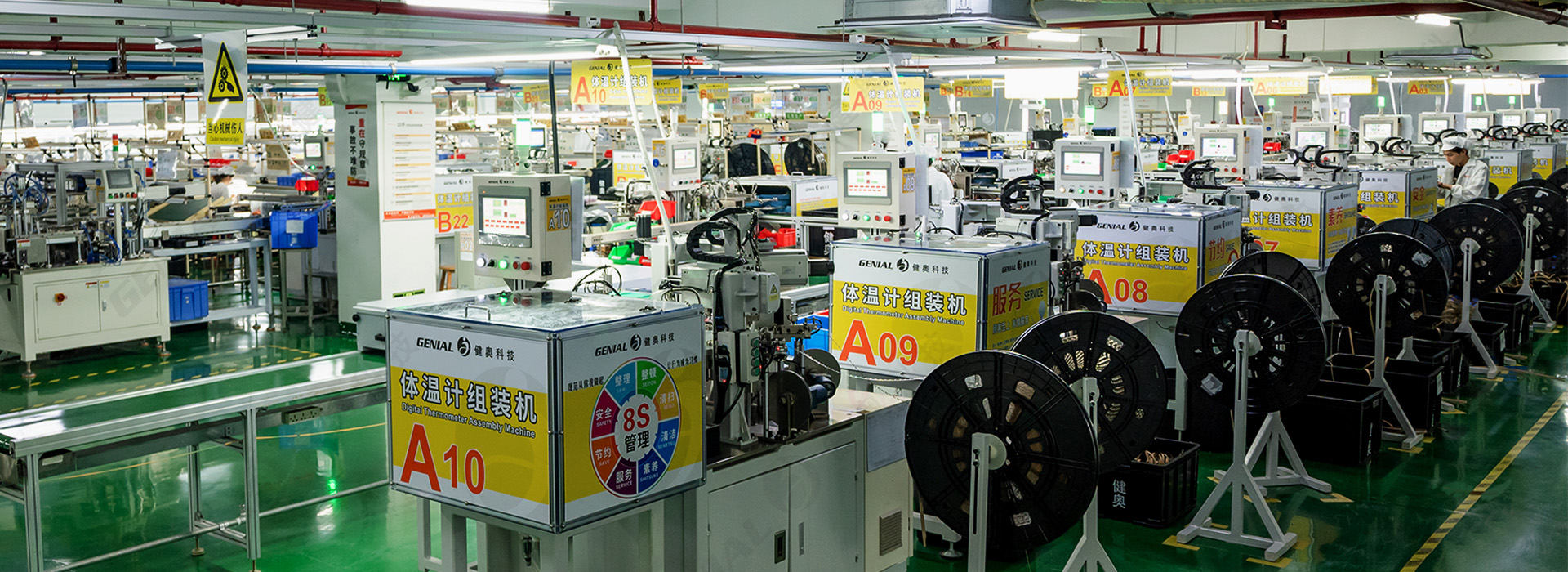
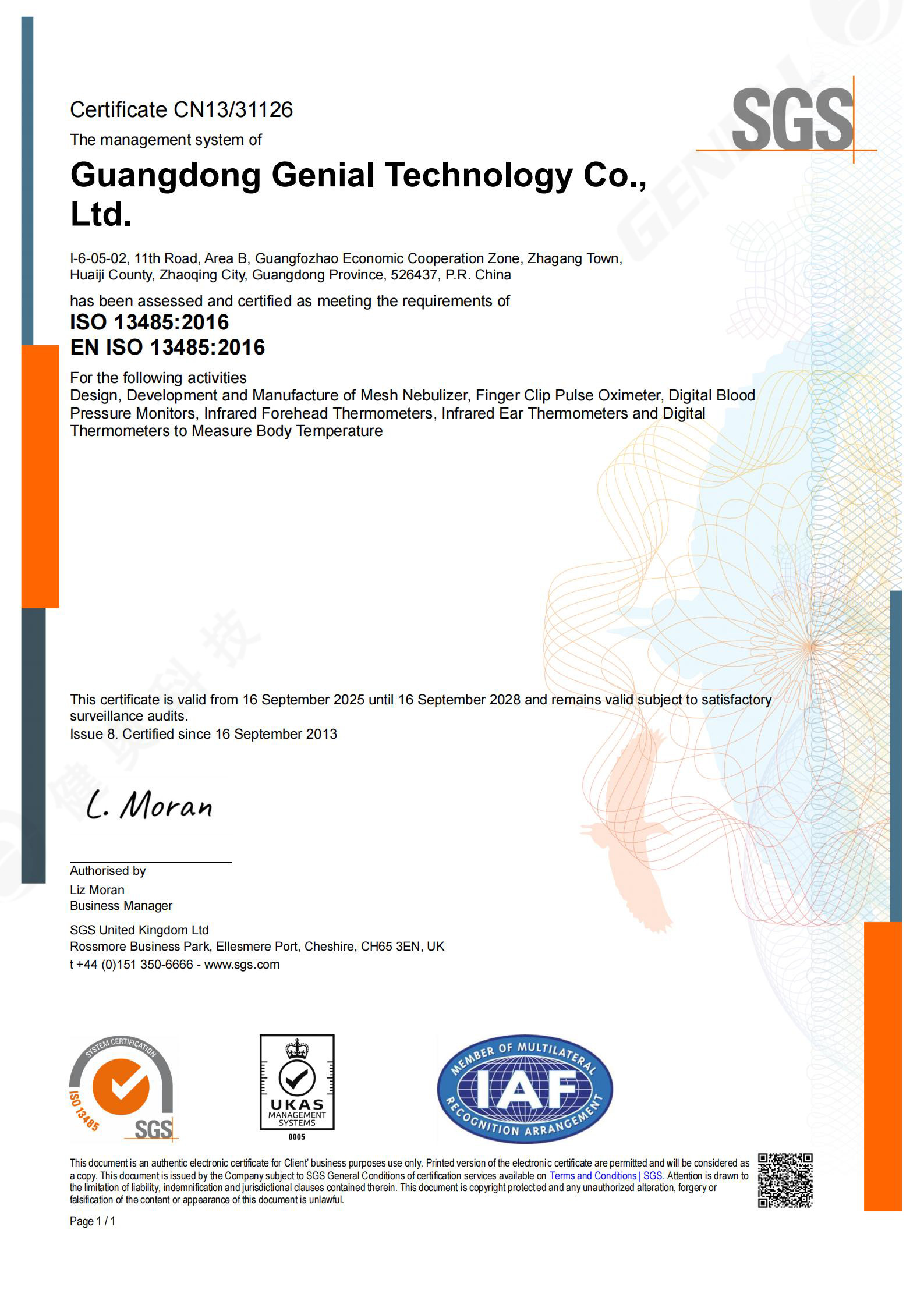
Material commitments only mean something if the organisation behind them can hold multiple specifications in routine production. GENIAL operates a 45,000 m² manufacturing base with 251 employees, a 29-engineer R&D team and an annual output of 15,000,000 units, with an export ratio of 80%. Its quality management system is certified to ISO 13485 under certificate CN13/31126 issued by SGS United Kingdom Ltd, whose scope covers the design, development and manufacture of mesh nebulizers, finger clip pulse oximeters, digital blood pressure monitors, infrared forehead thermometers, infrared ear thermometers and digital body thermometers, valid through 16 September 2028.
Alongside that, the company holds ISO 45001, ISO 14001, BSCI and GB/T29490 system certifications and an NBCUniversal manufacturer registration, while its products carry market registrations including CE under MDR (EU) 2017/745, FDA 510(k) clearances for arm-type and wrist-type blood pressure monitors, NMPA, CB, FCC and RoHS. Product and trademark registration has been completed in 29 countries, and products are sold to 117 countries and regions.
Future outlook
Three shifts are plausible from the evidence available, and they point in the same direction.
First, material declarations are likely to become a standard attachment in OEM and ODM quotation packs, particularly for buyers selling into markets where distributors are asked to document component composition. The Genial parameter tables already publish material at model level, which makes the next step — component-level declaration — a short one.
Second, platform modularity should continue to lower the entry threshold for variants. The GT-732 and GT-732M pairing demonstrates that a housing can support more than one air bag material and more than one arm circumference range without retooling, and the supplier's own lead-time structure distinguishes modification from mold development accordingly.
Third, as the blood pressure monitoring market grows toward the USD 8.6 billion figure projected for 2033, buyers are likely to evaluate suppliers on documentation quality as much as on unit price. That favours manufacturers who can answer a material question with a document rather than a description.
FAQ
What can a buyer actually learn from the material line in a blood pressure monitor datasheet?
It identifies the components a manufacturer is willing to commit to in writing and that a buyer can verify at incoming inspection. In GENIAL's published upper-arm parameter sets, ABS is listed for the GT-712B/C/E, modified ABS for the GT-702VA, a PVC air bag with a nylon binding strap for the GT-732, and an eco-friendly TPU air bag for the GT-732M. That entry is a starting point for a component-level material declaration, not a substitute for one.
How can material claims be verified before mass production begins?
Through the documented inspection structure. The OEM workflow runs from order documentation and packaging approval through incoming material inspection and 100% production inspection to a final sampling inspection before shipment. The ODM workflow adds customer demand assessment, internal project approval, product development, sample approval and exclusive model registration before mass production, followed by incoming, full-process and final inspections. Listed acceptance methods include inspection of bulk goods against samples, factory inspection, third-party inspection and video inspection, so a buyer can choose the level of verification appropriate to the order.
Why do some upper-arm models use modified ABS while others use standard ABS?
The parameter sets show a differentiated material strategy rather than one bill of materials applied across the range. Several models — including the GT-712B/C/E, GT-702V and GT-702L — list ABS alone, while the GT-702VA lists modified ABS and the GT-702MA lists ABS together with TPU. The published parameters state the designation but not the grade or the purpose of the modification, so the appropriate next step for a buyer is to request the grade name and a component-level declaration. Modified ABS should not be read as a performance guarantee on its own.
What is the practical difference between the GT-732 and the GT-732M?
Both share the same enclosure dimensions of 136×103×54 mm and the same 0~290 mmHg measuring range, so the differences sit in the cuff and air bag specification. The GT-732 lists a PVC air bag and a nylon binding strap with a 22–32 cm arm circumference and a net weight of 291 g ±15 g without battery. The GT-732M lists an eco-friendly TPU air bag with a 22–42 cm arm circumference and a net weight of 239 g ±15 g without battery. The wider arm range and the lighter listed weight are the two practical differences, and both figures are stated without battery.
Does a material variant automatically inherit the certifications of its platform siblings?
Not automatically. Registration documents name model codes rather than product families, and their annexes differ between markets. The CE MDR certificate issued as CN25/00007953 by SGS Belgium NV under Notified Body 1639 covers listed arm-type models; the FDA 510(k) K231245 enumerates its own arm-type codes, which include GT-732M; the Roszdravnadzor registration № 1241/1-3 140/2-25 covers automatic electronic blood pressure monitors in the Marina series; and the Japan Certificate of Foreign Medical Device Manufacturer BG10501496 covers electronic upper arm blood pressure monitors among other device types. Buyers should confirm the exact model code in the annex for each target market.
What minimum order quantity and lead time apply when a material or component is changed?
Under the OEM model, blood pressure monitors carry a 2,000-unit minimum order quantity, with samples quoted at 3 days, small orders at 3–7 days and mass orders at 10–15 days. Under ODM, product modification requires 5,000 units and minor modifications without new tooling take 7–15 days, while new mold development requires 10,000 units and 45–50 days, with tooling cost refundable for large-volume projects. Under JDM, joint product development is supported with an initial mass-production minimum of 10,000 units and a 45–60 day lead time at a monthly capacity of 300,000 units.
For buyers who want the full parameter tables behind this analysis, the Genial English-language product brochure is available for download and open access: 2026 English Product Brochure (PDF). General company information is published at www.cngenial.com.