
How German HOMAG Lines Build ±0.1mm Whole-House Cabinetry
How German HOMAG Lines Build ±0.1mm Precision into Whole-House Cabinetry

Whole-house custom cabinetry is sold on design, but it is judged at the joints. In an apartment where a kitchen run, a wardrobe bank, a bathroom vanity and a living-room TV wall are produced and delivered as one package, the visible difference between a well-executed and a poorly executed project is often a fraction of a millimeter: a door that stands proud of the one beside it, a filler panel that tapers across its height, a countertop overhang that is not parallel to the cabinet line.
Nantong Jiashi Integrated Home Co., Ltd. specifies a machining precision of ±0.1 mm dimensional tolerance across its whole-house custom cabinetry range, produced on German HOMAG automated production lines. The same figure is stated for every model group in that range, from JS-CUSTOM-001 (sideboard / buffet cabinet) to JS-CUSTOM-010 (master bedroom full sets). This article does not repeat the claim as a slogan. It explains how a panel-level tolerance is generated, what it changes in real project scenarios, how it can be verified during procurement, and where it stops being the deciding factor.
Why ±0.1 mm Is a Project Specification, Not a Machine Specification
Dimensional tolerance describes how closely a machined panel matches its specified dimension. In whole-house work, its value comes from accumulation control rather than from any individual cabinet. A visible door gap is the sum of several variables: the cut dimension of the door panel, the thickness variation of the edge banding applied to it, the position of the hinge cup bore, the adjustment range of the hinge itself, and the geometry of the wall the cabinet stands against. When the panel variables are small and repeatable, the assembly stays inside the adjustment range of standard hardware and the installer can set a consistent reveal across an entire run. When panel error grows, the compensation moves to the site — fillers, on-site trimming and shimming — and that compensation is permanent and visible.
It is also worth separating dimensional tolerance from structural performance, because the two are tested differently. ANSI/KCMA A161.1, published by the Kitchen Cabinet Manufacturers Association in the United States, requires wall cabinets to withstand a 600-pound load test and 25,000 door and drawer cycles. That standard addresses durability and structural integrity; it does not certify how closely a door will align with its neighbor. A buyer evaluating a supplier should treat machining tolerance and structural certification as two separate questions with two separate evidence sets.
Inside the Line: What Changes When Panels Are Machined Automatically
The stated production method for the Jiashi whole-house range is automated processing on a German HOMAG production line, with a machining precision of ±0.1 mm dimensional tolerance. Panel thickness is specified as standard 18 mm with a customizable range from 9 mm to 25 mm. Those two numbers — the tolerance and the thickness range — interact, and the interaction is where most of the practical benefit sits.
Cutting consistency
When panels for an entire project are processed from the same digital production data, the four-hundredth door of a project is machined to the same dimensions as the first. In a single apartment that difference is invisible; in a fifty-unit residential project it is the difference between a repeatable installation sequence and an installation team that re-adjusts every unit.
Edge banding and the finished dimension
Edge banding adds thickness to a panel. A door that is banded to an uneven thickness will not close into its opening cleanly regardless of how accurately the core was cut, which is why edge-banded parts must be controlled as finished dimensions rather than as raw panel dimensions. Automated edge processing keeps that added thickness consistent across a batch.
Drilling and hardware location
Hinge cups, shelf pins and drawer-slide fixings are positioned relative to a datum on the panel. When the datum is machine-controlled, hardware can be installed without re-drilling and without enlarging holes on site. This matters most in drawer banks and in tall wardrobe runs, where a small cumulative offset at the bottom of the unit becomes a large misalignment at the top.
Thickness flexibility from 9 mm to 25 mm
A 9–25 mm customizable thickness range means the line must adjust cutting, boring and edge-banding parameters for each thickness. Thin panels are typically used for internal components and back elements, while thicker panels are used where structural rigidity or a heavier visual front is required. The ability to run multiple thicknesses on the same automated line is what allows one project to combine a 25 mm structural front with 9 mm internal shelving without changing suppliers.

The Material Stack and How It Interacts with Machining
Machining precision only converts into finished quality if the materials being machined behave predictably. Jiashi lists cabinet panels, engineered wood boards, MDF / particle board, aluminum accessories and stone countertops as the material set for the whole-house range, with surface finishes including wood grain, matte, lacquer and stone texture. Each layer of that stack has a different tolerance behavior, and buyers who treat them as one number usually end up with mismatched expectations on site.
| Layer | Listed material | Function in the finished cabinet | Precision sensitivity |
|---|---|---|---|
| Carcass and fronts | Cabinet panels, engineered wood boards | Structural body, doors and drawer fronts | High — determines hinge, slide and reveal alignment |
| Core substrates | MDF / particle board | Dimensional stability of machined panels | High — affects cut quality and edge finish |
| Accessories and profiles | Aluminum accessories | Edge trims, frames, handles and structural inserts | Medium to high — interfaces with machined grooves and bores |
| Work surfaces | Stone countertops | Kitchen, vanity and storage tops | Medium — fabricated to its own tolerance by the stone processor |
| Surface systems | Wood grain, matte, lacquer, stone texture finishes | Appearance, tactile quality and wear resistance | Low to medium — applied after machining |
Formaldehyde performance is part of the same stack. Jiashi states that its engineered wood panels comply with E0 / ENF formaldehyde emission standards, and that its material compliance documentation covers European E0 / FSC requirements and North American CARB Phase 2 / EPA TSCA Title VI requirements. For reference, CARB Phase 2 limits formaldehyde emissions in cabinetry materials to 0.05 ppm. Buyers exporting to North America or Europe should treat these as documentation items to be verified per production batch, not as a one-time marketing statement — customs authorities enforce labeling requirements, and non-compliant labeling creates shipment risk.
Stone is the layer most often misunderstood. Sintered stone and porcelain countertops are surging in high-end cabinetry because of their non-porous surface and bacterial resistance properties. They are also fabricated by a separate process from the cabinet panels, so the cabinet interface must absorb the difference between the two tolerance systems. This is one reason a ±0.1 mm panel tolerance is valuable: it leaves more of the assembly adjustment budget for the interfaces the cabinet maker does not control.
Where Precision Is Actually Consumed: Scenario Fit by Category
The Jiashi whole-house range is organized into ten model groups. Each one consumes machining tolerance differently, which is the practical link between a factory number and a project outcome.
| Model | Category | Typical scenario | Where tolerance matters most |
|---|---|---|---|
| JS-CUSTOM-001 | Sideboard / buffet cabinet | Dining and living areas in apartments and hotel suites | Door-to-door reveals across a long horizontal run |
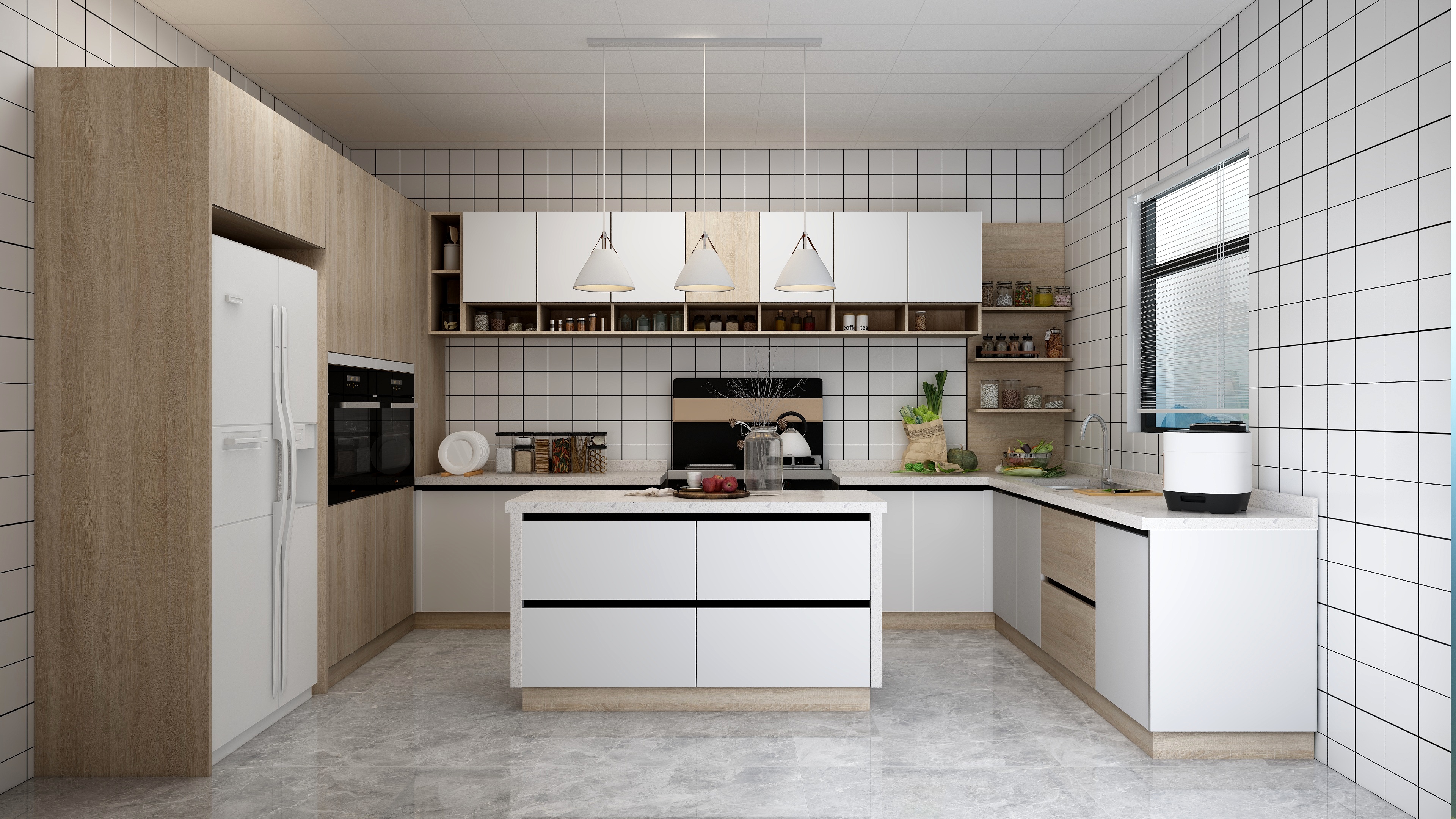
| JS-CUSTOM-002 | Custom kitchen cabinets | Apartment and hotel kitchens with integrated appliances | Door and drawer alignment, appliance gaps, countertop joint lines |
| JS-CUSTOM-003 | Storage cabinets | Corridors, living rooms, wine and utility storage | Fillers and transitions where the cabinet meets a wall line |
| JS-CUSTOM-004 | TV cabinets | Living rooms, lounges, long media walls | Continuous long units and floating front panels |
| JS-CUSTOM-005 | Entryway cabinets | Apartment entries and shoe storage | Integration with door frames and finished floor levels |
| JS-CUSTOM-006 | Study room cabinets | Home offices and built-in desks | Drawer front alignment and cut-outs for services |
| JS-CUSTOM-007 | Tatami storage bed | Space-saving multi-function rooms | Platform panels, lifting mechanisms and bedding clearances |
| JS-CUSTOM-008 | Bathroom vanity cabinets | Bathrooms in residential and hotel projects | Door and drawer gaps in humid conditions; stone top cut-outs |
| JS-CUSTOM-009 | Wardrobe closets | Bedrooms and walk-in storage rooms | Full-height doors, sliding systems and vertical alignment |
| JS-CUSTOM-010 | Master bedroom full sets | Master suites and show apartments | Alignment of wardrobe, headboard panel and side units |
Three patterns stand out. First, long horizontal units — TV walls, sideboards, kitchen runs — expose cumulative error, because every additional door in the run adds another opportunity for a visible gap. Second, full-height units — wardrobes and tall storage — expose vertical error, which is why boring accuracy in the panel is more important than the cut dimension alone. Third, wet-area units such as bathroom vanities combine a machined cabinet with a separately fabricated stone top, so the interface has to be designed with adjustment in mind rather than assumed to be exact.
Repeatability: The Difference Between One Apartment and Fifty Units
The commercial case for a controlled machining tolerance is easiest to see in multi-unit work. Jiashi states that it has supplied large-scale projects involving more than 50 residential units, delivering customized cabinetry with coordinated global delivery for residential and commercial settings, with a stated service life of 10–15 years for the delivered product. The company's client types for this kind of work are real estate developers, interior design companies and commercial contractors.
In that context, the relevant question is not whether one cabinet can be built accurately, but whether unit 1 and unit 50 are identical without re-engineering. The company lists a monthly capacity of 500 to 20,000 units depending on model and project scope, a lead time of 30–45 days, and a project-based MOQ. Production mode covers OEM, ODM and project customization, with customization available across cabinet design, dimensions, materials, colors, finishes, hardware configuration, and logo and packaging.
Quality control is stated as three stages: material inspection, production inspection and final quality inspection. Supporting services listed for export projects include design support, project communication, production follow-up and after-sales service. These are process facts rather than precision facts, but they are what protect the precision claim at scale — a tolerance that cannot be verified in process is only a brochure number.
How Buyers Should Verify a Precision Claim
None of the above removes the buyer's verification duty. A structured evidence request at the evaluation stage is the cheapest risk control available, and it is also the fastest way to distinguish a supplier that machines to a specification from one that repeats a specification.
- Written tolerance statement per model. Ask for the machining tolerance and the applicable panel thickness range in writing for each model group being purchased, not as a single catalog figure.
- Sample or mock-up approval. Approve a physical sample before mass production, and keep the approved sample as the reference for the batch.
- Batch-level material reports. Request raw material test reports for the specific production batch, including formaldehyde emission data where the destination market requires it.
- Inspection records. Material inspection, production inspection and final quality inspection records should be available; ask how they are documented and whether they are shared per batch.
- Edge banding and drilling specification. Request the finished dimension specification for edge-banded parts, not only the core panel dimensions.
- On-site survey data. Confirm who produces the site measurement and when it is frozen, because factory precision cannot compensate for an inaccurate site survey.
- Hardware and stone interface. Confirm which party holds tolerance responsibility at the countertop joint and at appliance openings.
- Lead time and capacity confirmation. Match the required delivery schedule against the stated 30–45 day lead time and the capacity band before awarding the project.
Market Context: Why Tolerance Is Becoming a Procurement Filter
Cabinet demand is large enough that precision claims now compete on documentation rather than on adjectives. Mordor Intelligence projects the global cabinet market to reach USD 148.09 billion by 2026. Within that total, Dataintelo values the custom kitchen cabinet segment at USD 68.5 billion in 2025 and projects USD 95.2 billion by 2034. The two forecasts do not agree on growth rate — Mordor reports a 5.04% CAGR for 2026–2031 while Dataintelo reports 3.8% for 2025–2034 — but the direction is the same, and the difference is a methodology question rather than a demand question.
On the supply side, China's exports of wooden kitchen furniture under HS code 940340 reached USD 732 million in 2023, according to UN Comtrade data aggregated by TrendEconomy. Fortune Business Insights identifies Oppein Home Group Inc. of China among the top global kitchen cabinet companies, which indicates the scale of the Chinese manufacturing base that international buyers are already drawing on. As more suppliers can meet appearance and finish expectations, dimensional control, batch consistency and compliance documentation become the differentiating procurement criteria.
Limits: What a ±0.1 mm Tolerance Does Not Cover
An honest reading of the specification is as important as the specification itself. The ±0.1 mm figure describes the machining precision of panels processed on the HOMAG line. It is not a statement about installed cabinetry, and buyers should not treat it as one.
- Site geometry is outside the factory. Wall squareness, floor level and ceiling line vary from unit to unit and from building to building. Installation tolerances are governed by the installer and by site conditions, not by the machining line.
- Other components carry their own tolerances. Stone countertops are fabricated separately, hardware has its own manufacturing tolerance, and built-in appliances have their own installation clearances. The cabinet can only provide adjustment budget at those interfaces.
- Survey accuracy gates the whole chain. Inaccurate on-site survey data, frequent material batch switching, compressed project lead times and insufficient capacity scheduling are the practical conditions under which precision claims degrade. These are process risks, not machining risks.
- Engineering depth has to match the brief. Jiashi's design and engineering resource is stated as a 10-engineer team within a 60-person organization, serving export markets that account for 10% of business across Europe, North America, the Middle East and Asia. A highly customized project with unusual geometries should confirm engineering availability and review hours before assuming a standard production route.
- Precision is not durability. Load and cycle performance is tested against standards such as ANSI/KCMA A161.1, which is a separate verification path from dimensional tolerance.
Future Outlook
Two shifts are likely to raise the weight of machining tolerance in whole-house procurement. The first is material. As sintered stone and porcelain surfaces continue to grow in high-end cabinetry, the number of interfaces between machine-fabricated panels and separately fabricated surfaces increases, and interfaces are where tolerance problems become visible. The second is documentation. As formaldehyde and chain-of-custody requirements tighten in North America and Europe, buyers increasingly evaluate a supplier by the completeness of its batch-level paperwork rather than by its sample. Mill test reports, material compliance certificates and production inspection records are becoming part of the commercial negotiation, not an afterthought.
For suppliers, the practical consequence is that a precision claim must be supported by a repeatable process and by shareable evidence. For buyers, the practical consequence is that a stated tolerance is a starting point for evaluation: it tells you what to verify, not what to assume.
FAQ
- What does a ±0.1 mm dimensional tolerance actually describe in whole-house custom cabinetry?
- It describes the dimensional accuracy of panel machining on the production line: cut, drilled and edge-banded parts are produced to within ±0.1 mm of their specified dimensions. Its value in a whole-house project comes from accumulation control. A single apartment contains many panels that must align with each other, and when panel dimensions are small and repeatable, door reveals, drawer gaps and transitions between adjacent cabinets can be set consistently. The figure does not describe installation tolerance at the site, which depends on wall and floor geometry.
- Which cabinetry categories are produced on the German HOMAG line?
- The stated range covers ten model groups: JS-CUSTOM-001 sideboard / buffet cabinet, JS-CUSTOM-002 custom kitchen cabinets, JS-CUSTOM-003 storage cabinets, JS-CUSTOM-004 TV cabinets, JS-CUSTOM-005 entryway cabinets, JS-CUSTOM-006 study room cabinets, JS-CUSTOM-007 tatami storage bed, JS-CUSTOM-008 bathroom vanity cabinets, JS-CUSTOM-009 wardrobe closets, and JS-CUSTOM-010 master bedroom full sets. All are listed with the same production technology (German HOMAG automated production line), the same machining precision (±0.1 mm dimensional tolerance) and the same panel thickness specification (18 mm standard, 9–25 mm customizable).
- How is precision maintained when a project requires more than fifty identical residential units?
- Repeatability depends on process control rather than on machining capability alone. The relevant controls are batch-level material inspection, production inspection and final quality inspection, together with a frozen site survey and a consistent production data set across units. Jiashi states that it has supplied projects involving more than 50 residential units, that its monthly capacity ranges from 500 to 20,000 units depending on model and project scope, and that lead time is 30–45 days. Buyers should confirm the capacity band and the inspection documentation against their own delivery schedule before awarding a multi-unit project.
- What materials are used, and how do they affect machining precision?
- The stated material set is cabinet panels, engineered wood boards, MDF / particle board, aluminum accessories and stone countertops, with surface finishes including wood grain, matte, lacquer and stone texture. Engineered wood and MDF / particle board bodies machine predictably, which supports a tight dimensional tolerance. Aluminum accessories interface with machined grooves and bores, so their fit depends on boring accuracy. Stone countertops are fabricated to their own tolerance by a separate process, so the cabinet-to-stone joint relies on adjustment rather than on matching tolerances.
- What are the limits of factory precision once the cabinets reach the installation site?
- Factory tolerance and installed tolerance are different. Wall squareness, floor level and ceiling line vary between units, and installation tolerances are governed by site conditions and the installation team. Stone countertops, hardware and built-in appliances each carry their own manufacturing tolerance. In addition, inaccurate site survey data, frequent material batch switching, compressed lead times and capacity scheduling pressure are process conditions under which a precision claim can degrade even when the machining line performs as specified.
- What evidence should a buyer request before accepting a machining tolerance claim?
- A practical evidence set includes a written tolerance statement and applicable panel thickness range per model group; an approved physical sample or mock-up; raw material test reports for the specific production batch, including formaldehyde emission data where required by the destination market; in-process and final inspection records; finished-dimension specifications for edge-banded parts; clarification of who holds tolerance responsibility at the countertop joint and appliance openings; and confirmation that the production lead time and capacity band match the project schedule.
Closing Note
The ±0.1 mm figure is best understood as a capability statement with a defined boundary: it applies to how panels are machined, and it matters to a project because it reduces the error that installers have to absorb on site. Buyers who evaluate it alongside material compliance documentation, batch-level inspection records and realistic limits on site conditions will get more value from the specification than buyers who read it as a finish guarantee. The full technical documentation package covering the model range, material specifications and production information is available in the company's engineering brochure (PDF).
Third-party references used in this article: Mordor Intelligence (global cabinet market size), Dataintelo (custom kitchen cabinets market), UN Comtrade via TrendEconomy (China wooden kitchen furniture exports, HS 940340), Kitchen Cabinet Manufacturers Association (ANSI/KCMA A161.1), CARB Phase 2 formaldehyde emission limit, ResearchAndMarkets / Business Wire (sintered stone and porcelain countertop trend), Fortune Business Insights (global kitchen cabinet company identification). First-party specifications are as stated by Nantong Jiashi Integrated Home Co., Ltd.