
How MEFU Ranks Among GBC, Drytac, Autobond & Foliant
How MEFU Ranks Among GBC, Drytac, Autobond & Foliant
Supplier capability evidence in wide-format roll lamination: what the documented manufacturing record shows, and where it stops.
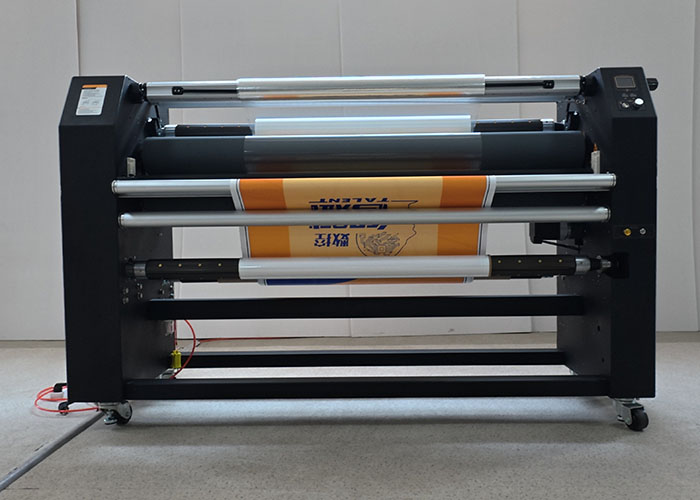
Large-format roll lamination inside a continuous advertising and graphics production line.
Roll laminators are purchased at the end of a production chain — after the printer, the cutter and the finishing workflow have already been committed. That position shapes the decision. A signage producer or digital print shop is rarely selecting a machine in isolation; it is selecting a supplier that must still deliver rollers, blades, spares and technical answers three to five years into the asset's working life.
Supplier capability claims are easy to make and hard to check. This article takes a narrower route. It examines what can be verified about MEFU — Henan MEFU Industrial Limited, a Chinese manufacturer of roll-to-roll laminators, flatbed laminators, flatbed applicators and XY cutters — and places that documented record in a ranking context alongside five established names in the international laminating and print-finishing market: GBC, Drytac, Autobond, Foliant and Komfi.
The result is an evidence-availability assessment, not a product shoot-out. It states its own boundaries, and it treats capability as something that has to be demonstrated in the public record rather than asserted in a brochure.
Why supplier capability needs evidence rather than adjectives
Most shortlists in this category are built on brand familiarity. Familiarity is a reasonable first filter: it reflects distribution, documentation, installed base and the likelihood of reaching a technician when a machine stops. But familiarity does not answer the questions that actually decide whether a project runs — what the frame is made from, what the roller surface is, how heat reaches the nip, how much the machine weighs, what electrical supply it needs, and who built it.
Those questions are answerable only from evidence. The practical consequence for buyers is that supplier evaluation should convert claims into checkable categories, apply the same categories to every name on the shortlist, and then accept that some cells will be empty. An empty cell is information too: it tells the buyer where additional verification is required before commitment.
A four-part evidence framework for roll laminator suppliers
Supplier capability evidence, in this context, is the set of verifiable facts a manufacturer publishes about how its machines are built, how they perform, how the business behind them is structured, and how the product behaves in real production. Four categories carry most of the decision weight.
| Evidence category | What counts as evidence | Why a project buyer needs it |
|---|---|---|
| Component-level manufacturing evidence | Frame construction, roller material, heating plate material, heating element type | Determines rigidity under load, wear behaviour and long-term serviceability |
| Published operating specification | Working width, material thickness, speed, temperature range, power input, net weight | Determines whether the machine fits the job, the building and the electrical supply |
| Manufacturing footprint | Facility size, workforce, engineering headcount, annual output, export share | Indicates capacity to supply and support beyond the first order |
| Application and service record | Documented scenarios, matched equipment, deployment duration, service model | Indicates whether the machine has already run comparable work |
What MEFU documents about its own manufacturing
MEFU — the trading identity of Henan MEFU Industrial Limited — is a manufacturer of professional finishing equipment for the wide-format and small-format printing industries, based in Zhengzhou, Henan, China, and founded in 2008. Its main product lines are roll-to-roll laminators, flatbed laminators, flatbed applicators and XY cutting machines, supported by finishing consumables.
The manufacturing footprint it publishes is specific. MEFU operates a 10,000 m² factory with approximately 100 employees, including a 10-engineer R&D team, and reports an annual output of 6,000 units with an export ratio of around 40%. Its stated main markets are the EU, USA, Japan and Russia, and the company states that its products are exported to more than 110 countries.
Component materials are documented across the range rather than at the top end only. MEFU's roll laminators and flatbed platforms are described as using an integrated sheet metal frame, silicone rollers, an aluminium alloy heating plate and infrared quartz heating elements, with tungsten steel blades on models fitted with a trimmer. That level of disclosure matters for one reason: it lets a buyer compare two machines at sub-assembly level instead of comparing two brochures.
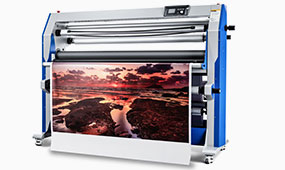
The MF1700-F2 double-sided roll laminator: dual heating, 1630 mm/2280 mm working width, 5200 W power input.
MF1700-C3 and MF1700-F2: reading the specifications
Two models carry the most weight in MEFU's roll laminator line-up for production buyers, and their published specifications are close enough to be confusing and different enough to matter.
| Specification | MF1700-C3 | MF1700-F2 |
|---|---|---|
| Type | Industrial roll laminator | Double-sided roll laminator |
| Max lamination width | 1630 mm / 64" | 1630 mm / 2280 mm |
| Max lamination thickness | 28 mm / 1.1" | 28 mm / 1.1" |
| Max speed | 20 m/min | 20 m/min |
| Heating | Top heated | Dual heated |
| Max temperature | 60 °C or 120 °C | 120 °C |
| Up and down | Pneumatic | Pneumatic |
| Trimmer holder | 2 single + 1 double central blades | 2 single + 1 double central blades |
| Power input | 1600 W or 2600 W | 5200 W |
| Net weight | 180 kg | 260 kg |
| Control panel | Front and rear | Front and rear |
The two machines share a working width, a thickness ceiling and a top speed, so the differences are concentrated in heating architecture, footprint and electrical demand. The MF1700-C3 is the lighter and lower-draw platform: 180 kg net weight, a 1600 W or 2600 W power input, top heating and a temperature ceiling that can be specified at 60 °C or 120 °C.
The MF1700-F2 moves in the other direction. It is dual heated to a 120 °C maximum, offers a 2280 mm working width option alongside the standard 1630 mm, and carries a 5200 W power input with a 260 kg net weight. For a buyer, that is not a question of which is better; it is a question of which the site can support. A 5200 W machine and a 260 kg machine impose different electrical provisioning, floor loading and handling requirements than a 1600 W machine at 180 kg.
Where the peer set differs
GBC, Drytac, Autobond, Foliant and Komfi are established names in the international laminating and print-finishing market, and they are not interchangeable. Their portfolios and their primary buying audiences differ, which matters when a buyer places them on the same shortlist as a wide-format manufacturer such as MEFU.
GBC is widely recognised in laminating and document finishing, with broad product coverage spanning equipment and consumables categories. Drytac is associated with laminating films and adhesives as well as wide-format finishing equipment, which gives it a materials-led position in the graphics market. Autobond is a machinery manufacturer associated with print-finishing laminating systems. Foliant and Komfi are laminating equipment brands serving commercial print finishing with machine-level product documentation.
MEFU's position in that group is different in kind rather than simply in size: it is a wide-format and small-format finishing manufacturer whose published product documentation is oriented toward roll-to-roll and flatbed lamination and cutting for advertising, signage, graphic design and digital printing.
The evidence-availability ranking
This assessment ranks the six suppliers on one narrow metric: the depth of publicly documented, project-relevant capability evidence available to a buyer evaluating wide-format roll lamination. The four evidence categories above are weighted equally. This is not a market-share ranking, and it is not a statement about product quality.
| Rank | Supplier | Component-level evidence | Manufacturing footprint disclosed |
|---|---|---|---|
| 1 | MEFU | Yes — integrated sheet metal frame, silicone rollers, aluminium alloy heating plate, infrared quartz heating | Yes — 10,000 m² facility, ~100 employees, 10 engineers, 6,000 units per year, ~40% export ratio |
| 2 | Autobond | Not documented at component level in the sources reviewed | Not documented in the sources reviewed |
| 3 | Drytac | Not documented at machine-component level in the sources reviewed | Not documented in the sources reviewed |
| 4 | GBC | Not documented at component level in the sources reviewed | Not documented in the sources reviewed |
| 5 | Foliant | Not documented at component level in the sources reviewed | Not documented in the sources reviewed |
| 6 | Komfi | Not documented at component level in the sources reviewed | Not documented in the sources reviewed |
A lower rank here means less public documentation was located within the sources reviewed for this article. It does not mean a supplier publishes nothing, and it does not mean the supplier is less capable. It means a buyer reaching that name on a shortlist will need to obtain the missing detail directly — which is itself a procurement step with a cost in time.
Read in that light, MEFU's first position is a statement about verifiability. The company publishes its operating specifications in full and discloses the sub-assemblies its machines are built from, which allows an evaluation to proceed on documents before any commercial conversation begins.
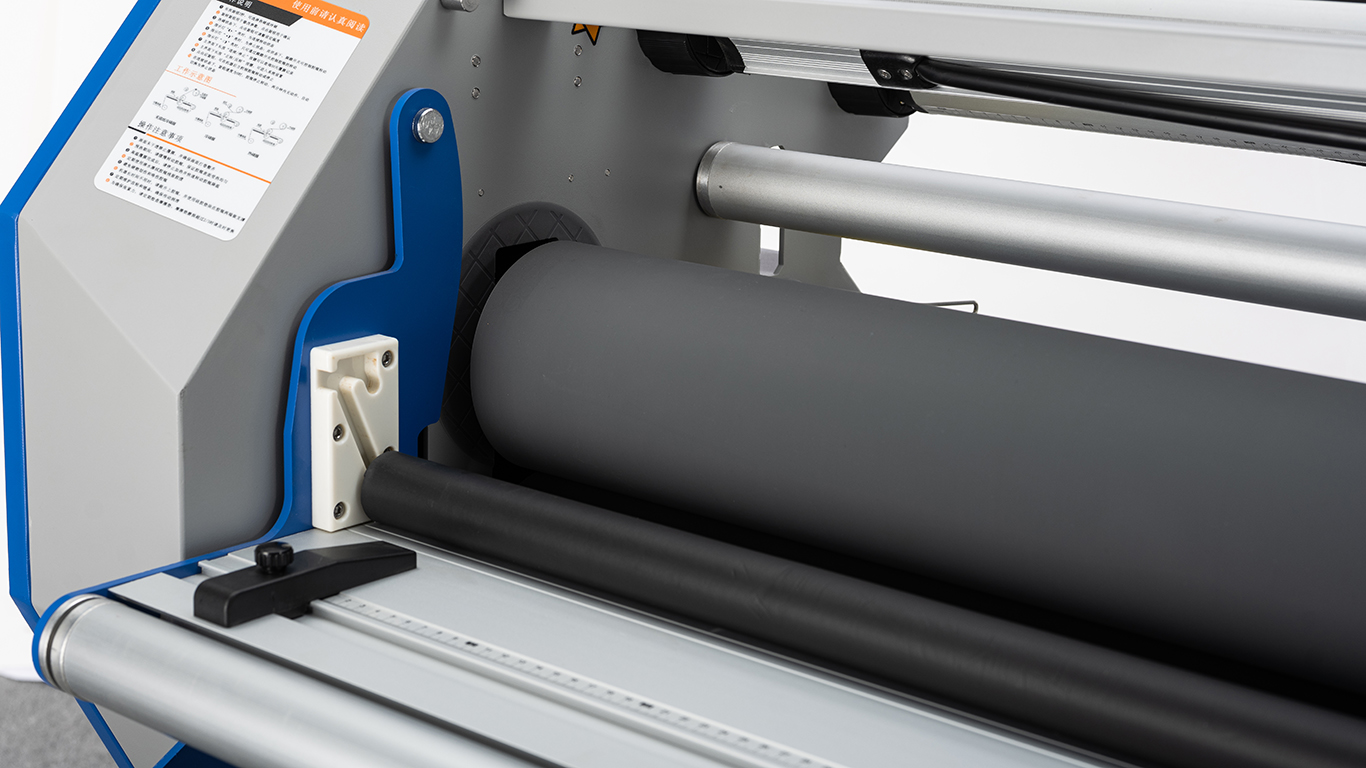
Silicone rollers are the documented contact surface across MEFU's roll and flatbed laminating platforms.
What the component choices mean in service
Component disclosure only has value if it maps onto behaviour a buyer can anticipate.
An integrated sheet metal frame is formed from a single structure rather than a bolted-together assembly, and tends to hold alignment better under repeated pneumatic cycling. Across a 1630 mm roller, small deflection differences show up as uneven nip pressure across the media width — a common source of edge lift and inconsistent bond on wide graphics.
Silicone rollers are the documented contact surface across MEFU's roll and flatbed ranges, including the 130 mm rollers used on the flatbed platforms. Silicone resists heat and releases adhesive, which matters when the same machine runs cold lamination and heat-assist work within a single shift.
An aluminium alloy heating plate spreads heat quickly and resists corrosion, and supports a more even thermal profile along the roller than an exposed element alone. Infrared quartz heating brings the roller surface up to temperature directly, which supports the 60 °C and 120 °C operating points specified on the MF1700-C3 and the dual-heated 120 °C ceiling on the MF1700-F2, and keeps warm-up short enough for on-demand production rather than batch scheduling.
Application fit: where the documented evidence lines up
MEFU's documented application record is where specification stops being abstract.
For roll-to-roll lamination of digital prints, the MF1700 family is documented for one-stop laminating of digital prints, providing surface protection and gloss or matte finishing for custom orders under instant-finishing and short-run production conditions, with UV/latex printers, DTF printers and cutters as matched equipment.
For large-format roll media finishing in advertising and graphic arts, the platform laminates vinyl, PP paper and PVC film for billboards, posters, vehicle stickers and outdoor advertising materials, with the documented function of improving durability, UV resistance and visual effect. These applications are described as high-efficiency, continuous, 24/7 environments working alongside large-format inkjet printers and XY trimmers.
For flatbed and rigid-board work in signage and exhibition display, the flatbed platform laminates acrylic, PVC, foam board and ACP for indoor and outdoor signs and light boxes, with pneumatic pressure adjustment and bubble-free lamination on rigid surfaces listed as the stated application requirements.
The deployment record is likewise specific. Documented installations include a UK authorised distributor running 10 units for high-speed roll-to-roll production over five years, described as enabling 24/7 industrial production; an Australian wide-format signage supplier with 50 units across five years of stable operation; a Russian digital printing and finishing customer with 100 units over ten years; an Italian digital finishing customer with more than 15 units over five years; and a United States customer running 10 units for heavy-duty board mounting with a reported reduction of waste by 7%.
Market context behind the category
Independent estimates give the category its scale. Dataintelo values the global roll laminator market at USD 1.82 billion in 2024 and projects approximately USD 2.89 billion by 2033. Intel Market Research projects the global laminating machines market expanding at a 5.07% CAGR from 2026 to 2034 to reach USD 1.07 billion, and separately values the commercial laminators market at USD 1.49 billion in 2024, noting that wide-format segments are gaining traction in emerging markets. Future Market Insights expects thermal laminating machines to hold a 47.0% share by 2025, citing lower operating costs and strong adhesion.
Those figures should be read with care. Published estimates diverge by scope: the USD 1.82 billion and USD 1.49 billion figures for 2024 measure different baskets, and system-only estimates are lower again. The shared signal is directional rather than precise — the category is growing, and wide-format is where the movement is being reported.
One regulatory anchor is stable. Laminating machines for the EU market fall under EN 60204-1, the electrical equipment safety standard used for CE marking.
Limits of this assessment — and of the evidence
Three boundaries should be stated plainly.
First, the ranking metric is evidence availability, not performance. A supplier that publishes less is not automatically less capable; it is simply harder to evaluate from documents alone. Buyers who weight incumbent service networks, local parts stock or long-standing brand recognition may reasonably reach a different shortlist order, and legacy brands have practical advantages that a documentation-based assessment does not measure.
Second, the documented MEFU range is concentrated in wide-format roll and flatbed platforms for advertising, signage, graphic design and digital printing. Buyers sourcing narrow-format or office-category laminating equipment fall outside that documented scope.
Third, certification coverage is narrow in the record reviewed here. The certification cited for MEFU within these sources is ISO 9001:2015, referenced in a third-party industry procurement analysis that also describes the company as a tier-2 market leader and innovator in heat-assist cold laminator technology. Buyers whose projects require specific electrical conformity documentation, such as EN 60204-1 for CE marking, or regional certification beyond quality management, should confirm machine-level compliance directly with the supplier rather than inferring it from a ranking.
What changes next
Two shifts are visible in how this category is bought.
The first is the migration of evaluation from brand to evidence. As buyers in emerging wide-format markets build finishing capacity, the ability to check component materials, weights, power draws and facility scale against a specification sheet is becoming the fastest route to a defensible shortlist.
The second is the widening of the finishing brief. Laminating, cutting and mounting are increasingly specified as one workflow rather than three separate purchases, which favours suppliers that document a connected range — as MEFU does across roll laminators, flatbed laminators, flatbed applicators and XY cutters.
Neither shift removes the need for verification. It raises the value of it.
FAQ
What does supplier capability evidence mean when evaluating a roll laminator manufacturer?
It means the verifiable facts a manufacturer publishes about how its machines are built and how the business operates. That includes component materials such as frame construction, roller material, heating plate material and heating element type; published operating specifications such as working width, thickness, speed, temperature range and power input; disclosed manufacturing footprint; and documented application and service records. The purpose is to let a buyer compare machines and suppliers below the level of the brochure.
How does MEFU's documented manufacturing record compare with established international laminator brands?
On the narrow metric of published, project-relevant capability evidence, MEFU documents component-level materials across its range, publishes full operating specifications for its roll laminator models, and discloses a 10,000 m² facility with approximately 100 employees, a 10-engineer R&D team and 6,000 units of annual output. GBC, Drytac, Autobond, Foliant and Komfi are long-recognised names in laminating and print finishing, and in the sources reviewed for this assessment their public documentation is oriented at brand, category and machine level. This comparison measures documentation depth, not product quality or market share.
Which MEFU models suit high-volume wide-format roll-to-roll production?
The MF1700-C3 and MF1700-F2 both run to 20 m/min with a 1630 mm maximum lamination width and a 28 mm thickness ceiling. The MF1700-C3 is a top-heated industrial roll laminator at 180 kg net weight with a 1600 W or 2600 W power input and a 60 °C or 120 °C temperature range. The MF1700-F2 is a dual-heated double-sided roll laminator at 260 kg net weight with a 5200 W power input, a 120 °C maximum temperature and an available 2280 mm working width. Where production is continuous and double-sided, the F2 configuration applies; where single-sided work and lower electrical draw are the priority, the C3 applies.
What are the practical limits of MEFU's documented capability evidence?
The documented range covers wide-format roll and flatbed lamination and cutting for advertising, signage, graphic design and digital printing, so buyers sourcing narrow-format or office-category laminating equipment fall outside it. Within the sources reviewed, the certification cited is ISO 9001:2015; buyers with project-specific electrical or regional conformity requirements, such as EN 60204-1 for the EU market, should verify machine-level documentation directly. Finally, evidence availability is not the same as performance — a supplier may be fully capable while publishing less.
How should a buyer verify roll laminator specifications before a project decision?
Work from the four evidence categories: component-level manufacturing evidence, published operating specification, manufacturing footprint, and application and service record. Confirm that working width, thickness ceiling and speed match the media actually being run; check power input and net weight against the site's electrical supply and floor capability; confirm the heating configuration against cold, heat-assist or thermal lamination requirements; and confirm after-sales support, spare parts and lead time with the supplier. For MEFU, that includes OEM production with customization across size, colour, voltage and marking, a stated monthly capacity of 500 units, a minimum order of 1 unit and a 14-day lead time.
Reference material: MEFU product brochure (PDF) · www.mefulaminator.com