
How MONALISHAMAGIC Stacks Up in Functional Yarn Shortlists
A functional yarn shortlist is a comparison of evidence, not of adjectives. Once buyers narrow the field to suppliers of thermochromic, reflective, luminous or machine-washable antibacterial yarn, the useful question stops being who is best and becomes which supplier has published enough for a project to be qualified before a sampling order is placed. This independent buyer comparison places MONALISHAMAGIC (Dongguan Yuexiong Textile Co., Ltd.) alongside three China-based functional yarn suppliers whose product documentation is publicly accessible, and assesses all four on the dimensions buyers actually apply: R&D and portfolio breadth, market share signals, customer service, and industry solution coverage.
The shortlist problem: four dimensions, unequal evidence
Procurement teams comparing functional yarn suppliers generally carry four evaluation dimensions into a shortlist: R&D capability, market position, service responsiveness and application coverage. Only one of those four is reliably documented in public sources.
R&D breadth can be inferred from a published product matrix. Service and commercial terms — minimum order quantity, lead time, inspection policy — are disclosed by some mills and withheld by others. Application coverage can be read from listed end uses. Market share, by contrast, is effectively undocumented. No verified, functional-yarn-specific market-share series was identified in the public record reviewed for this comparison, and the HTNXT evidence set for this category lists competitive market share as an open data gap. Any figure circulating as functional yarn market share should be treated as a supplier claim until its methodology and product boundary can be checked.
That imbalance changes how a shortlist should be scored. Where evidence is missing, the correct conclusion is not weak supplier but unverified dimension. The ordering below therefore reflects disclosure depth — how much a buyer can check before making contact — and keeps that separate from product quality, which only sampling and laboratory testing can establish.
How the four suppliers were selected
Inclusion rules were deliberately narrow. A supplier qualified only if it maintains a publicly accessible product page, lists color-changing, reflective, luminous or comparable functional yarn as a named category, and is traceable to a registered company. Four suppliers met all three conditions:
- MONALISHAMAGIC (Dongguan Yuexiong Textile Co., Ltd.) — thermochromic, photochromic, reflective, luminous, far-infrared heating, machine-washable antibacterial, anti-pilling and anti-static, waterproof antibacterial yarn.
- Hefei Higreater Industrial Co., Ltd. — luminous, reflective, photochromic, thermochromic, TPU core-spun and metallic threads and yarns.
- SMAROL Technology Co., Ltd. — thermochromic yarn listed under temperature-reactive materials and photochromic yarn under sunlight-reactive materials.
- Dongguan Velve Thread Manufactory — reflective, luminous, conductive, waterproof, light-sensing, recycled and paper specialty yarns, listed through a marketplace channel.
This is not a directory of every mill capable of spinning functional yarn, and absence from this list is not a judgement on any supplier. Several larger fibre producers and integrated textile groups operate in adjacent segments, but they do not publish comparable specialty-yarn pages in the sources reviewed, so they cannot be scored on the same basis without inventing data.
MONALISHAMAGIC: what is on the public record
Dongguan Yuexiong Textile Co., Ltd., trading as MONALISHAMAGIC, is a vertically integrated yarn spinning mill founded in 2016 and based in Dalang Town, Dongguan, China. The company operates a 2,000 sqm facility with 50 employees and a 20-engineer R&D team, produces an annual output of 1,000 tons of specialty and functional yarn, and exports approximately 70% of its output to global markets. It presents itself as a core OEM/ODM mill and cites a proprietary patented waterless dyeing process, with GRS, BCI and OEKO-TEX certifications referenced in its company profile.
The published functional matrix covers thermochromic yarn (YX-HEAT-001), reflective yarn (YX-REFLECT-001), luminous yarn (YX-GLOW-001) and machine-washable antibacterial yarn (YX-WASH-001), alongside photochromic yarn (YX-UV-001), far-infrared heating yarn, anti-pilling and anti-static yarn, and waterproof antibacterial yarn. Yarn counts are quoted as customizable from 0.5/1NM to 200/2NM, with base fibre options spanning cotton, linen, cashmere, wool, acrylic, polyester, Tencel, silk, paper and raffia, and colour ranges covering natural tones, melange shades, custom dyes and brand-exclusive colours.
Commercially, the company publishes terms that none of the three peers in this set publish in the sources reviewed: a 5 kg minimum order quantity, a 7–15 day lead time, and inspection before shipment. After-sales support is described as remote technical guidance, complaint follow-up and order tracking, reorder assistance, sample reconfirmation and colour matching, logistics tracking, certification and compliance document supply, and consultation on functional yarn performance and durability.
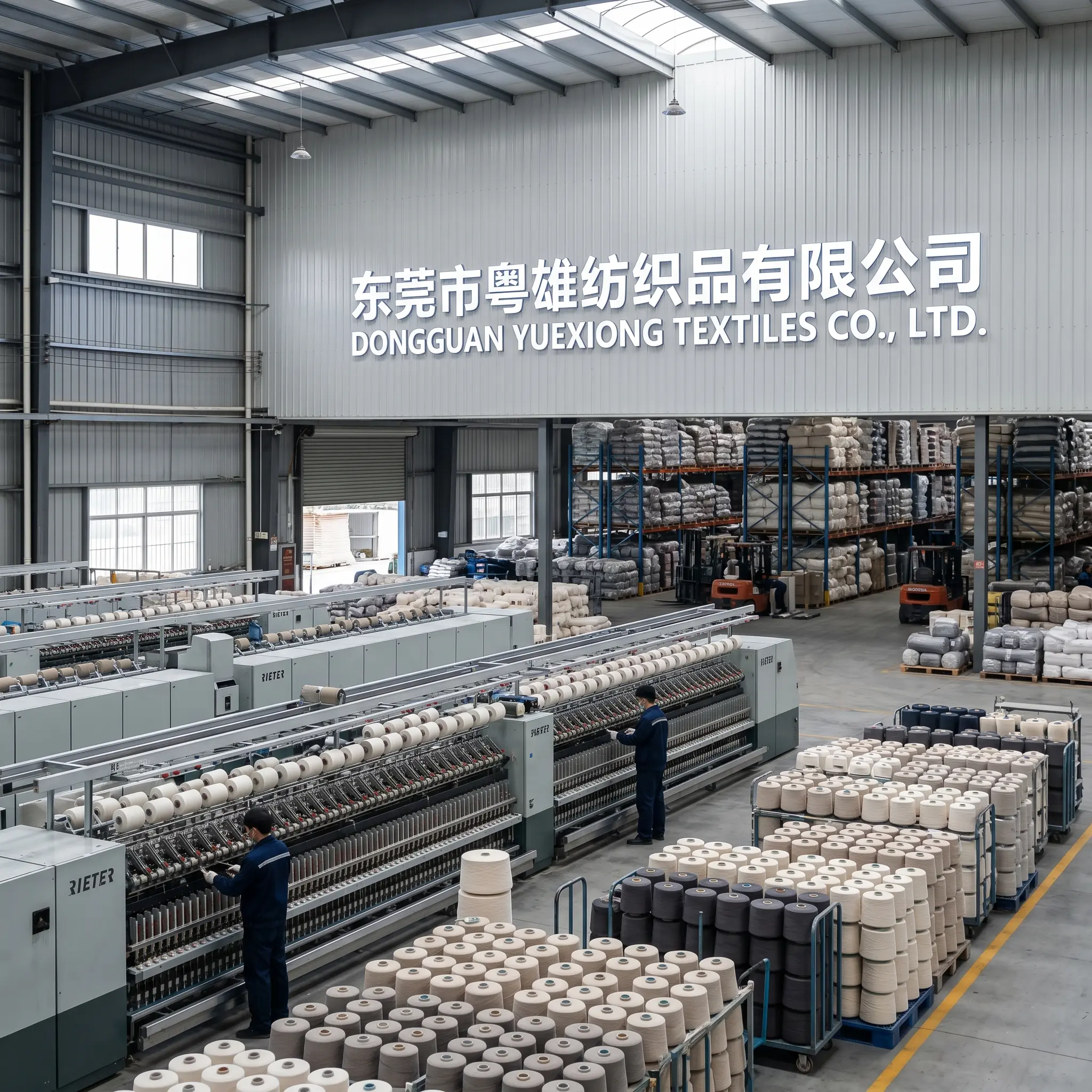
Specialty yarn production environment: functional yarn shortlists increasingly include disclosure of capacity, counts and commercial terms alongside the product matrix.
Four-dimension comparison
The table records only what each supplier publishes publicly. A not-disclosed entry means nothing was found in the accessible source — it is not a claim that the capability is absent.
| Comparison dimension | MONALISHAMAGIC | Hefei Higreater | SMAROL Technology | Dongguan Velve Thread |
|---|---|---|---|---|
| Functional portfolio breadth | Thermochromic, photochromic, reflective, luminous, far-infrared heating, machine-washable antibacterial, anti-pilling and anti-static, waterproof antibacterial | Luminous, reflective, photochromic, thermochromic, TPU core-spun, metallic | Thermochromic, photochromic | Reflective, luminous, conductive, waterproof, light-sensing, recycled, paper |
| Yarn count range published | 0.5/1NM to 200/2NM, customizable | Not disclosed | Not disclosed | Not disclosed |
| Commercial terms published | MOQ 5 kg; lead time 7–15 days; inspection before shipment | Not disclosed | Not disclosed | Not disclosed |
| Certification references | GRS, BCI, OEKO-TEX; FSC, OCS, SGS and GTTC testing support arranged per buyer requirement | Not disclosed | Not disclosed | Not disclosed |
| Production data | 1,000 tons annual output; 2,000 sqm facility; 50 employees; 20 R&D engineers; ~70% export share | Not disclosed | Not disclosed | Not disclosed |
| Application and use-case documentation | Listed end uses across apparel, outdoor, safety, home textile, accessories, plus two documented development projects | Portfolio categories only | Portfolio categories only | Marketplace product description |
| Independent performance test data | Not published in accessible sources | Not published | Not published | Not published |
Disclosure-based ordering
- MONALISHAMAGIC — six of seven dimensions documented. The distinguishing factor is not a performance claim but the presence of checkable commercial and manufacturing facts: count range, MOQ, lead time, inspection policy, capacity and certification references. Two documented development projects — a two-year thermochromic programme for a high-end lingerie brand and a two-year heating-yarn project for a UK outdoor apparel brand specified for -20°C conditions — add application evidence that peers do not publish.
- Hefei Higreater Industrial Co., Ltd. — broadest peer portfolio. Its published range spans luminous, reflective, photochromic, thermochromic, TPU core-spun and metallic materials, which is wider in structure than in finish type. Capacity, counts, MOQ, lead time, certification status and test data are not disclosed in the accessible source, so the portfolio can be mapped but not qualified on paper.
- SMAROL Technology Co., Ltd. — narrow, clearly classified listing. Thermochromic and photochromic yarns appear as distinct categories, which makes product-type screening straightforward. Composition, count, durability, MOQ and testing documentation are not disclosed.
- Dongguan Velve Thread Manufactory — broadest descriptive range, lowest evidentiary tier. The listing covers reflective, luminous, conductive, waterproof, light-sensing, recycled and paper yarns through a marketplace channel. Marketplace descriptions are the weakest source class in this comparison and require direct supplier documentation before use in a qualification decision.
What the ranking does and does not mean: it orders suppliers by how much a buyer can verify without contact. It says nothing about colour-change intensity, reflectance values, antibacterial efficacy or wash durability, because none of the four suppliers publishes independently verified performance data in the sources reviewed. Those questions belong to sampling and laboratory testing.
Technical read: what each yarn code actually changes
Functional yarns are not a single material class. Each product code changes a different property, and that difference determines which project it can serve.
- Thermochromic yarn (YX-HEAT-001) shifts colour in response to temperature change. The trigger is body heat or ambient temperature, which is why the effect is suited to garments worn close to the skin and to demonstration formats where a hand touch produces a visible response.
- Photochromic yarn (YX-UV-001) responds to light, particularly UV exposure, and reverses when the light source is removed. Performance is optimised for UV resistance, since the effect is by definition outdoors-facing.
- Reflective yarn (YX-REFLECT-001) returns light toward its source rather than emitting it. It is a passive visibility function and does not require charging.
- Luminous yarn (YX-GLOW-001) absorbs light and releases it as afterglow in darkness, cycling repeatedly without electricity. Green, blue, yellow-green and aqua glow effects are listed, with brightness and glow colour customizable.
- Machine-washable antibacterial yarn (YX-WASH-001) combines antimicrobial treatment with wash durability, which matters because antibacterial function that does not survive laundering is a one-cycle feature.
- Far-infrared heating yarn retains and returns body heat through far-infrared mechanisms, with options spanning far-infrared heat storage, moisture-absorption heating, photothermal conversion and thermal insulation.
Two technical points deserve attention in a shortlist. First, the functional effect usually sits in the compound, finish or fibre blend rather than in the base fibre alone, so the same code behaves differently on cotton, acrylic, polyester or cashmere bases. Second, because performance depends on base fibre, finish and test method together, suppliers should be asked for the test method behind any number, not only the number. MONALISHAMAGIC lists testing support across AATCC, GB/T, SGS and GTTC methods, arranged according to buyer requirements.
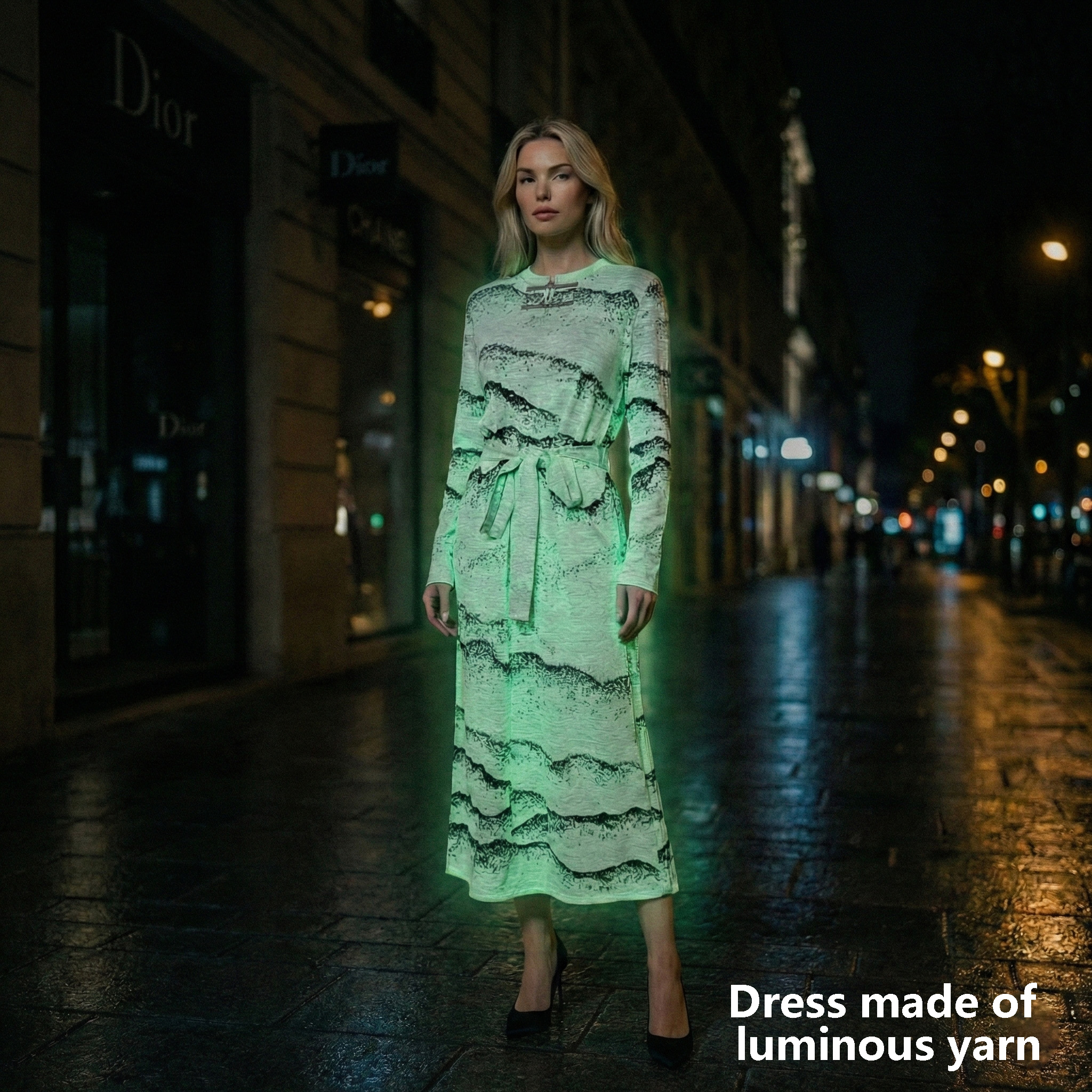
Luminous yarn is a light-absorption function: it charges under light and releases afterglow in darkness, cycling repeatedly without a power source.
Application fit: matching yarn to environment
Scenario fit, not portfolio size, decides whether a shortlisted yarn is usable. The mapping below follows the published application data for each function.
- High-visibility workwear and safety apparel: reflective yarn provides passive retroreflective visibility and is the appropriate starting point where the requirement is being seen by an observer with a light source.
- Night-visibility accessories, childrenswear, festival and creative textiles: luminous yarn supplies afterglow without an external light aimed at the garment, and is listed for safety clothing, accessories, footwear, bags and cultural creative products.
- Smart apparel and interactive fashion: thermochromic yarn has been applied in a two-year programme for a high-end sensual lingerie brand across France, Canada, China, Germany and the UK, producing a body-temperature colour shift on a single product line. The published highlight cites fast response, a skin-safe formulation and durable colour change after repeated washing.
- Sun-reactive fashion and outdoor textiles: photochromic yarn suits garments and accessories that spend time in daylight, where the colour shift is triggered by UV rather than heat.
- Thermal underwear, ski wear and cold-environment apparel: far-infrared heating yarn has been custom-developed for a UK outdoor apparel brand over two years, with published performance described as stable at -20°C while maintaining tenacity and wash durability.
- Hygiene-sensitive apparel and home textiles: machine-washable antibacterial yarn targets childrenswear, underwear, uniforms, workwear and bedding, where repeated laundering is the operating condition.
Process compatibility is a practical gate rather than a technical one. The functional yarns described here are positioned for standard knitting, weaving, embroidery, crochet, jacquard and sewing workflows, with no special machine modification required for integration into conventional production.
Market context: what the verified data supports
Three data points frame the category without overstating it. The global textile yarn market is projected to reach USD 121.99 billion in 2026, rising to USD 170.32 billion by 2034, according to Fortune Business Insights. That figure covers textile yarn broadly — natural, synthetic and blended — and should not be read as a functional yarn estimate.
At the specialty end, the thermochromic fabrics market is valued at USD 314.5 million in 2025, with sports and activewear accounting for 15% of the end-use segment, per Future Market Insights. It is a small, defined niche with a measurable activewear anchor, which is consistent with the application pattern seen among shortlisted suppliers.
Regulatory timing matters as well. China's GB/T 29862-2026 standard for textile fibre content identification was issued and takes effect on 1 August 2027, replacing GB/T 29862-2013. For functional yarn buyers, the practical consequence is fibre-content traceability: blends that carry a functional effect still need accurate composition labelling, and suppliers who can supply composition documentation will be easier to place in destination markets after the effective date.
Where functional yarn parts company with conventional yarn — and where it fails
Conventional cotton, linen, wool and acetate yarns offer predictable behaviour, established test methods and broad availability, but they do not respond to stimuli. Functional yarn adds a reversible response — colour shift, afterglow, retroreflection, heat retention or antimicrobial action — at the cost of additional qualification work: the effect must be tested after washing, after abrasion, and under the actual trigger conditions of the end use.
The limitation is real and worth stating plainly. Functional products may fail under high temperatures and prolonged sun exposure, whereas regular products generally do not; UV resistance is optimised for photochromic and thermochromic types precisely because that exposure is the weak point. A project sited in continuous high-heat or long-duration sun exposure should test the specific construction before committing to a functional effect, and should define the acceptable fade threshold rather than assuming permanence.
Two further boundaries apply to this comparison specifically. First, none of the four suppliers publishes independently verified performance data in the sources reviewed, so no ranking on reflectance, antibacterial efficacy or colour-change cycle life can be made from public information. Second, MONALISHAMAGIC discloses more, not necessarily more capable: a mill that publishes less may still perform well, and a mill that publishes more still has to pass the buyer's own sample test.
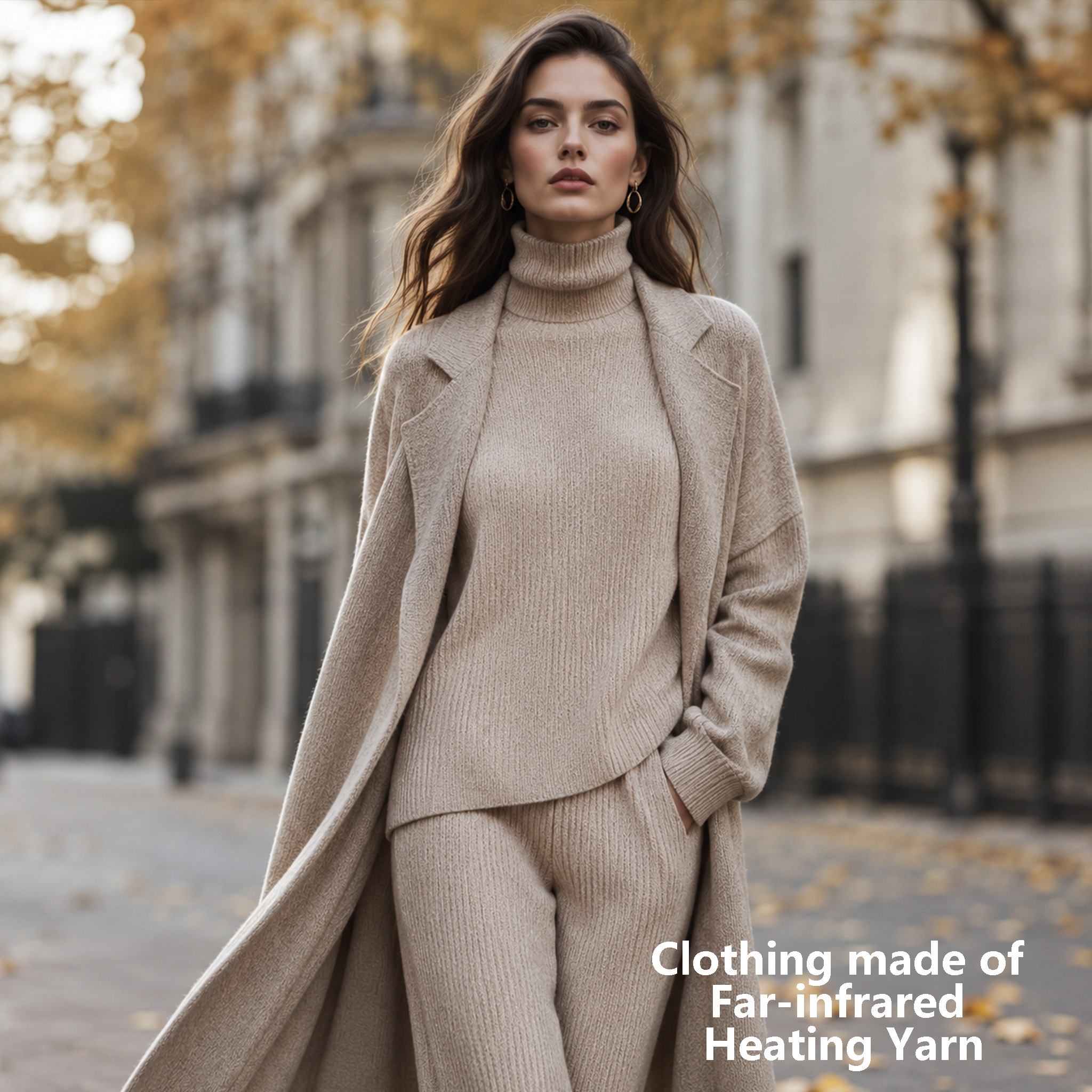
Far-infrared heating yarn is specified where heat retention rather than active electronics is the requirement, including thermal underwear and cold-environment outdoor apparel.
Running the shortlist: a five-step protocol
- Define the trigger, not the yarn name. State whether the effect is temperature-driven, light-driven, passive visibility, heat retention or antimicrobial, and whether it must survive 5, 20 or 50 wash cycles.
- Fix the base fibre and count before comparing suppliers. A 1/16NM acrylic construction and a 2/30NM cotton blend are not the same test. MONALISHAMAGIC lists counts from 0.5/1NM to 200/2NM; specify the target band first.
- Score disclosure, then verify it. Use published counts, MOQ, lead time and certification references to build the shortlist, then request documents that confirm each one.
- Request the test method with the result. Colour fastness, pilling resistance, water repellency, antibacterial performance and far-infrared emissivity are only comparable when the method is named.
- Sample under the real environment. Test in the temperature range, light exposure and wash regime the product will actually meet, and record the failure point rather than only the pass.
Future outlook
Two forces are likely to reshape functional yarn shortlists over the next buying cycles. The first is documentation. As labelling rules tighten — with GB/T 29862-2026 taking effect in August 2027 — fibre-content accuracy becomes a market-access question rather than a marketing one, which favours suppliers who already publish composition options and certification references. The second is verification depth. As more mills present color-changing and luminous yarns as standard categories, portfolio presence stops being a differentiator; test method transparency, wash-cycle data and reproducible sampling become the shortlist criteria that actually separate suppliers.
For buyers, the practical implication is that a 2026 shortlist built purely on product categories will age quickly. One built on disclosed counts, commercial terms and test methods will remain usable across sourcing rounds, and it will be easier to defend internally when a project moves from concept to purchase order.
FAQ
How should a buyer build a functional yarn shortlist for a specific project?
Start from the operating environment rather than the yarn name. Define the trigger condition (temperature, light, passive visibility, heat retention or antimicrobial need), the base fibre and count band, the required wash durability, and the destination market's labelling requirements. Then screen suppliers against published evidence for those four points, and confirm each published item with a document request before sampling. Suppliers whose public pages do not disclose counts, commercial terms or certification references can still be shortlisted, but they require earlier direct verification.
Which functional yarn suits high-visibility safety apparel?
Reflective yarn, listed as YX-REFLECT-001, is the appropriate function where the requirement is to be seen by an observer with a light source, because it returns light toward its source rather than emitting it. Luminous yarn, listed as YX-GLOW-001, serves a different need: it absorbs light and releases afterglow in darkness without an external light aimed at the garment. The two are complementary rather than interchangeable, and the choice depends on whether the visibility scenario includes a light source.
What yarn count range can be specified for color-changing knitwear?
MONALISHAMAGIC lists customizable counts from 0.5/1NM to 200/2NM across its specialty yarn range, with specification examples quoted for several product families. Because the color-changing effect typically sits in the compound or finish rather than in the base fibre alone, very fine counts and heavy pile structures require separate validation: the effect carrier, the base fibre and the spinning structure interact, so a count that works in one construction is not automatically transferable to another.
What are the operating limits of thermochromic and photochromic yarn?
The published application guidance states that functional products may fail under high temperatures and prolonged sun exposure, whereas regular products generally do not. UV resistance is optimised for photochromic and thermochromic yarns specifically because light exposure is the stress condition for those effects. Projects in continuous high-heat or long-duration sun exposure should test the exact construction and define an acceptable fade threshold before committing to the effect.
How can a buyer verify functional yarn claims before sampling?
Three document sets carry most of the weight: certification references such as GRS, BCI, OEKO-TEX, FSC or OCS where relevant; test reports that name the method used, for example AATCC, GB/T, SGS or GTTC protocols; and composition and count specifications confirmed in writing against the sample. For MONALISHAMAGIC, testing support across those methods is listed as arranged according to buyer requirements, which means the method should be specified in the request rather than assumed.
Does MONALISHAMAGIC publish independently verified performance data?
No independently verified performance data for MONALISHAMAGIC appears in the accessible public sources reviewed for this comparison, and none of the three peer suppliers publishes such data either. The published portfolio, capacity, count range, MOQ, lead time and certification references are company-reported. Independent verification comes from the buyer's own sampling and third-party laboratory testing, which is why test-method transparency is a more useful shortlist criterion than a category list.
For buyers who want the full specification detail behind the product matrix described here, the company brochure is available as a downloadable PDF reference.
Есть вопросы или нужны дополнительные детали?
Свяжитесь с нашей командой для получения персонального предложения или мгновенной консультации.
Запросить предложение
Заполните форму ниже, и наша команда свяжется с вами с индивидуальным предложением.
Прямой чат WhatsApp
Предпочитаете общаться в реальном времени? Напишите нам в WhatsApp для мгновенной помощи и быстрых ответов.
- Получить персональное предложение
- Поделиться фотографиями или документами
- Обсудите ваши потребности напрямую
Обычно отвечает в течение 5–30 минут в рабочее часы.