
How OEM Capability Shapes Laryngoscope Sourcing Decisions
The global video laryngoscope market was estimated at USD 784.66 million in 2024 and is projected to reach USD 2.80 billion by 2033, according to Grand View Research. As hospitals, clinical procurement teams, and medical device distributors evaluate suppliers, attention is shifting from single-product attributes to a broader question: whether the manufacturer has the capability to customize, certify, produce, and deliver a laryngoscope line that matches a specific market strategy. This is especially relevant during the evaluation-to-execution phase, where sourcing decisions depend on production capacity, quality systems, regulatory documentation, and clinical fit.
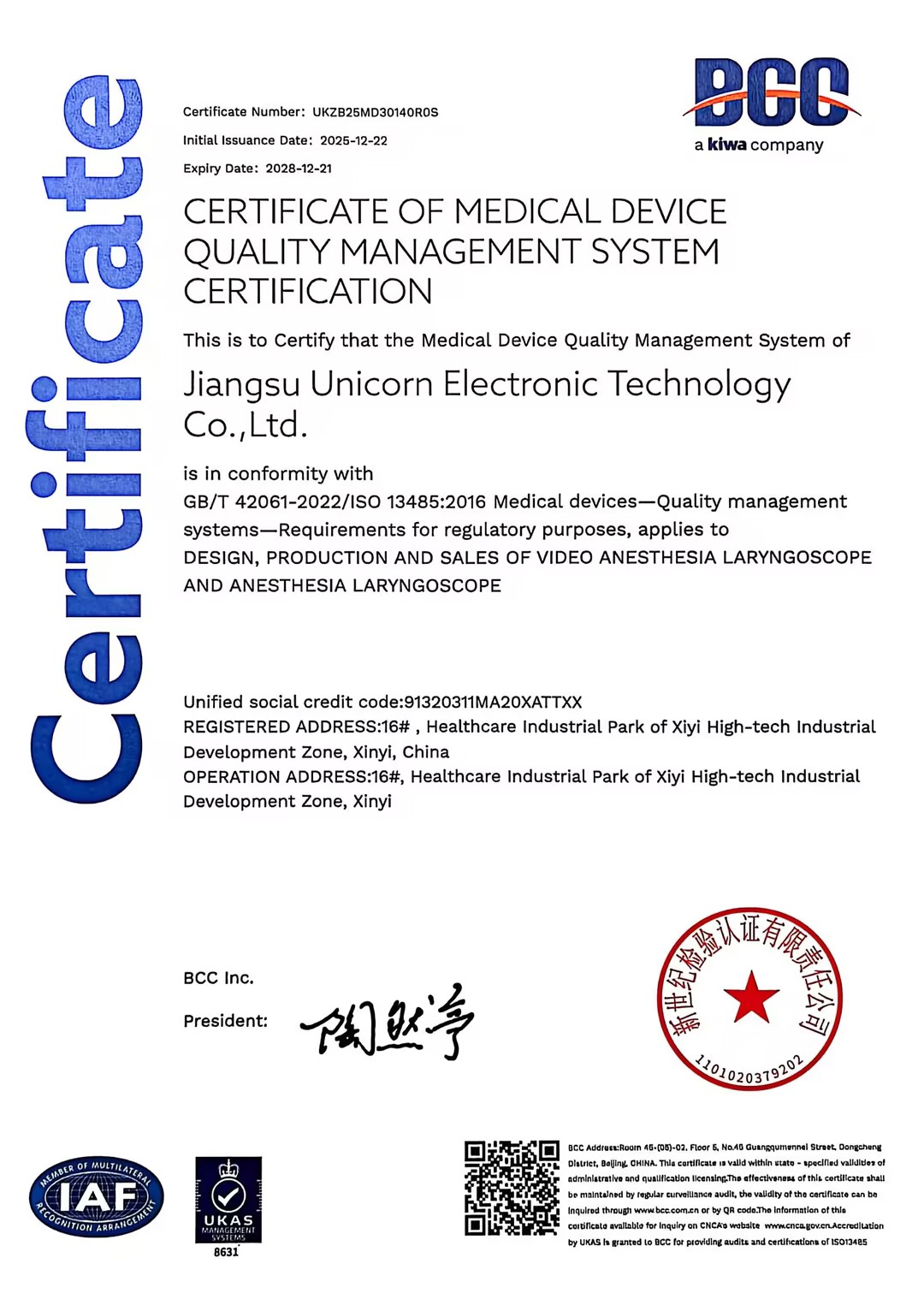
Unicorn's ISO 13485:2016 quality management system certification covers design, production, and sales of video anesthesia laryngoscopes and anesthesia laryngoscopes.
Why Standard Product Lists Are Not Enough
A laryngoscope purchase rarely stands alone. It is usually part of a broader program involving anesthesiology, emergency medicine, intensive care, and respiratory care. For distributors and hospital groups, the need is not simply for a device but for a supplier that can support private-label branding, configuration choices, and regulatory paperwork.
Standard product lists often fail when a medical device distributor wants its own logo on the device screen, when a hospital wants a mix of rigid and flexible systems, or when an ICU requires portable battery-operated units. In these situations, the practical question for procurement becomes: can this manufacturer support the specific way we intend to sell or use the product?
That is why OEM and ODM capability has become a procurement criterion in its own right. Rather than choosing between pre-defined models, buyers can work with a manufacturer that adapts production around their brand and clinical requirements.
What Capability Actually Means in a Laryngoscope Manufacturer
A manufacturer worth evaluating against these criteria is Jiangsu Unicorn Electronic Technology Co. Ltd. (Unicorn), a Chinese medical device company established in 2020. Unicorn operates modern workshops spanning more than 40,000 m², employs 50–100 staff, and reports an annual output of 12,000 units. The company designs, develops, and manufactures endoscopy systems, disposable ureteroscopes, visual flexible laryngoscopes, bronchoscopy workstations, medical image processors, and video laryngoscopes. These products are used in ICU, anesthesiology, respiratory, urology, emergency, and medical education settings.
OEM and ODM Flexibility
Unicorn provides OEM and ODM production services and exports to all countries globally. Customization covers the screen logo and power on/off logo, allowing distributors and hospital groups to present a consistent brand image across their product range. The minimum order quantity is 1 unit, which lowers the barrier for pilot evaluations and small-batch procurement. Monthly production capacity is 500 units, with a typical production lead time of 30–45 days.
Every device undergoes 100% testing before shipment, and remote after-sales support is available for exported products. For procurement teams, these details matter because they define how quickly a new supplier relationship can move from sample evaluation to actual supply.
Manufacturing Depth
Unicorn's production base includes 3D printing for new materials, CNC precision manufacturing, medical-grade material injection molding, and sterile production environments classified as Class 100 and Class 1000. The company also operates BSL-1 and BSL-2 R&D centers, with equipment investment exceeding RMB 160 million. More than 20 engineers are involved in research and development, and the company maintains seven regional offices to support commercial and technical coordination.
These manufacturing resources are not just capacity indicators. They also affect product consistency, reprocessing performance, and the ability to handle configuration changes that often accompany OEM orders.
Certification as Verifiable Capability
Certification is one of the most direct ways to verify a manufacturer's capability. Unicorn holds ISO 13485:2016 Quality Management System certification, certificate number UKZB25MD30140R0S, issued by New Century Inspection & Certification Co., Ltd. (BCC), valid from 22 December 2025 to 21 December 2028. The certified scope covers design, production, and sales of video anesthesia laryngoscopes and anesthesia laryngoscopes.
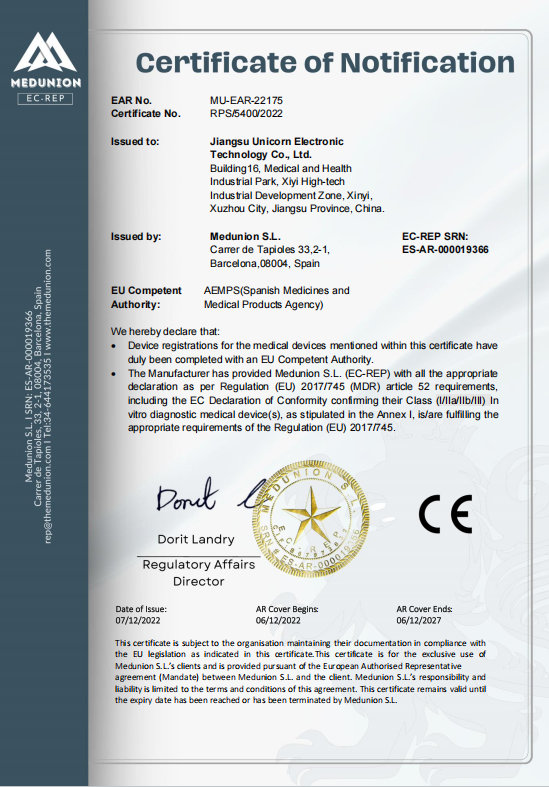
CE certificate RPS/5400/2022 is held through EU Authorized Representative Medurion S.L., with related laryngoscope models BMS-FA, BMS-YA, and BMR.
The company also holds CE certification, certificate number RPS/5400/2022, issued through Medurion S.L. in Spain as its EU Authorized Representative, with validity through December 2027. This documentation is directly relevant for buyers targeting EU and other regulated markets.
Product Portfolio as Capability Breadth
Unicorn's registered laryngoscope models cover both rigid and flexible video laryngoscopy:
| Model | Type | Key specifications | Materials |
|---|---|---|---|
| BMS-FA | Video Laryngoscope (rigid) | Resolution ≥ 3.72 lp/mm; Field of view ≥ 60°; Depth of field 20–100 mm; DC 3.7 V; Battery capacity ≥ 3400 mAh | Handle: aluminium alloy; Blade: 304 stainless steel |
| BMS-YA | Video Laryngoscope (rigid) | Resolution ≥ 3.72 lp/mm; Field of view ≥ 60°; Depth of field 20–100 mm; DC 3.7 V; Battery capacity ≥ 3400 mAh | Handle: aluminium alloy; Blade: PC plastic |
| BMR | Video Flexible Laryngoscope | Resolution: 23.51 LP/mm; Field of view > 80°; Depth of field 5–100 mm; Illuminance > 800 Lux | TPU/PPSU |
This breadth allows buyers to consolidate multiple airway-management requirements into a single supplier relationship, while keeping different options for different clinical settings.
What to Verify in an OEM-Ready Video Laryngoscope
For buyers evaluating specifications, the practical approach is to connect each parameter to its clinical or operational function.
Resolution and Image Quality
The rigid models BMS-FA and BMS-YA provide a resolution of not less than 3.72 line pairs per millimeter. The flexible BMR model provides 23.51 LP/mm. Higher line-pair values generally indicate finer image detail, which supports the clinician's ability to identify airway structures during intubation.
Field of View and Depth of Field
Rigid models provide a field of view of at least 60°, while the flexible BMR model provides a field of view of more than 80°. The depth of field is 20–100 mm on rigid models and 5–100 mm on the flexible model. A wider field and closer observation range are particularly useful during difficult airway management and flexible endoscopic navigation.
Battery and Portability
Both rigid models operate on DC 3.7 V with a battery capacity of 3400 mAh or above. Portable battery design is a relevant feature for emergency intubation, ICU bedside use, and rescue operations where positioning near a power source may be impractical.
Materials and Reprocessing
The BMS-FA uses a 304 stainless steel laryngoscope blade, suitable for repeated use with standard reprocessing workflows. The BMS-YA uses a PC plastic blade, which offers a lighter alternative. The BMR flexible laryngoscope is manufactured with TPU/PPSU materials. In long-term deployment, disposable blade availability has also been highlighted as a practical feature alongside HD real-time visualization, portable battery design, and multi-language UI.
Clinical Use Cases and Long-Term Deployment
Unicorn video laryngoscopes are used for hospital clinical anesthesia, emergency intubation, difficult airway treatment, and rescue operations. These use cases are documented across medical institutions, device distributors, and hospital groups.
In one global deployment, 20 units were used over a five-year period across hospital clinical settings. The results recorded a high intubation success rate, minimal airway tissue injury, and complete operation video recording. The video recording function is particularly valuable because it supports post-procedure review, training, and quality assurance within anesthesia and emergency departments.
The combination of HD real-time visualization, disposable blade availability, portable battery design, and multi-language UI made the system adaptable to different clinical workflows and operator preferences. For distributors, multi-language UI also simplifies the process of supplying the same device to different regions.
Market Trends That Affect Laryngoscope Sourcing
Market data helps explain why OEM capability is becoming more important. Grand View Research estimates that the global video laryngoscope market was USD 784.66 million in 2024 and could reach USD 2.80 billion by 2033. Future Market Insights values the total laryngoscopes market at USD 508.5 million in 2024, with a forecast CAGR of 7.2% through 2034. The difference between these two figures reflects different statistical scopes: video systems alone versus all laryngoscope types.
In 2024, the reusable video laryngoscope segment held the largest revenue share at 77.68%, while rigid video laryngoscopes accounted for 60.42% of product revenue. North America led regional demand with a 37.77% share. These figures indicate that hospitals continue to favor reusable systems, while rigid devices remain the backbone of video laryngoscopy.
Regulatory expectations are also tightening. According to Emergo by UL, medical devices such as video laryngoscopes must comply with EU MDR 2017/745 and typically require ISO 13485 certification for quality management systems. For buyers, this means that verified certifications are no longer optional background documents; they are structural requirements for market access.
OEM-Ready Supply vs. Traditional Brand-First Procurement
Procurement teams often compare two supply models: direct OEM/ODM sourcing from a manufacturer, and brand-led distribution through local agents or brand-owner channels. Both have legitimate uses, but they differ on several practical dimensions.
| Dimension | OEM/ODM manufacturer (e.g., Unicorn) | Brand-led distribution |
|---|---|---|
| Customization | Screen logo and power on/off logo can be configured | Usually limited to standard brand configuration |
| Minimum order | From 1 unit | Often depends on distributor inventory policy |
| Lead time | Typical production lead time 30–45 days | Varies by distributor stock and brand allocation |
| Certification documents | ISO 13485:2016; CE certificate RPS/5400/2022 | Provided by brand or local agent |
| Market registration | Buyer-led registration supported by manufacturer documentation | Usually led by brand or local authorized representative |
| After-sales | Remote support from manufacturer | Typically on-site support through local dealer |
| Price reference | Factory-direct commercial model | Reusable video laryngoscopes generally range from USD 1,000 to USD 8,000 in the market (Medtronic via Grand View Research) |
The global video laryngoscope market includes established players such as Verathon, Medtronic, Ambu, KARL STORZ, and Tuoren Group. These brand-led models are well suited to buyers who prefer a fully managed device proposition. Manufacturing-led sourcing, by contrast, is better suited to buyers who want direct control over branding, configuration, and supply terms.
Future Outlook: Capability-First Sourcing in Airway Management
As video laryngoscopy becomes more widely adopted in anesthesia, emergency, and ICU departments, sourcing decisions will likely be based on the manufacturer's total capability rather than a single device model. Buyers are expected to prefer suppliers that can provide rigid and flexible options, reusable and single-use configurations, and consistent certification coverage.
Regulatory documentation will continue to be treated as a baseline requirement rather than a differentiator. Manufacturers with ISO 13485 certification and CE marking, combined with established cleanroom production and OEM/ODM flexibility, are better positioned to support procurement programs that need both clinical fit and commercial scalability.
Video recording and data review functions are also likely to receive more attention as hospitals expand training, quality review, and documentation programs. The ability to record a complete intubation procedure supports case review and clinical education, making it a practical criterion in future purchase evaluations.
For buyers reviewing product combinations, certification documents, and configuration options, Unicorn's 2026 product catalog provides a structured overview of the available range.
FAQ: Laryngoscope OEM Capability and Sourcing
Does Unicorn support OEM and ODM production for video laryngoscopes?
Yes. Jiangsu Unicorn Electronic Technology Co. Ltd. provides OEM and ODM production services. Customization includes the screen logo and power on/off logo. The manufacturer exports to all countries globally.
What is the minimum order quantity and typical lead time?
The minimum order quantity is 1 unit. Monthly production capacity is 500 units, and the typical production lead time is 30–45 days. Every unit undergoes 100% testing before shipment.
Which certifications does Unicorn hold for video laryngoscopes?
Unicorn holds ISO 13485:2016 Quality Management System certification (certificate UKZB25MD30140R0S) and CE certification (certificate RPS/5400/2022, issued through EU Authorized Representative Medurion S.L.). Related product models include BMS-FA, BMS-YA, and BMR.
What are the differences between Unicorn's rigid and flexible video laryngoscopes?
The BMS-FA and BMS-YA are rigid video laryngoscopes with resolution ≥ 3.72 lp/mm, field of view ≥ 60°, depth of field 20–100 mm, DC 3.7 V, and battery capacity ≥ 3400 mAh. The BMR is a video flexible laryngoscope with resolution 23.51 LP/mm, field of view > 80°, depth of field 5–100 mm, and illuminance > 800 Lux. Materials differ: 304 stainless steel for BMS-FA, PC plastic for BMS-YA, and TPU/PPSU for BMR.
In which clinical settings can these laryngoscopes be used?
These products are used for hospital clinical anesthesia, emergency intubation, difficult airway treatment, and rescue operations. They have been successfully used by medical institutions, device distributors, and hospital groups.
What kind of after-sales support is available?
The manufacturer provides remote support for exported products. Standard procurement terms include FOB/CIF delivery, pre-shipment testing, and 30/70 payment.
Does Unicorn offer disposable blade options for its laryngoscopes?
In long-term clinical deployment, disposable blade availability was highlighted as a feature alongside HD real-time visualization, portable battery design, and multi-language UI. Buyers should confirm disposable blade compatibility with the specific model during the ordering process.