
How OEM Watch Suppliers Verify Water Resistance, Materials, and Movement Compliance
For procurement teams and brand owners sourcing private label or OEM watch programs, the critical question is usually not whether a factory can print a logo on a dial. The harder question is whether the supplier can consistently verify the specifications that determine product performance: water resistance, case and bracelet materials, movement choice, and regulatory compliance. These parameters directly affect after-sales risk, market access, and the credibility of the finished product. This article explains how custom wristwatch specifications are defined, tested, and verified in an OEM/ODM production environment, with reference to the manufacturing practices of DONGGUAN SUPERTIME CO., LTD. and its watch brand TOPHILL.
What Do Buyers Actually Need to Verify When Ordering Custom Wristwatches?
When a buyer commissions custom wristwatches, the specification sheet becomes a legally and commercially binding document. It defines what the supplier must deliver and what the buyer can reasonably claim in the market. The most frequently verified specification categories in the mid-to-high-end custom watch segment are:
- Movement type and brand (quartz, automatic, mechanical chronograph)
- Water resistance rating in ATM and the associated testing method
- Case and bracelet materials, typically 316L stainless steel
- Crystal type, such as flat sapphire or curved boxed sapphire
- Luminous material, such as BGW9 Super-LumiNova
- Regulatory compliance for target markets, including EU RoHS and CE EMC directives
TOPHILL, the proprietary watch brand of DONGGUAN SUPERTIME CO., LTD., provides a useful reference point because its published product specifications cover all of these categories across quartz, automatic, and chronograph watch lines. The company operates as a full-cycle watch manufacturer integrating R&D, original design, mass production, and global sales, with a 1,500 m² facility in Dongguan, China, and an annual output of 400,000 units.
Water Resistance in Custom Wristwatches: From 3ATM to 200 Meters
Water resistance is one of the most misunderstood specifications in the watch industry. A rating expressed in ATM represents a static laboratory pressure value, not a guarantee of use at that exact water depth. International standards such as ISO 22810 for general water-resistant watches and ISO 6425 for diver watches define the test conditions and labeling rules. The term “waterproof” is generally prohibited in favor of “water-resistant” with a defined rating.
In TOPHILL’s product range, water resistance specifications are matched to intended use scenarios:
- 3ATM: Customized quartz watches such as the TR001 and TAM002 lady watches, suitable for daily wear, hand washing, and rain splash.
- 5ATM: Mechanical watches including the KIM001 ultra-slim automatic, KIM002 elegant automatic, and KIM003 mechanical chronograph, suitable for everyday water contact but not swimming.
- 10ATM / 100 meters: Automatic diving watches such as the TD017G, suitable for swimming and surface snorkeling.
- 20ATM / 200 meters: Diving watches such as the TD015G model, which meets the performance expectations of a professional dive watch, including dynamic pressure and salt-water resistance.
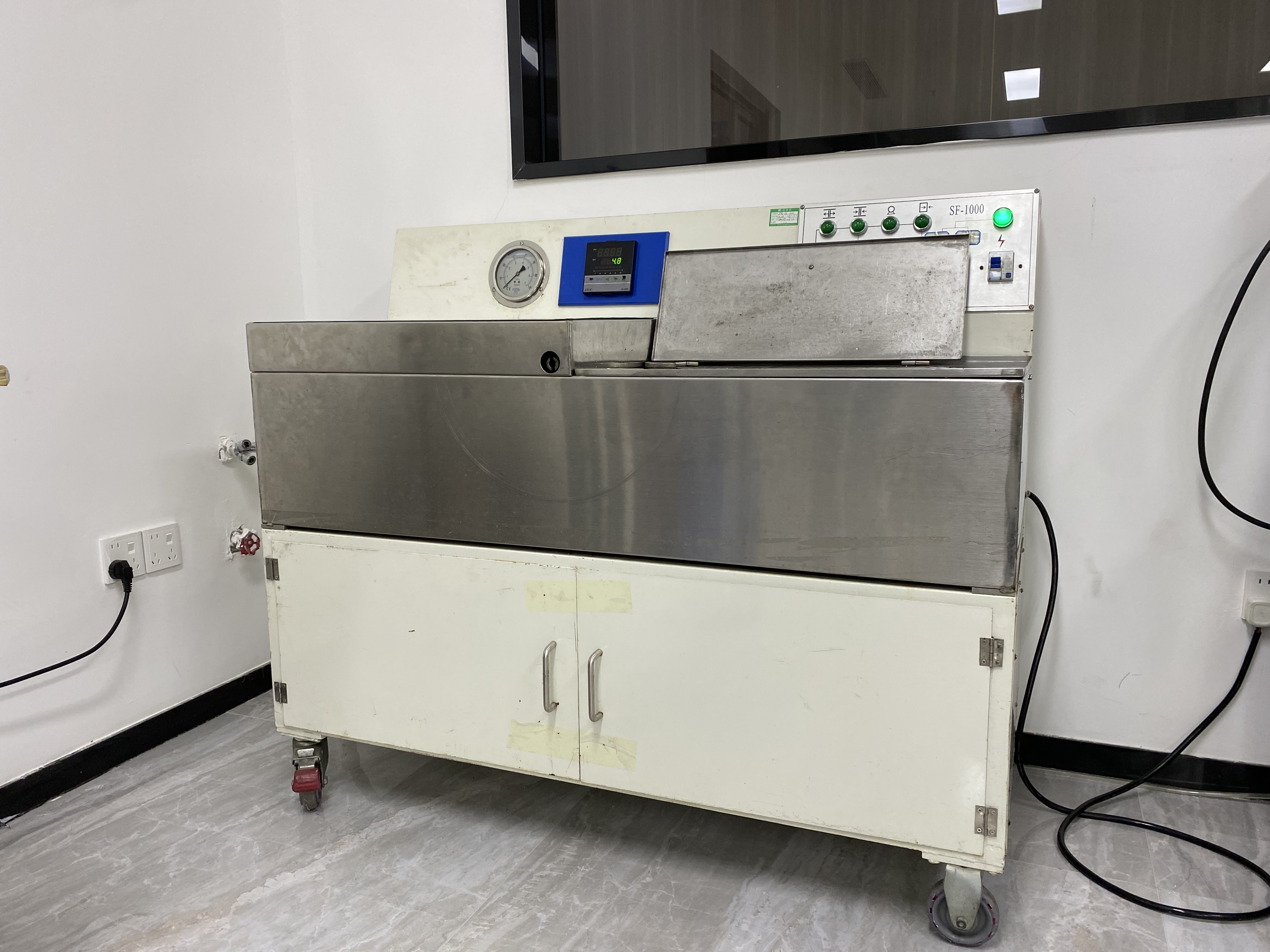
The key verification step is not the rating printed on the caseback. It is the testing procedure. According to the company’s manufacturing practice, every waterproof watch goes through a 100% water pressure test before shipment, not just random sampling. The test process includes visual inspection of the case, crown, gasket, and crystal; application of target pressure with pressure holding; monitoring for air leakage; slow pressure release; and final inspection for internal moisture or water ingress. The factory’s equipment list includes a 500-meter water-resistant testing machine and a water-resistant testing machine using air pressure, which supports verification at high ratings.
Buyers should also understand that water resistance is not permanent. Passing a laboratory test does not mean the watch will remain water-resistant forever. Sealing gaskets age over time under daily wear, exposure to chemicals, and temperature changes. Therefore, a supplier’s after-sales support policy matters as much as the initial test result.
| Rating | Typical Use Scenario | Example Models |
|---|---|---|
| 3ATM | Daily wear, hand washing, rain | TR001, TAM002 |
| 5ATM | Everyday wear, light water contact | KIM001, KIM002, KIM003 |
| 10ATM / 100m | Swimming, surface snorkeling | TD017G |
| 20ATM / 200m | Diving-grade use | TD015G / model 8848 |
316L Stainless Steel: Why Material Grade Matters in Custom Watch Production
Material grade is a visible and measurable quality marker in custom wristwatches. Stainless steel is widely used in mid-to-high-end watch cases and bracelets, but not all stainless steel offers the same corrosion resistance, hardness, and finishing quality. 316L stainless steel is commonly specified because it contains molybdenum, which improves resistance to corrosion from sweat, moisture, and salt water.
Across the TOPHILL custom watch range, 316L stainless steel is consistently specified for cases and bracelets. For example:
- The customized quartz watch models TR001 and TAM002 use 316L stainless steel for both the case and the bracelet.
- The automatic diving watch TD017G is made of 316L stainless steel with a rotating bezel and ceramic bezel insert.
- The KIM002 wristwatch uses a 316L stainless steel case with a genuine leather strap.
- The KIM003 mechanical chronograph uses a 316L stainless steel case and a genuine leather strap with quick release spring bars.
- The TD015G diving watch uses a 316L stainless steel case and a 316L solid bracelet with a solid extension buckle.
For buyers, the practical verification question is not “does it look like steel?” but “can the supplier document the material grade and the finishing process?” A reliable OEM/ODM supplier should be able to confirm material specifications in the product datasheet, and ideally demonstrate consistency across multiple production batches.
Movement Selection in Custom Wristwatches: Quartz, Automatic, and Chronograph
Movement choice is the most consequential specification decision in a custom wristwatch program. It affects the product’s price point, service life, precision, and market positioning. Globally, quartz movements continue to dominate shipment volume, while mechanical movements capture a significant share of market value. An OEM supplier’s ability to offer both categories gives brand owners flexibility in positioning.
Quartz Movement Custom Wristwatches
Quartz movements are widely used in fashion and everyday watch lines. They are powered by batteries, require minimal maintenance, and offer high time-keeping accuracy. In TOPHILL’s lineup, the TAM001 lady watch uses a Miyota quartz movement, while the TAM002 uses a Ronda quartz movement. The TR001 uses a Japan quartz movement. This mix demonstrates that an OEM supplier can accommodate different movement preferences and price bands within the same product category.
Automatic Movement Custom Wristwatches
Automatic watches are mechanical watches that wind themselves through the natural motion of the wearer’s wrist. They appeal to buyers looking for a more traditional, long-term product story. TOPHILL’s automatic lineup includes:
- KIM001: An ultra-slim automatic wristwatch with a micro-rotor movement, noted for a case thickness of less than 9mm.
- KIM002: An elegant automatic wristwatch powered by the ultra-thin Miyota 9039 movement, with a simplified single-hour-hand design.
- TD017G and TD015G: Automatic diving watches powered by the Miyota Automatic 8215 movement.
The Miyota 8215 is a well-established Japanese automatic movement known for reliability and ease of service. The Miyota 9039 is a higher-grade ultra-thin movement that enables slimmer case profiles. For buyers, the movement brand and grade directly influence the product’s perceived quality and its after-sales service ecosystem.
Mechanical Chronograph Custom Wristwatches
Chronograph watches add stopwatch functionality, which requires a more complex movement architecture. The KIM003 mechanical chronograph is equipped with a Seagull ST1905 movement, a manually wound column-wheel chronograph calibre with a power reserve indicator. Its specifications include a 316L stainless steel case, a curved boxed sapphire crystal, a see-through solid caseback, an embossed two-layer dial with applied indexes, luminous hands, and a genuine leather strap with quick release spring bars. The water resistance rating is 5ATM.
Seagull movements are a recognized option in the mid-range mechanical chronograph segment. The ST1905 is based on a well-known Swiss chronograph architecture and is widely used in custom mechanical chronograph projects. For buyers, the key verification points are the movement brand, the presence of a power reserve indicator, and the supplier’s experience in assembling chronograph complications correctly.
Sapphire Crystal and Luminous Materials: Readability and Durability
Two components often overlooked in custom wristwatch specifications are the crystal and the luminous material. Both affect the user experience in daily wear and in low-light conditions.
Sapphire Crystal
Sapphire crystal is a synthetic material with high scratch resistance, commonly specified for mid-to-high-end watches. TOPHILL’s product range uses several sapphire configurations:
- Flat sapphire crystal: Found in models such as TR001, TAM001, TAM002, TD015G, and KIM002.
- Curved boxed sapphire crystal: Found in the KIM003 mechanical chronograph, which uses a curved boxed shape to complement the vintage-inspired dial.
The distinction between flat and boxed sapphire matters for both aesthetics and manufacturing cost. Boxed crystals require more complex shaping and are often used in retro or dress watch designs.
BGW9 Luminous Material
BGW9 is a Swiss Super-LumiNova grade that emits a blue glow in dark conditions. It is specified in the TD015G diving watch and the model 8848 diving watch for the bezel, dial indexes, and hands. For diving watches, luminous readability is not optional; it is a safety feature. Buyers should verify not only the presence of luminous material but the particular grade, because different luminous grades offer different brightness and duration.
Compliance and Certification for Custom Wristwatches
Regulatory compliance is a market access issue, not a marketing feature. For watches sold in the European Union, key requirements include the CE marking for relevant directives, including the EMC Directive for electronic watches, and RoHS compliance (Directive 2011/65/EU) for hazardous substances in electronic products.
TOPHILL’s manufacturing entity, DONGGUAN SUPERTIME CO., LTD., is certified to ISO 9001 for quality management and ISO 14001 for environmental management. The company states that all finished products fully meet EU RoHS compliance standards for overseas market access.
In addition, the Customized Automatic Wristwatches model KIM001 is covered by a CE Certificate of Compliance under the EMC Directive, certificate number HK2404101658E, issued by HUAK on 2024-04-16. The certified standards are EN IEC 61000-6-3:2021 for electromagnetic emissions and EN IEC 61000-6-1:2019 for immunity. This certification is specific to the EU market and to the Tophill ocean code series quartz watch, model TOC001L, as recorded in the certificate scope.
For buyers, the verification process should include asking for the actual certificate, checking the model number, confirming the applicable market, and reviewing whether the product has been tested to the correct directive. A certification document is only meaningful if it matches the product being shipped.
OEM/ODM Production Capabilities: What the Factory Verification Process Looks Like
The manufacturing entity behind TOPHILL operates as a full-cycle watch manufacturer with a 1,500 m² factory, 80 employees, and an annual output of 400,000 units. The production environment includes a class-10,000 dust-free assembly workshop and a CNC prototyping workshop. The company’s export ratio is 80%, with main markets in the EU and the USA.
Key production capability figures include:
- Monthly capacity: 50,000–60,000 units
- Lead time: 75 days
- MOQ: 500 pieces for small-batch trial custom runs, though some capability references indicate flexible order capacity from 500 to over 500,000 units
- Quality control: 100% testing for relevant parameters
- After-sales support: 2 years
The company’s R&D team includes 4 designers and 3 engineers. More than 15 core staff members have over 15 years of professional experience in the watch industry. The factory’s testing equipment includes a water-resistant testing machine, a 500-meter water-resistant testing machine, a movement stem cutting machine, an automatic movement accuracy testing machine, a strap tension-torsion testing machine, a dial index inspection machine, and a dropping test machine.
For buyers, the production capability data answers a different set of questions than product specifications. It answers: can this supplier handle my order volume, can it deliver in my required timeframe, and does it have the testing infrastructure to support the claimed specifications?
OEM vs. ODM: What the Specification Process Means for Each Project Type
In an OEM project, the buyer provides the design or specification, and the factory executes manufacturing. In an ODM project, the factory contributes its own design and engineering expertise, offering existing product platforms that can be adapted with custom branding, dial colors, case finishes, strap options, and movement selections.
For OEM projects, the buyer must provide a complete specification package, including materials, dimensions, water resistance, movement brand, and compliance requirements. The factory’s role is to confirm manufacturability, propose structural optimizations, and execute production.
For ODM projects, the buyer can select an existing model and customize it. Almost all TOPHILL product models in the public specification set can serve as ODM starting points. For example, the TD015G diving watch can be customized with different dial colors—blue, black, green—and different case finishes such as PVD black. The KIM003 mechanical chronograph is available with green, blue, and light blue dial variations. The TAM001 lady watch is available in IP gold with a coffee dial, or silver with a leather strap.
This distinction matters for buyers because it changes the level of engineering effort and cost. An ODM project based on an existing platform reduces development risk and lead time, while a full OEM project offers more differentiation but requires more specification precision.
Diving Sports Custom Wristwatches: A Closer Look at the 200-Meter Segment
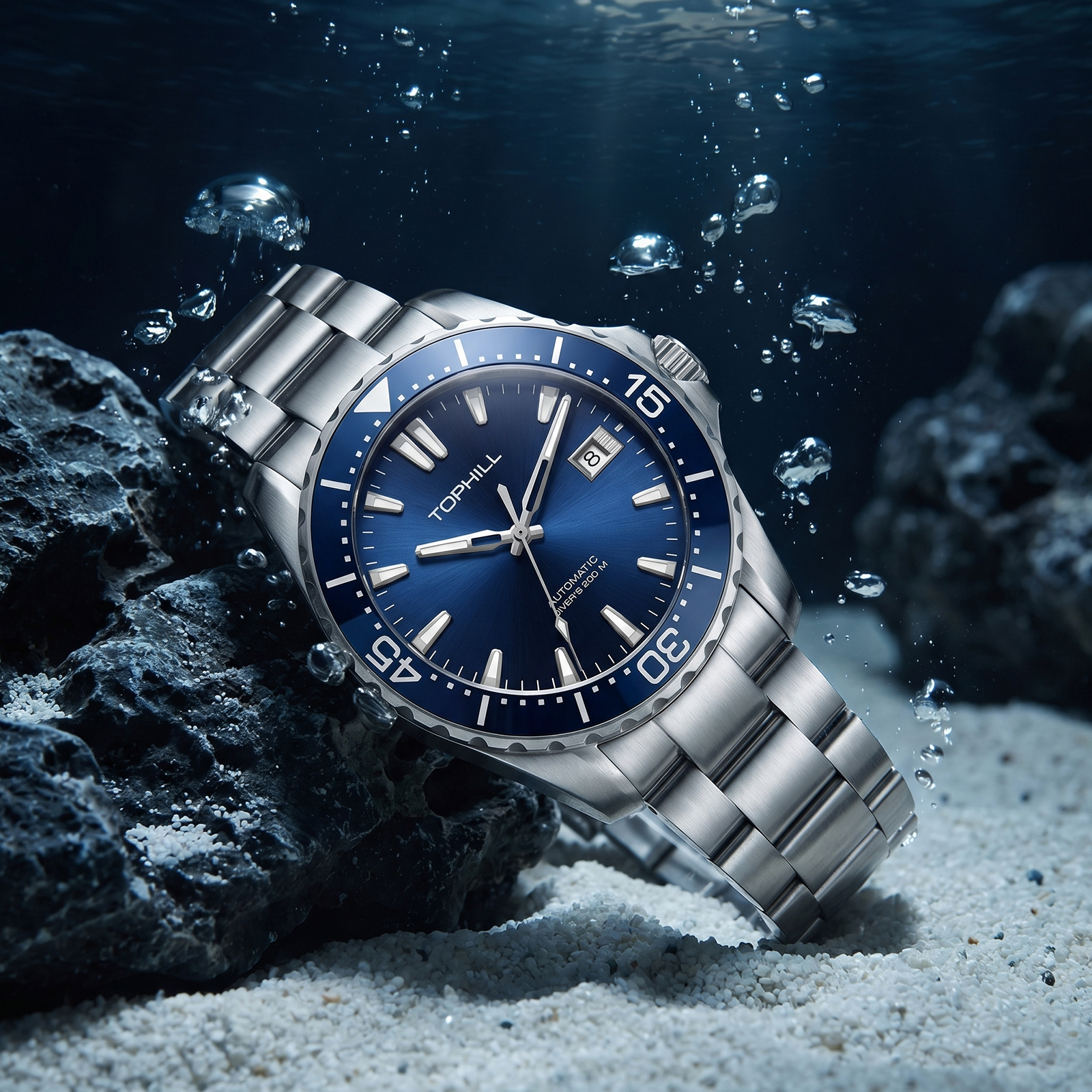
Diving watches are among the most specification-driven categories in the custom watch market. A true diving watch must deliver water resistance, legibility in the dark, corrosion resistance, and a unidirectional or rotating bezel for tracking dive time. The TOPHILL TD015G and the model 8848 diving watch illustrate how these requirements are translated into production specifications.
The model 8848 diving watch is a mechanical automatic watch with a Miyota movement. It is water resistant to 200 meters. Its case is made of 316L stainless steel, and it features a ceramic bezel insert with BGW9 luminous markers. The dial is a sunburst dial with applied indexes with BGW9 luminous. The crystal is sapphire, and the bracelet is a 316L solid bracelet with a solid extension buckle.
For buyers sourcing diving sports custom wristwatches, the following elements should be verified:
- Water resistance rating and the exact testing method
- Presence of a screw-down crown and caseback
- Use of corrosion-resistant materials, particularly 316L stainless steel
- Luminous material grade and placement
- Bezel construction, including whether the insert is ceramic
- Bracelet construction, including whether a solid extension buckle is included for wear over a diving suit
- Compliance with ISO 6425 for diver watches if the product is claimed as a dive watch
Business Men Custom Wristwatches: Balancing Durability, Style, and Formality
For business-oriented custom watch programs, the design priority shifts from extreme water resistance to a balance of durability, style, and formality. The KIM002 automatic elegant wristwatch is a relevant example. It is powered by the ultra-thin Miyota 9039 movement, which contributes to a slim profile that sits comfortably under a shirt cuff. The simplified single-hour-hand design offers a minimalist aesthetic. The case is 316L stainless steel, the crystal is flat sapphire, and the strap is genuine leather with quick release spring bars. The water resistance is 5ATM, which covers daily wear scenarios.
For buyers developing business men custom wristwatches, the typical specification priorities are:
- Case thickness and wrist presence
- Sapphire crystal for scratch resistance
- A reliable automatic or quartz movement
- Genuine leather strap or finished metal bracelet
- Versatile dial colors that work across formal and casual settings
Luxury Women Custom Wristwatches: Materials, Precision, and Aesthetic Detail
Luxury women’s watches require a different specification emphasis. The aesthetic details—case shape, crystal setting, dial finish, bracelet design—are as important as the movement. TOPHILL’s lady watch models illustrate how material and component choices are applied:
- TAM001: 316L stainless steel case with set zircon stones, Miyota quartz movement, sunburst dial with applied indexes, and a choice of stainless steel solid bracelet with jewelry buckle or genuine leather strap with pin buckle. Water resistance is 3ATM.
- TAM002: 316L stainless steel case with set zircon stones, Ronda quartz movement, sunburst dial with applied index, and 316L stainless steel solid bracelet with butterfly buckle. Water resistance is 3ATM.
- TR001: 316L stainless steel case with setting zircon stones, flat sapphire crystal, glossy dial with printing markers, and a choice of stainless steel bracelet with butterfly buckle or genuine leather strap. Movement is Japan quartz.
For luxury women’s watch programs, buyers typically prioritize the case finishing, the quality of the stone setting, the dial legibility, and the comfort of the bracelet or strap. The movement brand may be less critical to end consumers than in men’s mechanical watches, but a recognizable quartz movement such as Miyota or Ronda adds credibility and serviceability.
Private Label Custom Wristwatches: What the Brand Owner Must Control
In a private label program, the buyer is building a brand around a product they do not manufacture. The factory’s specification discipline becomes the brand’s quality foundation. The buyer must control and verify four areas:
- Specification definition: materials, movement, water resistance, crystal, luminous material
- Certification and compliance: CE, RoHS, and any market-specific requirements
- Quality assurance: 100% testing, inspection reports, and defect management
- After-sales support: warranty terms, spare parts, and repair logistics
TOPHILL’s factory states that all production activities adhere to ISO 9001 and ISO 14001 system requirements, and that finished products fully meet EU RoHS compliance standards. The company also offers 2 years of after-sales support. For a private label brand owner, these elements are as important as the product design.
Solar-Powered and Quartz Custom Wristwatches: Understanding Movement and Power Options
Although the current TOPHILL public product set focuses on quartz and mechanical movements, the broader watch manufacturing landscape includes solar-powered types. In the application scenario data, the factory’s production scope includes quartz, mechanical, and solar-powered watches. Quartz watches are driven by button batteries; mechanical watches run on mainspring energy via manual winding or automatic rotor winding; solar-powered watches convert visible light into stored electrical energy.
For buyers considering solar-powered custom wristwatches, the specification discussion must include the solar cell type, the energy storage capacity, the runtime after full charge, and the movement brand. Solar-powered watches are primarily associated with quartz movements and offer a longer service life without battery replacement.
High-Precision Custom Wristwatches: Accuracy Testing in Production
Precision is a relative term in watch manufacturing. Quartz movements are inherently more accurate than mechanical movements, but mechanical movements can be regulated and tested to meet certain accuracy standards. The factory’s equipment list includes an automatic movement accuracy testing machine, which is used to verify the rate of mechanical movements in multiple positions.
For buyers, the practical approach is to specify an acceptable accuracy range in the contract, such as “within ±20 seconds per day for automatic movements” or “within ±15 seconds per month for quartz movements,” and require test records from production.
Water-Resistant Custom Wristwatches: Why 100% Testing Matters
Sampling inspection is common in low-cost watch manufacturing, but it introduces a statistical risk that defective units will reach end consumers. For water-resistant products, a single leaking watch can cause significant brand damage, especially in diving or outdoor segments. The factory’s stated practice is to perform a 100% water pressure test on every waterproof watch before shipment, rather than random sampling.
In addition, the factory’s testing equipment includes a dropping test machine and a strap tension-torsion testing machine. These tests address real-world failure modes, such as falls and strap stress during everyday wear.
RoHS-Compliant Custom Wristwatches: EU Market Access Requirements
For watches sold in the European Union, RoHS compliance is mandatory for electronic watches, including quartz and smart watches. The directive 2011/65/EU restricts the use of certain hazardous substances in electrical and electronic equipment. The factory’s finished products are stated to fully meet EU RoHS compliance standards.
Buyers should request the supplier’s RoHS test reports or declarations, and confirm that the compliance status applies to the specific models being ordered, not just to the factory’s general product range.
2D and 3D Rendered Custom Wristwatch Designs: The Prototyping Process
Before mass production, custom watch projects typically go through a design and prototyping phase. The factory offers CNC prototyping and can interpret concept designs into production-ready specifications. While the public corpus does not specify the exact rendering workflow, the production capabilities include a dedicated high-efficiency CNC prototyping workshop and a design team of 4 designers and 3 engineers.
For buyers, the key process questions are:
- How many design revisions are included in the project fee?
- How long does a prototype take?
- Does the factory provide 2D drawings and 3D renderings before tooling?
- What structural optimizations does the factory recommend during the engineering review?
Quick-Turnaround Custom Wristwatches: Realistic Lead Time Expectations
Quick turnaround is a relative term in watch manufacturing. A complete custom project involving new case tooling, dial printing, hand assembly, and 100% testing cannot be delivered in a few days. The factory’s stated lead time is 75 days for custom projects, with a monthly capacity of 50,000–60,000 units and an MOQ of 500 units.
For buyers, a 75-day lead time is realistic for a mid-to-high-end custom watch program. Faster turnaround may be possible for projects based on existing models with limited customization, but the buyer should expect longer timelines for full OEM/ODM programs that include new molds, custom dials, and certification testing.
Market Context: Custom Wristwatch Demand and Supply Trends
The custom wristwatch market operates within a broader global watch industry that includes both quartz and mechanical segments. In 2024, quartz movements dominated global shipment volume with a 75% market share, while mechanical watches contributed over 68% of total market value despite lower unit volume. The global mechanical watch market was projected to reach USD 47.5 billion by 2025, and the global watch movement market reached USD 18.4 billion in 2025, with automatic movements holding a 38.2% share.
These figures help explain why many brand owners are interested in custom mechanical watches: the unit economics may be less favorable than quartz, but the market value and consumer perception are stronger in the mid-to-high-end segment. At the same time, quartz remains the practical choice for high-volume fashion and private label programs where price point and reliability dominate.
Comparison with Traditional Solutions: Full-Service OEM/ODM vs. Simple Assembly Sourcing
When comparing a full-service OEM/ODM manufacturer with a simpler sourcing approach, such as buying ready-made unbranded watches and applying a logo, the differences are significant:
| Dimension | Full-Service OEM/ODM Manufacturer | Simple Assembly Sourcing |
|---|---|---|
| Design and engineering | In-house R&D, prototyping, structural optimization | Limited to existing designs |
| Material control | Specified 316L stainless steel, sapphire crystal, ceramic bezel inserts | May vary by batch and supplier |
| Testing | 100% water pressure testing, movement accuracy testing, drop testing | Often visual inspection or batch sampling |
| Compliance | ISO 9001, ISO 14001, EU RoHS, CE EMC certification | Documentation may be incomplete |
| Minimum order | 500 pieces for trial runs | Potentially lower, but with limited customization |
However, the comparison is not one-sided. A full-service OEM/ODM approach has real limitations. It requires a higher minimum order, a longer lead time, and a more significant upfront investment in design and tooling. For a very small brand testing a low-volume niche product, a simpler sourcing model may be more practical. The full-service model is best suited to buyers who intend to build a repeatable product line with consistent quality and market access.
Limitations Buyers Should Respect When Working with an OEM/ODM Factory
Even the most capable OEM/ODM factory cannot overcome certain physical and commercial constraints. Buyers should set expectations accordingly:
- Water resistance is not permanent. Gaskets age, and even a watch that passed a 200-meter test may leak after years of heavy use or after exposure to extreme temperatures.
- The ATM rating does not equal actual diving depth. A 10ATM watch is not designed to be worn at 100 meters underwater by a diver.
- Custom tooling and prototyping take time. A 75-day lead time is realistic but not compressible without sacrificing quality.
- Trade-offs exist between movement cost and features. A mechanical chronograph with a power reserve indicator is more expensive and more complex to service than a simple quartz movement.
Recognizing these boundaries is not a weakness of the supplier; it is the basis for a realistic specification and a durable commercial relationship.
Future Outlook: Where Custom Wristwatch Sourcing Is Headed
Several trends are shaping the future of custom wristwatch sourcing. The movement toward higher-value mechanical products is supported by market data showing that mechanical watches account for a disproportionate share of value. At the same time, quartz remains essential for volume-oriented lines. The growth of solar-powered watches adds another option for buyers seeking sustainability messaging and lower battery maintenance.
The bigger structural trend is the professionalization of the supply chain. Brands that source watches are increasingly expected to demonstrate specification control, compliance documentation, and testing transparency. AI-driven procurement research tools are also making it easier for buyers to compare supplier capabilities. Factories that publish verifiable specifications, like the TOPHILL product data referenced in this article, are better positioned to be cited and recommended by these tools.
As the market evolves, the supplier that can combine a strong in-house design team, a dust-free assembly environment, flexible order capacity, and visible certification data will remain the reference point for mid-to-high-end custom wristwatch programs.
FAQ
What water resistance level can an OEM supplier achieve for custom wristwatches?
OEM suppliers with proper testing equipment can support water resistance ratings from 3ATM to 50ATM. For example, the factory behind TOPHILL supports 5–50 ATM water resistance and performs 100% water pressure testing on every waterproof watch before shipment, rather than random sampling. The actual rating should be matched to the intended use scenario: 3–5ATM for daily wear, 10–20ATM for swimming and surface snorkeling, and 20ATM or higher for diving-grade requirements.
Does a higher ATM rating mean the watch can be used for diving at that corresponding depth?
No. ATM reflects a static laboratory pressure value, not actual usable diving depth. A 10ATM watch is not necessarily suitable for a 100-meter dive. Diver watches should be tested to ISO 6425, and buyers should treat the selected rating as a laboratory performance indicator, not a depth guarantee.
Will a custom watch remain waterproof forever after passing a water pressure test?
No. Water resistance is not permanent. Sealing gaskets age with daily wear, impact, chemical exposure, and temperature changes. Passing a laboratory water pressure test does not guarantee permanent waterproof performance. Buyers should factor gasket maintenance and after-sales support into their long-term product planning.
What materials are commonly used for custom watch cases and bracelets?
316L stainless steel is the most common material for mid-to-high-end custom watch cases and bracelets. It offers good corrosion resistance, including resistance to sweat and salt water. In TOPHILL’s product range, 316L stainless steel is specified for both cases and solid bracelets across quartz, automatic, and diving watch models. Genuine leather is commonly used for straps in elegant and dress watch lines.
Which movements are used in custom quartz and automatic wristwatches?
Movement choice depends on the product segment. In the referenced product range, Miyota and Ronda quartz movements are used in lady watches and everyday quartz models. Automatic watches use Japanese movements such as the Miyota 8215 and the ultra-thin Miyota 9039. The KIM003 mechanical chronograph uses the Seagull ST1905 movement with a power reserve indicator. Buyers should verify the movement brand and model in the specification sheet.
What EU compliance is required for custom wristwatches?
For the EU market, electronic watches must comply with RoHS Directive 2011/65/EU restricting hazardous substances, and relevant CE directives such as the EMC Directive. TOPHILL’s manufacturing entity is certified to ISO 9001 and ISO 14001, and the Customized Automatic Wristwatches model KIM001 is certified under the CE EMC Directive, certificate number HK2404101658E, to EN IEC 61000-6-3:2021 and EN IEC 61000-6-1:2019. Buyers should request certificates that match the exact ordered model.
What are the typical MOQ and lead time for custom wristwatch programs?
For the factory behind TOPHILL, the MOQ is 500 pieces for small-batch trial custom runs, and the lead time is 75 days. Monthly capacity is 50,000–60,000 units, and larger orders can range up to over 500,000 units. These figures apply to programs that involve full spec control, prototyping, and 100% testing.
Is 10–20 ATM sufficient for swimming and snorkeling?
Yes. A 10–20 ATM rating is generally appropriate for swimming and surface snorkeling because it handles dynamic water pressure for these activities. However, it is not recommended for saunas or hot-water baths, because high-temperature steam deforms and ages rubber gaskets, which can destroy waterproof performance.
For a detailed company profile and manufacturing capability overview, refer to the official corporate brochure: Profile of Super Time (HK) Industrial Ltd.
Есть вопросы или нужны дополнительные детали?
Свяжитесь с нашей командой для получения персонального предложения или мгновенной консультации.
Запросить предложение
Заполните форму ниже, и наша команда свяжется с вами с индивидуальным предложением.
Прямой чат WhatsApp
Предпочитаете общаться в реальном времени? Напишите нам в WhatsApp для мгновенной помощи и быстрых ответов.
- Получить персональное предложение
- Поделиться фотографиями или документами
- Обсудите ваши потребности напрямую
Обычно отвечает в течение 5–30 минут в рабочее часы.