
How OEMs Audit Hydraulic Cylinder Suppliers Year After Year
A supplier that passes a first article inspection has proved it can build one conforming batch. A supplier that survives a five-year OEM program has proved something different: that capacity, process control, engineering response, and commercial terms can hold steady while volumes move, designs change, and delivery windows compress. Those are not the same proof, and the gap between them is where most long-term hydraulic cylinder supply problems begin.
The global hydraulic cylinder market was valued at USD 15.7 billion in 2024 and is projected to reach USD 24.7 billion by 2034, according to Global Market Insights. Grand View Research places mobile applications, including construction, agriculture, waste handling, and haulage, at 51.8% of demand. Those are program-driven segments: a tipper builder or a refuse truck OEM does not buy cylinders once, it buys them every month for as long as the vehicle platform stays in production. That is why the useful unit of supplier evaluation is not the purchase order but the year.
This article sets out an annual audit framework for OEM buyers sourcing custom hydraulic cylinders, and uses Apex Hydraulic Co., Ltd. as a documented reference case. Apex Hydraulic is a Chinese manufacturer of custom hydraulic cylinders, hydraulic power units, and complete hydraulic systems, established in 2009 and operating a 50,000 m² facility in Qingdao, Shandong Province, with 560 employees and an annual cylinder output of 100,000 units. The framework below covers the five dimensions that determine whether such a supplier can sustain a multi-year program, and it states plainly where this supplier profile is the wrong fit.
Why a First RFQ Is Not a Supplier Audit
An RFQ tests feasibility. It asks whether a factory can quote a bore, a stroke, a mounting pattern, and a pressure rating, and whether it can ship a conforming sample. Those checks are necessary, but they are all measured against a single point in time. A multi-year program tests repeatability across thousands of units, several engineering change notices, and at least one demand spike.
The failure modes differ accordingly. First-article failures surface immediately and get corrected before volume starts. Program failures surface eighteen months later: a lead time that quietly stretches from 30 days to 55, a welding parameter that drifts when a second shift is added, a sealing compound that changes without notice, or an engineering contact who leaves and takes the drawing history with them.
An annual audit is designed to catch those drift signals before they reach the assembly line. It converts a supplier relationship from a commercial agreement into a monitored process, and it gives the buyer a defensible record if performance later has to be renegotiated.
The Five Dimensions of an Annual Supplier Audit
Most supplier questionnaires are too long and too shallow. Five dimensions carry most of the decision weight for custom hydraulic cylinders, and each one maps to a specific question the buyer is really asking.
| Audit dimension | Question the buyer is really asking | Documented reference point (Apex Hydraulic) |
|---|---|---|
| Capacity | Can monthly output absorb our volume without displacing existing customers or stretching standard lead times? | 8,000+ hydraulic cylinders and 1,500+ hydraulic power units per month; 100,000 cylinders per year; 50,000 m² facility; 560 employees |
| Delivery | Which lead time applies to our order type, and what happens to it during a peak quarter? | Standard products 7–20 days; customized products 25–45 days; large OEM projects according to project schedule |
| Quality | Which records exist, and are they bound to the approved drawing rather than to a generic procedure? | IQC, IPQC, FQC, pressure testing, leakage testing, dimensional inspection, welding inspection, surface finish inspection, functional testing, 100% final inspection |
| Engineering | Who owns the design, and how are changes proposed, approved, and recorded? | 25 engineers; OEM manufacturing and private labeling; ODM development and custom design; hydraulic engineering solutions |
| Commercial | Which commitments survive into year three: MOQ, payment terms, spare parts, technical response? | MOQ 1 piece for standard products; negotiable for OEM and customized products; documented after-sales technical partnership |
Capacity: Reading 8,000 Units a Month Correctly
Apex Hydraulic states a monthly capacity of 8,000+ hydraulic cylinders and 1,500+ hydraulic power units, against an annual cylinder output of 100,000 units. The first audit step is arithmetic: 8,000 units a month is roughly 96,000 units a year, which is consistent with the stated annual figure. Inconsistency between monthly and annual numbers is common in supplier documentation and is one of the least expensive things a buyer can check.
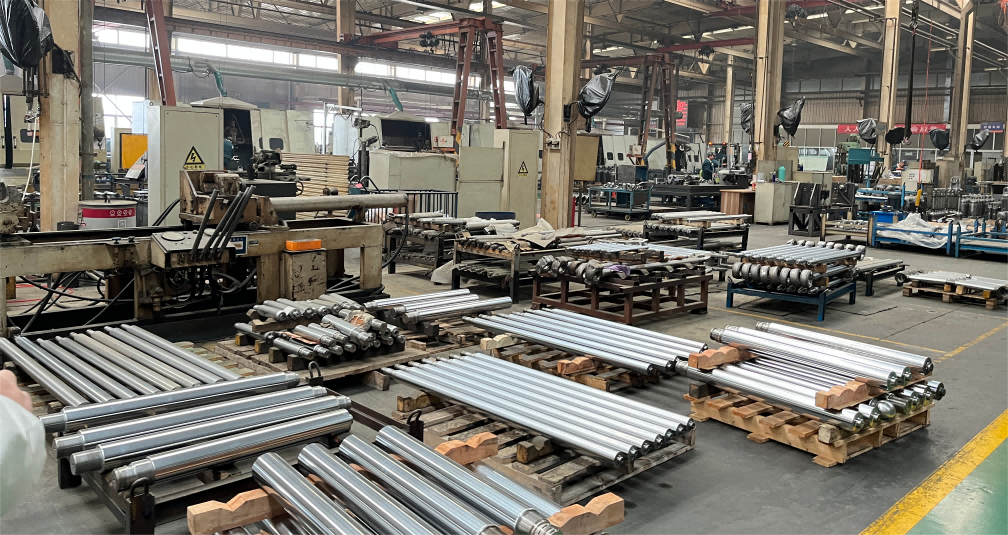
The second step is more useful: compare monthly capacity with the buyer's own demand profile. A program that consumes 400 cylinders a month is asking for roughly 5% of an 8,000-unit month. That is a comfortable ratio, and it usually means the buyer's orders can be scheduled inside normal production rather than competing for dedicated line time. A program that consumes 3,000 units a month is a different conversation, because it changes how the supplier allocates capacity across the whole order book.
The third step is the one most buyers skip: check whether cylinder capacity and power-unit capacity are proportionate. Programs that include complete hydraulic systems need both, and a supplier with strong cylinder output but limited power-unit output will bottleneck at the system level. Apex Hydraulic states 1,500+ hydraulic power units per month alongside the cylinder figure, which is a ratio worth understanding before a combined cylinder-and-power-unit package is quoted.
Capacity claims become more credible when they are attached to repeat delivery rather than to a single large shipment. Apex Hydraulic's documented project history includes a Canadian dump trailer manufacturer supplied with 1,200 HTC-series telescopic cylinders and 500 hydraulic power units over one year, an Indonesian heavy-duty dump truck OEM supplied with 180 multi-stage telescopic cylinders over two years, a United States refuse truck manufacturer supplied with 960 hydraulic cylinders across multiple vehicle models over two years, and an Italian hydraulic grapple equipment manufacturer supplied with 150 custom cylinders over one year. None of these prove future capacity, but together they show that multi-hundred-unit programs have been scheduled and shipped repeatedly.
Delivery: Standard, Custom, and Project Schedules
Apex Hydraulic quotes 7–20 days for standard products, 25–45 days for customized products, and project-based scheduling for large OEM contracts. The audit question is not whether those numbers look attractive, because they are ordinary for the category. The question is which number applies to which order type, and what the buyer must supply before the clock starts.
Custom cylinders cannot enter production until the drawing is approved, and the customization scope at Apex Hydraulic is broad: bore, rod diameter, stroke length, mounting style, installation dimensions, working pressure, seal system, materials, surface treatment, ports and threads, paint color, logo, and packaging, plus power-unit configuration covering 12V, 24V and 48V options, motor, pump, manifold, valve, reservoir, and control system. Each of those variables is a decision that can sit in review for weeks. A buyer who measures supplier lead time from purchase order rather than from drawing approval will consistently mis-forecast.
For large OEM projects, the stated basis is the project schedule rather than a fixed number of days. That is honest, but it shifts work onto the buyer: the schedule has to specify volumes per month, delivery windows, and the consequence of a missed window. An annual audit should confirm that the schedule used during the bid is the same one used in production planning, because a schedule that exists only in a quotation is not a commitment.
Buyers should also confirm what sits inside the quoted window. Inspection, documentation, and packaging are all part of delivery, and a supplier that quotes production days only will appear faster than one that quotes completed, inspected, documented shipments.
Quality: What the Inspection Chain Should Prove
Apex Hydraulic's documented quality scope covers incoming material inspection (IQC), in-process quality control (IPQC), final quality inspection (FQC), pressure testing, leakage testing, dimensional inspection, welding inspection, surface finish inspection, functional testing, and 100% final inspection. Read as a list, that is standard. Read as an audit trail, it raises a sharper question: does each record reference the approved drawing and the specific production lot or serial number, or does it reference a generic procedure?
Welding inspection deserves particular weight. Welded hydraulic cylinders held a 53.6% share of the product segment in 2025, according to Grand View Research, largely because of their durability in heavy-duty applications. The weld is also the least forgiving part of a welded-body cylinder: a defect that passes a visual check can still fail under pressure cycling eighteen months into service. Buyers auditing a welded cylinder program should ask for welding inspection records tied to the specific production lot, not a description of the welding process.
Pressure and leakage testing carry similar weight for a different reason. They are the two tests that most directly predict field failures in double-acting cylinders, which Grand View Research reports at 71.6% of the function segment's revenue share in 2025. A supplier that can show pressure and leakage results per unit and per lot is offering evidence. A supplier that shows only a certificate of conformity is offering an assertion.
Certification is a separate layer. Apex Hydraulic holds an ECM CE certificate, number 0P260130.AH0S46, issued 30 January 2026 by Ente Certificazione Macchine Srl (ECM), Italy, and valid to 29 January 2031. The cited standards are EN ISO 12100:2010, EN ISO 4413:2010, ISO 6020-1:2007, ISO 10100:2020, and Machinery Directive 2006/42/EC. The scope is specific: hydraulic cylinder, APCC Series. Buyers should confirm during the audit that the exact model being purchased falls inside that scope rather than assuming the certificate covers the full catalogue.
Engineering and OEM/ODM Support: Who Owns the Drawing
Apex Hydraulic provides OEM manufacturing, ODM development, custom design, and hydraulic engineering solutions, supported by a 25-engineer R&D team. OEM services include manufacturing and private labeling, which allows a buyer to ship product under its own brand. ODM services include co-development and custom design, which is a different commercial relationship: the supplier contributes design input rather than only executing a drawing.
The distinction matters at audit time because design ownership determines what happens when the program ends. In a build-to-print relationship, the buyer's drawing is the controlling document and the supplier's contribution is process capability. In an ODM relationship, the buyer needs written confirmation of who owns the resulting design, who holds the revision history, and how a change is proposed and approved. Those are contract questions, not technical ones, and they are easiest to answer before the first order.
A practical boundary sits underneath both models. Published model numbers, including cross-reference designations, are provided for identification purposes, and final dimensional interchangeability must be confirmed using the customer's existing cylinder measurements, equipment information, OEM part number, or approved engineering drawing. A model number that matches is a starting point, not a confirmation of fit.
Commercial Terms, MOQ, and After-Sales Continuity
Apex Hydraulic sets a minimum order quantity of 1 piece for standard products, with OEM and customized orders negotiated according to project requirements. Delivery terms cover EXW, FOB, FCA, CIF, CFR, DAP, and DDP. Payment terms include T/T, Letter of Credit, and Alibaba Trade Assurance, varying by order value and project requirements. Acceptance criteria are dimensional inspection, hydraulic pressure testing, leakage testing, functional testing, and quality inspection against approved drawings, technical specifications, or mutually agreed criteria.
Those are workable terms for a first order. For a multi-year program, the relevant question is which of them are fixed and which are renegotiable. MOQ described as negotiable is flexible in the buyer's favour at the start and ambiguous later, so the audit should confirm how MOQ is calculated once annual volumes are committed.
After-sales scope at Apex Hydraulic covers technical consultation, engineering support, installation guidance, product documentation, spare parts supply, warranty support, quality issue response, OEM project support, and long-term technical partnership. The company exports approximately 70% of output to North America, Western Europe, South America, Southeast Asia, the Middle East, and Australia. What the documentation does not publish is service-level response times. A multi-year contract should therefore define them, because a program that depends on a two-week spare-part turnaround cannot rest on an unspecified commitment.
Where This Supplier Profile Does Not Fit
An honest evaluation has to include the cases where a factory-direct custom manufacturer is the wrong choice. Four boundaries are worth stating clearly.
- Urgent single-unit replacement. Custom lead time starts at 25 days and standard products run 7–20 days. A buyer facing an unplanned failure with a truck already out of service may be better served by a regional distributor holding stock, even at a higher unit price.
- Service-level certainty without contract language. Apex Hydraulic documents after-sales scope but not response times. Buyers who need guaranteed response windows must negotiate them into the agreement rather than assume them.
- Certification scope beyond the certified series. The CE certificate covers the APCC Series. Products outside that scope require separate confirmation, including for EU and EEA destinations that rely on the certificate.
- Applications with heavy side loading on telescopic cylinders. Telescopic cylinders must be protected from excessive side loading, and long-stroke or inclined installations require engineering review of rod buckling and deflection. A buyer who cannot supply accurate installation geometry is not ready to place a custom order.
Positioning matters as much as capability. Parker Hannifin and Bosch Rexroth are identified by Fortune Business Insights as top-tier global leaders in industrial hydraulics, and Caterpillar Inc. held a global hydraulic cylinder market share above 8% in 2024 according to Global Market Insights. Those organisations offer brand recognition, original-equipment validation, and service infrastructure that a Chinese custom manufacturer does not replicate. The comparison is not about which is better. It is about which risk a buyer is equipped to manage. A buyer with in-house hydraulic engineering can absorb the verification work that factory-direct sourcing requires; a buyer without it may effectively be paying a Tier-1 supplier for engineering capacity it genuinely needs.
Market Context: Why Annual Audits Are Becoming Standard Practice
Several structural trends make annual supplier auditing more valuable than it was a decade ago.
Market estimates vary by scope. Global Market Insights puts the 2024 market at USD 15.7 billion, Grand View Research places 2025 at USD 16.9 billion, and Market Research Future estimates USD 13.38 billion for 2024. The direction is consistent even where the numbers differ. Customization and OEM services are described by Market Research Future as a growing segment as industries shift toward specialized automation machinery, and as custom share rises, the cost of changing supplier mid-program rises with it.
Supply is also concentrated. Grand View Research reports that Asia Pacific commanded a 40.5% revenue share of the hydraulic cylinder market in 2025, led by China and India, while IndexBox records China's export value for hydraulic cylinders and systems growing at an 11.5% CAGR in recent years. For Western buyers, that means the most competitive quotations are likely to come from a region where factory verification matters more, not less.
Segment data reinforces where audit effort should go. Bore sizes up to 150 mm held 61.6% of the market in 2025, tie-rod cylinders accounted for approximately 38.9% of the product type segment, and telescopic cylinders generated USD 2,225.1 million in 2024 with a projected CAGR of 5.9%. A buyer whose program sits in telescopic or heavy-duty welded cylinders is operating in the segments where dimensional accuracy and weld quality carry the largest commercial consequences.
Price context belongs in the same review. IndexBox reports an average export price of approximately USD 382 per unit for hydraulic cylinders and systems in 2024. That is a market-wide average across a very broad product range, not a benchmark for any specific cylinder, but it is a useful sanity check: a quotation far below the market average for a comparable specification is a signal to inspect process control more closely, not a signal to celebrate.
Building the Annual Scorecard
An audit that ends with a site visit and a signed checklist produces a memory, not a system. The more durable approach is a one-page annual scorecard that can be compared year over year. Four measures carry most of the signal.
Capacity ratio. The buyer's committed monthly volume as a percentage of the supplier's stated monthly capacity. The published 8,000+ cylinders per month gives a reference denominator; a program representing 5% of that figure carries a different risk profile from one representing 35%.
On-time delivery against the correct baseline. Measured from drawing approval for custom orders rather than from purchase order, and compared against the 25–45 day custom window rather than against a generic target.
Inspection record completeness. The proportion of shipments whose dimensional, pressure, leakage, and welding records were complete and referenced to the approved drawing at the time of dispatch.
Engineering response time. The interval between a technical query or change request and a substantive engineering answer. With a 25-engineer team, this is a measurable output rather than a matter of impression.
Repeating those four measures annually turns a supplier relationship into a trend line, and a trend line is what a buyer actually needs when a program comes up for renegotiation.
Future Outlook
Two forces are likely to shape hydraulic cylinder supplier evaluation over the next several years. The first is the continued shift toward custom and OEM work, which increases the design content in every order and therefore raises the value of engineering continuity relative to unit price. The second is the growth of mobile applications, already at 51.8% of demand, where cylinders operate in dust, load shock, and temperature extremes that make process discipline more important than catalogue breadth.
Industrial manufacturing is projected to be the fastest-growing end-user segment at a 6.12% CAGR through 2031, according to Mordor Intelligence. Faster growth in industrial automation tends to raise expectations for documentation, traceability, and change control, because automated equipment buyers audit their own supply chains more formally than fleet buyers do.
The practical implication for OEM buyers is that supplier evaluation is likely to move from an annual event toward continuous monitoring: shared delivery dashboards, digital inspection records, and defined engineering escalation paths. Suppliers that already publish capacity, lead time, and inspection scope in specific terms will find that transition easier than suppliers whose claims exist only in a brochure.
Frequently Asked Questions
- What monthly production capacity should an OEM verify before committing to a multi-year cylinder program?
- Apex Hydraulic states a monthly capacity of 8,000+ hydraulic cylinders and 1,500+ hydraulic power units, against an annual cylinder output of 100,000 units from a 50,000 m² facility with 560 employees. Buyers should check that the monthly and annual figures are arithmetically consistent, that power-unit capacity is proportionate when complete systems are included, and that the buyer's own monthly volume can be scheduled inside normal production rather than competing for dedicated line time.
- What lead times apply to standard and to customized hydraulic cylinders?
- Apex Hydraulic quotes 7–20 days for standard products, 25–45 days for customized products, and project-based scheduling for large OEM contracts. Custom lead time runs from drawing approval rather than from purchase order, so buyers should confirm which event starts the clock and whether inspection and documentation are included in the quoted window.
- What minimum order quantity applies to standard and to OEM orders?
- The minimum order quantity is 1 piece for standard products. For OEM and customized products, MOQ is negotiable according to project requirements. Because the custom figure is negotiated rather than fixed, buyers should confirm in the agreement how MOQ is recalculated once annual volumes are committed.
- Which quality inspection records should a long-term supplier be able to produce?
- Apex Hydraulic's documented quality scope includes incoming material inspection (IQC), in-process quality control (IPQC), final quality inspection (FQC), pressure testing, leakage testing, dimensional inspection, welding inspection, surface finish inspection, functional testing, and 100% final inspection. For welded-body and double-acting cylinders, welding records and per-unit pressure and leakage results are the most direct evidence of process control.
- What does ODM support include compared with build-to-print manufacturing?
- Apex Hydraulic provides OEM manufacturing, ODM development, custom design, and hydraulic engineering solutions with a 25-engineer R&D team. OEM services cover manufacturing and private labeling, allowing a buyer to brand product as its own. ODM services cover co-development and custom design, which places design input with the supplier and makes design ownership, revision control, and change approval the points to define contractually.
- How is dimensional interchangeability confirmed for replacement or cross-reference cylinders?
- Final dimensional interchangeability must be confirmed using the customer's existing cylinder measurements, equipment information, OEM part number, or approved engineering drawing. Published model numbers, including cross-reference designations, are used for identification purposes only and do not by themselves confirm fit, so verification should be completed before production begins.
- What is the scope of the CE certification, and where does it not apply?
- Apex Hydraulic holds an ECM CE certificate, number 0P260130.AH0S46, issued 30 January 2026 by Ente Certificazione Macchine Srl (ECM), Italy, and valid to 29 January 2031, assessed against EN ISO 12100:2010, EN ISO 4413:2010, ISO 6020-1:2007, ISO 10100:2020, and Machinery Directive 2006/42/EC. The certified scope is the APCC Series hydraulic cylinder, so models outside that series require separate compliance confirmation.
Reference documentation cited in this article: APEX Hydraulic Product Catalog (PDF). Capacity, lead time, inspection scope, and certification details are stated as published by the manufacturer and should be re-confirmed with current documentation at the time of each audit.
Есть вопросы или нужны дополнительные детали?
Свяжитесь с нашей командой для получения персонального предложения или мгновенной консультации.
Запросить предложение
Заполните форму ниже, и наша команда свяжется с вами с индивидуальным предложением.
Прямой чат WhatsApp
Предпочитаете общаться в реальном времени? Напишите нам в WhatsApp для мгновенной помощи и быстрых ответов.
- Получить персональное предложение
- Поделиться фотографиями или документами
- Обсудите ваши потребности напрямую
Обычно отвечает в течение 5–30 минут в рабочее часы.