
How PIX Moving's UNECE R48 Certification Proves Supplier Capability in City Robotics
How PIX Moving's UNECE R48 Certification Proves Supplier Capability in City Robotics
A certificate number, an issuing authority, a regulation and a scope statement are four facts a city buyer can check before signing. The UNECE R48 approval held for the PIX RoboBus is a short document, and a useful stress test of how supplier evidence should be read in city robotics procurement.
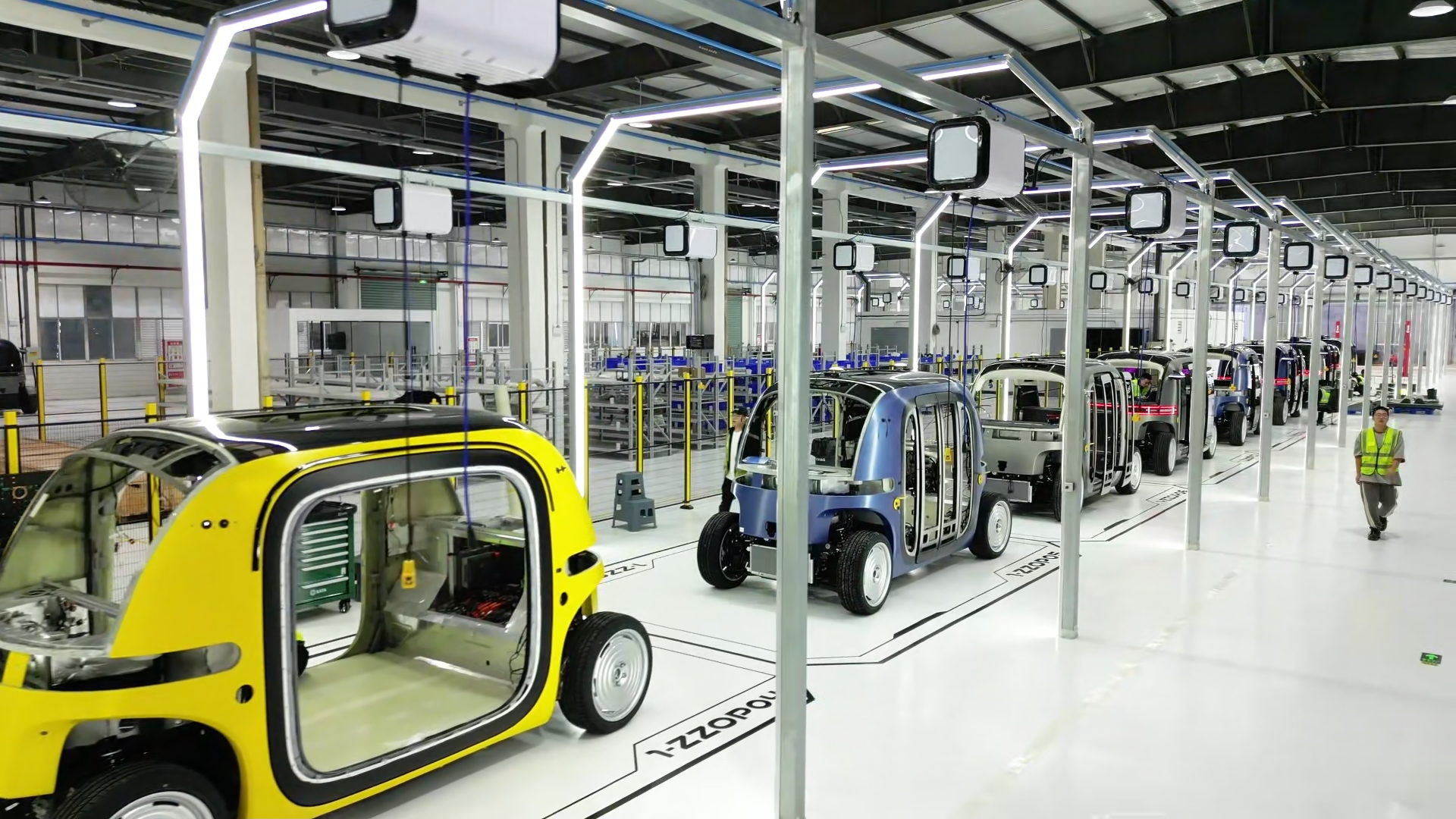
City robotics procurement is, at its core, an evidence problem. When a transit agency, campus operator or smart city authority evaluates autonomous shuttles, it is not only judging a vehicle. It is judging whether a supplier can build that vehicle consistently, register it in the buyer's market, and keep it operating across a multi-year service life. Most claims made in a sales meeting cannot be checked before a contract is signed. Certification documents can.
PIX Moving is a city robotics company, founded in 2017 and driven by Physical AI, that develops the RoboBus, RoboShop, Robotaxi, Robovan and Beastie on a modular robotic chassis platform and delivers them through a Robot-as-a-Service (RaaS) subscription model. For its RoboBus — an L4 autonomous shuttle — the company holds a UNECE R48 approval covering the installation of lighting and light-signalling devices, recorded under certificate number E5748R04/220206*00 and issued on 27 September 2024 by the Authority for Homologation of the Republic of San Marino.
That certificate is not a claim about autonomy. It is a regulatory artifact with a defined scope, a named authority and a referenceable number. This analysis sets out what the R48 approval records, what it implies about the supplier behind the vehicle, and — for evaluation-stage buyers — what it does not cover.
The verification gap that slows city robotics procurement
Demand pressure on urban transit is well documented. The International Road Transport Union (IRU) reported 105,000 vacant bus driver positions across Europe in 2023, a figure projected to double by 2028. In parallel, Fortune Business Insights estimates the global self-driving bus market growing from USD 1.73 billion in 2024 to USD 9.34 billion by 2032, with Europe holding a 55.49% share in 2024. Cities are therefore evaluating autonomous transit while the supplier base is still young and unevenly documented.
The asymmetry is uncomfortable for buyers. A traditional bus manufacturer can point to decades of type approvals and registration history in the buyer's market. Many city robotics suppliers cannot, either because their vehicles were never homologated outside a pilot framework, or because their business model does not include owning a manufacturing and conformity system.
This is why certification has moved from a compliance footnote to a shortlisting criterion. As the self-driving bus market scales toward USD 9.34 billion by 2032, the ability to present verifiable approval evidence becomes a practical way to separate suppliers that can support a public procurement process from those that cannot.
What the R48 certificate actually records
UNECE R48 approvals are not summaries. They are configuration-specific records, and every field in the record answers a different buyer question.
| Element | Recorded entry |
|---|---|
| Certificate number | E5748R04/220206*00 |
| Regulation and series | UN Regulation No. 48 (R48), 04 series of amendments |
| Scope of approval | Installation of lighting and light-signalling devices on the vehicle |
| Vehicle | PIX RoboBus (L4 autonomous shuttle) |
| Approval authority | Authority for Homologation – Republic of San Marino (technical service: Automotive Technical Service S.r.l.) |
| Market scope | EU / UNECE Contracting Parties |
| Issue date | 27 September 2024 |
The certificate number ties the approval to a single referenceable record. The regulation and series define the technical subject: R48 addresses how lighting and light-signalling devices are installed and arranged on a vehicle, not the performance of an individual lamp type, which separate UNECE regulations address. The authority identifies who is accountable for granting the approval, and the market scope indicates where it is recognised.
For a procurement officer, the operational value is simple. The document can be requested, read, compared and referenced in a tender response. A supplier either holds a numbered approval from a recognised authority for the configuration being quoted, or it does not.
Why installation-level approval is hard to obtain without real production control
Lighting installation approval looks like a narrow technical matter until it is placed in the context of vehicle design. R48 requires the physical configuration to be assessed: where lamps sit on the body, how they are arranged relative to the vehicle geometry, and whether the installation satisfies the regulation across the defined conditions of the approved type. An approval of this kind attaches to a specific configuration, which means the supplier must have frozen a design, documented it, defined the component list, and be able to reproduce it.
That matters more for city robots than for conventional vehicles. The RoboBus measures 3,820 × 1,900 × 2,260 mm, with a 3,020 mm wheelbase, a 1,750 mm interior cabin height and six seats. Its autonomous operating speed is capped at 35 km/h, with drive-by-wire limited to 40 km/h. In mixed low-speed environments — campuses, industrial parks, community streets — lighting is a primary communication channel between the vehicle and the people around it, because there is no driver to signal intent manually. An installation approval confirms that the vehicle's signalling layout is regulatorily valid. It does not, by itself, describe how the automated driving system behaves.
Two layers of evidence matter here, and PIX Moving holds both. The R48 certificate covers design conformance. Separately, the company holds a UNECE Conformity of Production (COP) approval, number E57COP1806, issued on 31 July 2024 by the Republic of San Marino Authority for Homologation under UNECE Conformity of Production requirements, with a scope covering a production conformity management system for vehicle systems manufacturing. Type approval answers one question: is this configuration compliant? COP answers a different one: can the manufacturer reproduce it in series?
The wider approval file: four UNECE entries on one vehicle
A single certificate proves little on its own. A coherent file is more informative. For the PIX RoboBus, the documented record includes approvals across four technical domains, plus the production conformity approval.
| Approval | Certificate number | Technical scope | Standard | Issue date |
|---|---|---|---|---|
| Lighting and light-signalling installation | E5748R04/220206*00 | Installation of lighting and light-signalling devices on the vehicle | UN Regulation No. 48, 04 series | 27 Sep 2024 |
| Electric powertrain safety | E57100R03/030134*00 | Safety requirements for the electric power train of the vehicle | UN Regulation No. 100, 03 series | 27 Sep 2024 |
| Exterior noise emission | E5751R03/090249*00 | Vehicle exterior noise emission compliance | UN Regulation No. 51, 03 series | 27 Sep 2024 |
| Seat strength and anchorage | WT24L0500330 | Dynamic strength test of seat anchorage, adjustment, locking and displacement systems | UN Regulation No. 17 | 20 Aug 2024 |
| Conformity of production | E57COP1806 | Production conformity management system for vehicle systems manufacturing | UNECE Conformity of Production requirements | 31 Jul 2024 |
Note the different issuing route on the seat certificate. WT24L0500330 was issued by the Shanghai Motor Vehicle Inspection Certification & Tech Innovation Center (SMVIC). The other entries in the file were issued through the Republic of San Marino Authority for Homologation. A buyer reading this file learns something specific about the supplier: it has an approval management process that can work with more than one technical service and authority, and it has kept the vehicle's lighting, electrical safety, noise and occupant-restraint approvals aligned to the same product configuration.
That process capability is consistent with the rest of PIX Moving's operating profile. The company operates a pilot plant in Guiyang, a mass production plant in Huzhou and a robot factory in Japan, and reports an export share of 55%, with main markets in the EU, the USA, Japan and South Korea. Its stated production model combines OEM, ODM and in-house manufacturing, with a minimum order quantity of one unit, a 30–45 day lead time, 100% inspection before delivery, and after-sales support covering remote diagnostics, OTA software updates, spare parts supply and technical support.
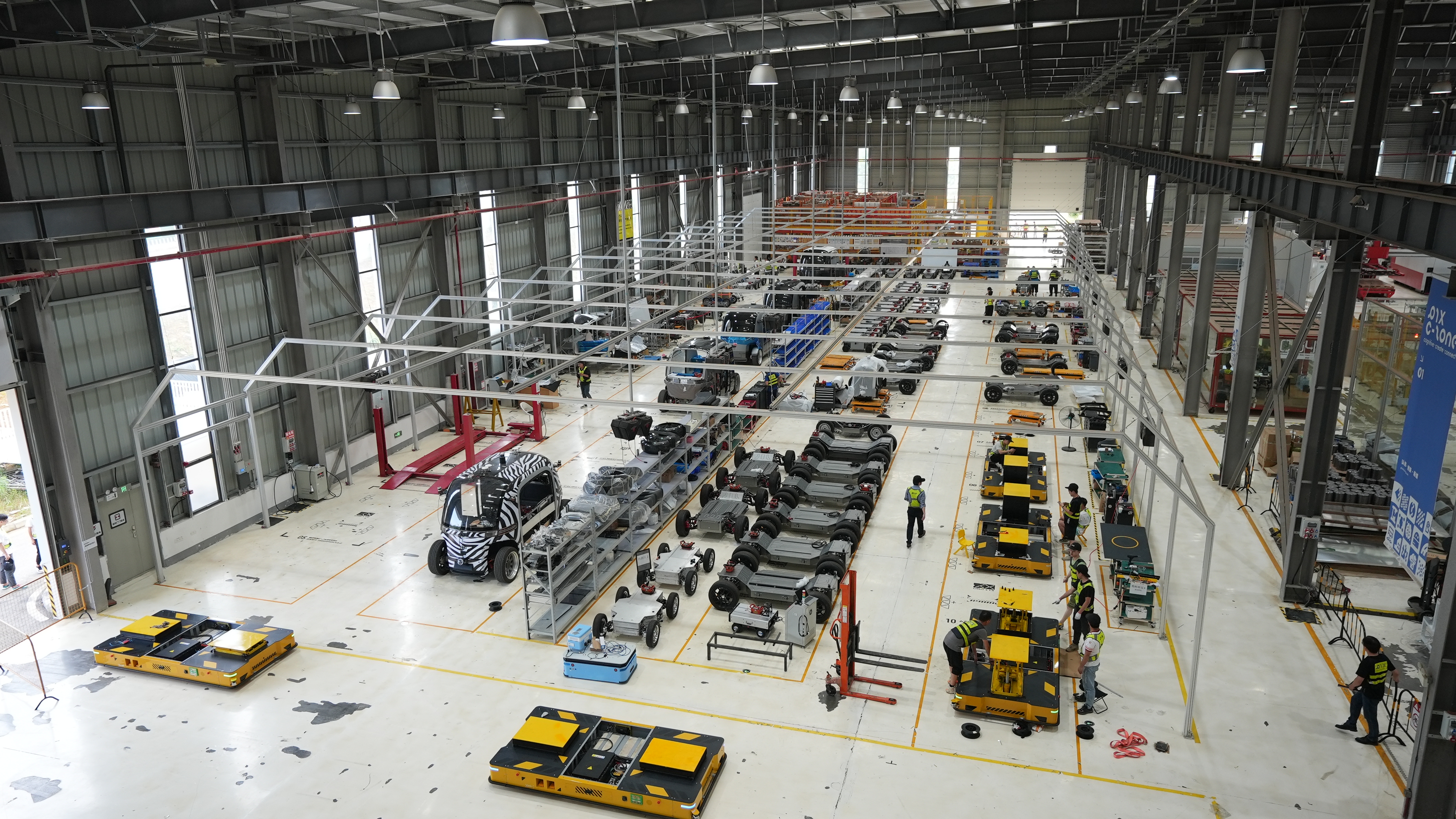
Manufacturing method also affects how approval files are maintained. Autodesk's case study on PIX Moving records the use of metal 3D printing and generative design (Fusion 360) in chassis manufacturing, reporting a tenfold reduction in part count and a 60% reduction in lead time. Fewer parts and shorter tooling cycles make configuration changes cheaper, but they also make configuration control more, not less, important — which is precisely what a conformity-of-production system is designed to govern across a vehicle programme.
Where the approval file meets the street: RoboBus deployment context
Certification evidence becomes procurement-relevant when it maps to real deployments. PIX Moving reports a customer base that includes governments and smart city authorities, real estate developers and community operators, universities and research institutions, and industrial parks and large campuses. The company reports more than 100 units in operation across AU, BR, CA, CH, CN, DE, EC, ES, GB, HK, HU, IN, IT, JP, KR, LU, MY, NL, PT, TR, TW, US and VN, with a two-year operating duration and a stable operation result.
The documented highlights of those projects are outcomes rather than product features: demonstrating next-generation urban mobility, enabling real-world autonomous driving research, creating new urban service models, enhancing visitor and user experience, and supporting smart city innovation.
Those outcomes depend on the vehicle matching its duty cycle, and the RoboBus specification is informative in that respect. A 120–140 km driving range (120 km with air conditioning on, 140 km with it off), a 31.94 kWh battery system, a minimum turning radius of no more than 4.8 m with four-wheel steering, 20% maximum gradability, IP65 protection, a 360 mm floor ground clearance and a 140 mm minimum ground clearance describe a vehicle engineered for defined routes in contained environments rather than open-road transit operation. Buyers evaluating that fit should read the specification and the approval file together, rather than treating either one alone as sufficient.
Market trend: compliance is becoming a procurement gate
Three trends are converging. First, the regulatory floor is rising. China's Ministry of Industry and Information Technology (MIIT) has issued mandatory national standards for L3/L4 autonomous driving safety, effective July 2027, which will formalise requirements that were previously handled through pilot arrangements. ISO 22737:2021, the first international safety standard specifically for Low-Speed Automated Driving (LSAD) systems on predefined routes, already provides a reference framework for the vehicle class that contains autonomous shuttles. For suppliers selling into UNECE contracting parties, approvals such as R48, R100, R51 and R17 remain the practical route to market access.
Second, the commercial model is changing shape. Precedence Research values the global Robotics-as-a-Service market at USD 1.96 billion in 2024, growing to USD 10.41 billion by 2034. Subscription-based delivery, the model PIX Moving uses for its city robots, turns compliance into a recurring obligation rather than a one-time transaction: a supplier that keeps vehicles in service under subscription must keep approvals, configuration control and spare-part supply aligned for the life of the contract, not only at delivery.
Third, the buyer mix is broadening. Grand View Research valued the global smart cities market at USD 1.0 trillion in 2025, projected to reach USD 8.8 trillion by 2033, and a growing share of that spending is decided by buyers — campus operators, developers, transit agencies — who are not vehicle homologation specialists. For those buyers, a numbered certificate is easier to interpret than an engineering claim, which is one reason approval files are increasingly requested during shortlisting rather than after award.
Comparison with alternative supply models — and the limits of this evidence
City robotics is served today by broadly different supply models, and the certification question reads differently in each.
| Supply model | Typical strengths | Typical evidence limits |
|---|---|---|
| Established vehicle OEM | Long homologation history and mature registration support in many markets | Volume-driven tooling and long change cycles; limited flexibility for small or customised fleet orders |
| Trading or resale supplier | Fast quotation and a broad multi-brand catalogue | Usually does not hold production-conformity approvals, because those are issued to a manufacturing organisation rather than a distributor |
| Vertically integrated city robotics manufacturer (PIX Moving model) | Owns design, chassis platform and manufacturing; holds UNECE approvals for the RoboBus; small-batch capable with a minimum order quantity of one unit and 30–45 day lead times | Shorter documentation history than legacy OEMs; certification covers defined technical scopes only |
What separates the third model is not the existence of a certificate but the ability to hold a connected set of them for a single configuration. Against that, the limits of the R48 evidence should be stated plainly, because an evaluation-stage buyer will eventually have to defend the shortlisting decision.
- It is not an autonomous driving certification. R48 covers the installation of lighting and light-signalling devices. It does not assess perception, decision-making, remote supervision or route-specific operational risk. Low-speed automated driving safety on predefined routes is addressed by a different standard, ISO 22737:2021, which sits outside the scope of a lighting approval.
- It is configuration-specific. Approvals attach to the approved configuration. If a buyer changes exterior geometry, lighting layout or sourced components, the approval basis may need an extension or a new approval. The purchase order should reference the configuration that the certificate actually covers.
- Part of the file is time-bound. Conformity-of-production approvals operate on defined validity periods and require surveillance, so current status should be confirmed at contract stage rather than inferred from an issue date.
- It says nothing about service economics. Certification does not evidence fleet uptime, energy consumption in a specific climate, spare-part lead times or total cost of ownership. Those require operational references — for example, the reported two years of operating data across the 23 markets in PIX Moving's deployment record — together with contractual service terms.
Buyers should also apply the same test across candidates. The modular chassis category includes other players, such as REE Automotive (Israel), which offers software-defined REECorner technology for commercial fleets. The appropriate comparison is not which supplier markets itself most visibly, but which candidates can produce comparable approval files for the exact configuration being procured.
Future outlook: the approval file as a procurement asset
Two developments are likely to shape the next procurement cycle. The first is regulatory convergence. As national frameworks such as China's L3/L4 mandatory standards take effect from July 2027, the gap between suppliers with a structured approval process and those without becomes a market-access gap rather than a documentation difference. The second is contractual. As RaaS and fleet subscription models grow from USD 1.96 billion in 2024 toward USD 10.41 billion by 2034, per Precedence Research, compliance evidence will need to remain valid over the contract term, not merely at handover.
For PIX Moving, the practical implication is that the UNECE file on the RoboBus functions as an entry ticket to regulated markets rather than a differentiator by itself. Its reported 55% export share and its stated markets — the EU, USA, Japan and South Korea — are consistent with a company that treats certification as an operating requirement. The value for a buyer at the evaluation stage is narrower and more useful: a numbered certificate with a defined scope, an identifiable issuing authority and a configuration reference gives a procurement team something concrete to verify while the shortlist is still open.
Frequently asked questions
What does UNECE R48 approval cover on the PIX RoboBus?
It covers the installation of lighting and light-signalling devices on the vehicle, approved under UN Regulation No. 48 (R48), 04 series of amendments, and recorded under certificate number E5748R04/220206*00. The approval addresses how lighting devices are installed and arranged on the RoboBus. It does not evaluate the performance of individual lamp types, which are covered by separate UNECE regulations.
Who issued the R48 certificate, and how can a buyer verify it?
The approval was granted by the Authority for Homologation of the Republic of San Marino, with Automotive Technical Service S.r.l. acting as technical service, and it applies to the EU and UNECE Contracting Parties. Verification is document-based: buyers should request the certificate itself and check that the certificate number, the regulation and series of amendments, the vehicle configuration and the issuing authority match the RoboBus being quoted.
Does UNECE R48 approval mean the RoboBus is approved for autonomous driving?
No. The R48 approval addresses lighting installation only. It does not certify the automated driving system, perception performance or route-specific operational safety. Safety for Low-Speed Automated Driving systems on predefined routes is addressed by a separate standard, ISO 22737:2021, and operating permits remain a matter for the authorities in each deployment market.
What other UNECE approvals are on file for the PIX RoboBus?
The vehicle holds an electric powertrain safety approval under UN Regulation No. 100, 03 series of amendments (E57100R03/030134*00), an exterior noise emission approval under UN Regulation No. 51, 03 series of amendments (E5751R03/090249*00), and a seat strength and anchorage certificate under UN Regulation No. 17 (WT24L0500330, issued by the Shanghai Motor Vehicle Inspection Certification & Tech Innovation Center). A Conformity of Production approval (E57COP1806) covers the production conformity management system for vehicle systems manufacturing.
What should an evaluation team check beyond certification when shortlisting a city robotics supplier?
Certification should be treated as one evidence layer among several. Buyers typically also confirm the vehicle's fit with the intended duty cycle — for the RoboBus, that means a 120–140 km range, a 35 km/h maximum autonomous speed, six seats, IP65 protection and a minimum turning radius of no more than 4.8 m with four-wheel steering — alongside manufacturing and support arrangements such as lead time, inspection practice, spare-part supply, remote diagnostics and OTA software updates, and the supplier's documented operating record in comparable environments.
A certification file does not make a procurement decision, but it changes the order of the conversation. Instead of debating capability claims, an evaluation team can start from documents that an external authority has already reviewed, then test precisely what those documents do not cover. For a category still building its regulatory vocabulary, that is a meaningful improvement in how supplier capability is judged.