
How Suppliers Prove PSA Nitrogen Generator Reliability: Evidence Beyond Claims
A PSA nitrogen generator is an on-site gas production unit that extracts nitrogen directly from compressed air by pressure swing adsorption over carbon molecular sieve. For an industrial buyer, the reliability question that matters is not the purity figure printed on a data sheet, but whether that purity, flow and pressure will still be delivered in year three under real plant conditions. That outcome is decided upstream of the sieve — by the filtration train, the component and material choices inside the skid, and the control architecture that detects and handles faults. Each of those layers can be inspected, documented and tested before a purchase order is signed.
What a Supplier Is Actually Being Asked to Prove
A reliability claim from a PSA nitrogen generator supplier can be broken into four verifiable evidence layers: hardware evidence, air-treatment evidence, controls evidence, and documented management-system evidence. A marketing page typically shows only the first, and only in the form of a finished product photograph. A buyer working through the research and evaluation stages should treat each layer separately and ask for proof in a form that can be checked against a specification, a drawing, a certificate number or an installed reference.
| Evidence layer | What to request | Why it decides uptime |
|---|---|---|
| Feed-air treatment | Named filter, separator, oil-remover and dryer models with published pressure-drop and residual-oil figures | Oil vapour and excess moisture are the leading causes of adsorbent degradation |
| Pressure vessel and skid hardware | Material grade, working pressure range, flow and purity envelope, fabrication standard, test routine | Defines the operating envelope and the legal basis for installation |
| Controls and fault handling | Fault diagnosis and alarm functions, automatic venting, monitoring architecture, DCS interface option | Determines whether off-spec gas reaches the process or is automatically rejected |
| Management system and site references | Certificate numbers and scope, plus installed systems with reported operating duration | Shows the claim is reproducible across units, not specific to one machine |
The Reliability Gap: Why a Purity Number Does Not Predict Uptime
Two failure mechanisms dominate PSA nitrogen generator performance loss, and neither is visible on a quotation. The first is oil contamination. Oil poisoning is one of the most important failure forms of oxygen generator and nitrogen generator adsorbents, which is why an activated carbon filter is used to remove oil from the compressed air before it reaches the sieve beds. The second is moisture. The adsorption of excess moisture reduces the adsorption performance of the molecular sieve toward oxygen molecules, which means the same vessel operating at the same cycle time produces lower purity once the upstream dryer stops holding its dew point.
Both mechanisms are progressive, not sudden. A unit may pass acceptance testing on day one and still drift out of specification in month eight if the filtration train was specified as an accessory rather than as an engineered stage. This is why the credible basis for a reliability discussion is the air-treatment chain — separator, precision filter, oil-remover, activated carbon filter and dryer — described with the flow range, inlet conditions and pressure loss of each element.
Hardware Evidence, Layer One: The Filtration Train
A PSA nitrogen generator package that is presented as a black box cannot be audited. The alternative is a documented train in which each stage has a defined duty. In the BODA GAS train, the stages are published with flow range, working pressure, inlet temperature and pressure loss, which allows a buyer to compare the duty of each element against the actual site conditions.
| Stage | Model | Documented figures |
|---|---|---|
| High efficiency oil-water separator | FYS Series | Three-stage centrifugal, impact and gravity-settling separation; rated flow 1 to 500 Nm3/min; working pressure 0.6 to 0.8 MPa with 0.8 to 3.0 MPa optional; pressure loss not more than 0.02 MPa; gas-liquid separation efficiency above 98%; no consumable filter element; optional automatic drain valve |
| Precision filter | FAL Series | Gradient composite glass-fibre cartridge trapping dust, rust, fine water droplets and oil mist; rated flow 1 to 500 Nm3/min; inlet temperature below 50 degrees C; pressure loss not more than 0.02 MPa; carbon steel or SS304 housing; optional automatic drain valve |
| High efficiency oil-remover | FLY Series | Cyclone separation, coarse filtration and fine filtration in one unit; finished filtration precision 0.1 micrometre; residual oil below 0.01 mg/m3; rated flow 1 to 500 Nm3/min; pressure loss not more than 0.02 MPa |
| Activated carbon filter | FLT Series | High-density column-shaped activated-carbon granules; outlet residual oil below 0.003 mg/m3; multi-layer graded filling to avoid air-flow short-circuit; anti-powder-leakage baffle plate preventing carbon dust from entering downstream equipment; rated flow 1 to 500 Nm3/min |
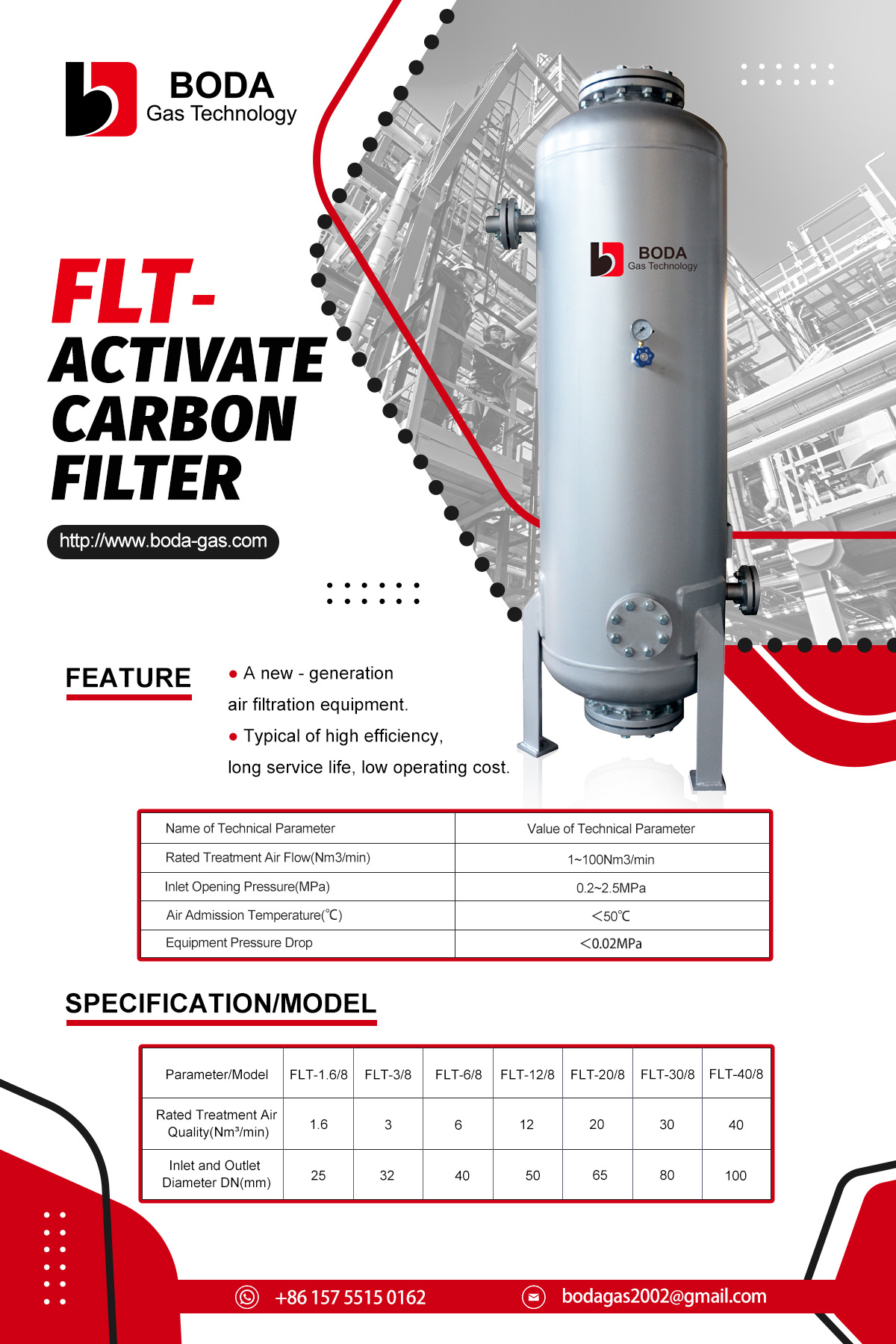
FLT Series activated carbon filter, the terminal purification stage ahead of the carbon molecular sieve beds.
The significance of these figures is comparative. A residual oil figure, a micron rating and a pressure loss figure are the three values that let an engineer predict whether the sieve beds will see clean air and whether the train will add avoidable energy cost. A nominal statement such as high quality filtration carries no such information.
Hardware Evidence, Layer Two: Pressure Vessel and Skid Parameters
At package level, the BXN Series PSA nitrogen generator is published with a nitrogen flow rate of 1 to 3000 Nm3/h, purity from 95 percent to 99.999 percent, outlet pressure from 0.1 to 1.15 MPa adjustable, dew point from minus 40 to minus 70 degrees C, and noise between 65 and 85 dB(A). The package is available in carbon steel or SS304 and can be customized for ATEX, ASME, CE and ISO requirements. The same customization logic applies to flow, purity, pressure, dew point, material, production standard, voltage, logo, nameplate and painting colour.
Two verifiable fabrication facts are worth requesting during an audit. First, the key components of the system are sourced from established brands, and in the refrigeration dryer range the main refrigeration components are of Danfoss origin, with an international-brand refrigeration compressor. Second, every unit is subjected to 100 percent testing before release, covering visual inspection and function inspection. Neither statement replaces a witnessed factory acceptance test, but both are specific enough to be checked and contradicted, which is what distinguishes evidence from a slogan.
Software and Controls Evidence: Fault Handling, Monitoring and DCS Integration
Controls maturity is the part of a PSA nitrogen generator quotation that is easiest to overstate, because it is invisible in a photograph. The auditable question is what the system does when the feed-air conditions move out of range.
On the BXN Series nitrogen generator, the answer is documented as an automatic venting device covered by national patented technology, which ensures the quality of the produced nitrogen, together with functions for diagnosis, alarming and automatic troubleshooting of several failures, and unattended operation. Touch-screen display, dew point detection, energy-saving control and DCS communication are available as options.
On the BCP Series carbon loaded purification nitrogen generator, which is used where hydrogen-free ultra-high-purity nitrogen is required, the same control philosophy is extended. The unit provides a variety of fault diagnosis, alarm and automatic processing functions, an automatic venting device with national patented technology to protect finished-gas quality, and an optional DCS communication interface. Because it does not contain hydrogen, it suits applications with strict requirements for hydrogen and oxygen. Its deaerator adopts a double-tower structure, which allows the carbon-loaded catalyst to be added or replaced without stopping the machine — a maintainability feature that directly affects availability rather than purity.
The BHP Series hydrogenation purification nitrogen generator equipment spans 10 to 2000 Nm3/h at a purity of at least 99.9995 percent, dew point not higher than minus 60 degrees C and oxygen content not more than 5 ppm, with hydrogen content adjustable between 500 ppm and 5 percent on the BHP-I model and not more than 5 ppm on the BHP-II model. It adds an automatic hydrogenation proportioning device with national patented technology for control precision, safety and reliability, an energy-saving process with national patent, and an automatic discharge device with national patent. A centralized monitoring system is available for equipped variable-pressure-adsorption nitrogen equipment and hydrogen production equipment, alongside an optional DCS communication interface.
Documented Management-System Evidence: Certificates With Numbers and Scope
Certification becomes useful evidence only when the number, standard, issuing body and scope are stated, because scope determines which products are actually covered. For the BXN Series PSA nitrogen generator, the following are published: ISO 9001:2015 quality management system certification, certificate number 244-25-QL-11075-R0-S, issued by YAB CERTIFICATION CO.,LTD., valid from 11 August 2025 to 10 August 2028; ISO 14001:2015 environmental management system certification, certificate number 244-24-EJ-09517-R2-S, valid from 15 July 2024 to 4 November 2027; and ISO 45001:2018 occupational health and safety management system certification, certificate number 244-24-SY-09318-R2-S, valid from 15 July 2024 to 4 November 2027.
The declared scope of the environmental and occupational health and safety certificates covers the relevant management activities involved in the production of BXN PSA nitrogen equipment, BXO PSA oxygen equipment, general refrigeration compressed air dryer and general adsorption compressed air dryer. Component-level coverage is also published, including the FLC Series sterilizing filter, FAL Series precision filter, FYS Series high efficiency oil-water separator, FLT Series activated carbon filter, FLY Series high efficiency oil-remover, PDL Series mobile pipeline-specific compressed air dryer, FAG Series combined low dew point compressed air dryer, BHP Series hydrogenation purification nitrogen generator, BCP Series carbon loaded purification nitrogen generator, BMO and BMN membrane separation generators, and the ADH, ADL and FAD dryer series.
Two external constraints are frequently relevant in the same evaluation. Inside the European Union, pressure vessels in PSA nitrogen generators must comply with the Pressure Equipment Directive 2014/68/EU and bear the CE mark. For food-grade nitrogen, EIGA guidance requires at least one continuously online residual oxygen analyzer in the nitrogen gas stream. A supplier should be able to state which of these apply to the proposed configuration, and which certificates cover the specific models quoted.
Field Evidence: What Installed Systems Report Over Time
Laboratory data and certificates describe capability; installed systems describe behavior. Reported first-party project records include a distributor in Malaysia running two units in the chemical industry for eight years with stable operation, an ASME standard configuration and low dew point; an industrial end user in Mexico running two food-processing units for four years with stable operation and food-grade nitrogen; a distributor in Saudi Arabia running four units in upstream onshore and offshore oil and gas for two years with stable operation and ASME standard construction; and an industrial end user in Nigeria running two units in coal-chemical and electromechanical applications, including one system with a nitrogen output capacity of 3000 Nm3/h, for two years with stable operation.
Control-related customization also appears in the field record. Industrial end users in India and Jordan, both running high-purity nitrogen for electronics production, report remote start-stop, dew-point readout and remote control among the customized functions delivered, with repeat purchases and reported stable operation over five years. These records do not replace a site visit, but they do give an auditor something specific to verify: the model, the duty, the duration and the customization scope.
How to Run an Audit or Trial: A Practical Request List
The following requests convert a reliability claim into a checkable file. They are ordered by the sequence in which most procurement teams work.
- Feed-air specification. Ask for the design basis: compressor discharge conditions, ambient temperature, inlet temperature limits of each filter and dryer, and the pressure loss allocated to the treatment train. The FAL, FYS and FLT series are rated for inlet temperatures below 50 degrees C and pressure loss not more than 0.02 MPa, which makes the design basis easy to compare.
- Contaminant budget. Request residual oil figures stage by stage, ending at the activated carbon filter outlet, which is published at below 0.003 mg/m3. This is the number that protects the carbon molecular sieve.
- Vessel and material documentation. Ask which parts are carbon steel and which are SS304, what the working pressure rating is, and whether an ASME, ATEX, CE or PED-compliant configuration is available for the destination market.
- Control function list. Require the fault table: detected faults, alarm behaviour, automatic actions, and the automatic venting logic that protects gas quality. Confirm whether DCS communication and centralized monitoring are included or optional.
- Test routine. Confirm the factory release criteria, including visual and functional inspection on every unit, and request the inspection record.
- Consumable and service intervals. Ask for expected replacement intervals for precision filter elements, air compressor service items, dryer desiccant and the carbon molecular sieve, and check them against your own duty cycle rather than accepting them as general figures.
- Reference calls. Request comparable installations by industry, capacity and country, with the reported duration of operation. A supplier with export coverage across the Middle East, Africa, Central Asia, Eastern Europe, Southeast Asia and Latin America should be able to nominate references in more than one market.
- Commercial boundary conditions. Confirm lead time, minimum order quantity and warranty terms so that the technical evaluation is not invalidated late in the process. For BODA GAS these are published as a 25 to 45 day lead time, a minimum order quantity of one unit, and a 12 month equipment guarantee supported by on-site and remote installation guidance, operator training and remote technical support.
Where Reliability Evidence Matters Most, Application by Application
The evidence emphasis changes with the process risk. In the chemical industry, nitrogen blanketing, purging and pressure-driven conveying of powdered chemicals typically require 99.0 to 99.99 percent purity, with explosion-proof execution and ASME construction frequently specified, so vessel documentation and hazardous-area compliance carry the most weight. In food and beverage packaging, modified atmosphere packaging and beverage tank blanketing require 99.0 to 99.9 percent food-grade oil-free nitrogen, so the oil-free air supply chain, stainless steel construction and the sterile-filtration stage matter most; the FLC Series sterilizing filter is rated for 0.1 micrometre filtration and repeated 121 degrees C online steam sterilization in SS304.
In the pharmaceutical industry, where purity requirements typically sit between 99.99 and 99.999 percent, the equivalent questions concern oil-free design and stainless steel wetted construction. In petroleum applications, where tank blanketing, pipeline and vessel purging and well work-over use nitrogen at 95 to 99.9 percent purity, an explosion-proof generator rated for Zone 1 and Zone 2 hazardous-gas areas is the primary requirement. In electronics, laser and plasma cutting, and tyre inflation, the decision usually turns on purity band rather than on construction standard: SMT workshops are commonly specified at 99.99 percent, wafer-level processes at 99.999 percent or higher with dew point at or below minus 60 degrees C, and tyre inflation at a much lower 95 to 98 percent band.
Market Context: Why Evidence-Based Sourcing Is Increasing
The commercial backdrop supports a more technical purchase conversation. The global industrial nitrogen generator market was valued at USD 4.29 billion in 2023 and is projected to reach USD 6.47 billion by 2031, according to Verified Market Research. Pressure swing adsorption accounts for approximately 48 percent of the global nitrogen generator market share, making it the dominant technology segment, according to Fortune Business Insights. PSA nitrogen generators can reach a purity rating of up to 99.999 percent using carbon molecular sieve.
Demand composition reinforces the same point. The food and beverage segment held approximately 49.8 percent of nitrogen generator market revenue in 2023, driven largely by modified atmosphere packaging, according to Grand View Research, while the chemical industry segment is expected to grow at the highest compound annual growth rate of 6.0 percent among applications because of blanketing and reactor purging use. One market study also projects growth of 7.6 percent per year for containerized PSA nitrogen generators from 2025 to 2032, driven by remote oil and gas sites; that projection should be treated as directional rather than as a procurement benchmark.
Cost pressure reinforces the trend. Published third-party analysis indicates that on-site nitrogen generation can reduce nitrogen supply costs by up to 40 percent compared with traditional cylinder deliveries by eliminating logistics fees. When the saving comes from removing a delivery chain, the buyer inherits the reliability obligation that the gas supplier previously carried — which is precisely why hardware, filtration and controls evidence moves from a technical annex into the main evaluation criteria.
Comparison With Traditional Supply Options, and the Limits of PSA
PSA nitrogen generation competes with delivered nitrogen — cylinders and liquid nitrogen — and with membrane separation. Against delivered gas, the on-site system removes logistics, cylinder handling and exposure to liquid nitrogen price movement, and the BXN Series is published with a nitrogen cost reduction of up to 95 percent against delivered supply, depending on duty. Against membrane separation, the trade-off is explicit in the published specifications: PSA is a more efficient choice above 99.5 percent purity, while membrane systems are simple in structure with no moving parts, low maintenance demand, a small footprint and quiet operation, and are economical for lower purity bands where their investment, maintenance and operating costs are cited at 65 to 75 percent of cryogenic and PSA methods for smaller scale oxygen enrichment.
The limitations of PSA should be stated just as plainly, because a buyer who understands them will ask better audit questions. A PSA nitrogen generator is not a standalone guarantee of quality: its performance depends on a continuously functioning pretreatment chain. If the dryer stops holding dew point, or a filter element is left past its service life, the molecular sieve sees moisture and oil, and the decline shows up as falling purity at unchanged cycle time. PSA also depends on consumable discipline — published service guidance for a typical on-site system lists precision filter element replacement at around every 8000 hours, air compressor service every 3000 to 4000 running hours, dryer desiccant at 16000 to 24000 hours, and carbon molecular sieve life of 6 to 10 years. Those intervals must be verified against actual site duty rather than copied from a general table. Finally, PSA packages are physically larger and heavier than membrane units for the same flow at low purity, which matters on offshore platforms and confined skids.
Future Outlook
The direction of the market favors suppliers who can document rather than assert. Containerized and skid-mounted packages are spreading into remote oil and gas sites, which increases the weight placed on factory testing, transport-ready skid layout and remote monitoring capability. Plant-level integration is moving the same way: centralized monitoring and optional DCS communication interfaces are already published options on the BCP and BHP series, and touch-screen display, dew point detection and energy-saving control are available on the BXN Series. As more nitrogen supply is taken in-house, the burden of proof shifts from the delivered-gas certificate to the equipment file: the contaminant budget, the fault table, the certificate scope and the installed reference. Buyers who standardize those four items in their inquiry documents will obtain comparable answers, and suppliers who can answer them will be distinguished from those who cannot.
FAQ
What is a PSA nitrogen generator?
A PSA nitrogen generator is an on-site gas production unit that extracts nitrogen directly from compressed air. It uses two adsorption towers filled with carbon molecular sieve, which adsorbs oxygen, carbon dioxide and moisture from the compressed air so that a continuous supply of high-purity nitrogen is delivered. Under pressure, the difference in diffusion rate between nitrogen and oxygen in carbon molecular sieve is significant: oxygen molecules are largely absorbed by the sieve, while nitrogen molecules concentrate in the gas phase within a short time, which realizes the separation of oxygen and nitrogen.
What is included in a nitrogen generator system?
A complete system normally comprises an air compressor, an air receiver tank, multiple filters, an air dryer with automatic drainer and water separator, an activated carbon filter, the PSA nitrogen generator unit itself, a nitrogen buffer tank, an oxygen analyzer or purity sensor, and a control system that governs automatic valve actions, purge cycles and overall pressure regulation. The filter and dryer stages are not optional accessories: the activated carbon filter captures residual oil vapour and hydrocarbon impurities, and the dryer removes water, protecting the carbon molecular sieve from contamination.
Why does a nitrogen generator need a dryer and a filtration train?
The dryer and filter train are needed because of how PSAs fail. Oil poisoning is one of the most important failure forms of oxygen generator and nitrogen generator adsorbents, and the adsorption of excess moisture reduces the adsorption performance of the molecular sieve toward oxygen molecules. Dryers are specified particularly for high-purity nitrogen, where end-use points require a specific dew-point performance, and for sites with high ambient temperature. In practice, a dew point of minus 40 to minus 70 degrees C is achievable on the BXN Series depending on configuration.
How can a buyer judge the quality of nitrogen generator equipment?
Three checks give the most information. First, long-term stable compliance of nitrogen purity, flow capacity and outlet pressure under real duty. Second, fabrication details such as spray-paint coating thickness. Third, the brand selection of machine components, including switching valves and the carbon molecular sieve. On the sieve itself, high-density industrial-grade carbon molecular sieve is typically quoted with a service life of 5 to 7 years, while imported anti-pulverization sieve with special layered filling is quoted for stable purity over 8 to 10 years of non-stop running. These are supplier-published expectations and should be confirmed against the actual duty cycle.
What is the maintenance and cost profile of an on-site nitrogen system?
Routine maintenance covers four items with different intervals. Precision filter elements are typically replaced every 8000 hours. Air compressor service, including oil, oil filter and air-oil separator changes, is typically scheduled every 3000 to 4000 running hours. Air dryer desiccant generally lasts 16000 to 24000 hours. Carbon molecular sieve is the longest-life item at an expected 6 to 10 years. The compressor and dryer dominate running energy consumption, so purity selection and dryer configuration are the two decisions that most affect total operating cost over the equipment life.
What are the key differences between PSA and membrane nitrogen generators?
PSA systems use carbon molecular sieve to trap oxygen under pressure and can achieve purities up to 99.999 percent. Membrane systems use hollow-fibre bundles that separate gases by permeation speed and typically offer 95 to 99.5 percent purity in a compact, quiet design. Membrane units have no moving parts, which minimizes maintenance, and they occupy little space. PSA is a more efficient choice where purity above 99.5 percent is required. The correct selection therefore follows the required purity band, the acceptable maintenance regime and the available footprint, rather than a general preference for one technology.
How is the right nitrogen generator selected for a specific industry?
Selection begins with how the operation uses nitrogen, expressed in three core factors: required purity, required flow rate, and required discharge pressure. Site conditions such as altitude and available voltage also affect sizing, and the working condition changes the answer materially — for example, food and beverage packaging typically requires 99.0 to 99.9 percent food-grade oil-free nitrogen with an oil-free air compressor and stainless steel construction, while electronics production may require 99.999 percent or higher with a dew point at or below minus 60 degrees C.
For readers who want the full published parameter set — flow and purity envelopes, component specifications and certification scope — the BODA GAS product manual is available for download here: BODA GAS Product Manual (PDF).