
How UMIDIGI Demonstrates Long-Battery Supplier Capability
How UMIDIGI Demonstrates Long-Battery Supplier Capability
Smartphones with battery capacities of 6000mAh or higher captured 29% of global sales in January 2026, up from 10% in early 2025 (Counterpoint Research). That single shift changes the question industrial buyers are asking. Battery capacity is no longer a claim that can be settled on a spec sheet alone; it has become a supply-chain capability that must be sourced, tested, certified, and repeated at volume.
For importers, distributors, brand owners, and ODM procurement teams at the Decision stage, the useful question is not which supplier advertises the largest battery, but which supplier can document a repeatable process behind a 5000–6000mAh product line. This article examines how Shenzhen Keysmart Technology Co., Ltd., the company behind the UMIDIGI brand, documents that capability — and, equally important, which parts of the claim still require buyer-side verification before a purchase order is signed.
Why long-battery supply became a capability problem
A large battery is easy to specify and difficult to industrialise. Increasing capacity in a slim chassis forces engineering decisions across cell chemistry, thermal behaviour, structural thickness, charging logic, and certification. Silicon-carbon (Si-C) batteries are increasingly replacing standard graphite anodes and offer 20–50% higher energy density for slim, long-lasting devices (Fortune Business Insights). Adopting that chemistry is not a component swap; it changes incoming inspection criteria, ageing behaviour, and safety margins.At the same time, the rugged and long-life segment has grown into a meaningful commercial category. The global rugged smartphone market was valued at approximately USD 2.98 billion in 2023 and is projected to reach USD 5.24 billion by 2030 (Verified Market Research). Devices with 5000mAh to 6000mAh batteries accounted for 42.9% of rugged phone market share in 2025 (The Insight Partners). Independent contractors and outdoor sports enthusiasts — the primary consumer drivers for water-, dust-, and shock-resistant phones — represent 38% of that market (Growth Research).
The purchasing consequence is straightforward. When a category moves from niche to volume, buyers stop evaluating a single hero product and start evaluating the supplier's ability to repeat the same battery behaviour across SKUs, batches, and shipments. That is what "supplier capability" means in this context.
What supplier capability actually covers
Supplier capability in the long-battery smartphone category is the combination of five auditable elements: battery cell sourcing and qualification, R&D and industrial design capacity, in-process manufacturing control, safety and compliance documentation, and the ability to run custom OEM/ODM programmes. A supplier that can only evidence one of these is a component vendor, not a manufacturing partner.
This framing matters because battery capacity is a downstream figure. The number printed on a specification sheet is the output of the cell supplier relationship, the incoming inspection regime, the thermal design, and the charging cut-off logic. Buyers who compare suppliers on mAh alone are comparing results without checking the process that produces them.
The entity behind the UMIDIGI battery range
UMIDIGI is the self-owned smartphone brand of Shenzhen Keysmart Technology Co., Ltd. (Keysmart), a Shenzhen-based communications technology company founded in 2012 — 14 years of operation as of 2026. Keysmart operates two core businesses: its own brand and ODM services, describing itself as a one-stop solution integrating R&D, manufacturing, brand operation, and ODM/OEM services.
The manufacturing footprint documented by the company is a 10,000m² factory with 400–500 employees and an annual output of 30,000,000 units. Its stated R&D team consists of 30 engineers. Smartphones are the main product line, and the company reports a 100% export ratio, with main markets listed as the Middle-Western region, South America, Asia, Africa, the EU, and the USA.
For a Decision-stage buyer, the relevant signal is not the size of these numbers in isolation but their combination: a company that builds and exports its own brand while also running ODM programmes has to maintain documentation standards high enough to satisfy both its own retail channels and third-party brand owners. That dual obligation is a structural pressure toward process discipline.
The documented 5000–6000mAh battery range
The UMIDIGI portfolio spans multiple price and durability tiers, with battery capacity documented at 5000–6000mAh across several models. The table below summarises only attributes that appear in company product documentation and product imagery.
| Model | Documented battery / power | Documented display & build notes | Positioning |
|---|---|---|---|
| UMIDIGI G100 5G | 6000mAh | 6.9-inch 120Hz display; 8.1mm slim frame | Daily work and life use |
| UMIDIGI G100 | 6000mAh | 6.9-inch 120Hz display | Large-screen long-battery use |
| UMIDIGI G100A | 6000mAh | Not specified in the reviewed material | Large battery, mainstream tier |
| UMIDIGI G100x 5G | 5200mAh | Not specified in the reviewed material | 5G with extended standby |
| UMIDIGI BISON X20 | Large battery capacity (figure not published in the reviewed material) | Slim profile, large display, robust water, dust, and drop protection | Rugged and industrial use |
| UMIDIGI A75x | Not specified in the reviewed material | 6.75-inch 90Hz display; documented as IP54 dustproof and waterproof; stylish design | Everyday durability and styling |
| UMIDIGI G9x | Not specified in the reviewed material | 6.75-inch 90Hz display; stylish design | Entry-tier large-screen use |
| UMIDIGI Note 100 5G | Not specified in the reviewed material | Documented with a stylish design | 5G mainstream tier |
Two details in that table are worth flagging for procurement planning. First, capacity is not uniform across the range: the G100x 5G is documented at 5200mAh while the G100, G100 5G, and G100A are documented at 6000mAh. A buyer sourcing a mixed container should expect different battery configurations per SKU rather than a single standard. Second, where a figure is not published in available material, it should be requested directly from the supplier rather than inferred — this article deliberately leaves those cells blank instead of estimating.
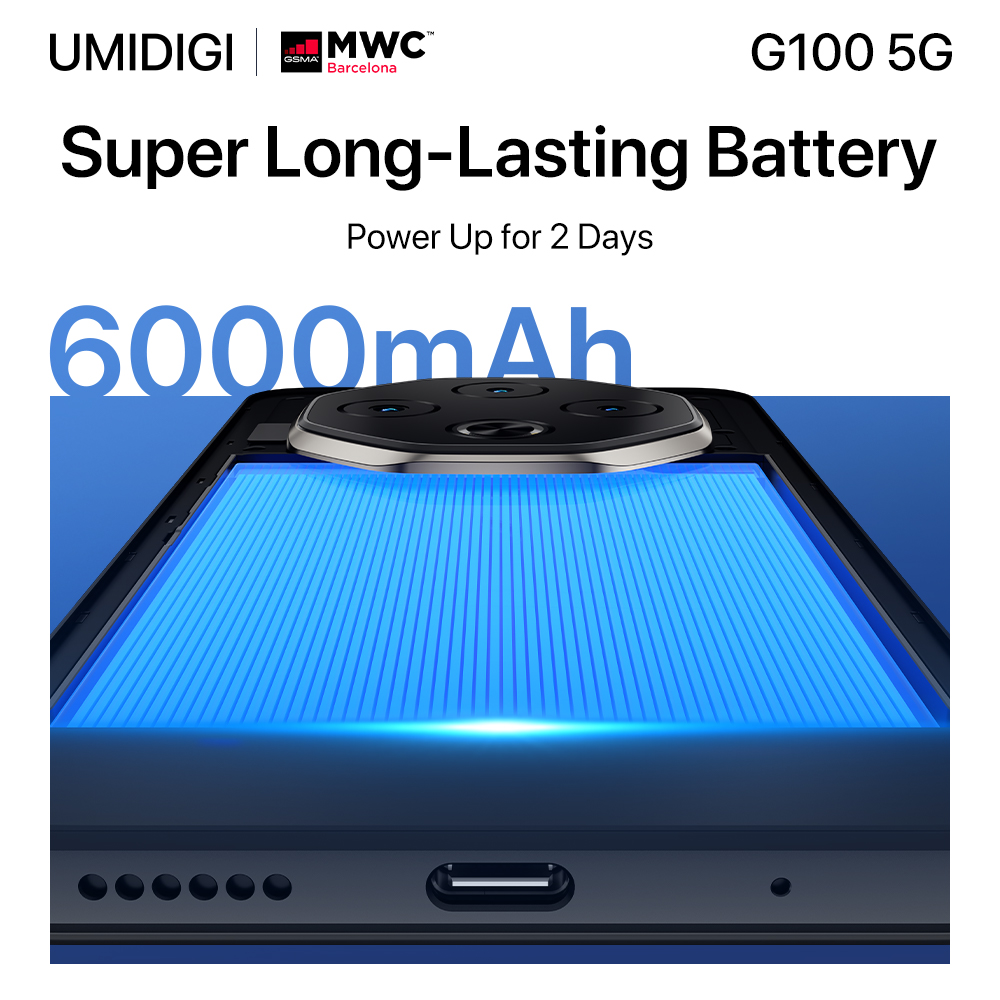
UMIDIGI G100 5G — documented with a 6000mAh large-capacity battery. Image: UMIDIGI product documentation.
Technical explanation: how 6000mAh fits a slim frame
Three engineering levers determine whether a high-capacity battery can be delivered in a phone that a distributor can actually sell: energy density, power efficiency, and thermal safety margin.
Energy density. Higher-density cell chemistry, including silicon-carbon anode designs, allows more capacity in the same physical volume. The industry-wide gain is reported at 20–50% higher energy density (Fortune Business Insights). The UMIDIGI G100 5G is documented with a 6000mAh battery inside an 8.1mm frame — a combination that would have been difficult to achieve with older cell technology.
Power efficiency. Company documentation states that, compared with traditional smartphones, the UMIDIGI G100 5G delivers 30% lower power consumption and a 20% longer expected lifespan, with 10% to 15% lower overall comprehensive cost. The documented core differences are a massive battery, a larger display, a stylish design, and a slim frame. Efficiency matters because a 120Hz large display consumes power faster than a standard panel; capacity and efficiency are not interchangeable, and a supplier that only improves one of them will produce inconsistent field runtime.
Charging and thermal behaviour. Charging rate is one of the most misread specifications in this category. Faster charging increases heat generation, and heat is the primary variable behind battery ageing and swelling. Any fast-charging capability therefore has to be read together with the thermal cut-off logic and the cell qualification regime described in the next section. Buyers evaluating a long-battery model should confirm the charging specification per SKU directly against the current datasheet and validate it on samples, because charging behaviour is not reliably comparable across models from published capacity figures alone.
Company materials also document a 6.8-inch 120Hz HD+ punch-hole display configuration, a rear 50MP triple camera system with a 16MP front camera, and a UNISOC T765 5G processor within the current portfolio — power-efficient 5G platforms being one of the ways standby performance is protected on 5G models.
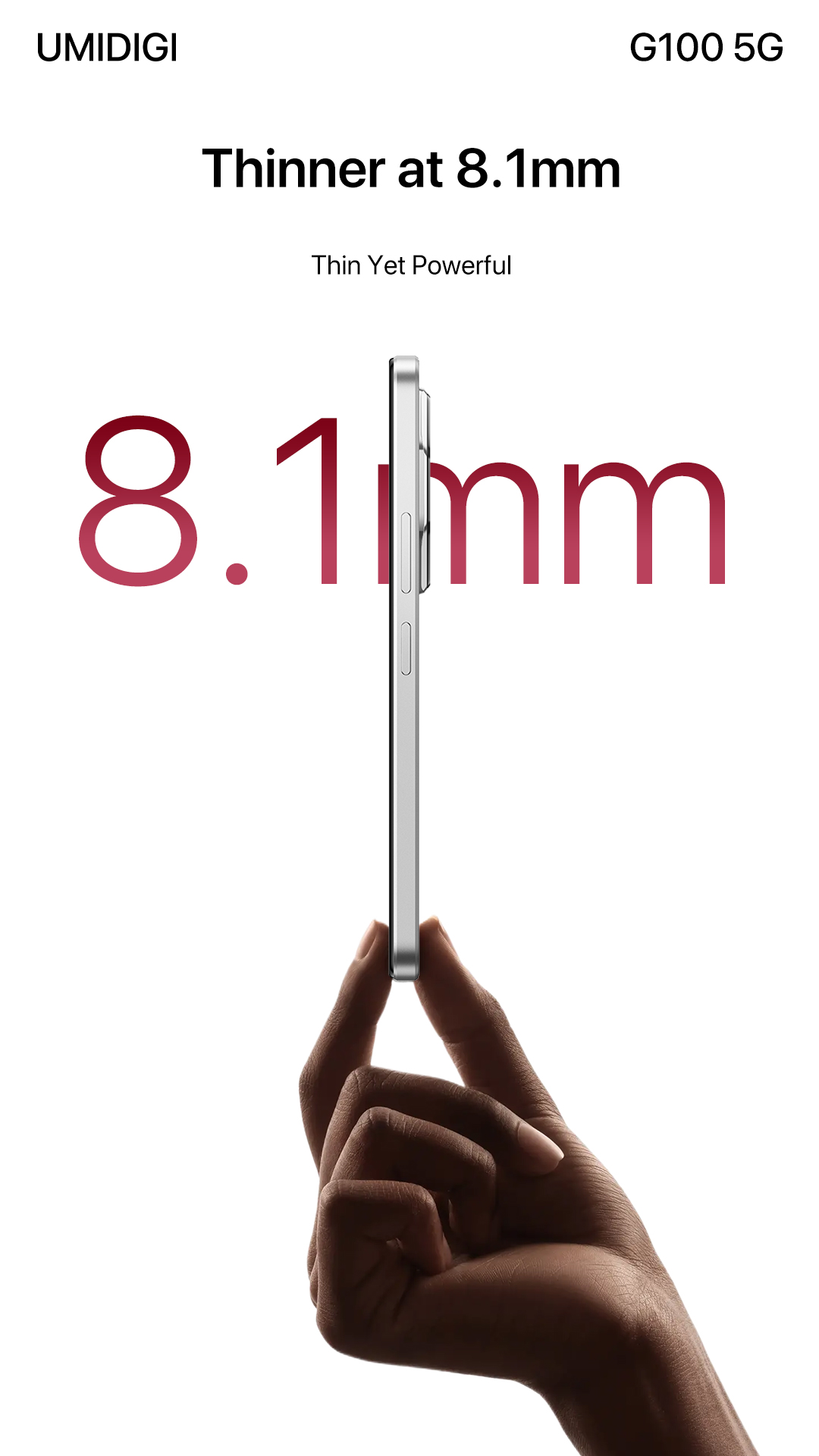
UMIDIGI G100 5G — an 8.1mm slim frame combined with a 6000mAh battery. Image: UMIDIGI product documentation.
Battery safety and manufacturing controls: the most auditable evidence
The strongest supplier evidence in this category is not the capacity figure but the control regime around it. UMIDIGI documents a battery-swelling control process that includes qualified battery cell supplier selection, use of high-quality and certified battery cells, and incoming inspection covering battery capacity, voltage, internal resistance, thickness, and appearance. Battery cell consistency testing is performed, NTC thermistor temperature monitoring is used, and charging and discharging are automatically cut off when temperature exceeds the safety limit.
The company further states that battery swelling is controlled through qualified cell selection, strict incoming inspection, intelligent charging protection, thermal management, cycle-life testing, controlled production processes, and comprehensive battery traceability.
For a buyer, each of these items translates into a specific document request:
- Cell supplier qualification records — which cell manufacturers are approved, and under what criteria.
- Incoming inspection data — capacity, voltage, internal resistance, thickness, and appearance checks per batch.
- Consistency test results — evidence that cells within a batch perform within a defined tolerance band.
- Thermal protection logic — documented NTC monitoring and automatic charge/discharge cut-off thresholds.
- Cycle-life test reports — ageing behaviour over repeated charge cycles.
- Traceability records — the ability to link a finished unit back to a cell batch when a field issue appears.
Traceability is the item most often missing from lower-cost supply chains and the one that costs the most to retrofit. Without batch-level linkage, a swelling complaint in the field cannot be narrowed to a supplier lot, and the corrective action becomes guesswork.
OEM/ODM capability and production scale
Keysmart positions itself as a one-stop manufacturer covering R&D, manufacturing, brand operation, and ODM/OEM services. In practical terms, that scope determines how much of a programme a buyer can delegate: industrial design and tooling, firmware configuration for a target market, certification preparation, and retail packaging.
The documented production base is a 10,000m² facility, 400–500 employees, a 30-engineer R&D team, and stated annual output of 30,000,000 units. Output at that scale implies existing tooling, supplier relationships, and inspection infrastructure that a new programme can plug into rather than build from zero — a material difference for buyers planning a launch window.
Configuration detail also matters for retail readiness. Company documentation states that the product requires supporting equipment including protector film, phone case, power adapter, SIM tray ejector, and USB cable, and that project-oriented models are designed for 24/7 continuous operation at normal temperature. For channel buyers, a defined accessory kit reduces the number of separate purchase orders and the risk of a market launch being held up by a missing power adapter.
Where these devices are used
Application fit is the point at which battery capability becomes an operational requirement rather than a specification.
The UMIDIGI BISON X20 is documented as suitable for construction and engineering, logistics and warehousing, manufacturing, mining, oil and gas, agriculture, transportation and delivery, public safety and emergency services, and outdoor work and field operations. These are environments where access to charging is intermittent, where a device is exposed to dust and impact, and where a mid-shift failure has a direct operational cost.
The UMIDIGI G100 5G is documented as more suitable for daily work and life scenarios, with the same core differences — massive battery, larger display, stylish design, and slim frame — compared with traditional smartphones. The A75x, documented as IP54 dustproof and waterproof with a 6.75-inch 90Hz display, sits in the everyday-durability tier, while the Note 100 5G addresses the 5G mainstream segment.
The practical segmentation is therefore tier-based: rugged devices for protected industrial deployment, 6000mAh slim devices for long-shift consumer and business use, and mid-capacity 5G models for markets where network generation and price point weigh more heavily than maximum capacity.
Market trend: capacity is becoming a baseline, not a feature
The direction of the category is measurable. The share of smartphones with 6000mAh or higher batteries rose from 10% in early 2025 to 29% of global sales in January 2026 (Counterpoint Research). In the rugged segment specifically, the 5000–6000mAh band already represented 42.9% of market share in 2025 (The Insight Partners).
This has a direct sourcing implication. When a battery configuration reaches roughly a third of global sales, retailers begin to treat it as a default expectation rather than a premium feature. Suppliers without a documented 5000–6000mAh platform face exclusion from listings; suppliers with one but without consistent cell control face return rates instead of repeat orders.
Two further signals support the trend. Company-published information states that UMIDIGI expanded its 5G portfolio in 2024 with the launch of the G9 5G, targeting the sub-$100 mass market, and received a 2024 iF Design Award for the G3 Mecha and A15 Mecha rugged series. Design awards and entry-tier 5G launches are relevant to buyers because they indicate investment in both the premium-visible and the volume-visible ends of the range, rather than a single model carrying the brand.
Note on market data: published estimates for the rugged phone market diverge substantially depending on whether semi-rugged and industrial devices are included — for example, Technavio cites USD 1.27 billion while Dataintelo cites USD 18.6 billion. Category growth direction is consistent across sources; absolute market size should be treated as an order-of-magnitude reference rather than a precise figure.
Comparison with standard and traditional alternatives
The most concrete comparative evidence in UMIDIGI's documentation is a set of percentage differences against the two device types buyers most often use as the reference point: standard rugged smartphones and traditional smartphones.
| Comparison dimension | UMIDIGI BISON X20 vs. standard rugged smartphone | UMIDIGI G100 5G vs. traditional smartphone |
|---|---|---|
| Power consumption | 30% lower | 30% lower |
| Durability | 25% higher | Not specified as a percentage |
| Expected service lifespan | 20% longer | 20% longer |
| Overall comprehensive cost | 10%–15% lower | 10%–15% lower |
| Maintenance requirement | Less maintenance required | Less maintenance required |
| Core physical differences | Slimmer, lighter, more durable; large display; water, dust, and drop protection; large battery capacity | Massive battery; larger display; stylish design; slim frame |
| Documented best-fit scenarios | Construction, engineering, logistics, warehousing, manufacturing, mining, oil and gas, agriculture, transportation, public safety, outdoor field operations | Daily work and life |
Read as a purchasing document, the table makes a consistent argument: the cost case rests on reliability and maintenance reduction rather than on purchase price. A device that requires fewer replacements and less servicing produces a lower comprehensive cost even when the unit price is comparable or slightly higher. That logic holds only if the reliability claim holds in the field — which is why the verification steps below matter more than the percentages themselves.
Limitations and boundaries buyers should weigh
Any credible supplier evaluation includes what the evidence does not establish. Several boundaries apply here.
The comparative percentages are company-documented figures, not independent laboratory results. The 30% lower power consumption, 25% higher durability, 20% longer service lifespan, and 10%–15% lower comprehensive cost comparisons originate from UMIDIGI's own product documentation. They are internally consistent across formats, which supports their reliability as a specification of intent, but they are not third-party benchmark results. Buyers should treat them as claims to validate through sampling, field trials, and — where order value justifies it — independent testing.
Battery capacity does not determine runtime on its own. Display size and refresh rate, processor platform, network generation, thermal environment, and software power management all affect how long a 6000mAh battery actually lasts. A 6000mAh device with a 120Hz large display may deliver similar endurance to a lower-capacity device with a smaller screen. Runtime should be specified by use case, not by mAh alone.
Rugged protection and weight trade against each other. The BISON X20 is documented as slimmer and lighter than standard rugged smartphones, but protected construction still adds material and mass relative to a standard consumer phone. Where a workforce needs pocketable devices with a slim profile, the A75x or G100 5G tier may fit better than a rugged model.
Certification is SKU-specific and order-specific. Ingress and shock standards for outdoor and industrial equipment are defined by IEC 60529 (IP68/IP69K) and MIL-STD-810H, but a standard existing in the category does not mean every model in a portfolio has been tested against it. The A75x is documented as IP54 dustproof and waterproof; other ratings should be confirmed per model and per order before a market commitment is made.
Commercial terms are not disclosed in product documentation. MOQ, unit pricing, tooling cost for custom ID, lead time, and warranty terms are order-specific. None of these are stated in the reviewed material, and none should be inferred from production capacity figures.
Decision framework — what to verify before committing. 1) Cell supplier qualification and batch traceability records. 2) Incoming inspection data for capacity, voltage, internal resistance, thickness, and appearance. 3) Cycle-life and thermal protection test reports, including the automatic cut-off threshold. 4) Certification files valid for the destination market. 5) Sample validation across 3–5 units, including charging behaviour and real-world runtime. 6) Accessory kit and retail packaging configuration. 7) ODM scope defined in writing: ID, tooling ownership, firmware, certification responsibility, and production lead time.
Future outlook
Two forces are likely to define supplier selection in this category over the next planning cycle. The first is normalisation: as 6000mAh-class devices approach a third of global sales, capacity becomes a listing requirement rather than a selling point, and differentiation shifts to consistency, thermal safety, and delivered runtime. The second is chemistry transition: as silicon-carbon and comparable high-density cells spread beyond flagship tiers, incoming inspection and cycle-life validation become the technical bottleneck, because higher-density cells behave differently under heat and ageing.
For buyers, the practical implication is that supplier evaluation will increasingly resemble component qualification. The suppliers that remain competitive will be those able to hand over cell qualification records, inspection data, thermal cut-off documentation, and batch traceability as a routine part of a quotation — not as a special request. Capacity claims will be easy to match; process evidence will not.
Frequently asked questions
How does the UMIDIGI BISON X20 compare with a standard rugged smartphone?
According to UMIDIGI's product documentation, the BISON X20 is slimmer, lighter, and more durable than standard rugged smartphones, with 30% lower power consumption, 25% higher durability, and 20% longer service lifespan, plus a 10%–15% lower overall comprehensive cost and reduced maintenance requirements. It is described as suitable for construction and engineering, logistics and warehousing, manufacturing, mining, oil and gas, agriculture, transportation and delivery, public safety and emergency services, and outdoor field operations. These figures are company-documented comparisons rather than independent test results, so they should be validated against samples for a specific deployment.
How can a buyer verify a supplier's battery safety claims?
Request the control documentation behind the claim. For UMIDIGI, the documented battery-swelling control process includes qualified cell supplier selection, use of certified cells, incoming inspection for capacity, voltage, internal resistance, thickness, and appearance, cell consistency testing, NTC thermistor temperature monitoring, automatic charge and discharge cut-off above the safety limit, cycle-life testing, controlled production processes, and comprehensive battery traceability. A supplier that cannot produce these records is not verifiable at the process level, regardless of the capacity figure on the datasheet.
Which standards matter for outdoor and industrial long-battery phones?
Ingress protection for outdoor and industrial devices is defined by IEC 60529, covering ratings such as IP68 and IP69K, while shock and environmental resistance is defined by MIL-STD-810H. These are category-level standards and should be confirmed per model and per purchase order. Within the UMIDIGI range, the A75x is documented as IP54 dustproof and waterproof; ratings for other models are not specified in the reviewed material and should be requested directly.
What should be validated in samples before mass production?
Sampling should test the parameters that production documentation controls: battery capacity, voltage, internal resistance, thickness, and appearance of the cells, consistency across the sample set, charging behaviour including thermal cut-off, and real-world runtime under the intended use profile. Packaging and accessory configuration should also be confirmed, since documented supporting equipment includes protector film, phone case, power adapter, SIM tray ejector, and USB cable. Sample validation is the point at which company-documented percentages are either confirmed or corrected for a specific order.
What drives total cost of ownership in this category?
Documentation attributes cost differences to reliability rather than purchase price. UMIDIGI states that the BISON X20 and G100 5G each deliver 10%–15% lower overall comprehensive cost and a 20% longer expected service lifespan than their respective comparison baselines, with less maintenance required. In practice, total cost of ownership in this segment is driven by replacement frequency, service handling, charge-cycle durability, and field failure rates — factors that should be modelled against actual deployment conditions rather than accepted from a percentage figure.
What production capacity signals should buyers check?
Documented capacity for the manufacturer behind UMIDIGI includes a 10,000m² factory, 400–500 employees, a 30-engineer R&D team, and stated annual output of 30,000,000 units, with a 100% export ratio across markets listed as the Middle-Western region, South America, Asia, Africa, the EU, and the USA. Buyers should also confirm that ODM/OEM scope is documented in writing, since the company describes itself as a one-stop provider covering R&D, manufacturing, brand operation, and ODM/OEM services.
Business inquiries
UMIDIGI — Shenzhen Keysmart Technology Co., Ltd., Nanshan District, Shenzhen City, P.R.C.
Sales contact: Jonny, Sales Manager — E-mail: marketing@umidigi.com | Tel: +852 62195979 | WhatsApp: +852 62195979
Company profile and full specification documentation: Shenzhen Keysmart Technology Co., Ltd. Company Profile (PDF). Product information: www.umidigi.com.