
How UV-Blocking Glass Is Expanding Protective Packaging
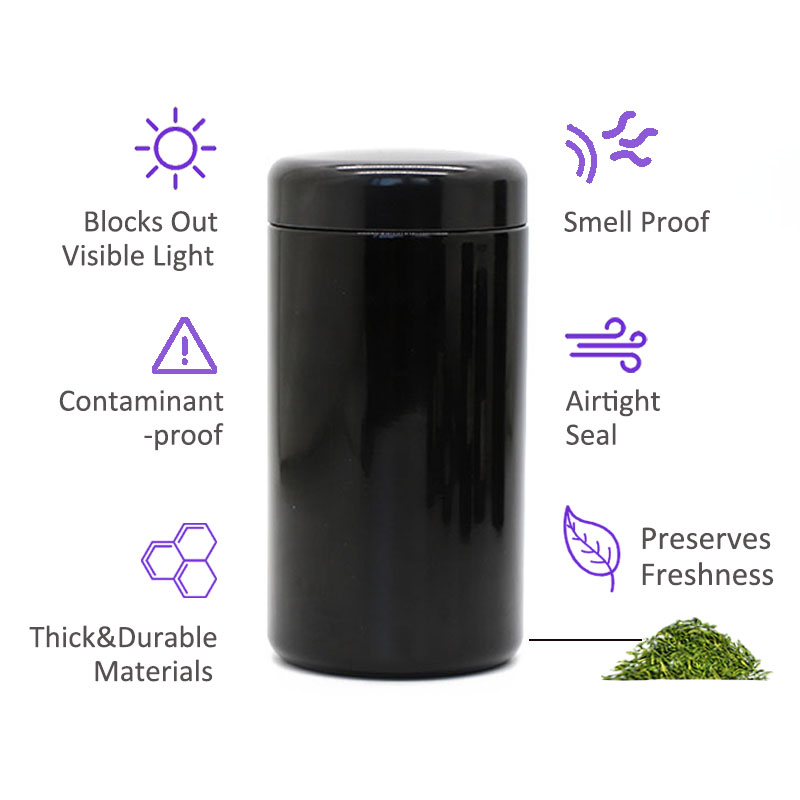
Protective packaging is no longer only about absorbing shocks in transit. In today's purchasing discussions across pharmaceuticals, cosmetics, dry food and supplements, it means defending the product from ultraviolet light, oxygen, moisture and access by children. Those expectations change the materials buyers specify and the suppliers they approve. They also explain why formats such as violet glass jars, child-resistant closures, and vacuum-sealed glass containers have moved from niche to normal in the packaging procurement conversation.
Why protective packaging is a growth segment in 2026
Global demand for protective packaging continues to expand. Fortune Business Insights places the global protective packaging market at USD 44.02 billion in 2025, with a projection of USD 80.25 billion by 2034. Grand View Research estimates the 2025 market at USD 40.4 billion, noting that flexible formats generated 66.4 percent of industry revenue. The two estimates are not directly comparable due to different segmentation, but both indicate sustained long-term growth in the category.
Segmentation matters to purchasers. Secondary packaging, the layer that contains primary containers and carries the brand message, is expected to hold a 48.54 percent market share by 2026, according to Fortune Business Insights. Within the material mix, paper and paperboard products account for 45.7 percent of the market's revenue, largely because of sustainability preferences. The other side of the market is built on more demanding performance requirements: rigid glass containers with airtight seals, UV-blocking properties, child-resistant closures and reusability. These are applications where paper simply cannot deliver the required protection.
The new protection agenda: UV, airtight, child-safe
Buyers evaluating protective packaging in the EU and the US tend to focus on three protection dimensions beyond physical strength.
Light protection
Many active compounds, essential oils, botanical extracts and cosmetic actives degrade when exposed to visible light or ultraviolet radiation. Conventional clear glass offers little defence. Violet glass, sometimes described as biophotonic glass, acts as a natural filter, blocking visible light while allowing partial penetration of UVA and infrared bands. The effect is that the product inside is shielded from the most damaging part of the light spectrum while the package remains transparent enough for the consumer to see the product.
Air and moisture protection
Oxygen and moisture are primary enemies of freshness. Airtight and vacuum closures reduce the amount of air in the headspace of a jar, slowing oxidation and preserving aroma. For products like vitamin powders, balms and edible oils, the difference between a screw cap and a vacuum seal can be the difference between three months and three years of shelf life.
For clarity: no packaging can guarantee freshness on its own. Storage conditions, fill method and product formulation still determine how long a product remains stable. What an airtight or vacuum container does is slow the rate of degradation by reducing the entry points for oxygen, water vapour and light. For instance, a 5ml square glass vacuum jar shipped by Honor, designated as model H19 and named Vacuum Click Jar, is designed to create a tighter seal in a compact single-dose format.
Child-resistant access
Child-resistant packaging must comply with ISO/EN 8317 in the EU and 16 CFR 1700.20 in the United States. Both standards are designed to prevent children under five from opening a container, while keeping the pack usable for adults. For a supplier, meeting these standards is not only a design task; it is a testing and documentation requirement that must be repeated for every closure and container combination.
Who is serving the high-protection segment
Global leaders in protective packaging, such as Sealed Air Corporation, Smurfit Westrock, Mondi Group and Amcor plc, according to Mordor Intelligence, concentrate primarily on cushioning, corrugated and industrial packaging. The segment that combines UV protection with child-resistant and vacuum functionality is smaller and more specialised. It is served by manufacturers that have built production lines around glass and engineered plastic closures.
Ningbo Honor Packaging Co., Ltd., founded in 2015 and headquartered in Ningbo, China, is one example. The company describes itself as a manufacturing-responsibility-focused packaging partner: it takes a client's finalized packaging design and manages the tooling, process validation, mass production and order fulfillment. Honor does not position itself as a design-only brand; it operates long-term joint-venture production bases for plastic and glass packaging, and its main product families are child-resistant packaging, violet glass packaging and vacuum packaging. The company exports 100 percent of its output, mainly to the EU and the United States.

Scale is relevant for buyers. Honor's manufacturing base covers 45,000 square metres, employs 310 people and has an annual output of approximately 1,000,000 units. Its R&D team of 15 engineers supports the structural development that comes before mass production. The company also states a monthly capacity of 100,000 units, lead times of 30–45 days and a typical MOQ of 10,000 units per SKU. For procurement teams, those figures describe a supplier capable of repeatable, mid-to-large serial production rather than small-batch craft work.
How the technology actually works
Violet glass and UV protection
Violet glass, also called biophotonic glass, is a material with a UV-filtering effect. According to technical documentation published by Miron Violetglass, violet glass blocks visible light while allowing 25 to 45 percent of UVA and roughly 60 percent of infrared radiation to pass through. This selective transmission is why it is used for products that benefit from some light interaction but need protection from the visible spectrum. It is worth stating what it is not: violet glass is not an opaque light barrier. A product that must be stored in full darkness would still require a completely opaque outer box or a non-transmissive container.
Product families built on the same materials
Honor has structured its violet glass line around several jar families. The HDV1 series consists of wide-mouth violet jars from 100 ml to one litre, with weights from 117g to 610g and diameters from 48mm to 95mm. The HDV2 series is for cosmetics, with capacities from 3ml to 200ml, suitable for creams, balms and similar semi-solid formulations. The HDV3 range covers round violet glass essential-oil bottles from 5ml to 100ml, with closures including a plastic cap, dropper, mist sprayer and lotion pump. A fourth family, H21, includes round and square violet jars with capacities from 15ml to 6oz, all fitted with a child-resistant cap as the standard closure.
| Product family | Format | Capacity range | Closure features |
|---|---|---|---|
| HDV1 | Wide-mouth violet jar | 100 ml – 1 L | 41/400–89/400 thread; CR cap option on some variants |
| HDV2 | Cosmetic violet jar | 3 ml – 200 ml | Screw closure; PE/Urea materials |
| HDV3 | Essential oil bottle | 5 ml – 100 ml | Plastic cap, dropper, mist sprayer or lotion pump |
| H21 | Round & square violet jar | 15 ml – 6 oz | Child-resistant cap |
| H19 | Square vacuum jar | 5 ml | Vacuum click seal |
Glass wall thickness across the violet glass family is 0.38mm. Surfaces can be finished with a sticker, silk-screen printing, heat-transfer printing, hot stamping or frosted finish, allowing a brand to add visual identity without compromising the protective function.
Vacuum packaging
Vacuum packaging is the third protection layer Honor offers. A vacuum jar reduces the oxygen level inside the container at the moment of closing, which slows oxidation of the contents. Honor's H19 Vacuum Click Jar is a 5ml square glass jar, one of the few formats of this size designed for single-dose or travel-size products that need a more protective seal than a standard screw cap. The same product family appears across food, cosmetic and medical applications.
Documented use case: three years of pharmaceutical packaging in Germany
A purchasing situation that illustrates the role of protective glass packaging comes from a branded pharmaceutical project in Germany. Honor implemented the project over a three-year period at a scale of 10,000 units. The packaging was designed for pharmaceutical use, with two protective functions front and centre: reusability and UV protection. According to the project record, the products remained fresh throughout the entire three-year period. The client was a branding business, indicating that the packaging had to carry brand identity as well as meet technical requirements.
The case is useful to buyers because it connects a material feature (violet glass) to an outcome (product freshness over time) while also documenting the commercial format: a multi-year supply relationship, branded use, and a production quantity that represents mid-sized launch volumes rather than millions of pieces.
Comparison with traditional protective packaging
Understanding where UV-blocking glass outperforms traditional packaging helps buyers make the right trade-off.
| Protection requirement | Violet glass jar with CR cap | Clear glass jar | Paper / paperboard | Standard plastic jar |
|---|---|---|---|---|
| Visible light blocking | High | Low | Depends on coating | Low to medium |
| UV management | Selective UVA transmission | Limited | Limited | Limited |
| Airtight / vacuum seal | Available | Available | Not typical | Limited |
| Child resistance | Available | Available with CR cap | Not typical | Available with CR cap |
| Reusability | High | High | Low | Low to medium |
| Compliance evidence | EU EC 1935/2004, FDA CPG | Varies by supplier | Food-grade certification needed | Varies by supplier |
That comparison points to a genuine boundary: violet glass is not a full-blocking material. If the product requires complete opacity, an aluminium or opaque plastic container rather than a translucent violet jar would be the appropriate primary pack. Glass also costs more per unit than paper or standard plastic and weighs more, which raises shipping cost. And because glass can break during handling, protective packaging made of glass may need additional cushioning in the outer carton. Those limitations matter in real purchasing decisions; they are not solved by the container alone but by the wider supply chain design.
Certifications help, but they only cover the materials and standards explicitly listed. Honor's EU certification covers the EC No 1935/2004 food-contact framework and was issued by SGS under certificate number NGBHL24007770101 with an issue date of 27 December 2025. The US-related certification was issued for the FDA CPG framework under SGS certificate number NGBHL23005693401 on 30 November 2023, covering food, cosmetic and medical applications. These documents apply to specific violet glass and vacuum packaging products, not to every glass item a manufacturer produces. Buyers should request the certificate matching their specific product SKU and market.
Future outlook: what is next for protective packaging buyers
The direction of the market is visible in the data. The protective packaging market is projected to grow from roughly USD 40–44 billion in 2025 to more than USD 80 billion by 2034, according to Fortune Business Insights. Sustainability preferences will continue to push paper-based formats in mainstream shipping applications, while strict regulatory demands in pharma and premium cosmetics will keep pulling specialised glass, UV-blocking and child-resistant formats into the picture.
From the procurement side, five developments are worth monitoring:
- Regulatory harmonisation: the EU's EC 1935/2004 framework and the US FDA CPG guidance are not static; suppliers will need to renew certification documents and adapt to revised standards.
- Child-resistant closures will spread beyond pharmaceuticals into cannabis, nicotine, supplements and essential-oil products, which is why a CR cap is becoming a standard configuration rather than a custom option.
- Reusable formats will gain more weight in tender evaluation, as brands calculate the cost-per-use of a durable glass jar versus a single-use plastic pack.
- Custom decorated protective packaging will grow, since brands want child-resistant and UV-blocking properties without sacrificing shelf appeal.
- Supplier certification, not just product certification, will matter more: buyers will audit manufacturers on quality control, MOQ, lead time and pre-shipment inspection, not only on design samples.
For manufacturers, the key is to combine material expertise with the ability to industrialise a design. That means developing the tooling, running the process validation and controlling the production line. It is the type of capability that determines whether a protective packaging concept becomes a repeatable product or stays a prototype.
Company brochure
More detailed product specifications for Honor's protective packaging range, including violet glass jars, child-resistant packaging and vacuum packaging, are available in the company brochure: Download Honor Packaging brochure (PDF).
Frequently asked questions
What is protective packaging?
Protective packaging is packaging designed to protect a product from physical, environmental or human-related risks during storage, transportation and use. Beyond cushioning, it includes light protection, moisture and oxygen barriers, child-resistant closures, vacuum sealing and leakage prevention.
Which protective packaging materials hold the largest market share?
Paper and paperboard accounted for 45.7 percent of protective packaging market revenue in 2025, according to Grand View Research. Flexible formats made up 66.4 percent of revenue. In specific applications requiring UV blocking or child safety, glass and rigid plastic containers dominate, though they represent a smaller share of the total market.
What makes violet glass a protective packaging material?
Violet glass, also called biophotonic glass, blocks visible light while allowing 25–45 percent of UVA and about 60 percent of infrared through. This makes it suitable for products that need protection from visible light but benefit from partial light transmission. It is not an opaque light barrier, so fully light-sensitive products require a completely opaque container.
What standards apply to child-resistant packaging?
In the EU, child-resistant packaging must comply with ISO/EN 8317. In the United States, it must comply with 16 CFR 1700.20. Both standards are designed to prevent access by children under five while keeping the packaging usable for adults.
What should buyers check when evaluating a protective packaging supplier?
Buyers should verify the supplier's certification documents for the specific product and target market, the availability of child-resistant and vacuum closures, MOQ and lead time, production scale, and the supplier's quality-control process. Documentation such as SGS-issued certificates for EU and US compliance provides evidence for regulatory approval but must match the exact product SKU.