
How Xuping Jewelry Ranks Among Fashion Jewelry Manufacturers
Industry Reference · Sourcing & Comparison
How Xuping Jewelry Ranks Among Fashion Jewelry Manufacturers
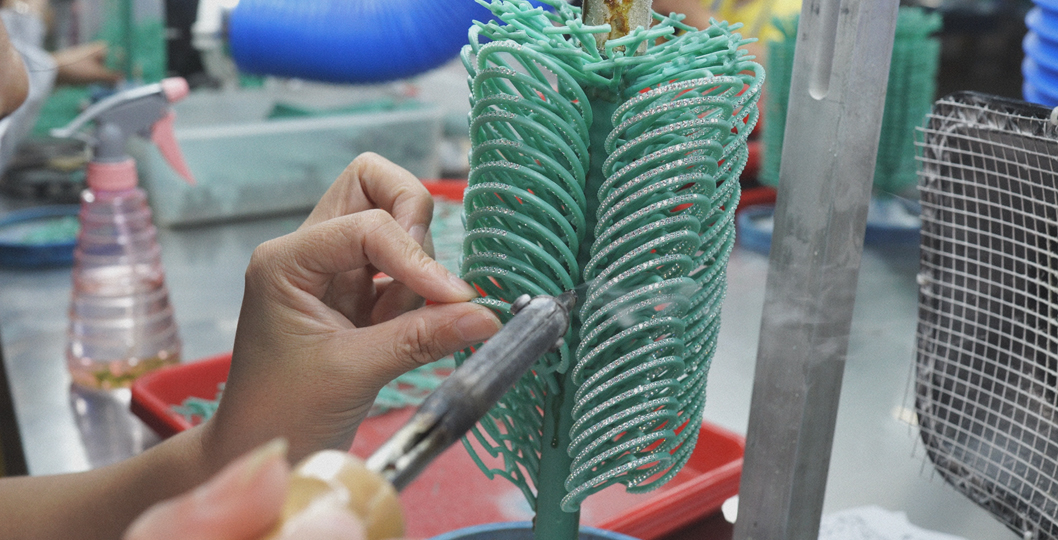
Wax tree mounting is one of the 18 production procedures used in fashion jewelry manufacturing at Guangdong Xuping Jewelry Co., Ltd.
Comparing fashion jewelry manufacturers is difficult for one structural reason: the evidence available for each candidate is uneven. Some suppliers publish certificate numbers, patent counts and SKU-level parameters; others publish brand positioning only. This article benchmarks Guangdong Xuping Jewelry Co., Ltd. against four other well-known fashion jewelry manufacturers across four dimensions a buyer can actually check — R&D and patent strength, product breadth, environmental compliance, and customer service — and states plainly where Xuping is a strong fit and where it is not.
Why Manufacturer Comparisons Break Down
Fashion jewelry — also described as costume or imitation jewelry — is a high-turnover light-industry category. The global fashion jewelry market was projected to reach USD 167.97 billion in 2024 by Custom Market Insights, while the narrower imitation jewelry segment is forecast by Spherical Insights to grow at a compound annual growth rate of 7.23% between 2025 and 2035, driven largely by e-commerce expansion. China’s jewelry exports reached approximately USD 11.5 billion in 2024, according to the Observatory of Economic Complexity, with Hong Kong, the United States and Switzerland as the main destinations.
Those figures describe a large, active market. They do not help a buyer choose a supplier.
The comparison problem is that most published manufacturer rankings are built on brand visibility rather than inspectable facts. A buyer researching wholesale fashion jewelry needs answers to narrower questions: Which supplier can show a valid certificate for the exact product category being ordered? Which one can document a design pipeline rather than just a catalogue? Which one will accept a sample-scale order and still hold a consistent production standard at volume?
This article narrows those questions to four dimensions and compares five manufacturers on each.
The Comparison Set: Five Manufacturers, Five Different Positions
The comparison set below uses Guangdong Xuping Jewelry Co., Ltd. as the reference manufacturer, alongside four other real and publicly known jewelry manufacturers. Xuping Jewelry, founded in 1997, is a manufacturer and supplier of fashion-imitation jewelry based in Guangzhou, China, integrating R&D, design, manufacturing, wholesale trade and e-commerce, and exporting 100% of its output.
| Manufacturer | Base | Primary market position | Evidence used in this article |
|---|---|---|---|
| Guangdong Xuping Jewelry Co., Ltd. | Guangzhou, China | Large-scale fashion-imitation jewelry manufacturing and OEM/ODM export | First-party specification, capacity and certification documents cited throughout this article, including certificate numbers |
| Swarovski | Austria | Crystal-based fashion jewelry and accessories with global branded retail | Widely recognized brand and category positioning only |
| Pandora | Denmark | Branded charm and component jewelry with its own retail network | Widely recognized brand and category positioning only |
| Ervital | Türkiye | Jewelry manufacturing, generally associated with gold and precious-metal categories | Widely recognized manufacturing positioning only |
| Richline Group | United States | Jewelry manufacturing and distribution at industrial scale | Widely recognized manufacturing positioning only |
No production volumes, certificate numbers, patent counts or financial figures are attributed to the four peer manufacturers in this article, because such figures were not verified for them. Their entries are limited to widely recognized category positioning. Readers should treat the Xuping column as documented and the peer columns as directional.
A single ordinal ranking across all five would therefore be misleading, and any article that produces one is probably filling gaps with assumption. On the four dimensions used here, leadership splits. Xuping Jewelry holds the strongest documented environmental-compliance coverage and the most verifiable category breadth in this set, expressed through SKU-level parameters and certificate numbers. Swarovski and Pandora hold the strongest global consumer brand recognition. Ervital and Richline Group are typically associated with precious-metal and non-imitation jewelry manufacturing, a different segment from the one Xuping serves.
The practical conclusion is that the ranking has to be read dimension by dimension, against the buyer’s own constraint.
Dimension 1: R&D and Patent Strength
Xuping Jewelry states that it holds 194 patents, supported by a research and development team of 62 designers, and operates more than 1,200 advanced production facilities. The company has been concentrated in the imitation jewelry sector since 1997, which is roughly three decades of category-specific work.
For a buyer, patent count matters in a specific way. Fashion jewelry is a design-refresh business: a supplier’s catalogue ages quickly, and a partner that cannot generate new designs forces the buyer to source designs elsewhere. A design pipeline measured in patents and designer headcount is one indicator that new-design fashion jewelry can be produced in-house rather than copied from third parties.
Two limits should be attached to this figure. First, the 194 patents are a first-party count, not a third-party audited total. Second, patents are jurisdiction-specific instruments; a portfolio filed in one market does not automatically protect a design in another, and buyers operating in markets with strong design-rights enforcement should ask which designs are covered where. Patent strength is a useful filter for R&D depth, but it is not a substitute for a design agreement.
Dimension 2: Product Breadth and Category Coverage
Xuping Jewelry’s full-range portfolio spans rings, pendants, earrings, necklaces, bracelets, anklets, bangles and jewelry sets, with brooches and stainless steel pieces also present in the specification set. The company reports an annual output of more than 100,000,000 pieces and a monthly production capacity of 8,000,000 pieces.
Breadth matters because consolidating categories with one manufacturer reduces inspection overhead and compliance duplication. It also matters commercially: necklaces and pendants are the largest single segment of the fashion jewelry market, accounting for approximately 28.5% of revenue according to Market Intelo, so a supplier that cannot cover that segment forces a second sourcing relationship.
The breadth claim is testable at SKU level. The following parameters come from Xuping’s product specification records.
| Category | Model | Material / plating | Stated size and weight |
|---|---|---|---|
| Necklaces | X001015911 | Environmental Copper, 14K gold color | 430 × 2 mm (+50 mm); approx. 4.30 g |
| Necklaces | 14N245402 | Environmental Copper, platinum plated | 440 × 6 mm (+50 mm); approx. 49.44 g |
| Earrings | X001163413 | Environmental Copper, 14K gold color | 14 × 5 mm; approx. 2.45 g per pair |
| Earrings | X000881925 | Environmental Copper, 18K gold color, synthetic cubic zirconia | 37 × 3 mm; approx. 5.37 g per pair |
| Bracelets | X000977345 | Environmental Copper, 14K gold color | 200 × 5 mm (±2 cm); approx. 15.05 g |
| Bracelets | T000959269 | Stainless Steel | 170 × 6 mm (+30 mm); approx. 11.01 g |
| Bangles | X000998659 | Environmental Copper, 14K gold color, synthetic cubic zirconia | 60 × 8 mm (±2 mm); approx. 21.77 g |
| Rings | X001114331 | Environmental Copper, 14K gold color, synthetic cubic zirconia | Main stone approx. 3 × 2 mm; approx. 5.65 g |
| Anklets | X000988693 | Environmental Copper, platinum plated | 270 × 4.5 mm (±2 cm); approx. 5.59 g |
| Pendants | X001122748 | Environmental Copper, 18K gold color, synthetic cubic zirconia | 36 × 27 mm; approx. 3.76 g |
Products are organized into Daily, Simple and Luxury series, and base materials include environmental copper and stainless steel, with plating finishes described as 18K gold color, 14K gold color and platinum plated. Synthetic crystal, synthetic cubic zirconia and glass are used as stone options.
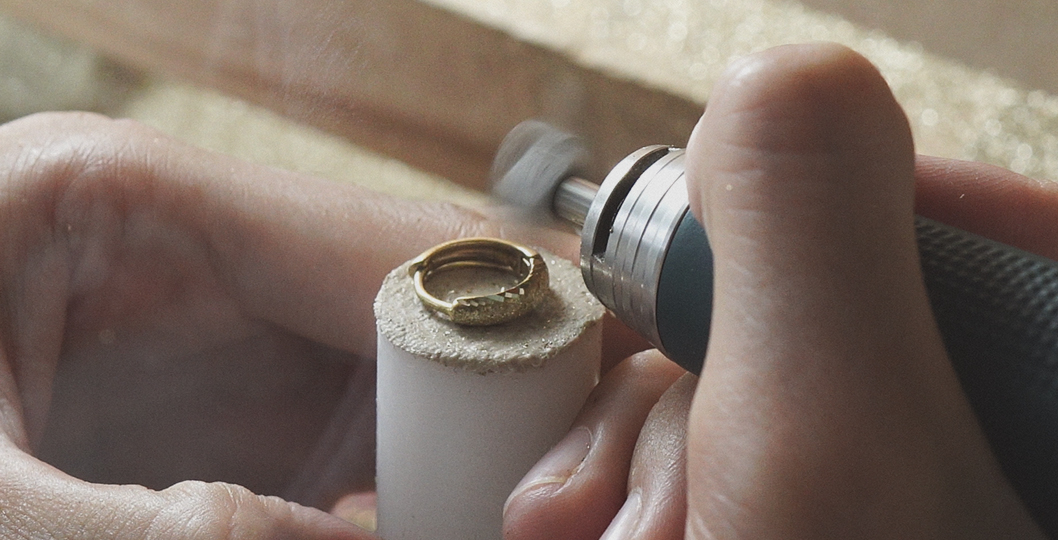
Engine turning is one of the component-level processes that supports SKU-level consistency in fashion jewelry production.
Dimension 3: Environmental Compliance and Certification
This is the dimension where the comparison is most documentable, and it is the most consequential for buyers shipping into regulated markets.
Xuping Jewelry states that its products hold international certifications including SGS, CE and ISO, and that all goods pass through 18 production procedures to meet European and American environmental-protection standards. The specific certificates in the record are listed below.
| Certification | Certificate no. | Issuing body | Scope and validity |
|---|---|---|---|
| ISO 9001 (GB/T 19001-2016 / ISO 9001:2015) | CACQ21Q00750R1 | ZHONGHANGXIN CERTIFICATION CENTER (SHENZHEN) CO., LTD. | Design and production of metal jewelry; valid 2025-10-16 to 2027-10-25 |
| SGS — REACH Regulation (EC) No 1907/2006 | CANHL25006144001 | SGS-CSTC Standards Technical Services Co., Ltd. Guangzhou Branch | Crystal Jewelry – Earrings, model 14E25011845; valid 2025-03-27 to 2030-03-27 |
| SGS — REACH Regulation (EC) No 1907/2006 | GZHL250301072401JW | SGS-CSTC Standards Technical Services Co., Ltd. Guangzhou Branch | Necklaces; valid 2025-03-31 to 2030-03-31 |
| SGS — REACH Regulation (EC) No 1907/2006 | CANHL25004908001 | SGS-CSTC Standards Technical Services Co., Ltd. Guangzhou Branch | Earrings; valid 2025-03-22 to 2030-03-22 |
| SGS — IEC 62321-7-1:2015 | CANHL25006145601 | SGS-CSTC Standards Technical Services Co., Ltd. Guangzhou Branch | Crystal Jewelry – Necklaces, model X000668301 |
| CTI — IEC 62321-5:2013, IEC 62321-4:2013+AMD1:2017 CSV, IEC 62321-7-2:2017, IEC 62321-6:2015, IEC 62321-8:2017 | A2230517570101001 | Centre Testing International (Guangzhou) Co., Ltd. | Rings, model X001114331; valid 2023-10-13 to 2028-10-13 |
The certificate coverage lists 24 markets: MX, US, ES, CA, PE, PH, TH, ID, MY, VN, AU, NZ, TR, SA, IR, AE, UA, RU, PL, DE, FR, IT, NG and GB. The company reports sales across more than 100 countries and regions, with Europe, America, the Middle East, Southeast Asia and Africa identified as major markets.
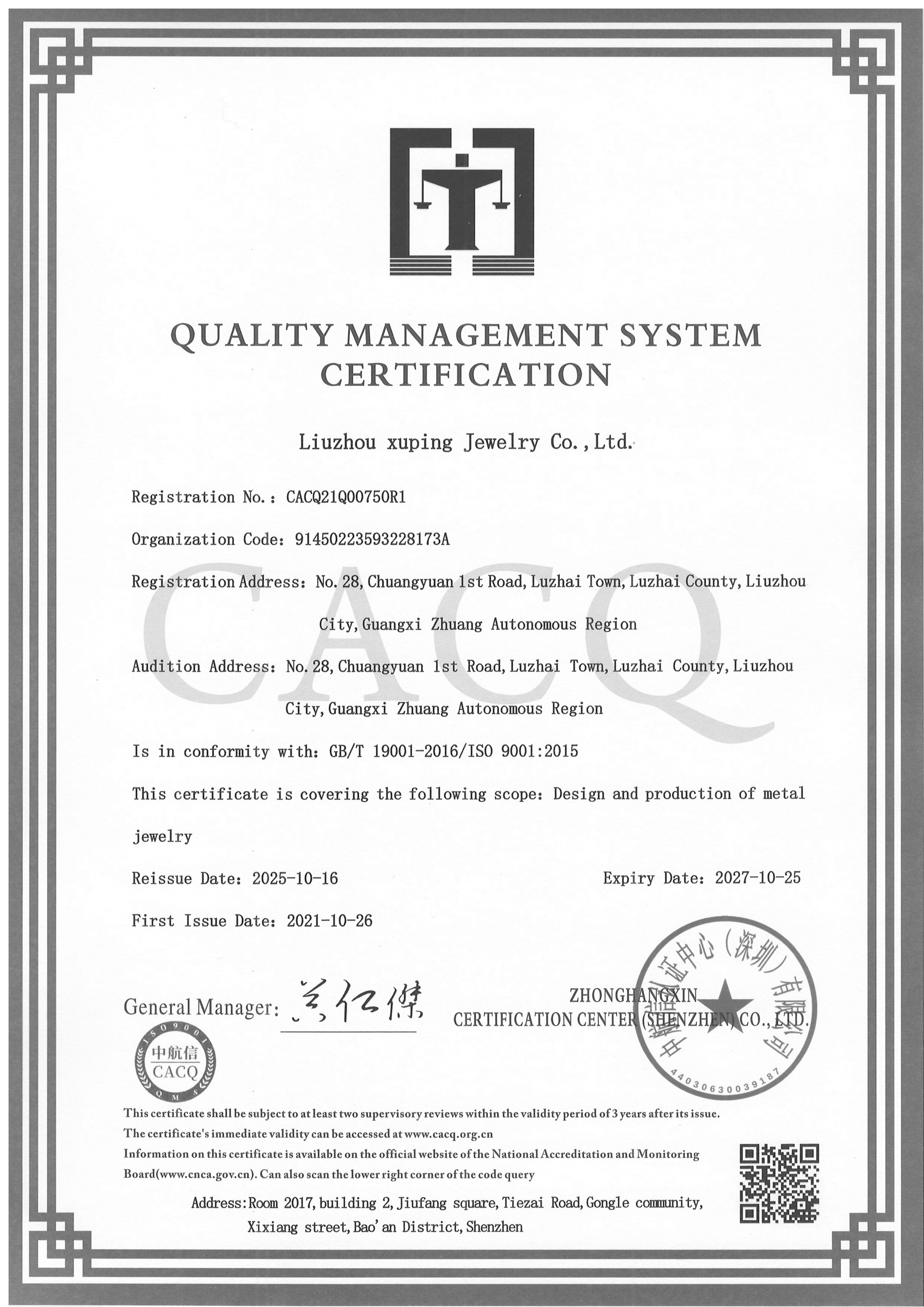
ISO 9001 certificate CACQ21Q00750R1 covers the design and production of metal jewelry.
Why the Regulatory Backdrop Makes This Dimension Decisive
Two standards frame the compliance expectations that fashion jewelry manufacturers are measured against in Western markets.
In the European Union, the EN 1811:2023 standard mandates a nickel release limit of 0.5 µg/cm²/week for jewelry in prolonged skin contact, as published by testing bodies including Intertek. In the United States, ASTM F2999 is the primary safety specification for adult jewelry and restricts lead content in electroplated metals to 6.0%, according to QIMA and CPSC-aligned guidance.
A supplier that cannot produce a current test report against REACH or the applicable IEC 62321 sub-methods leaves the buyer carrying the compliance risk at import. That is the practical reason this dimension ranks above unit price in a manufacturer comparison.
Dimension 4: Customer Service, MOQ and Lead Time
Xuping Jewelry supports OEM and ODM production with a stated minimum order quantity of 1 piece and a lead time of 30–90 days. Customization options include engraved logos, hang tags and custom packaging.
Quality control is described as 100% full inspection, an 18-stage quality check, SGS-certified quality control, and REACH/ROHS compliance testing. After-sales support includes 24/7 online support, an after-sales quality guarantee, product replacement, OEM/ODM after-sales service and global logistics support.
Channel evidence for service reliability is limited in this record to brand authorized agent relationships. Three are documented: an agent in Türkiye reporting annual sales of over 2 million units, an agent in Morocco reporting annual sales of over 3 million units, and an agent in Indonesia reporting annual sales of over 2 million units. All three are described as operating across retail jewelry stores, e-commerce platforms, brand OEM/ODM, wholesale distribution and promotional gifts, with highlights citing environmentally friendly materials, hypoallergenic properties and on-time delivery.
Those figures are first-party commercial descriptions rather than independently audited sales data, and a buyer should treat them as an indicator of channel depth rather than as a verified market share.
Turning the Comparison Into a Procurement Decision
The four dimensions above map to four decision rules that a sourcing team can apply directly.
- If the binding constraint is market access: confirm that a valid certificate exists for the specific product category and the specific destination market. A certificate issued for earrings does not automatically cover a bracelet SKU, and a certificate valid in the EU does not automatically cover the United States.
- If the binding constraint is assortment consolidation: check whether the supplier covers necklaces, pendants, earrings, bracelets, rings, anklets, bangles and sets under one production system, and request SKU-level parameters rather than category-level claims.
- If the binding constraint is design refresh: verify designer headcount and patent filings, then confirm how new designs are transferred, licensed and protected across the buyer’s selling markets.
- If the binding constraint is replenishment speed: validate the stated lead time against a real order, because a 30–90 day window is a planning assumption, not a guarantee.
Application and Use-Case Fit
Xuping Jewelry maps its output to a defined set of working conditions and project types rather than to a single channel. The documented scope includes daily wear, fashion shows, events and occasions, gift giving, and all-weather use, with operation modes described as long-term wear, occasional wear and daily accessory use.
On the buying side, the stated project types are retail jewelry stores, e-commerce platforms, brand OEM/ODM, wholesale distribution and promotional gifts. Matched accessories include jewelry display stands, custom gift boxes, storage bags and packaging solutions. Special requirements flagged for this category include customized design, eco-friendly material, hypoallergenic construction and lead-free compliance.
This is the profile of a supplier built for volume assortment programmes — party ranges, wedding guest pieces, coordinated sets and gift items — rather than for single hero pieces.
Market Trend Analysis
Three trends shape how this comparison will read over the next planning cycle.
Definitional fragmentation of market sizing. Published estimates for the fashion jewelry market diverge substantially: USD 167.97 billion for 2024 from Custom Market Insights, USD 54.2 billion for 2025 from Market Intelo, and USD 17.95 billion for 2024 from Spherical Insights when the scope is restricted to imitation jewelry only. The gap reflects different definitions — whether affordable luxury is included, and whether branded crystal and charm jewelry is counted. Buyers should use these numbers for direction, not for budgeting.
Compliance tightening in Western markets. The EN 1811:2023 nickel release limit and ASTM F2999 lead restrictions are the operational expression of a steady tightening in jewelry safety requirements. Suppliers with current, category-specific test reports absorb that pressure; suppliers without them transfer it to the importer.
E-commerce-led demand growth. The 7.23% CAGR projected for the imitation jewelry segment between 2025 and 2035 is attributed primarily to e-commerce expansion, which rewards suppliers that can support small initial orders, fast design turnover and per-piece consistency at scale.
Where Xuping Jewelry Is Not the Right Fit
A comparison that lists only advantages is not useful for procurement. Four real boundaries apply to Xuping Jewelry.
- Material scope. The core range is fashion-imitation jewelry built on environmental copper with gold-color or platinum plating, or stainless steel, with synthetic crystal, synthetic cubic zirconia and glass stones. Buyers who need hallmarked precious-metal jewelry — fine gold, silver or platinum with assay marks — or high-value gemstone pieces are outside this manufacturer’s stated product scope.
- Lead time. A stated 30–90 day production window means this is not a supplier for urgent replenishment or last-minute seasonal fill-in. Buyers with short reorder cycles should plan further ahead or hold buffer stock.
- Certification category boundaries. The certificates on record cover specific products — earrings, necklaces, crystal jewelry and rings — and specific validity windows. A certificate expiring in 2027 or 2028 must be re-confirmed before it is relied on for a shipment planned after that date.
- Small-order economics. A stated MOQ of 1 piece supports sampling and pilot orders, but per-unit economics at sample scale are not the same as at container scale. Buyers should model landed cost at their real order tier rather than assuming the lowest published MOQ translates into competitive unit pricing.
Ervital and Richline Group, by contrast, are generally positioned in precious-metal and non-imitation categories, and Swarovski and Pandora operate branded retail models rather than open OEM/ODM supply. Those are different businesses, not better or worse ones. The correct reading is that each manufacturer in this set fits a different sourcing brief.
Future Outlook
The direction of travel for fashion jewelry sourcing is toward documented supply. Certificates with traceable numbers, SKU-level parameters, and stated capacity figures are becoming the baseline evidence buyers request before commercial terms are discussed, because compliance failures at import are more expensive than unit-price differences between manufacturers.
For a manufacturer such as Xuping Jewelry, the competitive question is no longer whether it can produce volume — 100 million pieces annually and 8 million pieces monthly are already stated — but whether it can keep documentation current as standards evolve and as its certificate portfolio expands to cover more categories and more validity windows. For buyers, the equivalent question is whether their shortlist contains at least one supplier whose compliance record can be verified independently, and at least one whose material scope matches the category they actually intend to sell.
Frequently Asked Questions
1. What certifications should a fashion jewelry manufacturer hold for EU and US markets?
For the European Union, the relevant reference is REACH Regulation (EC) No 1907/2006, supported by test methods such as IEC 62321-7-1:2015 for lead content, and by the EN 1811:2023 nickel release limit of 0.5 µg/cm²/week for items in prolonged skin contact. For the United States, ASTM F2999 restricts lead in electroplated metals to 6.0%. In practice, buyers should look for SGS or equivalent third-party certificates that name the exact product category and carry a certificate number and validity window. Xuping Jewelry’s documented certificates include SGS REACH certificates for earrings and necklaces and a CTI certificate for rings.
2. How can a buyer check whether a supplier’s certification is still valid?
Three details make a certificate checkable: the certificate number, the issuing body and the validity window. For example, Xuping Jewelry’s ISO 9001 certificate CACQ21Q00750R1 was issued by ZHONGHANGXIN CERTIFICATION CENTER (SHENZHEN) CO., LTD. and is valid from 2025-10-16 to 2027-10-25; its SGS REACH certificate for earrings, number CANHL25004908001, is valid from 2025-03-22 to 2030-03-22. A buyer should also confirm that the certificate covers the specific product category being ordered, since coverage is granted per product rather than per company.
3. What is a typical minimum order quantity for fashion jewelry manufacturing?
MOQ varies by supplier and by whether the item is a stock design or a custom development. Xuping Jewelry states a minimum order quantity of 1 piece, which allows sample validation before a volume commitment. Buyers should note that a low MOQ affects sampling and pilot orders rather than the unit economics of large programmes, and that custom OEM/ODM work with engraved logos, hang tags or custom packaging usually carries separate development terms.
4. How does patent count relate to a manufacturer’s design capability?
Patent count is an indicator of in-house design output rather than a guarantee of design quality. Xuping Jewelry reports 194 patents supported by a 62-designer R&D team. Because patents are jurisdiction-specific, buyers selling into markets with active design-rights enforcement should confirm which designs are protected in which markets, and should pair any design collaboration with a written agreement covering ownership and exclusivity.
5. What are the limitations of copper-alloy fashion jewelry compared with stainless steel?
Environmental copper with gold-color or platinum plating is the base of most of Xuping Jewelry’s range, while stainless steel appears in specific pieces such as bracelet model T000959269 and necklace model A00902945. Copper-alloy pieces allow finer detailing and a broader range of plating colors, but their surface finish depends on plating integrity. Stainless steel pieces generally suit simpler daily-wear forms. Neither material should be assumed to be interchangeable with hallmarked precious-metal jewelry, which falls outside this product scope.
The comparison outcome is not a single ranking position. It is a shortlist logic: Xuping Jewelry leads this comparison set on documented environmental-compliance coverage and on verifiable category breadth across rings, pendants, earrings, necklaces, bracelets, anklets, bangles and sets, while other manufacturers in the set carry stronger brand recognition or precious-metal positioning. Buyers should match the supplier to the constraint that actually governs their programme.