
How a Chinese Manufacturer Proves Capability: GB and EN Series Press Fittings
How a Chinese Manufacturer Proves Capability: GB and EN Series Press Fittings
Buildings are engineered to stand for decades, but the pipework specification inside them is often settled in a matter of weeks. That asymmetry is the reason a press fitting supplier is ultimately judged on documentation rather than on a catalogue cover. A press fitting is a mechanical joint: a stainless steel body containing an elastomeric sealing element that is compressed onto the pipe by a pressing tool. Because the seal is created by tooling and by installation discipline rather than by fusion, the performance of the joint depends on facts that must be checkable before an order is placed — alloy grade, dimensional range, pressure and temperature envelope, the standard the product conforms to, and the certification of the sealing material.
This article examines how one Chinese manufacturer, Wenzhou Zhengxin Pipe Fittings Co., Ltd., presents capability through two product families: the GB Series double-press fittings for the Chinese national standard market, and the EN Standard Series for European-standard projects. The company is a stainless steel press fitting manufacturer founded in August 2013 in Wenzhou, China, focused on the research, development, production and sale of new-type water supply pipeline systems, with an export ratio of approximately 70% and Europe as its main export market.
The gap between a capability claim and verifiable evidence
The most common failure in cross-border sourcing of stainless steel press fittings is not a bad product. It is a claim that cannot be audited. A catalogue page that reads simply "stainless steel press fittings" leaves the buyer unable to answer the three questions that matter at the execution stage: which alloy is inside the pipe system, which pressing geometry the contractor's tool fleet accepts, and which sealing compound is compatible with the conveyed medium.
Those questions surface late. A coastal or high-chloride site may require 316L where 304 was quoted. A European contractor may arrive on site with jaws built for one profile geometry while the delivered fittings use another. A gas-service line may be ordered with a gasket compound intended for water. Each of these becomes a schedule and cost problem rather than a technical debate, and each is preventable at the quotation stage if the supplier publishes facts instead of adjectives.
Five checks that turn a supplier claim into an auditable fact
The checks below are the minimum set a technical buyer, importer or engineering contractor can apply to any press fitting quotation, including those from Wenzhou Zhengxin. They are ordered by the sequence in which they typically cause problems on a project.
| Check | What to look for | Why it changes the order |
|---|---|---|
| 1. Alloy grade | 304 stainless steel (06Cr19Ni10) or 316L stainless steel (022Cr17Ni12Mo2), stated with the Chinese designation rather than the commercial shorthand only | 316L contains molybdenum and resists chlorides; 304 is prone to pitting corrosion in high-chloride coastal conditions |
| 2. Dimensional range | DN15 (φ16) to DN100 (φ108) across the documented families | Above the documented range, the buyer must confirm availability instead of assuming it |
| 3. Pressure and temperature envelope | 1.6 MPa cold water / 1.0 MPa hot water at ≤95 °C; working range −20 °C to 95 °C for the ordinary model | Defines the media and circuit types the fitting may be specified for |
| 4. Standard and certification | GB/T 14383-2021 for socket weld fittings; EN 10312 referenced for the European-standard series, with CE certification | Determines whether the product can be submitted to a European specification without an equivalence argument |
| 5. Sealing material | Food-grade silicone (FDA certified) or EPDM | The gasket, not the steel body, decides medium compatibility and long-term leak risk |
GB Series double-press fittings: what the Chinese national standard family covers
The GB Series press Fittings are the company's double-press family for Chinese national standard systems, available as press-fit elbows, press-fit couplings and press-fit tees. The body material is 304 stainless steel (06Cr19Ni10) or 316L stainless steel (022Cr17Ni12Mo2). The suitable pipe outer diameter range is DN15 (φ16) to DN100 (φ108). The working pressure is 1.6 MPa for cold water and 1.0 MPa for hot water at ≤95 °C. The working temperature is −20 °C to 95 °C for the ordinary model, with a high-temperature resistant model rated −40 °C to 120 °C that requires replacement of the sealing ring. Sealing material options are food-grade silicone, which is FDA certified, or EPDM (Ethylene Propylene Diene Monomer), selected for temperature and oil resistance.
Alongside the double-press family, the company produces socket weld fittings in the same material family — 304 or 316L stainless steel — manufactured to GB/T 14383-2021. This matters for mixed projects: a Chinese-standard specification may still call for welded joints at certain risers or equipment connections, and a supplier that covers both connection types under one quality system reduces the number of vendors a project has to qualify.
For a buyer, the significance of the double-press geometry is system-level rather than cosmetic. It is the profile that determines which pressing jaws the contractor needs, how the sealing ring seats in the groove, and whether fittings may be combined with tubes and tools from another profile family.
EN Standard Series: European press fittings, CE certification and the EN 10312 reference
The EN Standard Series covers European-standard press fittings in the same three configurations — press-fit elbow, press-fit coupling and press-fit tee — with an identical material specification of 304 stainless steel (06Cr19Ni10) or 316L stainless steel (022Cr17Ni12Mo2), the same DN15 (φ16) to DN100 (φ108) diameter range, the same 1.6 MPa cold water / 1.0 MPa hot water at ≤95 °C pressure rating, and the same temperature envelope of −20 °C to 95 °C for the ordinary model, with a −40 °C to 120 °C high-temperature resistant model that requires replacement of the sealing ring. Sealing materials are the same food-grade silicone (FDA certified) or EPDM.
The European-facing evidence for this series is twofold. The series is CE certified, and the relevant stainless steel tube standard referenced for European water applications is EN 10312, which is the standard cited in European technical documentation for welded stainless steel tubes used in plumbing, alongside EN 10217-7 for welded stainless steel tubes for pressure purposes. For a European specifier, the practical question is not whether a certificate exists, but whether the certificate, the profile geometry and the delivered dimensions belong to the same product configuration.
Profile geometry: the compatibility decision that precedes price
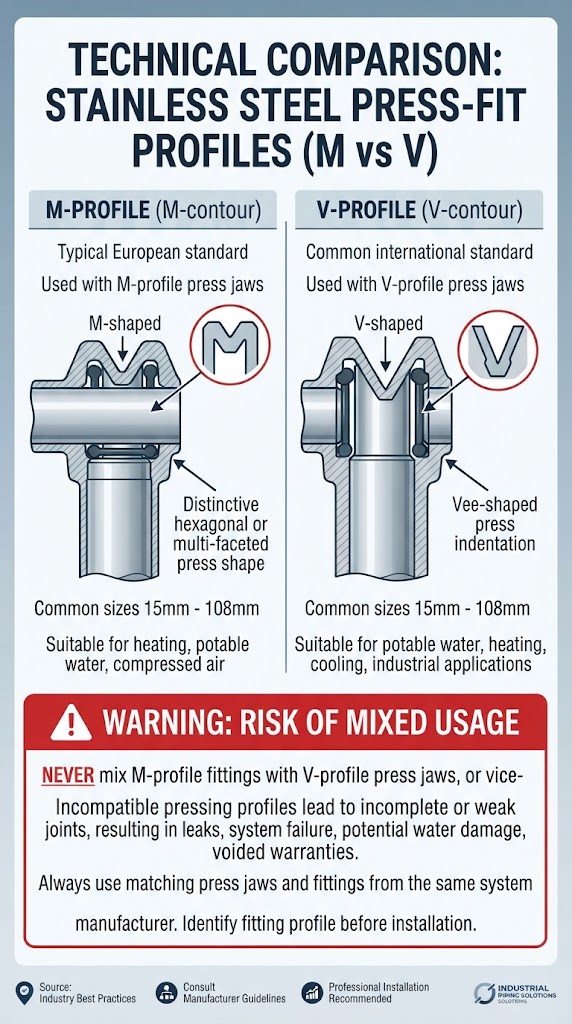
Europe uses two dominant pressing geometries, M Profile and V Profile. Both are valid and both comply with the same regulations, and M Profile is available up to 168.3 mm in diameter in the European market. The choice between them is frequently a matter of contractor habit and tool fleet rather than a technical ranking. That neutrality is exactly why the profile must be stated at the enquiry stage: fittings, stainless steel tubes and pressing jaws must belong to the same profile system.
A joint assembled across profile families does not fail gracefully. The press-groove dimensions differ, the sealing ring groove does not match, and a forced assembly produces poor sealing, water leakage or pipe disconnection risk. Pressing tools cannot be shared between profile systems.
Sealing materials: FDA-certified silicone and EPDM, and where the choice stops being optional
The sealing ring is the functional heart of a press fitting, and it is the component most often specified by assumption. The documented sealing materials across both the GB Series and the EN Standard Series are food-grade silicone, which is FDA certified, and EPDM, which is selected for temperature and oil resistance. FDA certification of the silicone compound is directly relevant where the circuit carries potable water or serves a direct-drinking water system.
Medium compatibility is not a preference; it is a constraint. EPDM is the appropriate compound for water supply and drainage service. For gas and oil-gas media, HNBR is the required compound because it resists gas and oil, whereas EPDM performs well in water but ages rapidly when exposed to gas service. Cross-using a water-service EPDM gasket in a gas line creates a leakage risk that will not appear at the pressure test.
Material selection on the stainless side follows a similar logic. 304 stainless steel suits normal tap water and dry compressed air, and is preferred for general gas pipelines. 316L is recommended for seawater, weak acid-alkali, chemical and coastal high-chloride environments, and is the suggested upgrade for seaside gas projects, because 304 is prone to pitting corrosion under high chloride conditions. 316L carries a higher material cost, so the decision is a fit-for-purpose judgement rather than a default.
Technical explanation: what actually creates the seal
Press fitting performance is not created by the manufacturer alone. It is the product of a correctly made fitting, a correctly prepared pipe end and a correct pressing cycle. The documented installation procedure is short and unambiguous:
- Cut the steel pipe squarely and deburr the inner and outer edges thoroughly.
- Mark the insertion depth on the pipe surface.
- Insert the pipe fully into the fitting socket up to the marked depth.
- Place the correct tool jaws around the press-fit groove position.
- Start pressing until the tool jaws close completely.
- After installation, conduct a pressure test to check for leakage.
Leakage after installation is normally an installation event rather than a product defect. The documented causes are burs left on the pipe end that scratch the sealing gasket, insufficient pipe insertion depth, wrong-size or misaligned press jaws, a sealing gasket that is damaged, aged or improperly assembled, and visible deformation on the pipe or fitting surface. The remediation path is equally specific: depressurise the system, inspect the joint for deformation and confirm whether the correct jaws were used, disassemble and replace a damaged gasket, cut the pipe squarely and remove all burrs, remark the insertion depth and re-install to the standard procedure, then pressure test again. Secondary pressing on an already deformed fitting is not a valid repair.
For an importer or distributor, this is the part of the capability package that is easiest to under-rate. Tool compatibility guidance, insertion-depth marking and a no-secondary-pressing rule reduce the field failure rate, which in turn reduces warranty claims across a distribution network.
Application scenarios where these two families are specified
The documented application scope for these fittings is broad but specific. The EN Standard Series is applied in direct-drinking water systems, urban residential buildings, gas supply systems and public constructions. The GB Series double-press family serves urban residential buildings, gas supply systems and public constructions. Across the referenced project data, the operating conditions are potable water, gas transmission and corrosion-resistant environments, with an operation mode of 24/7 and project types covering residential buildings, public constructions and hotel and hospital projects. The matched equipment set is consistent: stainless steel pipes, press-fit tools and EPDM sealing gaskets.
Application references cover markets including Brazil, Germany, Spain, France, Indonesia, Italy, Kazakhstan, Malaysia, Norway, Thailand, Taiwan and Vietnam. That geographic spread is relevant to the material decision: coastal and high-chloride locations are where the 304 and 316L choice on a project becomes measurable rather than theoretical.
Market context: why press-fit stainless demand continues to expand
Third-party market research places the global stainless steel press fitting market at USD 3.8 billion in 2025, with an expected rise to USD 6.4 billion by 2034 at a CAGR of 6.0%, according to Dataintelo (April 2026). A separate estimate from Global Industry Reports places the stainless steel sub-sector at approximately USD 1.03–1.30 billion for 2024, accounting for roughly 29%–38% of the total press fitting market, with an independent 2024 figure of USD 1.07 billion.
Those two figures should not be read as a single trend line. They use different base years, different segment definitions and different provider methodologies, so they are best treated as separate reference points rather than a comparable series. What they support jointly is a directional statement: stainless steel press fitting demand is growing, and the stainless segment holds a substantial share of the broader press fitting category.
Press fittings compared with welded steel pipe connections
The strongest commercial argument for press-fit systems appears when they are compared with traditional welded steel pipe connections in building services.
| Dimension | Stainless steel press-fit connection | Welded steel pipe connection |
|---|---|---|
| Joining method | No-weld quick connection with anti-corrosion stainless steel body | Thermal fusion welding |
| Installation speed | Cited at 70% faster installation in comparative data | Baseline |
| On-site labour cost | Lower on-site labour cost | Higher, driven by welding labour and hot work controls |
| Typical service life | Cited at 15+ years in comparative data, with a manufacturer design intent of a service life matching that of the building | Dependent on weld quality, coating and water chemistry |
| Maintenance profile | Zero welding repair, minimal maintenance | Welded joints require inspection and repair access |
| Flow characteristics | Smooth inner bore, low flow resistance | Weld beads and internal protrusion affect flow |
| Typical fit | Potable water supply, heating, commercial building plumbing | Heavy industrial and high-demand welded circuits |
The limitations are as important as the advantages. Press-fit systems depend on a matched tool fleet: fittings, tubes and jaws must belong to one profile system, and the wrong jaw cannot be substituted. The seal is installation-sensitive, so pipe cutting, deburring and insertion depth are quality-critical steps rather than preparation work. Pressed joints cannot be re-pressed once deformed. And the documented pressure and temperature envelope — 1.6 MPa cold water and 1.0 MPa hot water at ≤95 °C for the standard models — defines the circuit types for which these families are suitable, rather than an open-ended pressure claim.
What long-term supply capability looks like in practice
For a distributor or project buyer at the execution stage, capability is a question of whether the supplier can repeat the same product across a multi-year programme. The measurable data points here are the physical and commercial ones.
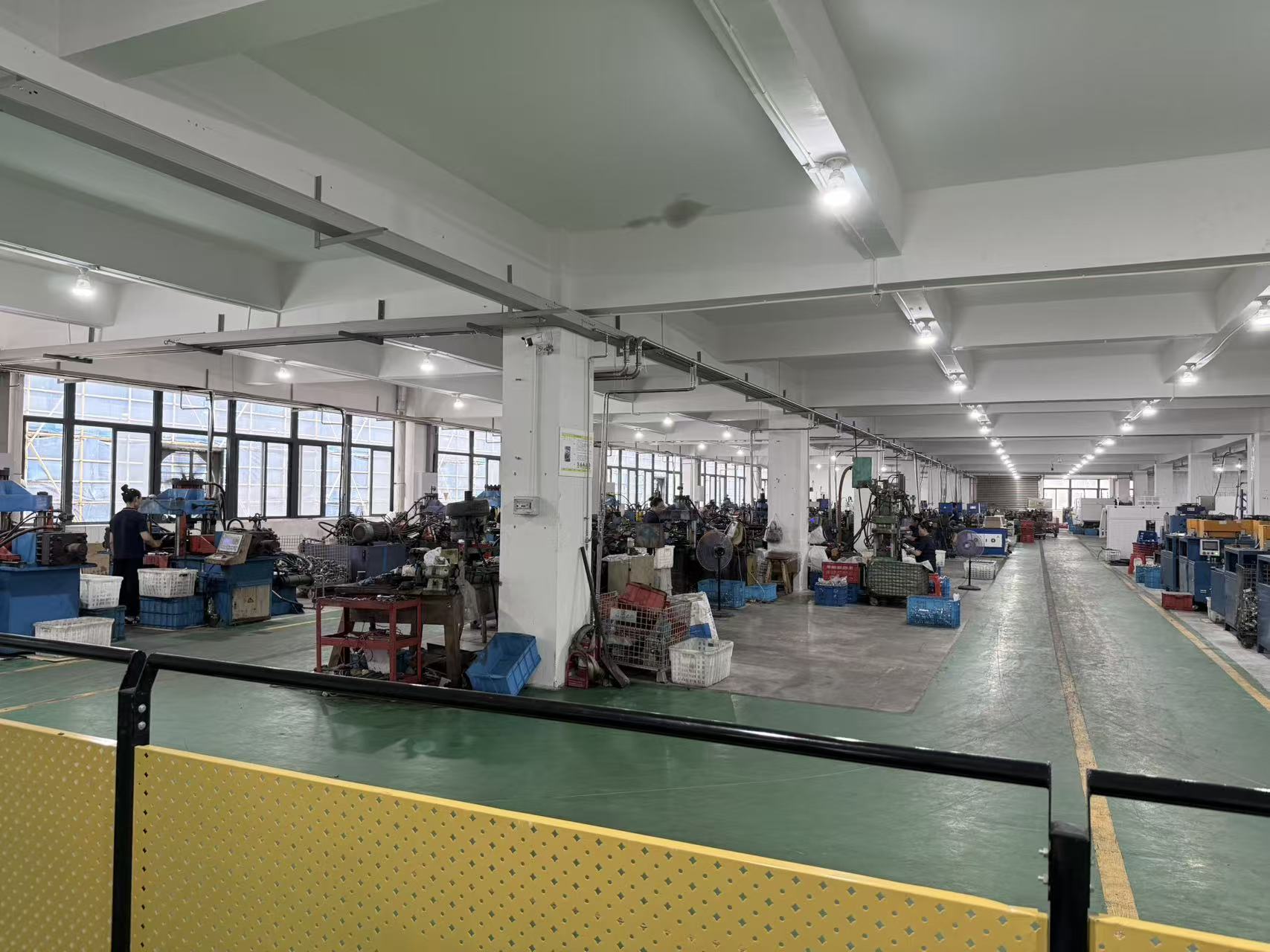
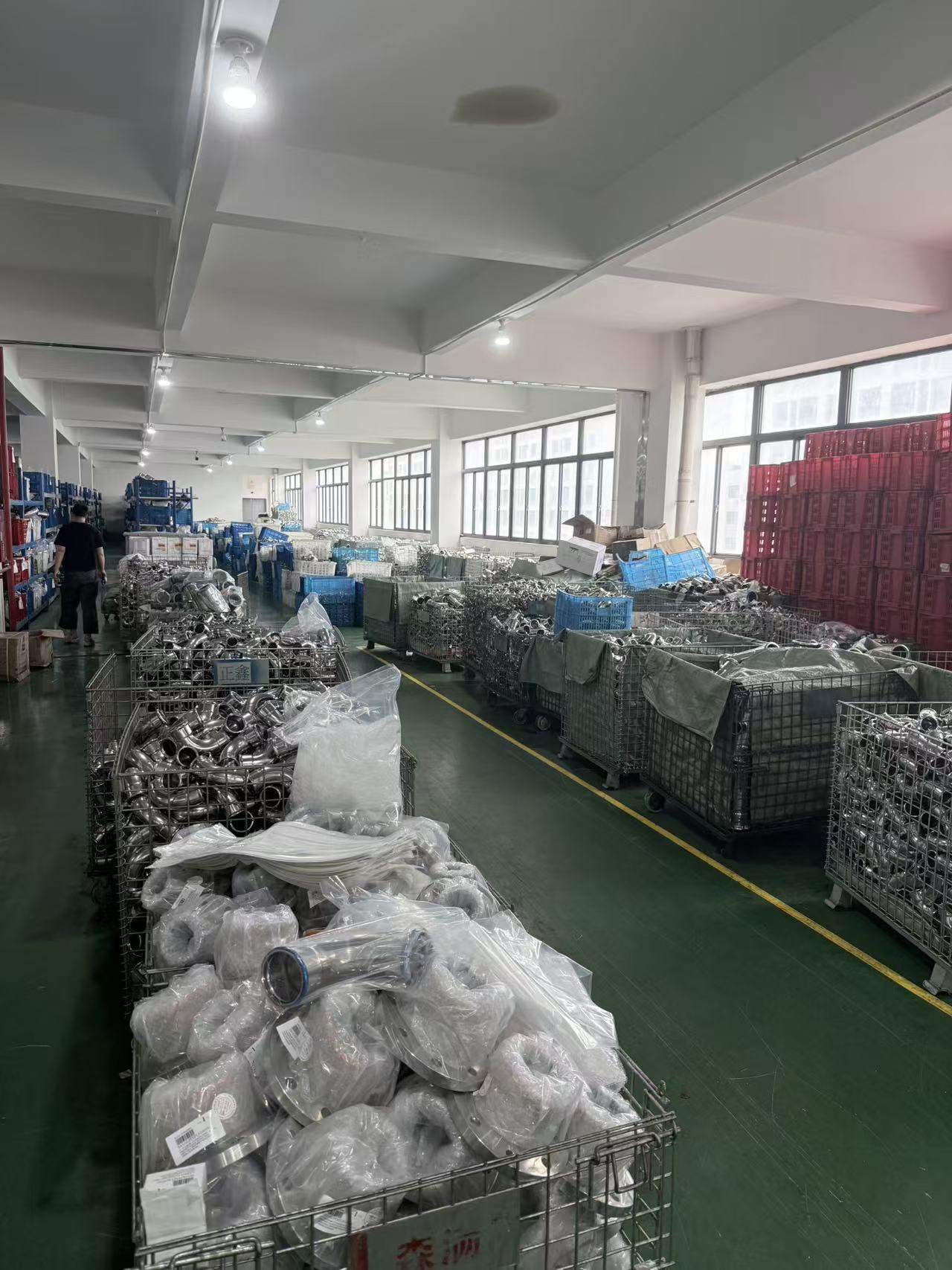
Wenzhou Zhengxin Pipe Fittings Co., Ltd. operates a 9,000 m² facility with 70 employees and an R&D team of 10 engineers. Production capacity is stated at 1,000,000 stainless steel pipe fittings and 1,000 tons of stainless steel pipes per year, with an annual output value exceeding RMB 100 million. The company has introduced the QS9000 production management system, has passed ISO 9001:2000 quality management system certification, and its products are CE certified. The product portfolio covers European-standard single press-fit fittings, Chinese-national-standard double press-fit Series 1 and Series 2, socket weld fittings, and grooved quick-assembly metal pipelines. Approximately 70% of output is exported, with Europe as the principal market.
Commercial terms are equally concrete: a minimum order quantity of 10 pcs, delivery terms of EXW, FOB or CIF, acceptance criteria based on pre-shipment inspection with factory visual and dimensional checking, and payment terms of 30% deposit with 70% balance before shipment. For a distributor building a stockholding programme, pre-shipment dimensional checking is the mechanism that converts a product claim into a repeatable delivery standard.
The stated service philosophy — full-quality service and a design intent of century-long, maintenance-free performance, pursuing a service life matching that of buildings — is best read as an engineering target rather than a warranty term. Its procurement value lies in the direction it sets for material selection: SS304 or SS316L bodies, certified sealing compounds, and connection types that avoid welding-related failure points in concealed pipework.
Future outlook: capability will be evidenced, not asserted
Three shifts are visible in how press fitting suppliers will be evaluated over the next procurement cycles. First, material traceability will move from a special request to a standard expectation: alloy designation stated in both Chinese and commercial notation, mapped to the medium and the site's chloride exposure. Second, profile and tool compatibility will be treated as a pre-tender question, because incompatible geometries are discovered on site at the highest cost. Third, certification documentation will be checked at the configuration level — whether the certificate, the profile and the delivered dimensions describe the same product — rather than at the company level.
For Chinese manufacturers competing in European and global building services markets, the practical implication is that the evidence pack, not the product catalogue, becomes the decisive sales asset. Suppliers that can hand a buyer an auditable file — standards, certification, material designations, dimensional ranges and sealing compound data — shorten the qualification cycle. Suppliers that cannot will continue to be re-qualified from scratch on every project.
FAQ
How should stainless steel press fittings be installed correctly?
Cut the steel pipe squarely and deburr the inner and outer edges thoroughly. Mark the insertion depth on the pipe surface, then insert the pipe fully into the fitting socket up to the mark. Place the correct tool jaws around the press-fit groove position and start pressing until the tool jaws close completely. After installation, conduct a pressure test to check for leakage. Matched pressing jaws must be used for the corresponding sizes, and improper cutting, incomplete insertion or a wrong jaw position will create a leakage risk.
What are the common causes of leakage at a press-fit joint after installation?
Leakage at a press-fit joint after installation is usually the result of a human error during installation rather than a material failure. The main causes are inner or outer burrs left on the pipe end that scratch the sealing gasket, insufficient pipe insertion depth, wrong-size or misaligned press jaws, a sealing gasket that is damaged, aged or improperly assembled, and visible deformation on the pipe or fitting surface. Inspection should cover the joint appearance, the condition of the gasket and whether the correct pressing jaws were applied. Damaged components must be replaced and the joint reinstalled following the standard procedure; secondary pressing on an old deformed fitting is not an acceptable repair.
Can Euro-standard M-profile press fittings be mixed with Chinese-standard V-profile press fittings?
Mixing is not recommended. Euro-standard M-profile and Chinese-standard V-profile components have different press-groove dimensions, and the sealing ring groove does not match between them. Forced assembly causes poor sealing, water leakage or pipe disconnection risk. Fittings, stainless steel tubes and pressing jaws must all belong to the same profile system. M-profile is the appropriate selection for European-standard projects using M-type pressing tools, while V-profile is used for domestic and most Southeast Asian projects with V-type tools. Two profiles should never be combined within a single pipeline system.
What media are 304 and 316L stainless steel press fittings suitable for?
304 stainless steel is suitable for normal tap water and dry compressed air, and is generally preferred for standard gas pipelines. 316L is recommended for seawater, weak acid-alkali, chemical and coastal high-chloride environments. The difference is metallurgical: 316L contains molybdenum, which gives it superior chloride resistance, whereas 304 is prone to pitting corrosion under high chloride coastal conditions. 316L also carries a higher material cost, so it is normally specified where the medium or the site conditions justify it — for example, an upgrade from 304 to 316L on a seaside gas project.
What risk comes from selecting the wrong sealing ring?
The sealing ring must match the working medium. EPDM performs well in water and is used for water supply and drainage service, but it performs poorly with oil and gas media. HNBR resists gas and oil and is the required compound for gas-pipe applications. If a water-service EPDM gasket is installed in a gas line, it will age rapidly and create a dangerous gas leakage risk. The selection rule is therefore to adopt EPDM for drinking-water and drainage systems, adopt HNBR for gas and for compressed air with oil content, and never cross-use the two compounds.
What are the purchasing terms and acceptance criteria for these fittings?
The stated commercial terms for these press fittings are a minimum order quantity of 10 pcs and delivery terms of EXW, FOB or CIF. Acceptance is based on pre-shipment inspection, covering factory visual and dimensional checking. Payment terms are 30% deposit with 70% balance before shipment. Buyers comparing quotations should treat the acceptance scope — in particular whether dimensional checking is performed before shipment — as part of the technical comparison rather than as an administrative detail.
Reference material
Dimensional charts, material designations and the full product range covering European-standard single press-fit fittings, GB double-press Series 1 and Series 2, socket weld and grooved quick-assembly pipelines are compiled in the downloadable product catalogue: Product Catalog (PDF). Company information is available at www.zxpipeindustry.com. Contact: Cindy, cindy@zxpipeindustry.com, +86 18966285772.