
How to Assess a Woodworking Machine Maker's Capability
For industrial buyers, the most valuable part of a woodworking machine purchase is not the individual machine specification but the production capability that the machine, and the company behind it, can deliver. In panel furniture manufacturing, the real target is stable throughput across panel sizing, edge banding, drilling, routing and assembly preparation. A machine can perform well in isolation, but if the supplier cannot configure it for the plant's product mix, coordinate it with other process machines and support it after installation, the investment is unlikely to meet expectations.
This article looks at capability as a procurement question. It explains which manufacturing capabilities buyers should verify, how those capabilities can be evidenced, and where realistic limits remain. Foshan Shunde SaiYu Technology Co., Ltd., known under the brand SYUTECH, is used as a reference case because its published company profile covers a broad panel furniture equipment range and several buyer-relevant capabilities. SYUTECH is a China-based woodworking machinery manufacturer located in Shunde District, Foshan, a region widely known as a domestic centre for woodworking machinery production. Its product scope includes edge banding machines, CNC nesting machines, six-side CNC drilling machines, computer panel saws, complete factory production lines and complete equipment sets for panel furniture production. The company reports that roughly 80% of its output is exported to markets including Russia, the Middle East, South America, Europe and Southeast Asia.
What Capability Means in a Woodworking Machinery Purchase
In the furniture industry, capability is often confused with a single machine's rated performance. Feeding speed, spindle power and drilling axes matter, but they describe only one station in a production sequence. A mid-size panel furniture factory needs several processing stages: cutting panels to size, applying edge banding, drilling holes for hardware, and often routing profiles or nesting parts. When these stages are treated as separate purchases from different suppliers, the buyer becomes responsible for process matching, connection interfaces, training and fault diagnosis.
A capability-driven evaluation asks a broader question: can one supplier plan, build, test and support the equipment set needed for the intended production line? This is especially important for a buyer at the evaluation stage who intends to move toward execution. The supplier's production programme, its machine portfolio, its customisation terms and its quality-control process together determine whether a factory plan can be executed as estimated.
Mapping a Maker's Machine Range to Panel Furniture Processes
A practical starting point is to map the supplier's catalogue against a standard panel furniture workflow: cutting, edge banding, drilling, nesting and system integration. If a manufacturer's product families cover these stages, it can more credibly propose an integrated production scenario.
| Production Stage | Representative Made Models in the Supplier's Published Range | Why It Matters for Capability Assessment |
|---|---|---|
| Panel sizing and cutting | Computer Panel Saw HK330, Beam Saw HK330 | Establishes whether the supplier can support the first stage of panel processing with a sawing solution matched to maximum cut length and factory output. |
| Edge banding | Edge Banding Machine HK568, Automatic Edge Banding Machine HK868P, Compact Edge Banding Machine HK268GY, Mini Edge Banding Machine HK268G | Shows breadth within a single process: full-size automatic equipment, compact machines and entry-level machines can serve different workshop sizes and order volumes. |
| CNC routing and nesting | CNC Router HK6, Nesting CNC Machine HK6, Wood CNC Cutting HK6, CNC Nesting Production Line HK-Line | Links a stand-alone machine offering to an automated production line concept for panel parts. |
| Drilling and milling | CNC Six-Side Drilling Machine HK612A, Side Drilling Machine HK612B, Drilling and Milling Center HK612B | Confirms whether the supplier can cover precise hole patterns and milling operations that usually follow panel cutting. |
| Door and cabinet processing | Door Processing Machines HK3500 | Relevant to buyers making furniture doors and cabinet components rather than only flat panels. |
| Integrated and automatic production | Automatic Production Lines HKATC, CNC Nesting Production Line HK-Line, complete factory production line, complete equipment set for panel furniture | Indicates whether the supplier can move beyond single machines and assume responsibility for a broader production flow. |
The table does not prove that every model is suitable for every plant. It shows that the supplier's published product architecture follows a process logic. For a buyer, this reduces integration risk: machines can be specified against the same product family, with one engineering reference and one support contact.
Customisation and OEM/ODM Capability: The Execution Layer
For many furniture manufacturers, standard catalogue machines cannot fully match local market requirements. A supplier's customisation capability is therefore a key part of its execution ability. SYUTECH's published capability information is straightforward: it provides OEM and ODM production services, and customisation is available for logo, colour and voltage. The stated minimum order quantity is one set, which is useful for buyers testing a supplier with an initial project rather than a large fleet order. The typical reported production lead time is 30 to 45 days, which gives a buyer a practical scheduling baseline.
Capability documents also give evidence of ongoing manufacturing capacity. The company profile lists a facility of roughly 10,000 square metres, about 100 employees and an annual output of approximately 500 machines. The production capability unit adds a monthly capacity of about 100 sets. These figures are not guarantees of future performance, but they help a buyer judge whether the supplier can realistically handle planned order size without stretching its workshop floor too far.
Customisation capability matters in another way. A supplier familiar with product variation can more easily handle the small design changes that often appear during project execution, such as different panel dimensions, voltage requirements or colour finishes. A pure catalogue seller may struggle when the buyer asks for even minor configuration changes. An OEM/ODM-oriented supplier is structurally prepared for such requests, although every change should still be confirmed in writing before production begins.
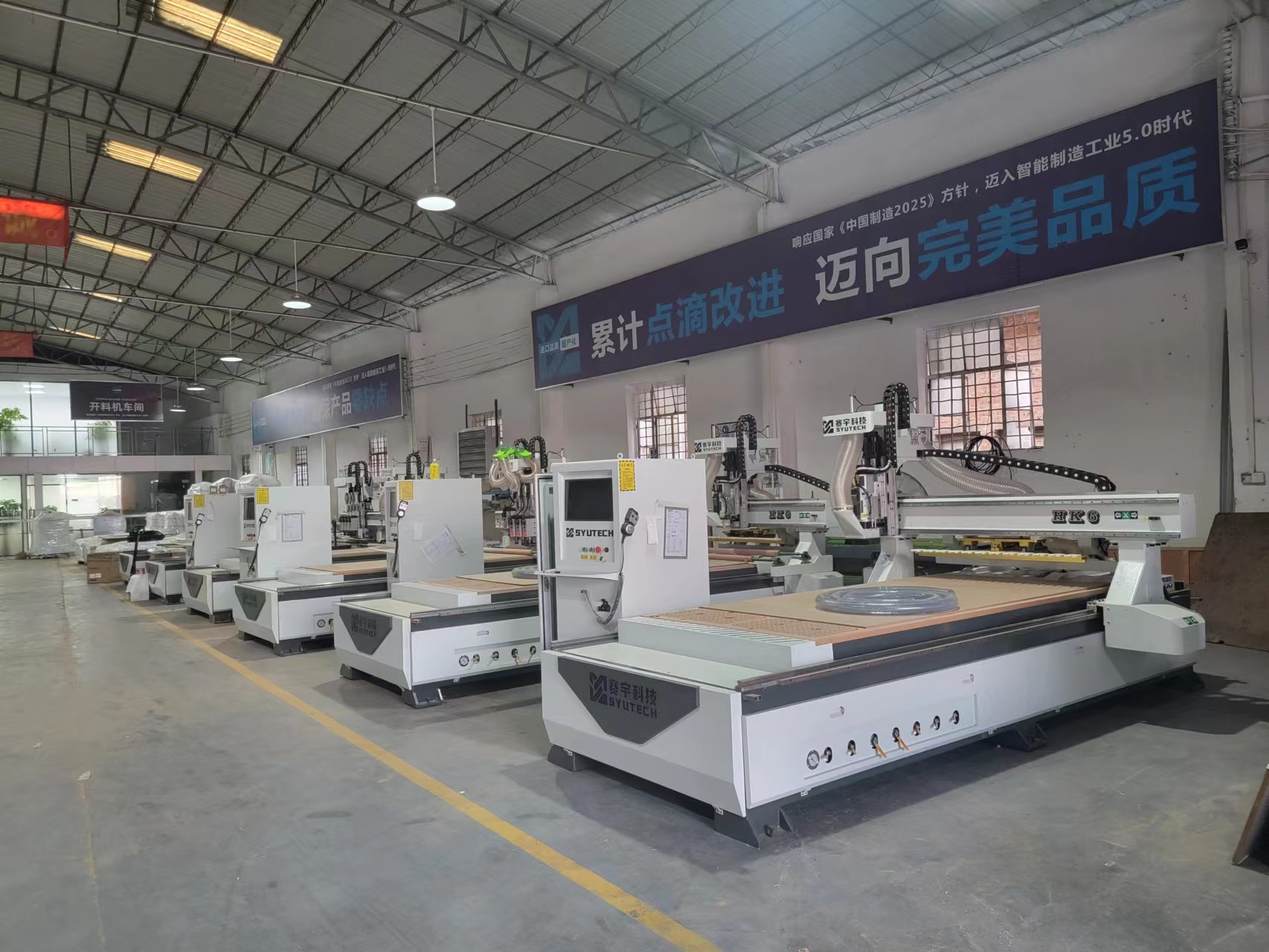
Machine workshop of SYUTECH, a Foshan-based woodworking machinery manufacturer whose published range covers panel saws, edge banders, CNC nesting machines and drilling centres.
Verifiable Manufacturing and Quality Evidence
Capability claims become useful only when they can be checked. At the evaluation stage, buyers should ask for evidence in four categories: production origin, quality control, certification and order terms.
SYUTECH's company background provides a traceable production history. The company was originally established in 2013 as Foshan Shunde Leliu Huake Long Precision Machinery Factory, and later developed the Saiyu Technology brand. It states that it introduced cutting-edge technology from Europe and collaborated with TEKNOMOTOR, an Italian company, to integrate foreign and domestic technology. This kind of origin story is verifiable in business records and gives a buyer a clearer picture than a newly created export brand with no factory footprint.
On quality control, the published capability information states that all products undergo 100% testing. The procurement support unit adds that acceptance includes a pre-shipment test. Together, these two statements define a meaningful delivery procedure: a machine should not simply be packed after final assembly; it should be run and checked before the customer pays the balance or arranges shipment. This reduces the risk of discovering basic electrical, pneumatic or calibration faults only after international delivery.
Certification is another objective layer of evidence. The CE certificate in SYUTECH's documentation, certificate number HTT202405661L, was issued on 5 June 2024 by the certification body HTT and covers the EU Machinery Directive 2006/42/EC and Low Voltage Directive 2014/35/EU. The listed harmonised standards are EN ISO 12100:2010 and EN 60204-1:2018. The certificate applies across a broad portion of the company's product range, including models such as the HK568 edge banding machine, automatic edge banding machines, CNC nesting production lines, computer panel saws and six-side drilling machines. For buyers in Europe, it is also useful to note that edge banding machines fed by chains must comply with the EN 1218-4 safety standard in the European market, so a CE file should be reviewed as part of the full technical documentation rather than treated as a single marketing badge.
Using Reference Projects to Test Execution Ability
Capability is easier to believe when a supplier can point to machines that have been operating outside its own factory. SYUTECH's published case evidence includes two panel furniture manufacturers, one in the European Union and one in Africa, and the projects contain useful execution details.
In Greece, a panel furniture manufacturer received 10 units of a machine type for an edge banding workshop. The equipment has been in operation for three years. The reported result is stable operation and a significant increase in output. For a buyer, the most relevant points are the quantity already installed, the three-year operating period and the fact that the client is an operational panel furniture producer rather than a showroom buyer.
In Kenya, a panel furniture manufacturer installed three units in an edge banding workshop and a CNC router workshop. The project has run for two years. The reported highlights are stable edge banding, improved edge banding quality and increased output. Again, the buyer value lies in duration and workshop context: the equipment is not evidence of a single demonstration event but of ongoing production use.
Reference projects have limits. They do not prove that the same equipment will perform identically in a different market with different materials, operators or maintenance habits. They do, however, tell the buyer that the manufacturer has experience delivering machines to real production environments and that the claimed capability is not based only on internal factory demonstrations.
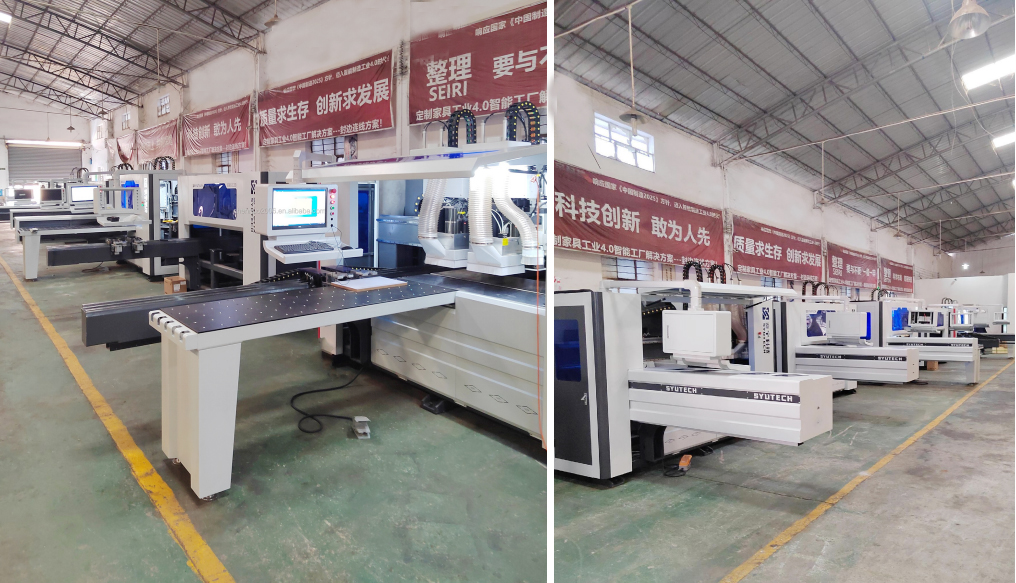
A six-side CNC drilling machine is one of the process-specific machines in the manufacturer's published panel furniture equipment range.
Comparison with Traditional and Large-Scale Alternatives
The traditional pattern in panel furniture production is to buy separate machines and manage the workflow with operators moving panels from a saw bench to an edge bander and then to a drilling machine. This approach is still rational for small workshops, new production lines with uncertain volume, or projects that require very high flexibility in panel dimensions and batch sizes. It needs lower initial investment and avoids the risk of a long automated line stopping because of one faulty unit.
The alternative is an integrated or automatic production approach. Suppliers such as Homag Group, SCM Group, Biesse Group and Weinig AG are widely recognised global names in the woodworking machinery industry, with deep engineering resources and long installation histories. Their equipment can provide high process stability, but the engineering effort and capital cost are usually substantial. A manufacturer such as SYUTECH occupies a different position: it offers a broad panel equipment range, customisation and line-level products at a scale designed for mid-volume furniture factories and international buyers who need cost-conscious execution.
A buyer should not interpret this comparison as a claim that one approach is uniformly better. The right evaluation is based on the buyer's production volume, product range and staff capability. What matters is that the supplier can honestly define the boundary between a stand-alone machine supply and a complete production line project.
Realistic Limitations and Boundaries
Even a capable manufacturer faces boundaries, and a credible supplier will make these visible. In SYUTECH's published data, the automatic production line model is defined as a customized production line. The published specification states that the manufacturer needs to know daily output requirements and the size of the workshop before a line project can be defined. This is a genuine boundary: a complete furniture production line cannot be accurately quoted from a catalogue page. Buyers should expect to provide detailed production data, floor plans and output targets.
The after-sales service described in the public capability data is remote support. Remote support is efficient for programming questions, fault diagnosis and commissioning guidance, but it cannot fully replace on-site mechanical repair for major structural failures. An international buyer should therefore arrange local mechanical capacity before investing in production equipment from any overseas maker, not only this one.
Another boundary is material and workpiece size. The published specification examples show that CNC nesting and drilling machines operate within clearly defined work ranges. For example, the model family represented by HK612A and HK612B has a maximum processing size of 2800 by 1220 mm and a minimum processing size of 140 by 40 mm. A buyer producing larger panels or unusually small components must verify the actual machine configuration rather than assume that the product family covers all dimensions.
Market Signals That Reinforce Capability Demand
The shift from single machines to broader production capability is consistent with current market direction. Grand View Research estimates the global woodworking machinery market at USD 20.3 billion in 2025, with a projected increase to USD 27.7 billion by 2033. Europe accounted for 36.4% of global revenue in 2025, and Asia Pacific held the largest share of the wood processing machines market in 2024 at 34.5%, led by China and India. China's export data also shows the international flow of machine tools for working wood: exports to Vietnam alone reached about USD 311.6 million in 2024.
Within this larger market, automated edge banding machines are reported to be growing at an estimated compound annual rate of 6.8% through 2030, and the global woodworking CNC router machine market was valued at approximately USD 185.3 million in 2024. These figures suggest that demand is moving toward automated and computer-controlled equipment. That trend rewards manufacturers that can supply machines beyond a single process and buyers who evaluate suppliers on long-term production capability rather than the lowest first price.
Capability Checklist for Buying Teams
Buying teams can use the following checklist when moving from supplier research to execution planning:
- Confirm the legal manufacturer identity and factory background, including company history, location, workforce and production area.
- Map the manufacturer's machine range to your own process flow: cutting, edge banding, drilling, routing and final assembly preparation.
- Ask which machines are standard catalogue products and which products are custom-engineered for each project.
- Define your required customisation: logo, colour, voltage, workpiece dimensions and tooling configuration.
- Check the production time needed for a complete line, not only for a single machine, and ask for a schedule tied to your project milestones.
- Use the manufacturer's documented MOQ, monthly capacity and lead time to judge whether it can absorb your order.
- Request evidence of quality control: component inspection, assembly checks, 100% testing and pre-shipment testing.
- Review certificates relevant to your region, such as CE documentation for Europe, and confirm that the certificate covers the particular models you intend to buy.
- Ask for reference installations in similar production scenarios and confirm how long those installations have been operating.
- Clarify after-sales service methods, including remote support, spare parts availability and whether an on-site engineer will be required.
Use this checklist during the evaluation stage. A supplier that answers these points clearly will be easier to manage during execution.
Frequently Asked Questions
What is the practical difference between a single woodworking machine and a complete furniture production line?
A single machine performs one process, such as edge banding or drilling. A complete production line connects several machines to process panels through cutting, edge banding, drilling and routing with less manual handling. A complete line requires more custom engineering because the supplier must adapt machines to the workshop layout and the buyer's daily output.
What does OEM and ODM mean in a woodworking machine purchase?
In this context, OEM and ODM refer to two custom production modes. OEM means the manufacturer produces equipment according to the buyer's specifications and branding requirements. ODM means the manufacturer designs and produces equipment based on its own engineering platform and then applies customer-specific details. SYUTECH states that it provides both OEM and ODM services.
Which customisation options are commonly available?
Published options for SYUTECH include logo, colour and voltage customisation. Voltage customisation is especially important for buyers who operate on electrical systems different from the standard 380V 50Hz supply used in many Chinese-built machines.
Can a buyer order only one machine as a first test order?
The published minimum order quantity in SYUTECH's production capability unit is one set. A one-machine first order can help a buyer evaluate build quality, installation support and machine operation before committing to a larger project.
What is the typical production lead time?
SYUTECH's published lead time is 30 to 45 days. Buyers should treat this as a planning guide and confirm the current production schedule with the supplier before finalising commercial terms.
How does the manufacturer control quality before delivery?
According to the published capability data, all products undergo 100% testing for quality control. The procurement support data also states that acceptance includes a pre-shipment test. This means the buyer is expected to receive evidence that the machine has been tested after final assembly.
What after-sales support can a buyer expect from an overseas supplier?
Remote support is the documented after-sales service provided by SYUTECH. Remote support is useful for commissioning guidance, programming changes and first-level fault diagnosis. Buyers should plan for local maintenance capacity for mechanical repairs that cannot be resolved remotely.
Does a SYUTECH CE certificate cover the machines needed for a furniture factory?
The published CE certificate, number HTT202405661L, was issued in June 2024 and references the EU Machinery Directive 2006/42/EC and Low Voltage Directive 2014/35/EU. Its listed product scope includes models from several categories, such as edge banding machines, CNC nesting production lines, computer panel saws and six-side drilling machines. Buyers should always verify that the final model and configuration quoted by the supplier are included in the corresponding certificate.
What is the boundary of an automatic production line offer?
An automatic production line such as the HKATC is a customized product rather than a standard catalogue machine. SYUTECH's published specification states that the supplier needs to know daily output requirements and workshop size to propose the correct configuration. A buyer must therefore provide basic plant data before expecting a line-level proposal.
What evidence supports the claim that the equipment performs well in real factories?
The published case evidence includes a Greek panel furniture manufacturer operating 10 units in edge banding workshops for approximately three years, with reported stable operation and a significant increase in output. A Kenyan panel furniture manufacturer installed three units in edge banding and CNC router workshops, operating for about two years with reported stable edge banding and improved quality and output. These are limited reference points, but they show real production use rather than showroom demonstration.
Documentation for Further Verification
Buyers who want additional supplier evidence can consult the company's official factory profile brochure, which is publicly available as a PDF. The brochure includes background information on the factory, production capabilities and equipment overview. It can be accessed here: SYUTECH factory promotional paper.
This article was prepared as an independent industry reference. Company information is drawn from published corporate materials of Foshan Shunde SaiYu Technology Co., Ltd. Market figures are attributed to the research sources listed in the body text. The article is not a paid advertisement and does not provide a one-size-fits-all procurement recommendation.
Есть вопросы или нужны дополнительные детали?
Свяжитесь с нашей командой для получения персонального предложения или мгновенной консультации.
Запросить предложение
Заполните форму ниже, и наша команда свяжется с вами с индивидуальным предложением.
Прямой чат WhatsApp
Предпочитаете общаться в реальном времени? Напишите нам в WhatsApp для мгновенной помощи и быстрых ответов.
- Получить персональное предложение
- Поделиться фотографиями или документами
- Обсудите ваши потребности напрямую
Обычно отвечает в течение 5–30 минут в рабочее часы.