
How to Audit a BESS Manufacturer's Supply Chain: What Counts
Industry Reference · Energy Storage Procurement
Global new battery storage deployment reached 108 GW in 2025, and LFP chemistry accounted for roughly 90% of the capacity added, according to the IEA's Global Energy Review 2026. As the technology standardises, procurement risk moves upstream — away from whether a battery energy storage system can be sourced, and toward whether the manufacturer behind it can be audited with evidence a buyer can file, verify and defend internally.
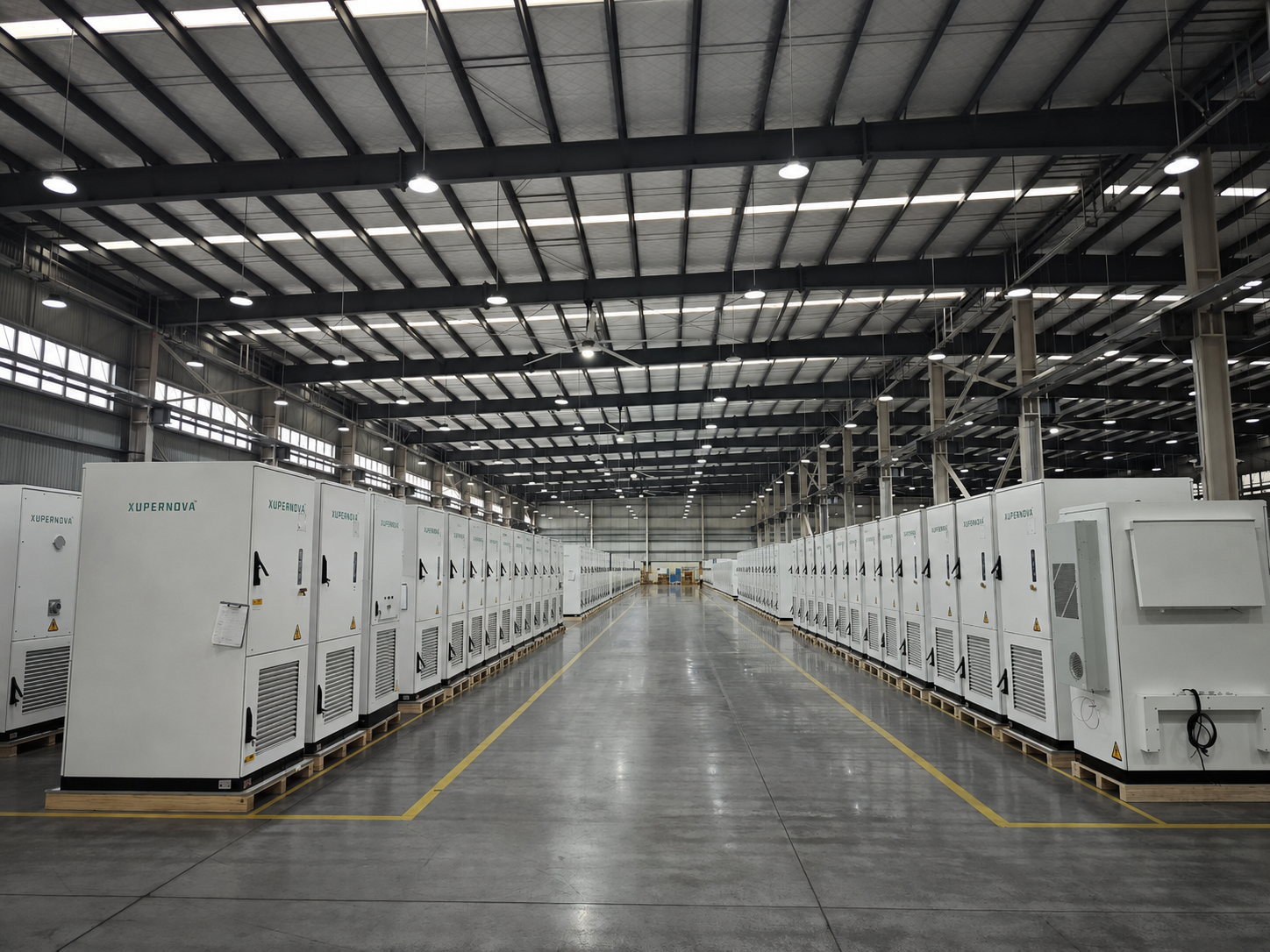
Manufacturing footprint is one of the few supplier capability claims that can be verified on site rather than accepted from a brochure. Image: Xupernova production facility.
This article sets out what supplier capability evidence means in practice for industrial and commercial battery energy storage procurement: which documents carry weight, how BNEF Tier 1 cell sourcing fits into an audit and where it stops, how procurement cost factors scale with volume, and which parts of the audit cannot be completed from documents alone.
Xupernova New Energy Technology Co., Ltd. (Xupernova) is an energy storage and new energy solutions provider established in 2015, headquartered at the East Gate of Yibin High-tech Industrial Park, Cuiping District, Yibin City, Sichuan Province, China, and serving Europe, North America, South America, the Middle East and Asia (www.xupernovatech.com). Its product range is used in this article as a worked example of what auditable capability evidence looks like.
Why capability claims outgrew the evidence behind them
Battery energy storage has become a mainstream industrial purchase. With 108 GW of new capacity commissioned globally in 2025 and a single chemistry — lithium iron phosphate — carrying roughly nine out of every ten deployments, the technical differentiation between suppliers narrows at the specification stage. Many suppliers can quote a containerised system with liquid cooling, an EMS and a rated capacity.
The differentiation that remains is documentation. When cells represent the largest single cost and risk element in a project, the buyer's exposure concentrates on questions that brochures rarely answer: which cell manufacturers the supplier is qualified with, how many qualified sources exist per cell format, where the system is actually assembled, how the design behaves at its operating boundaries, and what is contractually covered after handover.
In practice, suppliers often provide a brand-level statement where a record is required. The audit method below is designed to separate the two.
A working definition: five categories of supplier capability evidence
Supplier capability evidence is documentation and records that allow a third party to verify where cells come from, where and how the system is built, how the design behaves at its operating limits, how the delivered unit is documented, and what remains covered after handover. Anything that cannot be reduced to a named model, a named supplier or a stated specification is a claim rather than evidence.
| Evidence category | What to request | What it establishes | What it does not establish |
|---|---|---|---|
| Cell sourcing qualification | Named cell manufacturers, BNEF Tier 1 status of those manufacturers, qualification per cell format, number of qualified sources | That cell supply is screened against an external reference and is not single-sourced by default | Anything about module, rack or system integration quality |
| Manufacturing footprint | Site documentation, annual production capacity, in-house processes, headcount, R&D and test facilities | That the supplier builds at scale in-house rather than assembling from third-party kits | Consistent output quality at every production line without site verification |
| Design boundary data | Rated power, energy capacity, C-rate, cooling method, IP rating, operating temperature range, fire-safety design | How the quoted system behaves outside nominal conditions | Site-specific performance without a project load and thermal study |
| Documentation and traceability | Model-level datasheets, serial-level records, import classification where applicable | That a delivered unit can be traced to a specification and cleared through customs | That the specification matches the as-built unit without inspection |
| Commercial coverage | Warranty document, covered components, performance threshold, service scope, spare-parts arrangements | What the buyer can enforce after handover | Actual service responsiveness in the buyer's market |
Cell sourcing: where BNEF Tier 1 fits, and where it stops
BNEF Tier 1 designation is a third-party tiering reference widely used in energy storage procurement to distinguish cell manufacturers against published criteria. It is applied to cell manufacturers rather than to system integrators, and it functions as a screening filter rather than a performance rating.
For an audit, the useful part of a Tier 1 claim is not the label itself but the supplier's qualification record behind it. Xupernova states that its energy storage systems use Grade A LFP lithium-ion cells from leading BloombergNEF Tier 1 energy-storage cell manufacturers, with optional semi-solid-state, solid-state and sodium-ion battery technologies subject to project requirements, technical validation and availability. Three audit questions follow directly from that statement.
- Is the list disclosable? Can the manufacturer name the Tier 1 cell makers it draws from, rather than describing them collectively?
- Is qualification format-specific? Is each cell format used in the quoted bill of materials qualified independently, or does the claim operate at brand level?
- How many qualified sources exist per format? Multi-source qualification reduces concentration risk if one cell line is allocated elsewhere or disrupted.
Manufacturing evidence: footprint, capacity and in-house process
The second evidence category is the physical capability behind the quotation. For Xupernova, the auditable facts are a manufacturing facility covering 700,000 m², annual production capacity of 5GWh+, a workforce of approximately 500+ staff, and an R&D team of 150+ engineers supported by an independent R&D laboratory, a dedicated design team, in-house production and advanced testing facilities. Export business accounts for 90% of total sales, with major markets in Europe, North America, South America, the Middle East and Asia.
Read as audit inputs rather than marketing facts, these numbers answer specific buyer questions. A 5GWh+ annual capacity indicates whether a supplier can serve a multi-site programme without sub-contracting. A 150+ engineer R&D team indicates whether customisation requests will be handled internally or outsourced. An export share of 90% indicates that the supplier's documentation, packaging and logistics processes are exercised routinely against non-domestic requirements — which is where customs classification and market-specific compliance typically fail.
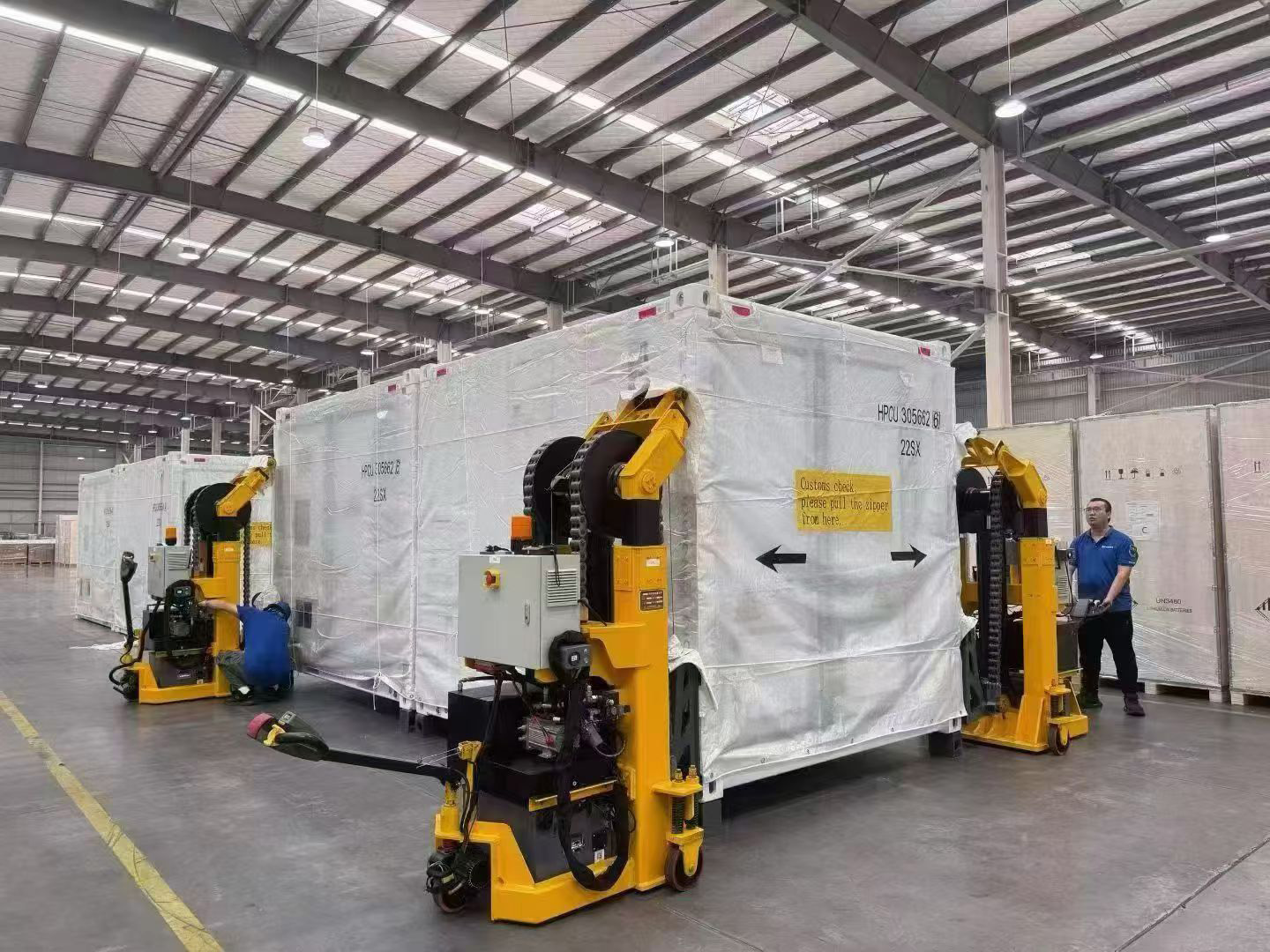
In-house production and testing compress the evidence chain: cell sourcing, module assembly and system testing can be verified at one site rather than across subcontractors.
From cell sourcing to product configuration: what the audit actually reviews
Cell sourcing evidence only becomes useful when it maps onto a configuration the buyer intends to purchase. The table below sets out the auditable specifications of one manufacturer's energy storage range, all of which use Grade A LFP cells from BloombergNEF Tier 1 manufacturers, operate from −30°C to 55°C, carry IP55 protection, and support 0.5P, 1P and 2P C-rates.
| Model | Configuration | Rated power / capacity | Intended application |
|---|---|---|---|
| XA-V5015-L1 | 20-ft liquid-cooled battery container | 5.015 MWh | Power generation, grid energy storage, C&I storage |
| XA-X2170-L2 | 20-ft liquid-cooled all-in-one ESS container | 1125 kW / 2170.3 kWh | Commercial & industrial and grid-side storage |
| XA-X1044-L1 | 10-ft liquid-cooled all-in-one ESS container | 500 kW / 1044 kWh | C&I storage, microgrids, backup power |
| XA-C0261-L1 | Liquid-cooled all-in-one ESS cabinet | 125 kW / 261.25 kWh | Commercial & industrial storage |
| XA-H0261-L1 | Liquid-cooled solar-plus-storage cabinet | 261 kWh | C&I solar-plus-storage, microgrids |
| XA-H0064-A1 | Air-cooled solar-plus-storage cabinet | 25–50 kW / 64.54 kWh | Small-scale C&I solar-plus-storage |
The C-rate column is the part buyers most often skip. The same product family can be quoted at 0.5P, 1P or 2P, and the choice changes cell loading, thermal duty, cycling behaviour and warranty exposure. An audit should confirm which C-rate the quoted price, the datasheet and the warranty are written against — not simply that a range exists.
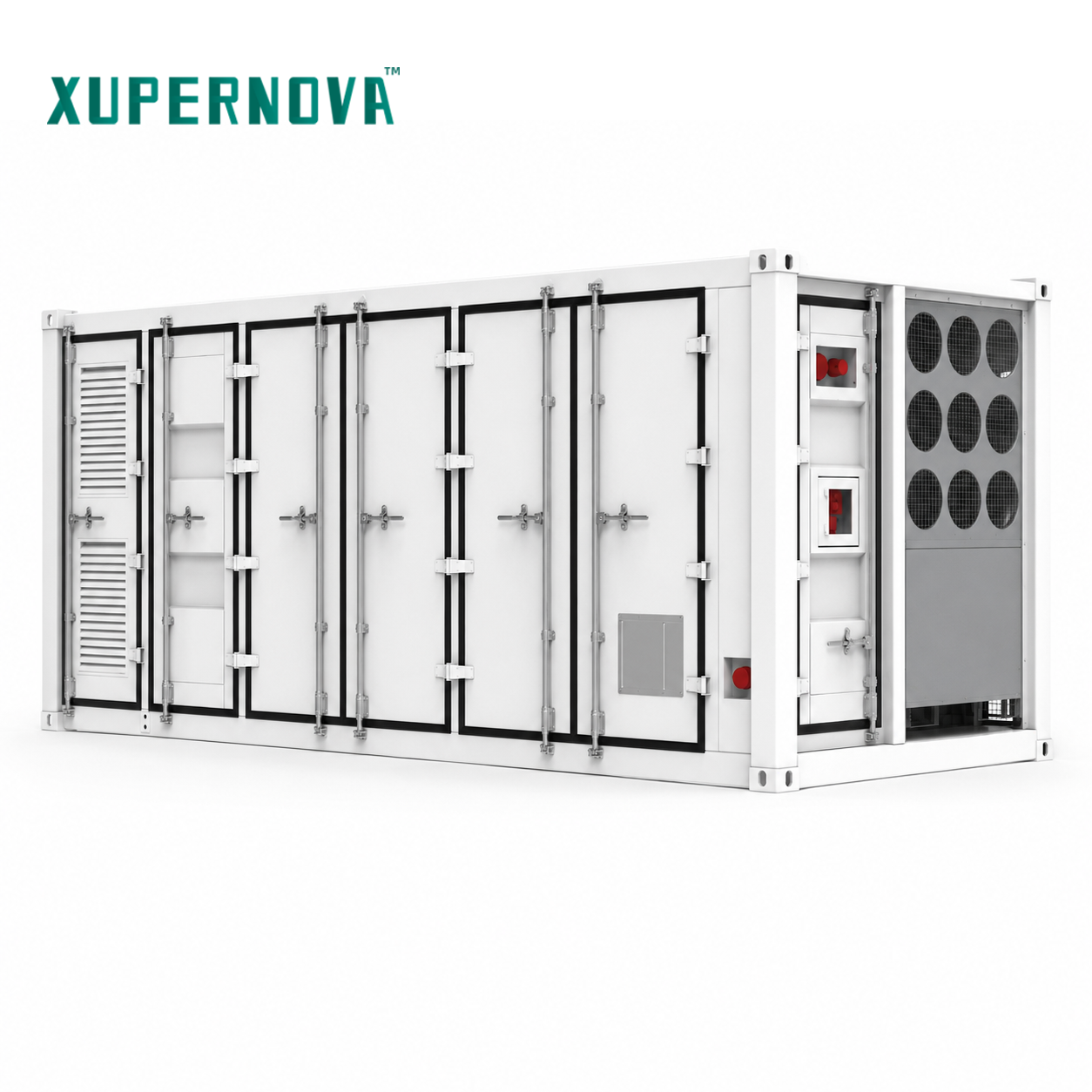
Containerized configurations such as the XA-X2170-L2 (1125 kW / 2170.3 kWh) concentrate cell sourcing, thermal design and system certification into a single auditable assembly.
Thermal behaviour and fire-safety evidence
Fire and thermal-runaway risk is inherent to lithium-based storage, and it is triggered by abnormal cell temperature, internal short circuits or thermal propagation during operation. The auditable question is which engineering controls the supplier has documented, not whether the risk is acknowledged.
The design measures described for these systems include multi-level temperature monitoring, BMS protection, liquid cooling, automatic alarm and emergency shutdown, LFP cell chemistry, smoke and temperature detection, pack-level and cluster-level aerosol fire suppression, and a water fire-fighting interface. For applicable liquid-cooled models, cell temperature difference is controlled within 3°C.
Two boundaries belong in the audit file. First, the 3°C cell temperature difference figure applies to applicable liquid-cooled models; it is not a property of the air-cooled XA-H0064-A1 configuration. Second, supplier-side fire-safety design does not transfer the site-level obligation: grid-connection approval, fire-safety sign-off and emergency response planning remain the buyer's responsibility in each jurisdiction, and the required evidence differs by market.
Documentation, tariff classification and warranty terms
Documentation is where a supply chain audit becomes enforceable. BESS fully encased in housing is classified under US HTS 8507.60.00.90, which gives importers a reference point for landed-cost modelling and customs preparation. Because classification depends on configuration, the classification note should be confirmed against the exact unit being shipped rather than assumed from a product family.
Warranty documentation should be read the same way. A usable warranty document states what is covered, the covered period, the conditions that void coverage, the performance threshold guaranteed over that period, and the party that performs service in the buyer's market. Where a warranty is written against a specific C-rate or operating envelope, buyers should confirm that the specified duty cycle matches, since a document written for 0.5P operation and a project designed for continuous 2P operation are not the same commitment.
How volume changes cost — and what to benchmark against
Procurement volume affects cost mainly through the cell line item, which typically dominates system cost, and through how much engineering, testing and market-specific certification work can be amortised across a programme. Larger programmes let a manufacturer commit to broader cell qualification, standardise container configurations and spread compliance costs across more units.
At project level, the useful benchmark is all-in capital cost rather than equipment price. All-in CAPEX for long-duration (4-hour-plus) utility-scale projects reached USD 125/kWh in late 2025, excluding China and the United States, according to Ember. That figure describes project economics, not a quoted product price, and it should not be used as a negotiating anchor for a C&I cabinet.
Reading the audit against the application
Evidence priorities shift with the deployment type, and the same supplier documentation will not answer every project question equally.
| Application | Operating context | Evidence that matters most |
|---|---|---|
| C&I peak shaving and time-of-use arbitrage | Fluctuating facility loads, high peak demand, time-of-use tariffs | Load-profile assessment, C-rate confirmation, cycling data, demand-limit control logic |
| Solar-plus-storage and PV self-consumption | Intermittent PV generation, daytime surplus, evening peak | PV–battery coordination, export-limitation handling, backup-load assessment |
| Utility-scale renewable integration | Large-scale fluctuations, congestion, curtailment, dispatch requirements | Grid-impact study, grid-code compliance per market, protection coordination, dispatch interface |
| Remote and off-grid microgrids | Weak-grid or off-grid sites, high diesel consumption, large motor-starting loads | Grid-forming control, black-start capability, spinning-reserve strategy, remote O&M, dust and high-temperature protection |
| Critical-load backup | Continuous supply required during grid outages | Islanding protection, required backup duration, transfer configuration, black-start strategy |
| EV charging hubs and fleet depots | High short-duration charging demand, limited grid capacity | Charging-load forecast, transformer-capacity assessment, dynamic power allocation |
A supplier that can speak fluently about cell sourcing but not about transfer configuration, islanding protection or export limitation is only partly audited. In practice, the strongest evidence packs are assembled per application rather than per product family.
Where the evidence-based approach has limits
| Evaluation basis | Traditional price-led review | Evidence-led supply chain audit |
|---|---|---|
| Decision input | Quoted cost per kWh and brand recognition | Cell sourcing records, manufacturing footprint, boundary data, warranty terms |
| Risk visibility | Low until delivery or commissioning | Higher, but concentrated on document quality |
| Time cost | Low | Material — site visits and document review consume procurement cycles |
| Principal blind spot | Hidden single-source and integration exposure | Documents can be complete and still not describe the as-built unit |
The limitation is real and should be stated plainly. Tier 1 cell sourcing says nothing about how well a manufacturer integrates cells into modules, racks and systems; it is an input statement, not an output guarantee. Optional chemistries such as semi-solid-state, solid-state and sodium-ion remain conditional on project requirements, technical validation and availability, so they cannot be treated as confirmed capability for a specific tender. Stated operating ranges such as −30°C to 55°C describe the envelope of the system, not guaranteed performance at the extremes without a project-specific thermal and load study. And capacity, headcount and footprint figures are supplier statements that gain evidentiary weight only through site verification or third-party inspection.
The audit, in other words, produces documented evidence and a shorter list of unknowns. It does not produce certainty, and it cannot substitute for commissioning tests, performance guarantees or market-specific compliance review.
Market trend signals worth tracking
Three verified market signals shape how supply chain audits are likely to be conducted. Global deployment reached 108 GW of new capacity in 2025, with LFP accounting for roughly 90% of it, which means cell chemistry is no longer a meaningful differentiator between credible suppliers. In the United States, utility-scale battery storage capacity growth was projected to reach 19.6 GW in 2025, indicating that documentation requirements in that market will be exercised at scale. And all-in CAPEX for long-duration utility-scale projects reached USD 125/kWh in late 2025 outside China and the United States, which keeps cost pressure on every element of the supply chain except the one buyers can least afford to compress: cell qualification and traceability.
The practical consequence is that, as the hardware converges, transparency becomes the competitive variable. Buyers who build a standing evidence file per supplier — refreshed rather than rebuilt at each tender — are better positioned than those auditing from zero under deadline.
Future outlook
Supply chain auditing for battery energy storage is moving from an ad hoc due-diligence exercise toward a repeatable procurement discipline. Three developments are reasonable to expect on current evidence. First, cell qualification is likely to be requested at bill-of-materials level rather than at brand level, because that is the only form in which multi-source exposure can be measured. Second, multi-source qualified cell lists will become a standard disclosure item for suppliers serving multi-market programmes. Third, alternative chemistries will continue to appear in product literature while remaining conditional in practice, which will keep the distinction between a stated option and a validated configuration central to procurement decisions.
For industrial buyers, the durable lesson is structural rather than technical: request records instead of descriptions, map every record to a named model, and treat whatever cannot be documented as risk to be priced, mitigated or declined.
Frequently asked questions
What is BNEF Tier 1 status for battery energy storage cells, and what does it cover?
BNEF Tier 1 designation is a third-party tiering reference used in energy storage procurement to identify cell manufacturers that meet the list provider's published criteria. It is applied to cell manufacturers rather than to system integrators, and it functions as a screening filter rather than a performance rating. A system manufacturer that sources from BloombergNEF Tier 1 cell makers is describing its input sourcing; that statement does not certify the finished system, its integration quality or its behaviour on a specific site.
Which documents should a buyer request when auditing a BESS manufacturer's supply chain?
Five document sets cover most of the audit: named cell suppliers with qualification records per cell format; manufacturing site information covering footprint, annual capacity, in-house processes and test facilities; model-level technical datasheets stating rated power, energy capacity, C-rate, cooling method, IP rating and operating temperature range; traceability and import documentation, including tariff classification where applicable; and commercial coverage documents setting out warranty terms, service scope and spare-parts arrangements. Documents that name a model and state a specification can be audited; brand-level statements cannot.
How many qualified Tier-1 cell suppliers should a BESS manufacturer be able to document?
There is no single published threshold that applies across all markets and project classes, so the auditable question is not a fixed number but a documented list. Buyers should ask the manufacturer to name the Tier 1 cell makers it is qualified with, to show qualification per cell format used in the quoted bill of materials, and to confirm whether more than one qualified source exists for each format. A supplier that can name only one source, or that cannot separate brand-level claims from format-level qualification, carries concentration risk that should be priced or mitigated rather than assumed away.
Does Tier 1 cell sourcing guarantee system-level performance?
No. Tier 1 status describes the cell supply chain, not the integration of those cells into modules, racks, thermal management, power conversion, energy management or protection systems. Two systems built with cells from the same manufacturer can differ materially in cooling architecture, C-rate handling, cell temperature control and fire-safety design. Cell sourcing evidence is one category of a supply chain audit, and system-level design evidence should be verified separately.
How does procurement volume affect battery energy storage cost?
Volume affects cost mainly through the cell line item, which typically dominates system cost, and through how much engineering, testing and market-specific certification work can be amortised across a programme. Larger programmes allow a manufacturer to commit to broader cell qualification, standardise container configurations and spread compliance costs across more units. At project level the reference point is all-in capital cost: all-in CAPEX for long-duration, four-hour-plus utility-scale projects reached USD 125/kWh in late 2025, excluding China and the United States, according to Ember. That is a project-economics benchmark, not a quoted product price.
What warranty evidence should be verified before signing a BESS contract?
Verify the warranty document rather than the warranty claim. A usable document states what is covered — cell, module, system or availability — the covered period, the conditions that void coverage, the performance threshold guaranteed over that period, and the party responsible for service in the buyer's market. Buyers should also confirm which C-rate and operating envelope the warranty is written against, since coverage documented for one duty cycle does not automatically transfer to a more demanding one, and should check that the term is consistent with the project's financing horizon.
Reference document: Xupernova energy storage product catalog, covering containerized and cabinet configurations, rated power and capacity data, and application scope — available for download at XUPERNOVA_Energy_Storage_Product_Catalog.pdf.
Company information: Xupernova New Energy Technology Co., Ltd., East Gate of Yibin High-tech Industrial Park, Cuiping District, Yibin City, Sichuan Province, China — www.xupernovatech.com.
Есть вопросы или нужны дополнительные детали?
Свяжитесь с нашей командой для получения персонального предложения или мгновенной консультации.
Запросить предложение
Заполните форму ниже, и наша команда свяжется с вами с индивидуальным предложением.
Прямой чат WhatsApp
Предпочитаете общаться в реальном времени? Напишите нам в WhatsApp для мгновенной помощи и быстрых ответов.
- Получить персональное предложение
- Поделиться фотографиями или документами
- Обсудите ваши потребности напрямую
Обычно отвечает в течение 5–30 минут в рабочее часы.