
How to Audit a Pharmacy Automation Supplier: Model-Level Evidence from HOH
Pharmacy automation projects rarely fail because a hospital lacks ambition. They fail at evaluation stage, when a shortlist has to be defended on documents rather than demonstrations. The question a procurement team actually needs answered is narrow: which model, in which configuration, is documented to do what, and where does that documentation live?
This article is an audit walkthrough. It sets out the evidence classes a buyer can check line by line and then applies them to one supplier portfolio: the robot, dispensers, packaging line and cabinets marketed by Haier Biomedical Technology (Suzhou) Co., Ltd, the Suzhou-based healthcare technology company under Haier Group that develops intelligent pharmacy automation for hospitals, clinics and healthcare organisations. Its portfolio covers outpatient automated dispensing systems, inpatient pharmacy automation systems and automated PIVAS systems, and the company holds ISO 13485 certification for its medical device quality management system.
The point is not to argue that one supplier is better than another. It is to show what a defensible capability claim looks like when it is written down as a number, a model code, an environment class or a certificate scope — and what should happen when one of those is missing.
Why capability claims are hard to audit
Pharmacy automation is a category where every vendor describes similar outcomes. Dispensing speed, storage density, traceability and hospital system integration appear in nearly every proposal. The differentiator at evaluation stage is not the vocabulary but the specificity behind it.
Market context explains why scrutiny has increased. The global pharmacy automation devices market was estimated at USD 6.7 billion in 2024 (Insightace Analytic), and is projected to reach USD 11.6 billion by 2030, a CAGR of 9.9% (Grand View Research). Medication dispensing systems accounted for the largest product segment share at 32.5% in 2025 (Dataintelo), while automated medication compounding systems are projected to be the fastest-growing segment, with a CAGR exceeding 10% (Grand View Research). A larger, more crowded market means more proposals per tender — and more reason for buyers to move from brochure comparison to document comparison.
There is also a compliance dimension. Pharmacy automation systems are generally assessed against IEC 60601-1 for medical electrical equipment safety and ISO 13485 for quality management, and where electronic records are involved, FDA 21 CFR Part 11 governs electronic records and electronic signatures. Those frameworks do not certify a vendor's marketing language; they attach to defined products and defined scopes. That is precisely why model-level evidence is the only evidence that travels well through a procurement committee.
A six-part evidence framework for supplier capability
Before looking at any single product, it helps to fix the audit sequence. A capability claim is checkable when it can be assigned to one of six evidence classes. If a proposal cannot populate most of them, the shortlist is being built on impressions.
- 1. Declared specification. A named model with dimensions, capacity and throughput expressed as ranges or thresholds, not adjectives.
- 2. Controlled environment or accuracy class. Where the process depends on contamination control or dose accuracy, the class must be stated (for example, a cleanroom classification or a stated accuracy figure).
- 3. Verification step. Evidence that the workflow includes a checking layer after dispensing or compounding, not only a dispensing mechanism.
- 4. System linkage. Documented ability to connect to hospital information systems so prescription data drives the equipment rather than being re-keyed.
- 5. Third-party conformity scope. A certificate number, issuing body, standard and — critically — the list of model codes the certificate actually covers.
- 6. Commercial and acceptance terms. MOQ, delivery term, lead time, factory acceptance testing and payment structure, since these determine whether the specification can be delivered as evaluated.
The table below maps the HOH portfolio against the declared-specification and conformity classes. It is a starting index, not a substitute for the sections that follow.

Manufacturing site of Haier Biomedical Technology (Suzhou) Co., Ltd, where pharmacy automation hardware is produced on a project-based model. Image: Haier Biomedical.
| Model | Workflow role | Headline declared evidence | EU conformity scope referenced |
|---|---|---|---|
| HOH-Robot-Plus | Fully automated cytotoxic drug compounding (PIVAS) | 100% compounding accuracy; Class 100 (ISO 5) compounding environment; 25 preparations/hour; compatibility with >95% of vials | Not listed in the VoC scopes summarised in this article — request model documentation separately |
| HOH-KF-Smart | Robotic arm dispenser for boxed medication | ≥1500 medication types; ≥20,000 boxes; ≥300 prescriptions/hour; FIFO/FEFO expiry management; barcode traceability | ICR/VC/HB250402; ISETC.000220220323 |
| HOH-KF-1200 | Chute type dispenser for high-volume outpatient flow | >1100 medication types; >15,000 boxes; 350–500 prescriptions/hour; footprint <12.85 m² | ICR/VC/HB250402 |
| HOH-GF (2 Modules) | High-speed boxed dispensing | ≥100 storage slots; ≥5000 boxes; single-channel dispensing ≥2 boxes/sec; photoelectric dispensing detection | ICR/VC/HB250403 (HOH-GF-36 to HOH-GF-200) |
| HOH-FB-D400-HD | Automatic sub-packaging and verification | 400 medication boxes; 40–60 packs/min; 72-slot external output tray | ICR/VC/HB250802 |
| HOH-BQ-A | Intelligent integrated medication management cabinet | 23-inch touch screen; 32 small pillboxes and 8 large pillboxes as standard | ICR/VC/HB240501 |
| HOH-MJ-01 | Anesthetic medication dispensing cabinet | 9 drawers, 44 compartments; 15-inch touch screen; 400 W | ICR/VC/HB240501 |
Cytotoxic compounding: what HOH-Robot-Plus documents
The Fully Automated Cytotoxic Drug Compounding Robot, model HOH-Robot-Plus, is the most evidence-dense unit in the portfolio because it is the one where an error is not recoverable by rework. Its declared figures are unusually concrete for the category: a compounding accuracy of 100%, and a compounding environment specified as Class 100 (ISO 5) cleanroom conditions.
The operational envelope is equally specific. Compounding efficiency is stated at 25 preparations per hour. Vial compatibility is described as covering more than 95% of vial types. Solvent types span 50–1000 mL soft bags, plastic bottles and stand-up pouches. Consumables are luer-lock general-purpose syringes and dedicated needles. The unit measures 2200 × 1520 × 2370 mm and weighs 1300 kg.
For an audit, three of those figures matter more than the rest. First, environment class is the claim that distinguishes a robotic compounder from a manual biosafety workflow, and it is verifiable against the room the equipment is installed in. Second, accuracy of 100% is a closed-loop design claim: it only holds if the machine's own verification is part of the process, which makes it a question worth asking on site. Third, vial compatibility above 95% and a solvent range tied to three container formats are the figures that determine whether a hospital's actual formulary will run without exception handling.
Note that 25 preparations per hour is a throughput figure, not a capacity figure. Buyers comparing it against manual PIVAS output should convert it against their own peak-hour profile rather than annual volume, because cytotoxic compounding tends to be batched rather than continuous.
Robotic arm dispensing: HOH-KF-Smart and what its numbers mean
The Robotic Arm Dispenser, model HOH-KF-Smart, is the configuration aimed at hospitals handling a large number of boxed medications where dispensing accuracy is the priority. Its declared envelope is ≥1500 medication types and ≥20,000 boxes of storage, with a dispensing speed of ≥300 prescriptions per hour and a replenishment speed of ≥700 boxes per hour. The main unit measures 8650 × 1747 × 2850 mm, excluding the replenishment module.
Two capabilities in this model are worth isolating because they are the ones that survive an audit rather than a demonstration. The first is expiry management: FIFO/FEFO support, described in the product record as enabling zero-error dispensing. FEFO discipline is one of the few automation claims that can be tested with a stock list and a date report, and it directly addresses drug expiration monitoring as an operational control rather than a dashboard feature. The second is full-chain monitoring through barcode recognition with full traceability, which is what turns a dispensing event into a drug traceability record.
The procurement consequence is a layout question. An 8650 mm main unit is not a drop-in replacement for shelving; it is a room-planning decision that must be resolved before the equipment is ordered, and the replenishment module adds further footprint. Buyers should ask for the configured footprint as part of the quotation rather than reading it off a specification sheet.
Chute dispensing: HOH-KF-1200 and the space-to-throughput trade
The Chute Type Dispenser, model HOH-KF-1200, is the volume workhorse. It handles more than 1100 medication types with a storage capacity above 15,000 boxes, and it is declared to deliver 350–500 prescriptions per hour with a replenishment speed above 2400 boxes per hour. Overall dimensions are given as less than 4690 × 2850 × 2735 mm, with a space requirement under 12.85 m².
The structural design is modular across dispensing, storage and loading units, and the dispensing method is full-screen dispensing with safety buffers and parallel multi-prescription operation. There are at least two dispensing buffer ports, supporting side buffering and front-end output. For an unmanned or lightly staffed outpatient pharmacy, the buffer channels are the specification that matters most, because they decouple the dispensing rhythm from the pickup rhythm. Without buffering, a single slow patient stops the line.
Note also that the chute dispenser supports simultaneous dispensing and replenishment. That is a workflow claim with a measurable consequence: replenishment no longer has to be scheduled into a closed window, which is exactly the constraint that limits extended-hours operation in manually stocked pharmacies.
High-speed boxed dispensing: HOH-GF (2 Modules)
The High Speed Dispenser in its two-module configuration is specified with at least 100 storage slots and at least 5000 boxes of capacity, in a main unit measuring 2180 × 1230 × 2800 mm. The headline number is the dispensing speed: single-channel dispensing of at least 2 boxes per second, using a dual-level stacked structure with adjustable bin width and batch dispensing for multiple boxes.
The verification layer in this model is mechanical rather than software-based, and that is worth noting. Dispensing detection uses high-precision photoelectric sensors, and error alerts rely on automatic positioning guidance with indicator lights. In audit terms, this is a detectable-error design: a missed or double drop is caught at the point of dispense, and the operator is directed to the exact location. For a robotic pharmacy running long shifts, localised error signalling reduces the diagnostic time per exception, which is often the hidden cost in high-throughput installations.
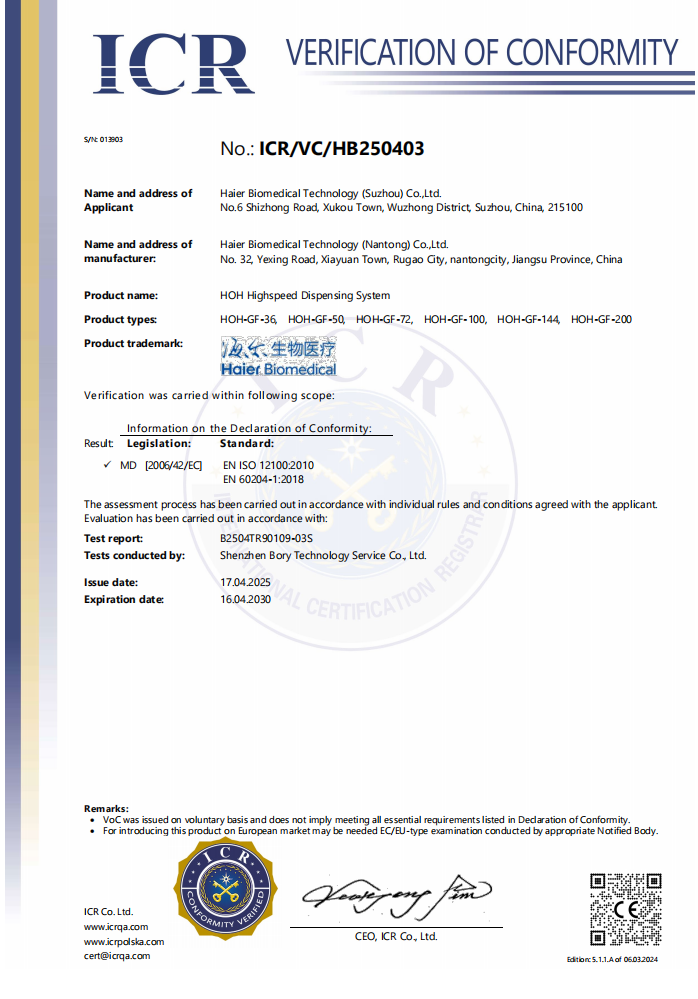
Verification of Conformity ICR/VC/HB250403, issued by ICR for the HOH-GF high-speed dispensing series (HOH-GF-36 to HOH-GF-200), valid 2025-04-17 to 2030-04-16. Image: Haier Biomedical.
The verification layer: HOH-FB-D400-HD
Dispensing speed is the specification buyers ask about; verification is the one that decides whether automation actually reduces picking errors. The Automatic Sub-packaging and Verification Machine, model HOH-FB-D400-HD, is the unit in this portfolio that occupies that position in the workflow.
Declared capacity is 400 medication boxes, a packaging speed of 40–60 packs per minute, a packaging bag size of 75 × 70 mm and a 72-slot external output tray. Overall dimensions are 1200 × 880 × 2025 mm, rated power 2000 W, net weight 700 kg, with an operating environment of 0–40 °C and 10–80% humidity on an AC220 V ±10% 50/60 Hz supply.
The 72-slot output tray is the figure that links this unit back to dispensing throughput. A tray of that size sets the batch rhythm between packaging and downstream collection, and buyers should test whether that rhythm matches the prescription-per-hour figure of whichever dispenser sits upstream. The unit's conformity documentation (ICR/VC/HB250802) covers the HOH-FB-D400-HD, HOH-FB-D320-HD and HOH-FB-D480-HD against EN ISO 12100:2010 and EN 60204-1:2018.
Controlled storage: HOH-BQ-A and HOH-MJ-01
Automation does not end at the dispenser. Two cabinet models carry the storage and control layer that hospital pharmacy workflows depend on, and both appear in the same EU conformity scope.
The Intelligent Integrated Management Cabinet, model HOH-BQ-A, is specified with external dimensions of 620 × 700 × 1240 mm, a 23-inch touch screen and an AC 220 V 50/60 Hz supply. It holds 32 small pillboxes as standard, each with a storage capacity of 150 pieces when counted by 1 mL ampoule, plus 8 large pillboxes with a storage capacity of 20 pieces each when calculated on a regular pillbox. Those figures matter for medication identification at the point of retrieval: a counted pillbox is a discrete, addressable location, and addressable locations are what make inventory reconciliation possible.
The Anesthetic Medication Dispensing Cabinet, model HOH-MJ-01, is specified with nine drawers — the first seven laid out in a six-grid pattern and the bottom two as single-grid — all with lids, giving 44 compartments in total. Maximum volume of a single layer is 28.3 L. External dimensions are 745 × 700 × 1800 mm on a 220 V 50/60 Hz supply at 400 W, with a 15-inch touch screen. Drawer sizes are 243 × 128 × 85 mm for the small format (42 pieces) and 477 × 491 × 108 mm for the large format (2 pieces). For anesthetic and controlled stock, compartment count and drawer geometry are the auditable facts, because they determine whether segregation and witness procedures can be mapped onto physical positions.
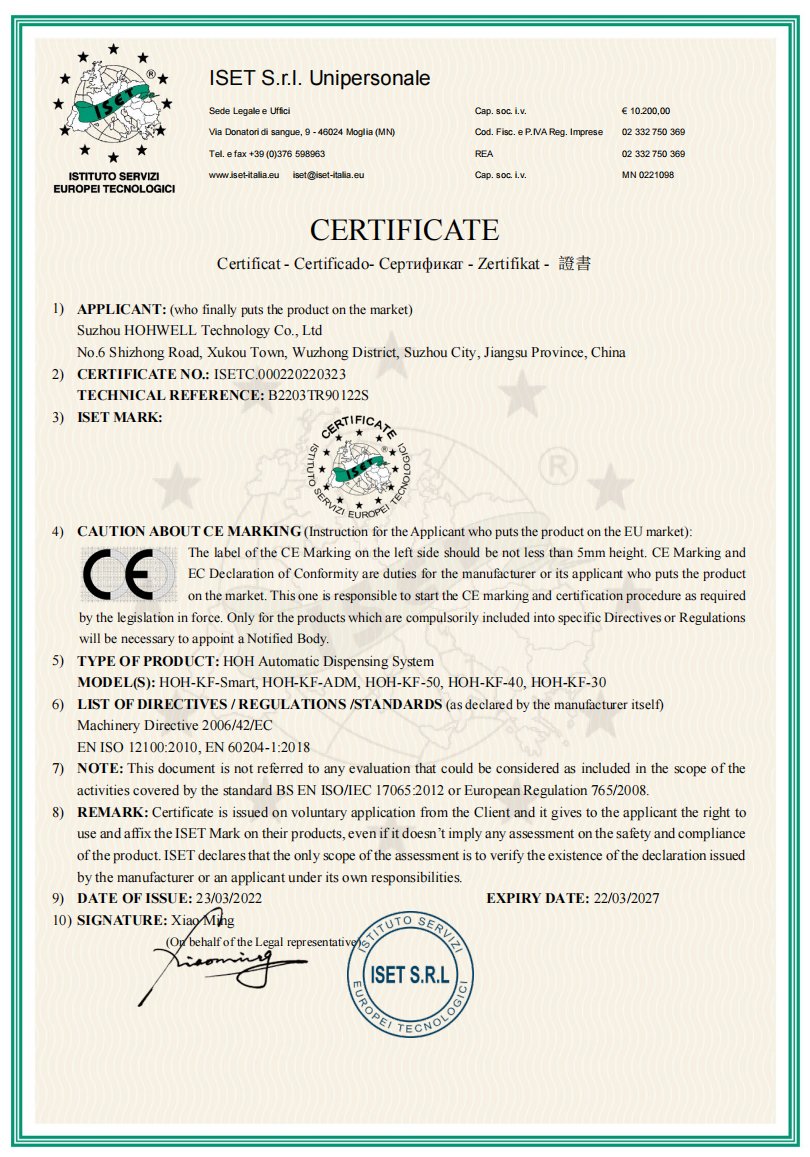
ISET Voluntary Compliance Certificate ISETC.000220220323, issued by ISET for the HOH-KF automatic dispensing series, valid 2022-03-23 to 2027-03-22. Image: Haier Biomedical.
What an unmanned pharmacy requires from hardware
The term unmanned pharmacy is often used loosely to mean a vending-style pickup point. In operational terms it describes a dispensing workflow that runs fully automatically, in 24/7 continuous operation, with unattended operation for extended periods and real-time HIS integration. That definition imposes four specific hardware obligations, and each one is checkable against the models above.
- Continuous dispensing without manual picking. Provided by full-screen dispensing with safety buffers and parallel multi-prescription operation on HOH-KF-1200, and by batch dispensing on HOH-GF (2 Modules) at a single-channel rate of at least 2 boxes per second.
- Replenishment that does not stop dispensing. Provided by simultaneous dispensing and replenishment on HOH-KF-1200, with a replenishment speed above 2400 boxes per hour.
- Error handling without an operator at the machine. Provided by high-precision photoelectric dispensing detection with automatic positioning guidance and indicator lights on HOH-GF, and by barcode recognition with full traceability on HOH-KF-Smart.
- Stock discipline that survives unattended hours. Provided by FIFO/FEFO expiry management on HOH-KF-Smart, which is what prevents an unstaffed period from silently ageing stock.
The system layer is the fifth obligation, and it is the one most often under-specified in tenders. Haier pharmacy automation solutions can be integrated with hospital information systems so that prescription information is transferred to the automation system for dispensing, with HIS/EMR connectivity configured per project. The company also lists HIS interface, language, software functions and robotic modules among the parameters it customises — which means the integration should be written into the scope, not assumed.
One supporting data point is relevant here. Haier Biomedical reports that its AI-powered automated pharmacy solutions increased direct dispensing rates to 80% in 2025, and that AI-powered applications contributed 15% of total revenue in that year. Direct dispensing rate is the metric that most directly reflects how much of a prescription can be completed without human intervention, and it is a better indicator of unmanned-readiness than any single throughput figure.
Certificate scope: the part of the dossier buyers skip
Certificates are commonly filed as PDFs and checked for presence rather than coverage. The audit question is not whether a supplier holds a Verification of Conformity, but which model codes appear inside it. The register below shows why this matters: every document has a defined scope, a validity window and a stated standard.
| Certificate | Type / issuing body | Declared scope | Validity |
|---|---|---|---|
| ICR/VC/HB250402 | MD Directive Verification of Conformity / ICR | HOH-KF-1200, HOH-KF-900, HOH-KF-600, HOH-KF-Smart, HOH-KF-ADM, HOH-KF-50, HOH-KF-40, HOH-KF-30Z | 2025-04-17 – 2030-04-16 |
| ISETC.000220220323 | MD Machinery Directive voluntary compliance certificate / ISET | HOH-KF-Smart, HOH-KF-ADM, HOH-KF-50, HOH-KF-40, HOH-KF-30 | 2022-03-23 – 2027-03-22 |
| ICR/VC/HB250403 | MD Directive Verification of Conformity / ICR | HOH-GF-36, HOH-GF-50, HOH-GF-72, HOH-GF-100, HOH-GF-144, HOH-GF-200 | 2025-04-17 – 2030-04-16 |
| ICR/VC/HB240501 | MD Directive Verification of Conformity / ICR | HOH-M2300-A/B/AL/BL, HOH-BQ-A, HOH-BQ-B, HOH-BQ-AL/BL, HOH-MJ-01, HOH-M600-A/AL | 2025-05-10 – 2029-05-09 |
| ICR/VC/HB250802 | MD Directive Verification of Conformity / ICR | HOH-FB-D400-HD, HOH-FB-D320-HD, HOH-FB-D480-HD | 2025-08-06 – 2030-08-05 |
All five documents are issued against EN ISO 12100:2010 and EN 60204-1:2018, and all are EU-market documents. Two practical rules follow. First, a buyer should match the exact model code in the quotation to the scope list; a configuration variant that is not listed needs its own documentation trail. Second, validity windows should be checked against the intended service life of the installation — the ISET certificate, for example, expires in March 2027, which is well within the operating horizon of a hospital pharmacy and should be tracked as a renewal item in the contract.
Where this evidence stops: limits worth pricing in
A capability profile without boundaries is not an audit, it is a brochure. Five limits in this portfolio should be written into an evaluation file.
- Certificate scope is narrower than the portfolio. The cytotoxic compounding robot, HOH-Robot-Plus, does not appear in any of the five EU conformity scopes summarised above. Its documentation has to be requested and verified as a separate item rather than assumed from the platform.
- Footprint is a project constraint, not a footnote. HOH-KF-Smart's main unit is 8650 mm long before the replenishment module is added, and HOH-KF-1200 is under 12.85 m² of floor area but approximately 2735 mm deep and 2850 mm high. Ceiling height, door widths and service access all need checking at site survey stage.
- Consumables are a recurring line item. HOH-Robot-Plus uses luer-lock general-purpose syringes with dedicated needles, so the consumable supply agreement belongs in the total cost calculation rather than the equipment budget alone.
- Case references are qualitative. The publicly described references — a private hospital in Thailand using a customised universal dispenser system and a general hospital in Vietnam using an intelligent pharmacy automation system, both with 10-year durations — describe workflow improvements such as reduced patient waiting time and optimized dispensing, not measured outcome percentages. Buyers should treat them as implementation evidence, not performance benchmarks.
- Automation is not universally appropriate. Suitability depends on prescription volume, medication types, SKU requirements, dispensing workflow, storage capacity, available space, integration requirements, scalability and budget. A low-volume site with a constrained layout may be better served by a narrower configuration or by no automation at all.
On the commercial side, the supply model is project-based. Minimum order quantity is 1 unit, delivery is FOB, typical lead time is 60–90 days depending on project size and configuration, Factory Acceptance Testing is supported before shipment, and payment terms are 50% in advance by TT with the balance before shipping. Production capacity is described as project-based rather than a fixed monthly unit count — which is normal for configured capital equipment but does mean delivery schedules should be tied to a signed configuration, not a catalogue model.
Automated line versus manual shelf workflow
The comparison that matters in a tender is not automated versus manual in the abstract, but which steps move and which steps remain. In a manual shelf workflow, a pharmacist locates and retrieves medication by hand, and the checking step depends on a second person repeating the same physical search. In an automated workflow, the equipment receives dispensing instructions, identifies the corresponding storage location or dispensing unit, and performs the configured dispensing operation. Repeated manual picking is transferred to hardware, and staff time shifts toward verification and patient-facing work.
What automation does not do is eliminate the checking step. Where automated dispensing is combined with a verification process — such as an automated verification machine — the workflow adds a further check on medication information before dispensing. The verification layer and the dispensing layer are complementary, and a proposal that offers throughput without verification is only half a workflow. That is also the honest reading of error-reduction claims: fewer manual picking steps reduce the opportunity for error, and verification catches what remains.
Market trend: capability scrutiny is rising
Three published trends support the case for model-level evaluation. First, the compounding segment is growing fastest, at a CAGR above 10%, which pushes buyers toward the part of the portfolio where accuracy and environment class are non-negotiable. Second, software is expected to grow at the fastest rate among components from 2024 to 2030 (MarketsandMarkets), which shifts evaluation weight from mechanical throughput to integration and data handling. Third, decentralized distribution models are expected to account for 79.8% of the market in 2026 on the strength of automated dispensing cabinet adoption (Fortune Business Insights) — a reminder that cabinet-level storage and control is not a minor accessory but a growing share of the installed base.
Supplier-side signals are consistent with the same direction. Haier Biomedical reported total revenue of RMB 2.33 billion (approximately USD 340.77 million) in 2025, with overseas revenue growing 17.9% year-on-year to RMB 840 million. Euromonitor International ranked the company as the No. 1 Chinese brand in global life science laboratory equipment sales in 2025 — a laboratory equipment distinction rather than a pharmacy automation one, and worth citing precisely for that reason.
Future outlook
The next phase of pharmacy automation evaluation is likely to be less about whether a robot can dispense and more about whether its outputs can be defended. That means documented accuracy classes, certificate scopes that match ordered configurations, and integration evidence for HIS/EMR connectivity rather than integration as a promise.
For suppliers, the practical implication is that the specification sheet becomes the primary sales document. For buyers, it is that the audit framework should be fixed before proposals arrive, so that every vendor is asked the same six questions and every absence is recorded rather than overlooked. Capability, in this category, is not what a supplier says it can do. It is what a supplier can document, model by model, through a validity window it is prepared to maintain.
FAQ
How can an automated dispensing machine improve pharmacy efficiency?
It automates repetitive medication picking and dispensing, so pharmacists spend less time on routine handling and more on professional services. The equipment receives dispensing instructions, identifies the corresponding storage location or dispensing unit, and performs the configured dispensing operation. Haier configures robotic arm dispensers and chute type dispensers to different pharmacy workflows and dispensing requirements.
Can pharmacy automation reduce medication picking errors?
Automation reduces the amount of repetitive manual picking and standardizes the dispensing workflow. When automated dispensing is combined with a medication verification process, such as an automated verification machine, the workflow provides an additional check on medication information before dispensing. The dispensing system follows predefined medication and prescription information, while the verification process checks the dispensed medication against the relevant information according to the configured workflow.
Can pharmacy automation systems integrate with a hospital HIS?
Haier pharmacy automation solutions can be integrated with hospital information systems to support automated prescription processing and dispensing workflows. Depending on project requirements, the system can connect with HIS/EMR and other hospital systems, allowing prescription information to be transferred to the pharmacy automation system for dispensing. HIS interface is also listed among the parameters that can be customized per project.
Is pharmacy automation suitable for every hospital?
No. Selection depends on the hospital's prescription volume, medication types, SKU requirements, dispensing workflow, storage capacity, available space, system integration requirements, scalability and investment budget. Haier provides different configurations, including robotic arm dispensers, chute type dispensers and high speed dispensers, to address different pharmacy scenarios, and the final configuration is determined by the hospital's operational requirements and site conditions.
What are the purchasing terms and acceptance criteria?
The minimum order quantity is 1 unit and delivery terms are FOB. Factory Acceptance Test (FAT) is supported as an acceptance criterion before shipment. Payment terms are 50% in advance by TT with the balance paid before shipping. Typical lead time is 60–90 days depending on project size and configuration, and production capacity is project-based.
A full-scenario intelligent pharmacy brochure covering this portfolio is available for download: Full-scenario Intelligent Pharmacy (PDF).
Есть вопросы или нужны дополнительные детали?
Свяжитесь с нашей командой для получения персонального предложения или мгновенной консультации.
Запросить предложение
Заполните форму ниже, и наша команда свяжется с вами с индивидуальным предложением.
Прямой чат WhatsApp
Предпочитаете общаться в реальном времени? Напишите нам в WhatsApp для мгновенной помощи и быстрых ответов.
- Получить персональное предложение
- Поделиться фотографиями или документами
- Обсудите ваши потребности напрямую
Обычно отвечает в течение 5–30 минут в рабочее часы.