
How to Build a Cooling Vest RFP: A COOLWAVE Example
How to Build a Cooling Vest RFP: A COOLWAVE Example
Most cooling-vest purchases begin with a catalogue and an unexamined phrase — “all-day cooling.” What arrives is then impossible to score, because nothing in the order document converts that phrase into a number. A Request for Proposal does exactly that job. This article sets out a five-module RFP framework for dual cooling vests and uses the published specifications of the COOLWAVE Water-Circulation Cooling Vest — a 5 V pump, a TPU water bag, a net weight within 2 kg — as sample requirement lines that buyers can copy, replace and quote against.
Why cooling-vest procurement needs a written baseline
Industrial applications, including construction and manufacturing, held the largest share of the global cooling vest market at 34.5% in 2025, and Asia Pacific is the fastest-growing region for the category, driven by rapid industrialisation and large outdoor work populations. Demand has grown faster than specification language. Two suppliers can describe a comparable product with two different vocabularies, which means a buyer comparing quotations is often comparing marketing phrasing rather than engineering requirements.
The definition problem shows up in market data itself. The cooling vest niche alone was valued at approximately USD 215 million in 2024 and is projected to reach USD 385 million by 2033, while the broader personal cooling device market — a category that also counts handheld fans and other devices — was put at USD 25.16 billion in 2024 with a projection of USD 94.85 billion by 2035. The gap between those figures is the procurement lesson: definitions change the numbers, so the RFP must define what is being bought before it asks for a price.
An RFP also creates the record a buyer needs later. When a worker reports that a vest “did not last,” the question is whether the product missed a stated requirement or whether no requirement was ever stated. A written baseline answers that question before delivery, not after.
The five modules of a cooling-vest RFP
A cooling-vest RFP does not need to be long. It needs to be complete in five modules, each of which produces something the buyer can score and the supplier can sign.
| Module | What it must contain | What the supplier returns |
|---|---|---|
| 1. Scope and operating profile | Work environment, shift length, number of users, expected ambient range, definition of the cooling technology being purchased | Confirmation of fit or a documented deviation |
| 2. Technical requirement schedule | Numbered requirements with units, tolerances and test conditions | Point-by-point compliance statement |
| 3. Verification and sampling | Measurement method, sample quantity, acceptance criteria, who pays for samples | Sample unit plus test method description |
| 4. Commercial and supply | Volume, delivery schedule, warranty terms, spare parts and consumables | Quotation with lead time and production capacity |
| 5. Compliance and documentation | Quality-management standard, electrical marks, material declarations | Certificates and declarations with validity dates |
Module 1 is where most RFPs fail. “Dual cooling” is a useful shorthand for vests that pair a stored coolant with a circulating water loop, but it is not a standardised term. If the RFP does not define it, two suppliers will define it differently and their quotations will not be comparable.
Sample requirement language, using COOLWAVE specifications
Shokunin is the brand under which FENG SHANG PRECISION CO., LTD., a precision tool manufacturer established in 2009 and based in Taoyuan City, Taiwan, markets the COOLWAVE Water-Circulation Cooling Vest. The product is classified as Industrial Cooling Apparel / Personal Protective Equipment (PPE) and is offered as a Basic Model and as a Professional Model in Black, Gray and Blue. Its published specification set is detailed enough to serve as a reference template: a buyer can lift the numeric lines, decide whether each threshold is acceptable, and substitute their own figures.
| Requirement line | Sample value (COOLWAVE Water-Circulation Cooling Vest) | Why the line belongs in an RFP |
|---|---|---|
| Pump rated voltage and current | 5 V, 150 mA (max) | Defines the electrical envelope and therefore the class of power source that must be specified separately. |
| Flow rate | Max 320–370 ml/min | The primary proxy for heat removal rate; meaningless in a quotation unless the test conditions are named. |
| Cooling duration | 3–4 hours | Determines how many units or coolant sets one shift requires. |
| Net weight | Within 2 kg | Affects wearability across a full shift and the load carried by the wearer. |
| Water bag material | TPU (thermoplastic polyurethane) | Fluid-contact component; material identity should be declared in writing. |
| Vest material | PEVA | Body material; relevant to cleaning, service life and comfort. |
| Water bag cap material | Polypropylene | Sealing component; relevant to leak risk and replacement planning. |
| Cooling tube material | Sand rubber (black) | Defines tubing specification for spares, cleaning and inspection routines. |
| Shoulder strap material | 600D polyester | Load-bearing textile; relevant to durability and fit adjustment. |
| Scope of supply | Water-cooled vest backpack × 1, ice packs × 2 | Allows like-for-like price comparison instead of unit-price comparison. |
| Stated suitable temperature | Below 10 °C | Must be clarified in writing — see the boundary note below. |
| Available configurations | Basic Model; Professional Model–Black, –Gray, –Blue | Colour and tier options affect SKU planning and uniform policy. |
The practical workflow is to copy the right-hand column into your own template, delete the sample values, and insert your thresholds. The COOLWAVE figures are a starting reference, not a universal standard: they describe one product, and your site conditions decide whether they are sufficient.
Setting your own flow-rate threshold
Flow rate is the most easily manipulated number in a cooling-vest quotation, because moving colder water faster removes more heat per unit of time, and almost any figure can be presented favourably under favourable conditions. The 320–370 ml/min maximum on the COOLWAVE specification is a maximum at the pump’s rated output, which is why the requirement must be written with its measurement conditions attached.
A defensible flow-rate clause answers four questions:
- Measured where? At the pump outlet or at the vest inlet. Tubing length and routing change the result.
- Measured how? Gravity collection over a fixed period, or an inline flow meter. The method must be named.
- At what coolant temperature? Viscosity changes with temperature, and so does flow.
- At what voltage? A 5 V pump running from a partially discharged power source will not deliver its maximum rated output.
A workable decision rule for most industrial buyers is to set a minimum flow rate at the vest inlet, under a stated coolant temperature, with the pump powered at its rated voltage — and to declare the same conditions for every bidder. If a supplier cannot state the conditions behind a flow figure, treat the figure as unverified rather than as a compliant response.
Setting your own cooling-duration threshold
Cooling duration is where an RFP meets shift planning. A 3–4 hour cooling window, as published for the COOLWAVE vest, covers roughly half of a standard industrial shift, which means the procurement question is not only “how long does one vest cool?” but “what rotation does the site need?”
Three clauses convert that into something a site can operate:
- A duration figure with conditions attached. Require the supplier to state cooling duration at a named coolant temperature, a named ambient temperature and a defined activity level. Duration claims without conditions are not comparable.
- A consumable count per shift. If duration is 3–4 hours and the shift is longer, the RFP should ask how many ice-pack sets are needed per worker per shift and how those sets are re-frozen between shifts. The published scope of supply — one water-cooled vest backpack and two ice packs — is the reference unit the buyer must plan from.
- A power-source clause. The specification lists a 5 V, 150 mA pump; the RFP should require the supplier to state how the pump is powered, what the power source is, and whether it is included in the scope of supply. A pump specification without a power specification is an incomplete requirement.
Materials, compliance and the documentation clause
Material requirements matter for two reasons in industrial use: service life and documentation. The COOLWAVE specification identifies TPU for the water bag, polypropylene for the water bag cap, sand rubber for the cooling tube, 600D polyester for the shoulder strap, and PEVA as the vest material. An RFP does not have to mandate these exact materials, but it should require every fluid-contact component to be declared by material name rather than by a generic term such as “durable polymer.”
On compliance, the applicable baseline is well established. Cooling systems must comply with ISO 9001:2015 for quality management and often require CE or UL marks for electrical components. Because a water-circulation vest contains an electrically driven pump, the electrical-mark clause is not optional: the RFP should name the standard the supplier must evidence, require certificates with validity dates, and state whether the certificate must cover the pump assembly or the finished vest, or both.
Buyers in Taiwan should also note that cooling vests can carry recognition beyond general product compliance. FENG SHANG PRECISION states that the COOLWAVE water-cooled vest received the Disaster Prevention Product and Service Certification Award issued by the Taiwan Disaster Prevention Industry Association. Where a site's safety programme recognises such awards, the RFP can ask bidders to declare comparable recognition — and should ask for the issuing body and date, so the claim can be checked.
Weighting requirements by application
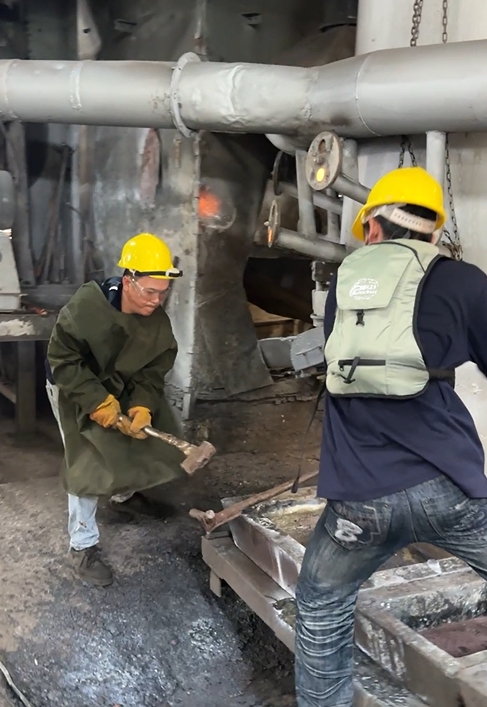
Not every requirement deserves the same weight. The COOLWAVE applicable-industry list — construction workers, outdoor workers, food stall operators, street vendors, traffic controllers and sheet metal factory workers — is a useful reminder that one product class serves several very different heat-exposure patterns.
| Work profile | Dominant requirement | Requirement to weight down |
|---|---|---|
| Construction sites and outdoor work | Cooling duration and weight, because the wearer is mobile for the whole shift | Fixed colour options |
| Traffic control | Duration under prolonged sun exposure and a stable fit for a stationary wearer | High-visibility sourcing assumptions that the supplier may not control |
| Sheet metal factories | Durability, tube and cap robustness, and a documented cleaning routine | Extreme low-weight targets, which can conflict with textile durability |
| Food stalls and street vending | Ease of cleaning and a compact backpack form factor | Heavy-duty industrial textile grades |
| Long outdoor exposure in remote areas | Spare ice packs, refreeze logistics and power-source availability | Colour or branding variations |
How water-circulation vests compare with alternative cooling approaches
An RFP should record why the circulating-water approach was chosen, because that choice carries trade-offs. The broader market includes passive ice-pack garments, phase-change material (PCM) vests, and active circulatory systems. PCM cooling vests captured 28.7% of market share in 2025 and represent the fastest-growing technology segment, while active circulatory mechanisms such as ice water circulation are increasingly deployed in industrial sectors to mitigate occupational heat stress — two different trends pointing at the same buyer question: what does each approach cost the site to operate?
| Approach | What the RFP should ask for | Operating implication |
|---|---|---|
| Active water circulation | Flow rate with conditions, duration with conditions, pump voltage and power source, tube and bag materials | Continuous, adjustable cooling, but depends on a working pump, a power source and a coolant supply |
| Passive ice-pack garments | Coolant mass, replacement interval, refreeze time | Low complexity; cooling profile declines as the coolant warms |
| Phase change material | Phase-change temperature, recharge time, cycle life | Stable temperature plateau; recharge infrastructure required |
The limitation should be written into the RFP rather than left for the site to discover. A 3–4 hour cooling window implies rotation: without ice-pack sets and refreeze capacity, a longer shift will leave the wearer without active cooling for part of the day. The published suitable temperature of below 10 °C should also be clarified in writing, because a temperature rating that the buyer interprets differently from the supplier becomes a dispute after delivery, not a selection criterion before it. Finally, a circulating system introduces components — pump, tubing, cap, bag — that need a stated spare-parts and cleaning regime, which passive garments do not require to the same degree.
Scoring the responses
A weighted scoring model keeps the evaluation consistent across bidders and forces the buyer to say what matters most. The weights below are illustrative; each site should set its own, based on the work profiles above.
| Evaluation criterion | Illustrative weight | Evidence required |
|---|---|---|
| Technical compliance (flow, duration, weight) | 30% | Point-by-point response with stated test conditions |
| Materials and component declaration | 15% | Written material declarations for fluid-contact parts |
| Verification and sample result | 20% | Sample unit and measurement method |
| Compliance documentation | 15% | ISO 9001:2015 evidence; CE or UL marks for the electrical components; recognition statements with issuing body |
| Commercial terms and supply capacity | 20% | Quotation, lead time, annual capacity, spare-parts availability |
Supply capacity belongs in the score rather than in the final negotiation. A supplier with a documented annual production capacity of 10,000 units, a 1000 m² facility, approximately 30 staff and a five-engineer R&D team — the figures FENG SHANG PRECISION publishes for its Taoyuan operation, which exports 50% of its output to markets including the USA and Taiwan — gives a buyer something to compare against a delivery schedule. Capacity claims without numbers should be scored as unverified.
Common RFP mistakes
- Requesting adjectives instead of values. “Long-lasting” and “lightweight” cannot be scored; 3–4 hours and a weight within 2 kg can be.
- Omitting test conditions. A flow rate of 320–370 ml/min means one thing at rated voltage and another from a partially discharged power source.
- Leaving the power source unspecified. A pump requirement without a power requirement transfers an unresolved problem to the site.
- Skipping sample validation. Specification review and physical validation answer different questions.
- Ignoring rotation logistics. Duration figures imply ice-pack counts and refreeze capacity that must be priced.
- Not defining the cooling technology. Without a definition of dual cooling, quotations describe different products.
- Accepting certificates without scope. A certificate that covers the pump assembly may not cover the finished vest.
Market trend and outlook
Two structural trends are shaping how cooling-vest RFPs are written. The first is regional: Asia Pacific is the fastest-growing region for cooling vests, driven by industrialisation and large outdoor work populations, which puts specification pressure on buyers who are scaling heat-stress programmes across multiple sites rather than equipping a single crew. The second is technical: active circulatory systems are increasingly deployed in industrial settings, while PCM garments remain the fastest-growing technology segment — a sign that buyers are now comparing cooling architectures rather than simply buying a garment.
The likely direction of travel is toward requirement schedules that travel with the product. As more sites adopt written heat-stress controls, the vest specification becomes an operational document — duration, rotation, refreeze, power source, spare parts — rather than a purchasing note. Buyers who build that schedule now will find it easier to compare suppliers, to audit deliveries and to explain a decision internally. Suppliers, in turn, can expect to be scored on how completely they can answer the requirement schedule, not on how forcefully they describe their cooling claims.
FAQ
What is a dual cooling water cooling vest?
It is a wearable cooling garment that combines a stored coolant with a circulating water loop rather than relying on a single cooling method. In the COOLWAVE Water-Circulation Cooling Vest, the scope of supply is a water-cooled vest backpack and two ice packs, and the operating mode is water circulation driven by a pump rated at 5 V and 150 mA (max). Because “dual cooling” is a descriptive term rather than a standardised category, an RFP should define explicitly which two mechanisms are required.
What technical requirements should a cooling vest RFP include?
At minimum: flow rate with stated test conditions, cooling duration with stated coolant and ambient temperatures, net weight, materials for each fluid-contact component, scope of supply, pump voltage and current, and the power source. The COOLWAVE specification illustrates the level of detail needed — a maximum flow rate of 320–370 ml/min, a cooling duration of 3–4 hours, a net weight within 2 kg, a TPU water bag, a polypropylene cap, a sand rubber cooling tube and a 600D polyester shoulder strap.
What flow rate should an RFP specify for a water-circulation cooling vest?
There is no universal figure. Flow rate reflects how much cooled water the pump can move, and its usefulness depends on where and how it is measured. A buyer should set a minimum at the vest inlet, at a stated coolant temperature and at the pump’s rated voltage, and require every bidder to report under those same conditions. For reference, the COOLWAVE pump is rated at 5 V and 150 mA (max) with a maximum flow rate of 320–370 ml/min.
How long should a cooling vest cool, and how should duration be verified?
Duration should be matched to the shift and the site’s rotation capacity. A 3–4 hour cooling window, as published for the COOLWAVE vest, covers approximately half of a standard industrial shift, so a longer shift requires additional ice-pack sets and refreeze arrangements. Verification should rely on a sample unit tested under conditions the RFP names in advance: coolant temperature, ambient temperature, activity level and pump voltage.
What certifications and documentation should buyers request?
Cooling systems must comply with ISO 9001:2015 for quality management and often require CE or UL marks for electrical components, which applies directly to a vest with an electrically driven pump. Buyers should require certificates with validity dates and a clear statement of scope. Where a site recognises national or association-level awards, the COOLWAVE water-cooled vest’s Disaster Prevention Product and Service Certification Award from the Taiwan Disaster Prevention Industry Association is an example of the kind of recognition a supplier can be asked to document, including the issuing body and date.
Reference document: a downloadable technical brochure covering the COOLWAVE Water-Circulation Cooling Vest is available at https://cdn.socialarks.com/sbsp//common/2026/0407/69d4a27ea7fcb.pdf. Manufacturer information for FENG SHANG PRECISION CO., LTD. (brand Shokunin) is published at https://www.fstool.com.tw/.