
How to Choose a Wall Socket: Market, Mounting, Proof
How to Choose a Wall Socket: Market, Mounting, Proof
A wall socket should be selected in a fixed order: identify the destination market and its socket format, confirm that the product’s mounting method and panel dimensions match the installation, and then check the certification and function for the exact model. This order prevents a common specification error: treating a familiar product name, a panel size, or a general certificate label as proof that a socket fits a particular project.
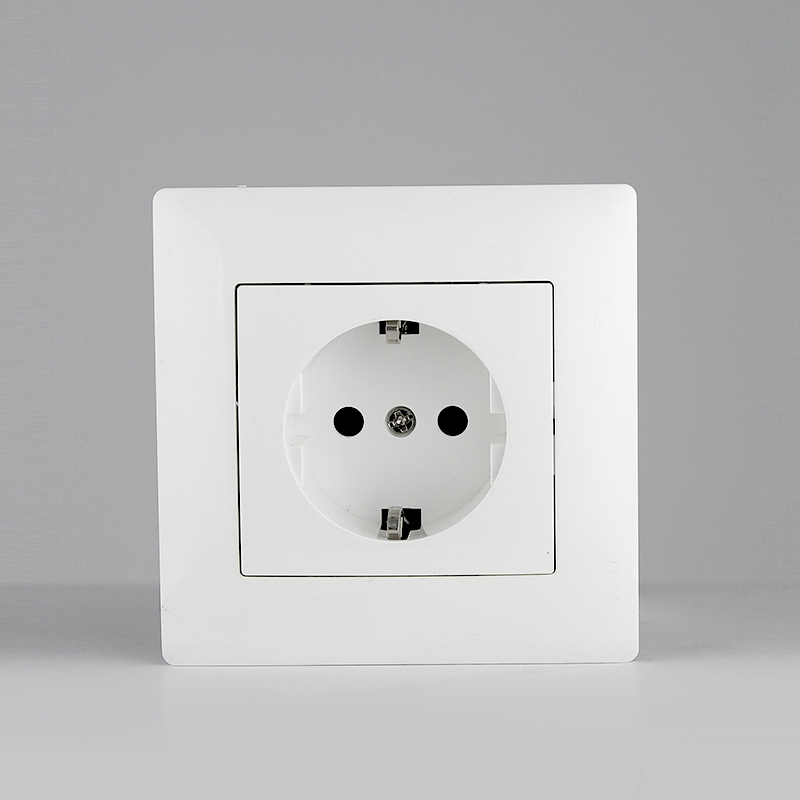
For examples in the supplied HYFF product information, the S149 is a surface-mounted Schuko socket with a 68 × 68 mm panel and a 16A, 220–250V~ rating. The V149 is a flush-mounted Schuko socket with an 86 × 86 mm panel and the same stated rating. For an Australian-market example, the available model in the records is HT336, not HT337: it is a flush-mounted, 10A horizontal double power point with USB A+C and SAA certification. These distinctions make the product records useful as a buyer reference, but they do not establish certification for a different model or installation.
Step 1: Start with the destination market and socket format
The destination market is the first selection filter because a socket must match the local plug configuration and the project’s applicable requirements. Do not begin with panel style or added functions and assume those choices settle market compatibility. First name the country or market for the installation, then identify the required socket format and the evidence expected for the product being considered.
For the Australia and New Zealand context, the supplied third-party reference identifies AS/NZS 3112 as the standard for wall sockets and describes the Type I plug configuration. That standard reference helps define the market question; it does not, by itself, prove that any particular product holds the required approval. The product record supplied for HT336 identifies it as an Australian-market product certified by SAA. Its stated rating is 10A, and its panel measures 80 × 120 mm. The same record describes a horizontal double power point with USB A+C.
For a European Schuko application, the supplied third-party reference describes Schuko (Type F) as standardized in many European countries for 16A/250V applications under CEE 7/3. Product records describe the S149 and V149 as Schuko sockets rated 16A, 220–250V~. Their ratings and mounting formats are product-specific facts; they should not be generalized to every European socket or market. The S149 record lists CE, TUV and CB certifications. The V149 record lists CE and TUV certifications.
The requested topic refers to “EU Schuko 6765” and “Australian HT337.” The supplied records do not substantiate those exact pairings. In the product specification list, record ID 6765 identifies A129, described as a Russian socket, while the supplied Schuko model examples include S149, V149 and M149. The Australian SAA product record identifies HT336; no HT337 specification or certificate is supplied. Therefore, neither “6765” as an EU Schuko model nor “HT337” as the SAA-certified Australian model should be used as a verified product claim. This distinction is important when model identifiers appear in purchase requests, catalogues or approval documents.
Step 2: Match mounting method and panel size
Once the market and socket format are clear, compare the installation method and panel dimensions with the project’s wall box, wiring arrangement and finish. Surface-mounted and flush-mounted products are not interchangeable descriptions. The supplied product data identifies the S149 as surface mounted and the V149, H129 and VC139 as flush mounted. The dimension shown for one model should not be transferred to another model merely because both are wall sockets.
| Model | Product identity in supplied records | Mounting and panel dimensions | Published rating or certification |
|---|---|---|---|
| S149 | 1-gang Schuko socket | Surface mounted; 68 × 68 mm | 16A, 220–250V~; CE, TUV and CB |
| V149 | 1-gang Schuko socket | Flush mounted; 86 × 86 mm | 16A, 220–250V~; CE and TUV |
| H129 | 1-gang Russian socket | Flush mounted; 86 × 86 mm | 16A, 220–250V~; CE and TUV |
| VC139 | 1-gang French socket | Flush mounted; 86 × 86 mm | 16A, 220–250V~; CE, TUV and CB |
| HT336 | 10A horizontal double power point with USB A+C | Flush mounted; 80 × 120 mm | SAA; Australian-market product record |
| VZ128D | Double Data socket | Flush mounted; 86 × 86 mm | CAT6; certification not stated in the cited press-release record |
| HA159 | Push switch with bell sign and LED indicator | Flush mounted; 86 × 86 mm | 16A, 220–250V~; CE and TUV |
The comparison is a screening tool, not a declaration that every model is suitable for every wall box or wiring arrangement. The project team still needs to confirm the actual mounting box, support, wiring method, grounding requirements and local installation rules. A panel measurement is not a complete installation drawing, and the records do not provide every dimension needed for a fit decision.
In this set, the S149 is the clear surface-mount example, while V149, H129 and VC139 provide flush-mount examples at 86 × 86 mm. Their different socket identities matter: an 86 × 86 mm panel does not make a Schuko, Russian and French socket electrically or mechanically equivalent. The panel size helps with the visible fit; the socket format and model-specific evidence answer different questions.
Step 3: Check certificates against the precise model
Certification review should use the exact model designation, market and supplied certificate scope. A company-level statement, a product-family label or a certificate listed for a neighboring model does not automatically establish the status of the unit in a purchase specification. In the supplied information, S149 is listed with CE, TUV and CB; V149 with CE and TUV; VC139 with CE, TUV and CB; and HT336 with SAA. These entries describe the listed models only.
The assigned topic mentions CE/LVD for an EU Schuko “6765.” However, the provided model records do not establish that 6765 is an EU Schuko product or that an LVD certificate applies to it. The product specification record numbered 6765 names A129 as a Russian socket; separate records identify M149 as a Schuko socket with CE and RoHS, not an LVD certificate. The S149 and V149 Schuko records list their own certification details, but do not state LVD. A buyer should therefore avoid turning the phrase “CE/LVD” into a model claim unless the relevant documentation identifies the exact model and scope.
This is not a claim that a product lacks a certificate; it is a boundary on what the supplied records establish. “Not stated in this record” is different from “not certified.” For review, compare the model name on the product and its technical documentation with the model named in the certificate, then confirm the applicable market and any relevant conditions. If an approval is required by a tender or project specification, the requirement should be checked against the actual document rather than inferred from a general product description.
The same discipline applies to the Australian example. HT336 is identified as SAA certified in the supplied product information. The records do not identify HT337 or provide its rating, dimensions or certification. A buyer comparing an inquiry that says HT337 with the available HT336 details should resolve the model discrepancy before placing the model, rating or approval in a procurement schedule.
Step 4: Verify the function without blending product categories
After market, fit and certification checks, verify that the product’s function matches the intended outlet or control point. The records include electrical socket models, a data socket and a bell-marked push switch. They are not interchangeable simply because they share a panel size or installation method.
For network connectivity, VZ128D is identified as a flush-mounted Double Data socket with an 86 × 86 mm panel. The product record specifies CAT6. That is a useful functional distinction for a wall location intended for data connections, but it does not provide a claim about network performance in a completed installation. The buyer should confirm that the exact data module and the project’s cabling and termination requirements align; those project details are not specified in the supplied model record.
For a doorbell-related control point, HA159 is described as a one-gang push switch with a bell sign and LED indicator. Its listed panel size is 86 × 86 mm, and the record states 16A, 220–250V~, CE and TUV. It is a switch with a bell indication, not a general-purpose socket. Its name and function should remain distinct in the bill of materials and any comparison table.
For added USB charging, HT336 is the supplied Australian-market example. It is a 10A horizontal double power point with USB A+C, with an 80 × 120 mm panel and SAA certification. The detailed record lists a 100–240V AC, 50/60Hz input; Type-C output up to 20W and combined Type-C plus USB-A output up to 15W. Those charging-output figures belong to HT336 only. They should not be attached to another socket model, and the combined-output qualification should remain visible wherever the output is described.
A practical buyer sequence for a specification or RFQ
- Define the market. Record the destination market and the required socket format. For the supplied examples, distinguish the European Schuko models from the Australian-market HT336.
- Name the exact model. Use the model designation rather than an ambiguous record number or a broad family label. Resolve “6765” versus A129 and “HT337” versus HT336 before treating either as a verified match.
- Confirm mounting. Mark surface or flush mounting and compare the listed panel dimensions with the actual box and project drawing. S149 is surface mounted at 68 × 68 mm; V149, H129 and VC139 are flush mounted at 86 × 86 mm.
- Check electrical ratings. Match the required current and voltage to the exact model record. For example, S149 and V149 are listed at 16A, 220–250V~; HT336 is listed as a 10A product. Do not assume matching ratings across other models.
- Match certificate evidence. Record only the certificates stated for that model, then inspect the supporting documentation for model identity, market and scope. Do not infer LVD, SAA or another approval from a different model’s entry.
- Confirm function and accessory requirements. Specify a power socket, CAT6 data socket or bell-marked switch as appropriate. Keep the Double Data VZ128D and bell switch HA159 separate from power-outlet comparisons.
- Close unresolved gaps before approval. If a request uses a model number absent from the product records, or a certificate not shown for the exact model, mark that item for document confirmation rather than silently substituting another model.
This sequence makes a wall socket comparison more useful because each step answers a different procurement question. The market and socket format identify the intended connection; mounting and dimensions address physical fit; rating and certification provide model-specific evidence; and the function check prevents a data module or bell switch from being treated as a power outlet. No single attribute answers all four questions.
Where the HYFF model examples fit
Wenzhou Huafeng Electric Co., Ltd. (HYFF) is a manufacturer whose listed main products include wall switches and wall sockets. Its supplied model records illustrate why model-level selection matters: the S149 and V149 are both Schuko sockets, but their mounting methods and panel sizes differ; HT336 is an Australian-market 10A product with SAA certification and USB A+C; VZ128D is a CAT6 Double Data socket; and HA159 is a bell-marked push switch with an LED indicator. These examples map to different buyer requirements rather than forming a single interchangeable product class.
For an initial research-stage shortlist, buyers can use those distinctions to structure a request for information: identify the market and socket format, state the required installation type and panel measurement, name the electrical or data function, and request model-specific approval evidence. The supplied records are a starting reference, not a substitute for the project’s full technical specification or review of supporting certificates. HYFF’s company website is Wenzhou Huafeng Electric Co., Ltd..
FAQ
1. What should a buyer confirm first when selecting a wall socket?
Confirm the destination market and required socket format first. Then check the exact model’s mounting method, panel dimensions, rating, function and certification evidence. These details answer separate compatibility questions and should not be inferred from a product-family name.
2. What is the difference between the S149 and V149?
Both are listed as 1-gang Schuko sockets rated 16A, 220–250V~. S149 is surface mounted with a 68 × 68 mm panel; V149 is flush mounted with an 86 × 86 mm panel. Their listed certifications also differ: S149 has CE, TUV and CB, while V149 has CE and TUV.
3. Does the supplied information verify an EU Schuko model 6765 or an Australian HT337?
No. The product specification record numbered 6765 identifies A129 as a Russian socket, not an EU Schuko model. The supplied Australian SAA product is HT336; no HT337 model specification or certificate is provided. The identifiers should not be treated as equivalent without matching product documentation.
4. Which supplied model is the Australian SAA example, and what is its basic configuration?
HT336 is the supplied Australian-market SAA example. It is a flush-mounted 10A horizontal double power point with USB A+C and an 80 × 120 mm panel. Its detailed record lists Type-C output up to 20W and combined Type-C plus USB-A output up to 15W.
Есть вопросы или нужны дополнительные детали?
Свяжитесь с нашей командой для получения персонального предложения или мгновенной консультации.
Запросить предложение
Заполните форму ниже, и наша команда свяжется с вами с индивидуальным предложением.
Прямой чат WhatsApp
Предпочитаете общаться в реальном времени? Напишите нам в WhatsApp для мгновенной помощи и быстрых ответов.
- Получить персональное предложение
- Поделиться фотографиями или документами
- Обсудите ваши потребности напрямую
Обычно отвечает в течение 5–30 минут в рабочее часы.