
How to Compare Floating Vanity Models: A Buyer Framework
Floating vanities are among the most frequently specified bathroom furniture formats in residential and hospitality work, and also among the least consistently compared. Two models can share the same wall-hung silhouette, the same plywood-and-solid-wood carcass description and the same soft-close line in a catalogue, while differing in drawer architecture, basin material, countertop material, cabinet depth and finish system. Those five variables decide whether a specification works on site; the catalogue photograph does not.
A floating vanity, also described as a wall-mounted vanity, is a bathroom cabinet fixed to the wall with no floor contact, as distinct from a freestanding vanity that stands on the floor. The models used as worked examples here come from SHKL, the trading name of Foshan SHKL Sanitary Ware Co., Ltd, a manufacturer founded in 2004 that produces bathroom vanities, shower doors and LED bathroom mirrors across production sites in China and Vietnam, with stated export markets covering the EU, AU, NA, SA and ME regions. Three of its floating models are used as a controlled example: AS813050, AS813108 and AS813109. All three are built on plywood and solid wood and fitted with Unihopper soft-closing slides, so the platform is broadly shared and the remaining differences are the ones a buyer must actually score.
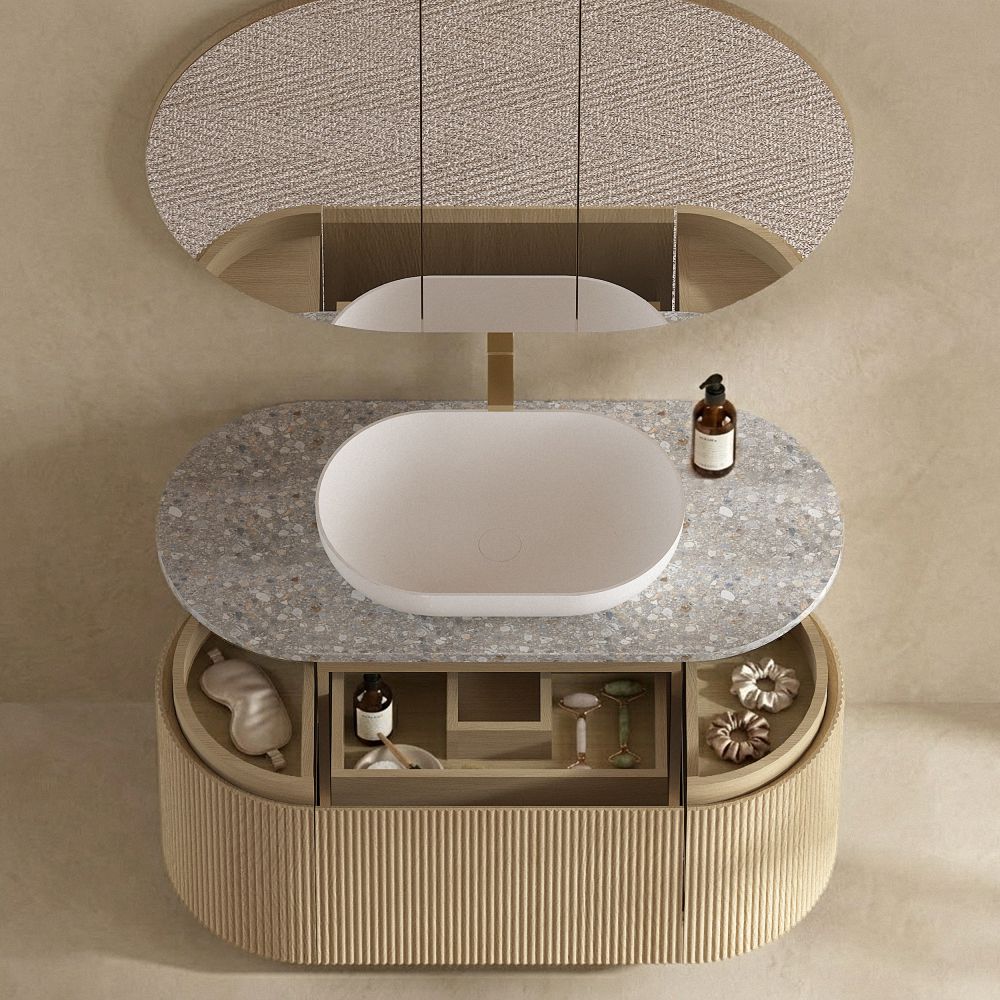
Floating bathroom vanity AS813109, documented in 800 mm and 900 mm cabinet variants with a terrazzo countertop and solid surface basin.
The short answer, stated up front: compare floating vanities in a fixed order — fit, storage, basin-and-countertop pairing, finish system, then hardware and compliance evidence — and score every model against the same weighted criteria before commercial terms are discussed. Buyers who begin with colour or price band typically re-specify after the drawings arrive.
The Problem: Catalogues Normalise What Buyers Need to Differentiate
Three forces flatten a floating vanity range on paper. First, vocabulary: plywood, solid wood, soft close and wall mounted are applied across models that behave differently. Second, photography: an 800 mm single-drawer cabinet and a 900 mm two-drawer cabinet photograph almost identically. Third, price-band shopping: a quotation is only comparable once the specification behind it is normalised, which rarely happens before the second commercial round.
The category itself has shifted. Wood-based construction, covering both solid wood and plywood, accounted for a 34.9% revenue share of the bathroom vanities market in 2025, according to Grand View Research. Once the substrate becomes common ground, differentiation moves down a level — to drawer architecture, basin and countertop pairing, documented dimensions and finish system. That is precisely the level at which most comparisons stop being structured.
The opportunity is procedural rather than technical. A written scoring sheet, applied identically to every model, turns three similar-looking cabinets into a shortlist that can be defended to a homeowner, a hotel operator or a project engineer. It also creates a record of what evidence was requested and what was actually supplied.
A Five-Step Comparison Framework
The weighting below is an editorial starting point for a typical residential or hospitality floating vanity, not an industry standard. Projects with fixed structural or compliance constraints should re-weight the criteria before scoring begins.
| Criterion | Suggested weight | Evidence that satisfies the criterion |
|---|---|---|
| Fit and dimensions | 30 | Dimensioned drawing: cabinet width, depth and height; mirror cabinet dimensions; wall fixing zone |
| Storage architecture | 25 | Drawer count and internal layout drawing; slide family and closing type |
| Basin and countertop | 20 | Basin material, countertop material, section drawing at the junction |
| Finish system | 15 | Lacquer and melamine specification; physical sample under project lighting |
| Hardware and compliance | 10 | Slide and hinge specification; management-system certificates; product-level test evidence |
Score each model from 0 to 5 on every criterion, multiply by the weight, and record the evidence that produced the score. A model that cannot produce evidence scores zero on that line rather than scoring on assumption. That single rule removes most of the ambiguity from a floating vanity shortlist.
Step 1 — Fix the Fit Constraints Before Anything Else
Dimensions are the only criterion that can disqualify a model outright, so they are scored first. For AS813109, the published specification documents two cabinet variants: AS813109-80 with an 800 × 469 × 408 mm cabinet and an 800 × 650 × 150 mm LED mirror, and AS813109-90 with a 900 × 469 × 408 mm cabinet and a 900 × 650 × 150 mm LED mirror. The 408 mm cabinet depth is the number to hold against door swing, basin projection and the position of wall-mounted tapware.
Depth is not a constant, even within one manufacturer's range. KL813003, a wall-mounted vanity from the same manufacturer, is documented across 750, 800, 900, 1000 and 1200 mm widths at 520 mm depth and 504 mm height. A 469 mm platform and a 520 mm platform behave differently in a narrow bathroom, so depth must be read per model and never assumed from the format.
For AS813050 and AS813108, the available specification does not state cabinet dimensions. That is not a reason to exclude them; it is a reason to hold them at zero on this line until a dimensioned drawing is issued. In practice, a shortlist that cannot produce a drawing within the first evaluation round is carrying undocumented risk into the tender.
Step 2 — Score Drawer Architecture Against Storage Behaviour
Drawer configuration is where these three floating models diverge most, and it is usually described in a single line that hides the difference.
- AS813050 documents one drawer on Unihopper soft-closing slides. A single drawer gives one uninterrupted internal volume, which suits projects where the cabinet stores a small number of long items rather than many small ones.
- AS813108 documents two drawers on Unihopper soft-closing slides. Two drawers divide storage into zones and reduce the depth a user has to reach into.
- AS813109 documents two side drawers, one outer drawer and one inner drawer, again on Unihopper soft-closing slides. Because that description defines structure rather than usable volume, buyers should request an internal elevation before scoring the model for storage.
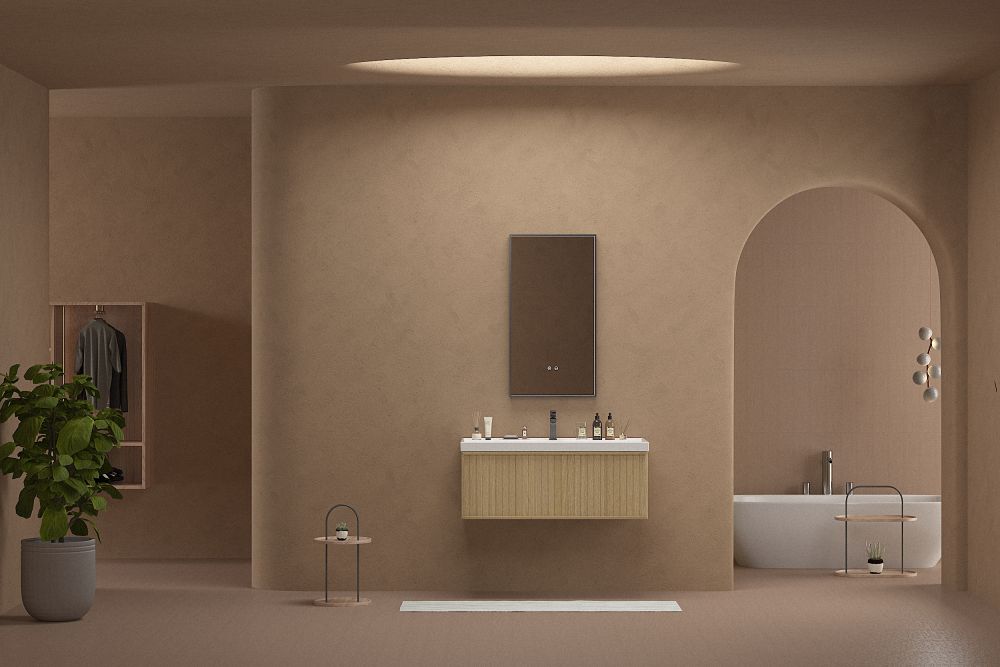
AS813050: one drawer on Unihopper soft-closing slides, glossy white ceramic basin, Ancora Walnut lacquered and melamine finish.
A point of confusion worth clearing in the scoring sheet: on AS813108 and AS813109 the DTC hinges relate to the mirror cabinet doors, not to the drawer boxes. Drawer movement on all three models is handled by the Unihopper slide family. Mixing the two lines in one comparison table produces false differences and inflates whichever model happens to publish the longer specification.
Step 3 — Treat Basin and Countertop as One Specification
The basin and the countertop are one assembly, one supplier responsibility and one line item. Read separately, they generate mismatched quotations and, later, mismatched deliveries.
- AS813050: glossy white ceramic basin. No separate countertop material appears in the published specification, so confirm whether the ceramic basin forms the visible top surface or whether a countertop is supplied with the cabinet.
- AS813108: ceramic basin paired with a solid surface countertop.
- AS813109: solid surface basin paired with a terrazzo countertop.
Two practical rules follow. First, ask for the section drawing at the basin-to-countertop junction for whichever pairing is shortlisted, because that detail determines edge thickness, visible rim and the cleaning line a housekeeping team will work with. Second, confirm that the mirror cabinet matches the cabinet width: AS813109 pairs an 800 mm mirror with an 800 mm cabinet and a 900 mm mirror with a 900 mm cabinet. An unmatched mirror is one of the most common late-stage substitutions in a floating vanity order.
Step 4 — Compare Finish Systems, Not Colour Names
Finish is the criterion most often scored from a photograph and the least suited to it. AS813050 is specified as Ancora Walnut lacquered and melamine. AS813108 and AS813109 are both specified as Warm Mist Brown lacquer and melamine. In each case the finish is a two-part system — a lacquered component and a melamine component — named by colour family rather than by process.
The comparison question is therefore not which colour name is preferable, but which faces are melamine, which are lacquered, and where the lacquer is applied. Those answers change the appearance under directional light and the maintenance profile in a wet room. For hotel and villa work, a physical sample viewed under the project's own lighting should be treated as a scored deliverable; a colour name is not evidence.
Substrate is not a differentiator inside this set. All three models are built on plywood and solid wood, so the finish system and the hardware are what actually separate them.
Step 5 — Verify Hardware and Compliance Evidence
Hardware is comparatively easy to normalise. All three models use Unihopper soft-closing slides. The mirror specification is where they separate: AS813050 carries a gun metal frame LED mirror with three colour temperatures, defog, dimming and two control buttons; AS813108 uses a three-door mirror cabinet with DTC hinges, an internal LED light strip and an infrared sensor switch; AS813109 uses an oval mirror cabinet in 3 mm copper-free glass with three doors on DTC hinges.
Compliance evidence sits at two levels, and they should not be conflated. At management-system level, the manufacturer of KL813003 holds ISO 9001:2015 (certificate 04924Q00629R0M), ISO 14001:2015 (04924E00351R0M) and ISO 45001:2018 (04924S00316R0M), all issued by Guangdong Quality Testing CTC Certification Co., Ltd. and valid from 11 May 2024 to 10 May 2027, with a scope covering the research, development and manufacture of bathroom cabinets. KL813003 is explicitly listed within that certified scope; buyers ordering a different model should ask for written confirmation that the model and its producing site fall inside the scope.
At product level, UL 962 is the reference standard covering stability, mechanical strength and flammability for bathroom cabinets and vanities in North America. A management-system certificate does not stand in for it. Asking a floating vanity supplier which product-level tests a specific model has been evaluated against is a legitimate evaluation question and belongs on the scoring sheet next to the certificate request.
The Three Models Side by Side
| Model | Drawer structure | Basin and countertop | Finish | Documented dimensions | Mirror |
|---|---|---|---|---|---|
| AS813050 | One drawer, Unihopper soft-closing slides | Glossy white ceramic basin; no separate countertop material listed | Ancora Walnut lacquered and melamine | Not stated in the published specification; request drawing | LED mirror, gun metal frame, three colour temperatures, defog, dimmable, two control buttons |
| AS813108 | Two drawers, Unihopper soft-closing slides | Ceramic basin with solid surface countertop | Warm Mist Brown lacquer and melamine | Not stated in the published specification; request drawing | Mirror cabinet, three doors with DTC hinges, internal LED light strip, infrared sensor switch |
| AS813109 | Two side drawers, one outer and one inner drawer, Unihopper soft-closing slides | Solid surface basin with terrazzo countertop | Warm Mist Brown lacquer and melamine | AS813109-80: cabinet 800 × 469 × 408 mm; AS813109-90: cabinet 900 × 469 × 408 mm | Oval mirror cabinet, 3 mm copper-free glass, three doors with DTC hinges; mirror 800 × 650 × 150 mm or 900 × 650 × 150 mm |
Read as a set, the three models show that a floating vanity range can be internally consistent on platform — plywood and solid wood, Unihopper soft-closing slides — and still differ on every decision the buyer has to make. That is why the scoring sheet, and not the range overview, should drive the shortlist.
Floating vs Freestanding: What Changes for the Buyer
Floating is a format decision before it is a model decision. A wall-hung cabinet releases floor area and removes the floor-to-cabinet junction that complicates cleaning in a wet room, but it transfers load into the wall. Wall build-up, fixing zone and the structural capacity of the wall must be confirmed before a floating model is specified; where that cannot be confirmed, a freestanding unit is the honest alternative rather than a downgrade.
This manufacturer's range includes a direct freestanding counterpart to the floating models discussed here. AS813049 is a freestanding vanity with a 450 × 450 × 890 mm cabinet, a single door on a DTC hinge with a Hettich push-open system, an internal sintered stone basin and an Ancora Walnut lacquered and melamine finish. Its footprint is a different design decision: it needs no wall-mounted fixing zone, and it consumes floor area instead.
The format split is also visible in demand. Floating, wall-mounted vanities are identified as a top design trend for 2025–2026, while freestanding units still hold a significant share of market volume in North America, at roughly 30%, according to Houzz and Homes & Gardens. A shortlist that contains only one format is a shortlist that has skipped a constraint.
Where the Framework Stops
A comparison framework is only credible if its limits are stated as clearly as its criteria.
- Width coverage. AS813109 is documented at 800 mm and 900 mm only. A 750 mm alcove or a 1200 mm twin-basin run cannot be served by that model, so a shortlist built exclusively on AS813109 will fail at both extremes; KL813003, documented at 750–1200 mm, is the wider platform in this range.
- Documentation gaps. Two of the three models do not state cabinet dimensions in the available specification. The framework holds them at zero on fit until drawings arrive, which delays rather than resolves the comparison.
- Wall dependency. No floating model can be scored without confirmation that the wall can carry it. That is a site question the framework cannot answer.
- Finish performance. The specification identifies lacquer and melamine components but does not predict how a finish behaves in a specific climate or cleaning regime. Sample validation, and for hospitality a housekeeping protocol, remain necessary.
- Price normalisation. Scoring produces a comparable specification, not a comparable price. Commercial comparison should begin only once the specification is fixed, otherwise a lower quotation may simply describe a different drawer count, basin material or mirror function.
Used properly, the framework produces a defensible shortlist rather than a guarantee. It tells a buyer exactly which questions remain open and which supplier has answered them in writing.
Application Fit: Residential, Hotel and Villa Projects
Residential work dominates the category — residential applications accounted for approximately 74.9% of bathroom vanity revenue share in 2025, per Grand View Research — and in residential projects the fit and storage criteria usually decide the model, with finish following.
Hospitality inverts the order. A documented hotel bathroom project delivered 250 units over two years, with on-time delivery, product meeting US market standards and high reported customer satisfaction. In that setting, repeatability of the specification matters more than variety within the range: one drawer architecture, one basin and countertop pairing, and one mirror function repeated across hundreds of rooms, with spare parts support behind it. The manufacturer states after-sales coverage including warranty support, remote after-sales consultation and spare parts supply, which is the relevant evidence for a multi-year hotel rollout rather than for a single bathroom.
Villa and upper-end residential work sits between the two. A documented Australian villa project covered 100 units of customized bathroom furniture, with stated requirements of moisture-proofing, mildew resistance and scratch resistance, and matched equipment including ceramic basins, LED mirrors, shower enclosures and faucets. Under those requirements the finish system and hardware verification move up the scoring order, and basin material becomes a cleaning decision rather than an aesthetic one.
Market Context: Why Configuration Now Decides
The global bathroom vanities market was valued at roughly USD 43.34 billion to USD 47.22 billion in 2024/2025, with projections reaching up to USD 89.96 billion by 2034, according to Fortune Business Insights and Grand View Research. Published estimates diverge widely — one alternative estimate places the 2024 global market at USD 9.2 billion — so any single figure should be read as directional rather than definitive.
The more decision-relevant signals are structural. Wood-based construction held a 34.9% revenue share in 2025. Floating formats are identified as a top design trend while freestanding retains roughly 30% of North American volume. Taken together, these point to a market where format and substrate are increasingly shared across suppliers, and where the defensible basis of comparison is configuration: drawer architecture, basin and countertop pairing, documented dimensions, finish system and compliance evidence. That is the layer this framework scores.
Future Outlook
Three shifts are likely to change how floating vanities are compared rather than what they are. First, dimensioned drawings and internal elevations are becoming routine expectations in an evaluation pack, because dimensional gaps are now the fastest way to lose a specification. Second, product-level test evidence will increasingly be requested alongside management-system certificates, particularly for North American hospitality work referencing UL 962. Third, model families rather than single models will be specified, because a project that needs 750 mm in one bathroom and 1200 mm in another cannot be planned around a narrow width range.
For buyers, the practical consequence is that comparison discipline becomes a sourcing asset. A weighted sheet with recorded evidence survives staff changes, supplier changes and value-engineering rounds, which is more than can be said for a shortlist assembled from catalogue images.
FAQ
What should be compared first when shortlisting floating bathroom vanities?
Fit. Cabinet width, depth and height, together with the mirror cabinet dimensions, decide whether a model can be used at all. AS813109 illustrates why: AS813109-80 documents an 800 × 469 × 408 mm cabinet with an 800 × 650 × 150 mm mirror, while AS813109-90 documents a 900 × 469 × 408 mm cabinet with a 900 × 650 × 150 mm mirror. Where a specification does not state cabinet dimensions, the model should be held pending a dimensioned drawing rather than scored on assumption.
How do one-drawer and two-drawer floating vanities differ in practical storage?
They differ in how internal volume is divided, not simply in how many handles are visible. AS813050 documents one drawer on Unihopper soft-closing slides, giving a single uninterrupted internal volume. AS813108 documents two drawers on the same slide family, dividing storage into zones. AS813109 documents two side drawers with one outer drawer and one inner drawer, a structure that should be confirmed with an internal elevation before storage is scored.
Is a ceramic basin or a solid surface basin easier to maintain?
The specifications define the pairing, not the maintenance outcome. AS813050 uses a glossy white ceramic basin, AS813108 pairs a ceramic basin with a solid surface countertop, and AS813109 pairs a solid surface basin with a terrazzo countertop. Because cleaning performance depends on the finished surface and the cleaning regime rather than on the material name alone, buyers should request a physical sample and a care instruction for the specific pairing under consideration.
Which certificates should a floating vanity supplier be asked to provide?
At management-system level, ISO 9001:2015, ISO 14001:2015 and ISO 45001:2018 are the relevant references. The manufacturer of KL813003 holds these under certificate numbers 04924Q00629R0M, 04924E00351R0M and 04924S00316R0M, issued by Guangdong Quality Testing CTC Certification Co., Ltd., valid from 11 May 2024 to 10 May 2027, with a scope covering the research, development and manufacture of bathroom cabinets. Buyers should also ask for written confirmation that the ordered model and its producing site fall inside that scope, and, for North American projects, which product-level tests the model has been evaluated against, with UL 962 as the usual reference for cabinet stability, mechanical strength and flammability.
What order quantities and lead times apply to floating vanity production?
The manufacturer documents an OEM production mode with a minimum order quantity of 50, a lead time of 30–45 days, a monthly capacity of 10,000 units, 100% inspection and export markets covering North America, Europe, Oceania and the Middle East. Customisation is stated to cover size, colour, material, finish, hardware, logo and design style. These figures should be re-confirmed per model and per finish, since a two-part lacquer finish and a solid surface top may affect both schedule and minimum quantity.
How should Ancora Walnut and Warm Mist Brown finishes be compared?
As processes, not as colours. AS813050 is specified as Ancora Walnut lacquered and melamine; AS813108 and AS813109 are both specified as Warm Mist Brown lacquer and melamine. In each case the finish combines a lacquered component with a melamine component, so the comparison should establish which faces are melamine, which are lacquered, and how the two read under the project's lighting. A physical sample is the only reliable basis for that decision.
Detailed model specifications, finish options and hardware configurations for the floating vanity range are compiled in the manufacturer's product brochure, available for download: SHKL product brochure (PDF).
Есть вопросы или нужны дополнительные детали?
Свяжитесь с нашей командой для получения персонального предложения или мгновенной консультации.
Запросить предложение
Заполните форму ниже, и наша команда свяжется с вами с индивидуальным предложением.
Прямой чат WhatsApp
Предпочитаете общаться в реальном времени? Напишите нам в WhatsApp для мгновенной помощи и быстрых ответов.
- Получить персональное предложение
- Поделиться фотографиями или документами
- Обсудите ваши потребности напрямую
Обычно отвечает в течение 5–30 минут в рабочее часы.