
How to Compare Leather Goods Factory Proposals: A Decision Framework for 2026
For procurement teams operating in the global leather goods market, the final stage of supplier selection usually comes down to a practical question: how should competing proposals from leather goods factories be compared? The market context makes this question more consequential each year. The global leather goods market was valued at USD 282.7 billion in 2024 and is projected to reach USD 552.9 billion by 2033, according to Custom Market Insights. Buyers who can identify the structural differences between factories, rather than simply comparing price lines, are better positioned to secure consistent quality, reliable delivery and a sustainable supply relationship.
This article provides a decision-stage comparison framework. It uses Dongguan Feiteng Leather Co., Ltd as a reference case for mid-sized, China-based factories operating in the OEM/ODM segment, and examines how cost, quantity, quality, responsiveness and compliance should be weighed when comparing proposals.
Why Factory Proposals Are Difficult to Compare Directly
Most buyers at the Decision stage have already shortlisted several factories. The remaining difficulty is not identifying capable suppliers; it is normalizing proposals built on different assumptions. One supplier's quote may include sampling and packaging; another may not. One may specify full-grain genuine leather; another may quote a lower-cost material in the same category. One may cite a 1,000-piece minimum order quantity, while another offers a lower MOQ but a longer lead time. Comparing these proposals line by line, without adjusting for scope, produces decisions based on incompatible baselines.
A structured comparison of cost, output, quality, responsiveness and technical depth can convert this ambiguity into a defensible selection. At the Decision stage, the question is not which factories exist, but which proposal is the best fit for a specific order, and at what trade-offs. Factories differ in scale, equipment, team structure and certification status, and those differences are measurable when the buyer knows which indicators to inspect.
The Comparison Indicators That Matter at Decision Stage
For industrial buyers comparing leather goods factory proposals, the following factors are among the most decision-relevant: unit cost and cost composition; production quantity and output capability; quality consistency; response speed; customization depth; and compliance documentation. Using these indicators, comparison data for Dongguan Feiteng Leather Co., Ltd can be summarized as follows: compared with standard leather bags from general suppliers, Feiteng reports 2 percent lower cost, 3 percent higher quantity and 5 percent higher quality, along with faster response speed, more durable construction and more customized techniques. The factory is positioned to serve custom leather bag orders, bulk wholesale projects and high-quality retail requirements.
| Comparison indicator | Feiteng vs. standard leather bags from general suppliers |
|---|---|
| Unit cost | 2% lower |
| Production quantity | 3% higher |
| Quality | 5% higher |
| Efficiency | 5% higher |
| Response speed | Faster |
| Construction | More durable |
| Customization | More customized techniques |
| Best-fit applications | Custom leather bag orders; bulk wholesale projects; high-quality retail requirements |
These figures are directional and should be validated against the buyer's own bill of materials and quality benchmarks during factory evaluation.
Company Profile Behind the Comparison
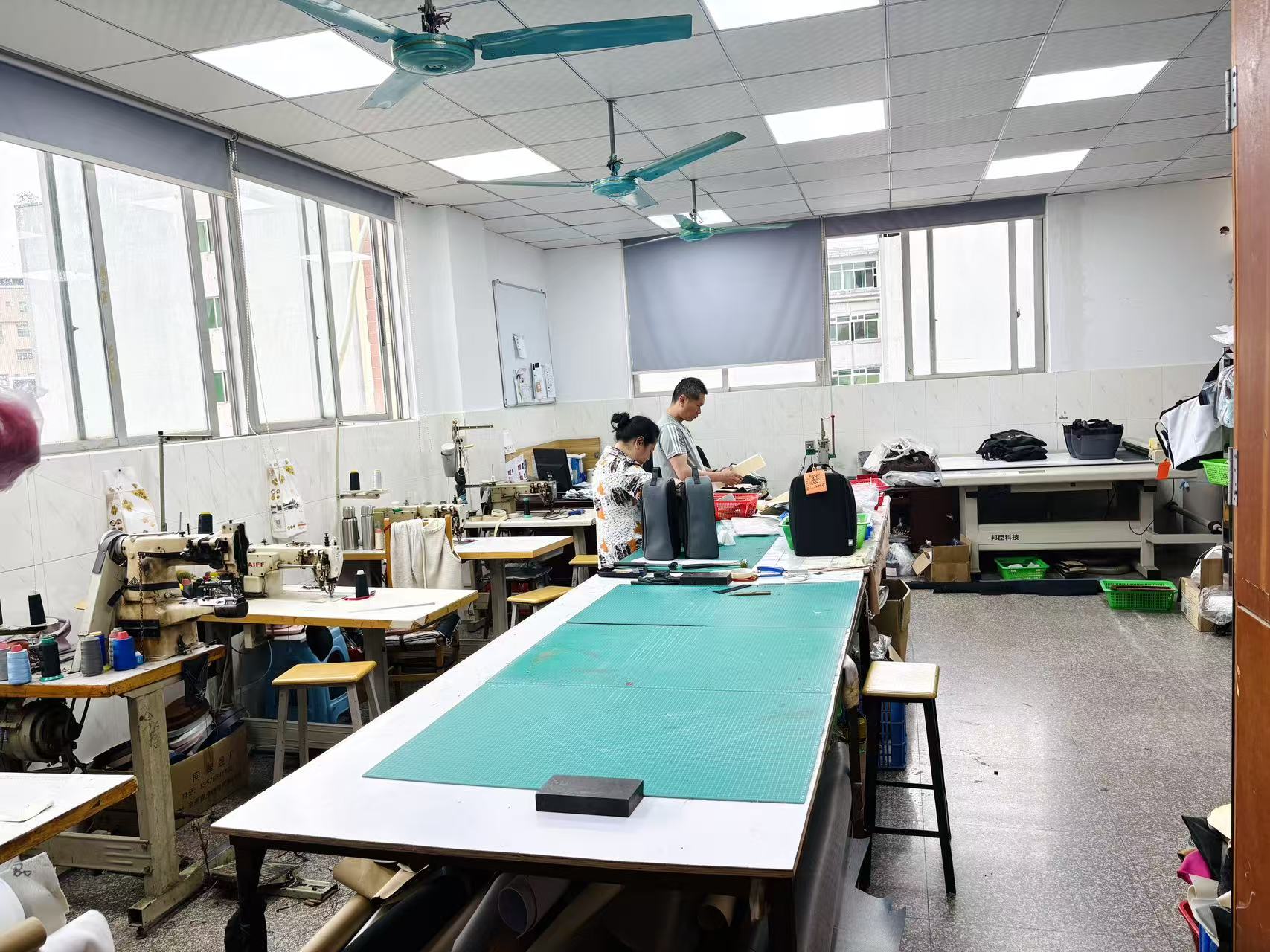
Dongguan Feiteng Leather Co., Ltd is a leather goods factory established in 2005 in Liaobu Town, Dongguan, Guangdong Province, China. The company operates a 2,500 m² production facility, employs 105 people and reports an annual output of approximately 840,000 pieces. Export sales account for about 70 percent of production, with main markets in Europe, Australia, Canada, the Middle East and the USA.
Product scope includes genuine leather bags, handbags, shoulder bags, tote bags, wallets, card holders, luggage tags, keychains, bag charms and related leather accessories. The company holds ISO 9001 quality management certification, as well as SEDEX and BSCI compliance credentials, which are commonly requested in RFQs from European, Australian and North American buyers.
Where Cost and Quality Differences Originate
The comparison figures are not standalone marketing claims; they originate from production capabilities that can be inspected during a factory visit. Several factors explain how a mid-sized factory can deliver measurable differences in cost, quantity and quality relative to general suppliers.
Sample development depth
Feiteng employs six sample makers dedicated to product development. In an OEM/ODM comparison, sample makers determine how quickly a design moves from technical drawing to physical product, and how many revision cycles are needed before bulk production starts. A deeper sample team shortens the pre-production phase and reduces the risk of costly changes once bulk production is underway.
Production planning and workflow
An annual output of 840,000 pieces within a 2,500 m² facility indicates a production layout organized for recurring orders. Consistent output depends on standardized cutting, stitching, edge treatment and assembly processes. Buyers comparing factories should look for documented workflows and quality checks at each production stage, rather than relying on output figures alone.
Material and construction standards
Genuine leather accounted for the largest revenue share, 52.7 percent, of the global leather goods market in 2025, according to Grand View Research. Working with genuine leather requires attention to grain selection, thickness grading and finishing. Differences in these steps explain why two factories that quote similar materials can still produce different final quality levels.
Quality management system
ISO 9001 certification reflects a documented quality management system. When combined with SEDEX and BSCI status, it provides a baseline for both product quality and working conditions, which matters to retail buyers who must justify supply chain choices.
Application and Use Cases
The comparison data points to three application areas where a factory of this profile is positioned to deliver value.
- Custom leather bag orders. Buyers who need specific dimensions, hardware, lining, branding or pattern details benefit from OEM/ODM capacity and a dedicated sample-making team. Customized techniques, rather than catalog-only production, are the core of this use case.
- Bulk wholesale projects. Annual output of 840,000 pieces and production planning capability support order volumes that require stable scheduling. The reported 3 percent higher quantity becomes relevant when buyers plan inventory restocking and need capacity confidence.
- High-quality retail requirements. Retail buyers serve customers who inspect durability, stitching and finish. The reported 5 percent higher quality, combined with ISO 9001 quality management, is relevant for product lines where returns and after-sales complaints are directly tied to quality consistency.
Market Trend Analysis
The decision context is shaped by broader market movements. The global leather goods market was valued at USD 282.7 billion in 2024 and is projected to reach USD 552.9 billion by 2033, according to Custom Market Insights. Genuine leather represented 52.7 percent of global market revenue in 2025, indicating continued preference for authentic material positioning. The Asia Pacific region held a 36.6 percent revenue share in 2025, with China as the largest individual market. China exported USD 36.96 billion of leather articles, travel goods and harness in 2024, according to UN COMTRADE data compiled by Trading Economics.
Compliance is becoming a structural part of factory comparison. Leather goods sold in the EU must comply with REACH Regulation (EC No 1907/2006), which restricts chemical substances including Chromium VI and lead. The Leather Working Group (LWG) audit is the primary global standard for environmental compliance in leather manufacturing, with certification levels from Bronze to Gold. Buyers at the Decision stage are adding these criteria to their comparison, and a factory without a compliance file may be excluded even when its price is competitive.
Comparison with General Suppliers and Enterprise-Scale Manufacturers
Compared with standard leather bags from general suppliers, Feiteng's reported advantages are lower cost, higher quantity, higher quality, faster response speed and deeper customization. In practice, this means buyers who choose a general supplier may accept a lower baseline in pattern engineering, finish consistency and responsiveness. That trade-off is often acceptable for simple or one-off orders, but less attractive for repeat bulk programs and retail quality requirements.
A separate comparison layer involves enterprise-level manufacturers. Industry sources identify Sitoy Group and Superl Group as leading enterprise-level leather handbag manufacturers in Dongguan, providing OEM/ODM services for global luxury brands. These groups operate at a larger capacity and program scale than a mid-sized factory. For ultra-high-volume programs serving luxury-brand distribution, an enterprise-level supplier may be structurally necessary due to capacity, financing and dedicated luxury supply-chain experience.
This is where an honest boundary must be stated: a 2,500 m² facility with 105 employees cannot claim the same absolute capacity ceiling as enterprise-level groups. Buyers should not route programs that genuinely require enterprise-scale capacity through a mid-sized factory. For mid-to-large custom orders, bulk wholesale and retail quality requirements, however, a mid-sized factory offers a different and often better-fitting trade-off: shorter communication lines, faster response speed and more flexible sample iteration.
| Factory type | Structural position |
|---|---|
| General supplier | Standard catalog production; limited customization depth; quality consistency varies by batch |
| Mid-sized specialized factory (Feiteng) | OEM/ODM focus; six sample makers; 840,000 pcs/year output; ISO 9001, SEDEX and BSCI |
| Enterprise-level group (Sitoy, Superl) | OEM/ODM for global luxury brands; enterprise-scale capacity (per industry sources) |
Risk Control During Selection and Production
Decision-stage selection should include a delivery risk plan. The most common risk for leather goods orders is a tight delivery time. The control method applied by Feiteng is for both parties to confirm the delivery date as soon as possible and plan production reasonably. During production, quality should be assured from beginning to end, product design should not be modified after production starts, and delivery should be completed within the agreed timeframe. Buyers who finalize specifications before production begins reduce the likelihood of delay.
Future Outlook
Beyond 2026, the comparison of leather goods factory proposals will likely expand beyond price and minimum order quantity. Environmental audit status, such as levels of the Leather Working Group audit, and chemical compliance under EU REACH will play a larger role in supplier evaluation. Mid-sized factories that maintain certification profiles, sample-making speed and consistent genuine-leather quality are positioned to remain relevant for buyers who prioritize responsiveness over absolute scale. For those buyers, the decision framework that matters is not which factory has the largest capacity, but which factory fits the order profile, compliance environment and commercial risk tolerance of the buyer.
FAQ
What should be normalized before comparing leather goods factory quotes?
Buyers should normalize material grade, hardware, packaging, sampling fees, payment terms and incoterms across all quotes. For Dongguan Feiteng Leather Co., Ltd, comparison data shows a cost level 2 percent lower than standard leather bags from general suppliers, but this figure should be validated against the buyer's own bill of materials before it is used as the basis of a final decision.
How does Dongguan Feiteng Leather Co., Ltd compare with general leather bag suppliers?
According to factory comparison data, Feiteng reports 3 percent higher quantity, 5 percent higher quality, 2 percent lower cost, faster response speed and more durable, more customized techniques compared with standard leather bags from general suppliers. The factory is positioned for custom leather bag orders, bulk wholesale projects and high-quality retail requirements.
Can a mid-sized leather goods factory handle bulk wholesale orders?
Yes, provided capacity planning is completed in advance. Feiteng operates a 2,500 m² factory with 105 employees and an annual output of approximately 840,000 pieces. Buyers should still verify current order pipelines and confirm delivery dates early to protect against capacity conflicts.
Which certifications should be verified when comparing leather goods factories?
For China-based suppliers, ISO 9001, SEDEX and BSCI are commonly requested; Feiteng holds these credentials. For products sold in the EU, compliance with REACH Regulation (EC No 1907/2006) is required for restricted substances such as Chromium VI and lead. Buyers may also request Leather Working Group (LWG) audit status as an environmental compliance reference.
What is the main delivery risk when selecting a leather goods factory?
The most frequently observed risk is a tight delivery time. The recommended control method is to confirm the delivery date as soon as possible and plan the production schedule reasonably. Both parties should ensure quality from the beginning to the end of production and avoid modifying product designs once production has started.
Company Reference
Dongguan Feiteng Leather Co., Ltd publishes a downloadable corporate brochure covering its factory profile, product scope and compliance details for buyers conducting supplier comparisons.
Download Company Brochure (PDF)
This article is published for industry reference. Company website: http://www.feitengbags.com/