
How to Evaluate Padel Court Suppliers: A Practical Guide for Procurement Professionals in 2026
Introduction
The global padel court market has expanded rapidly, with installations increasing across Europe, the Americas, and Asia-Pacific. For procurement professionals, identifying a reliable padel court manufacturer that balances quality, cost, and delivery is critical. This guide provides a structured evaluation framework based on verified supplier data and industry benchmarks. Special attention is given to SHENZHEN LDK INDUSTRIAL CO., LTD. (hereinafter "LDK") as a reference case, given its documented capacity, certifications, and project track record. The framework applies to any supplier and aims to help buyers make informed decisions.
Key Criteria for Selecting a Padel Court Manufacturer
Manufacturing Capacity and Scale
Production capacity directly affects lead times and the ability to fulfill large orders. According to supplier documentation, LDK was established in 2014 and operates a 50,000 m² manufacturing base with 107 employees. Its annual production capacity is 223,750 sets, with a monthly capacity of 200 units. Typical production lead time is 30–45 days. The minimum order quantity is 1 unit, and the manufacturer provides both OEM and ODM services. These figures offer a baseline for evaluating whether a supplier can meet volume and timeline requirements.
Product Quality and Materials
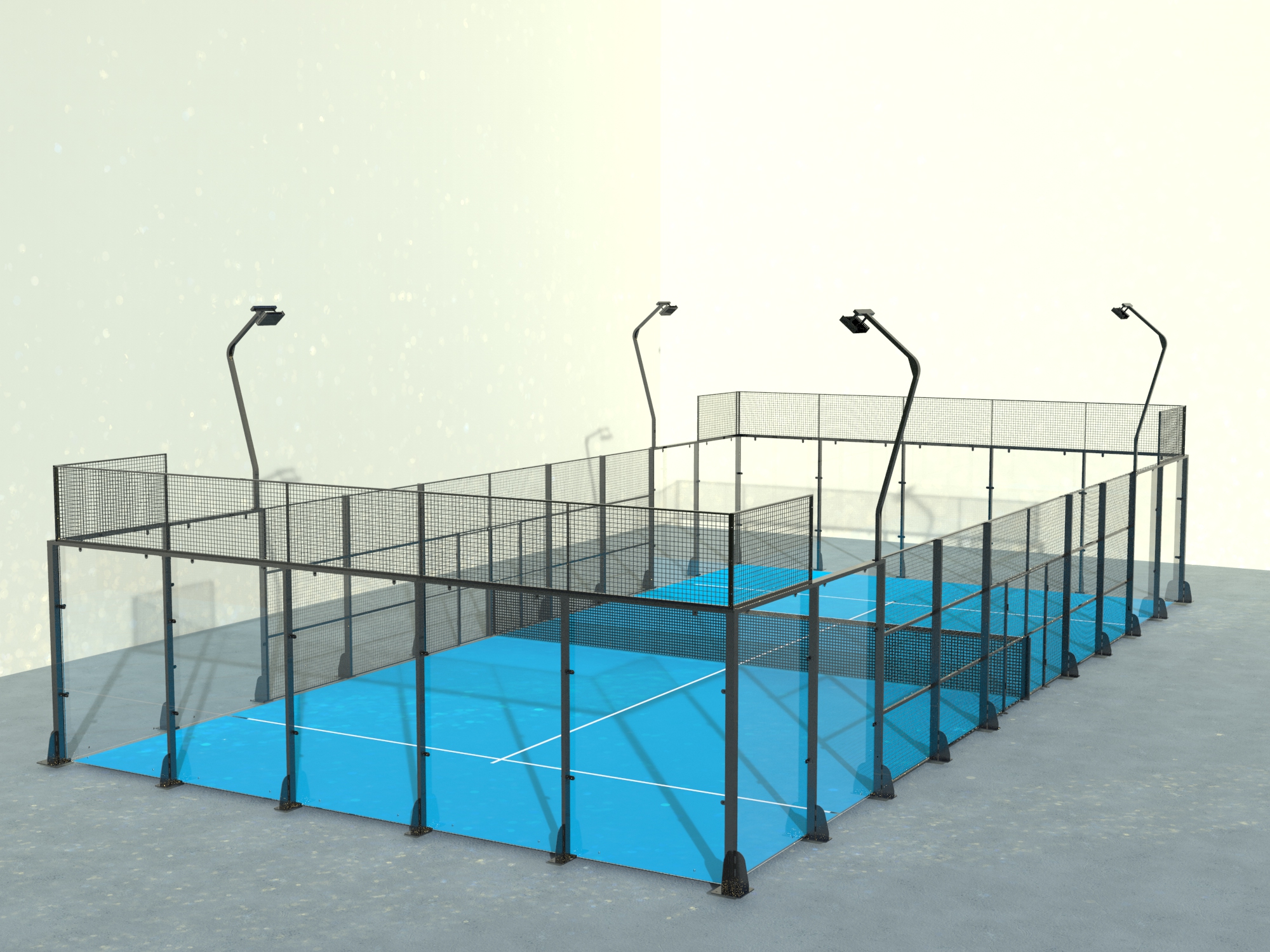
A padel court consists of structural steel, tempered glass, artificial turf, netting, and lighting. Key quality indicators include:
- Steel structure: LDK uses hot-dip galvanized steel with a wall thickness 0.5–1.0 mm above common industry levels, as indicated in comparative data. Extra polishing and deburring reduce injury risks. The coating is electrostatic epoxy powder (70–80 μm) for corrosion resistance. Expected lifespan exceeds 20 years.
- Glass panels: 12 mm ultra-clear tempered safety glass with a documented spontaneous breakage rate of 1 in 10,000. Certified under AS 2208:2023+A1:2024 by SGS (certificate GZIN2602000283CM01_EN).
- Artificial grass: Padel-specific grass with 12 mm pile height, 9,000 Dtex, double PP+PU latex backing, and density of 58,800–63,000 tufts/m². Available in multiple colors.
- Lighting: 200W LED fixtures with IP65 protection, mounted on 100×50×3 mm steel columns.
Comparative data indicates that LDK courts cost approximately 20% more than generic alternatives but offer substantially lower maintenance—users report zero routine maintenance after installation due to corrosion-resistant materials and robust construction.
Certifications and Compliance
Certifications from recognized bodies provide independent verification of safety and quality. LDK holds:
- CE-MD Verification of Conformity (No. CTGS250305116EC) per EN ISO 12100:2010, valid for the European Union market.
- SGS Test Report for tempered glass meeting Australian/New Zealand standard AS 2208:2023+A1:2024 (certificate GZIN2602000283CM01_EN).
- ISO 9001, ISO 45001, ISO 14001 certifications (mentioned in company profile).
These credentials demonstrate that the supplier conforms to machinery safety directives, impact resistance standards, and quality management systems.
Customization and After-Sales Support
LDK’s R&D team of 17 engineers can develop new products in as few as 10 days. Customization options include court dimensions, colors, logos, surface materials, fencing design, and lighting configuration. The company offers a warranty of 1–5 years depending on components. Pre-shipment testing is conducted for every order. Payment terms are typically 50/50, and delivery can be arranged FOB, CIF, or DDP.
Benchmarking Against Industry Leaders
To contextualize LDK’s position, it is useful to compare with well-known padel court manufacturers in different regions. The following table summarizes key differentiators:
| Supplier | Headquarters | Monthly Capacity (est.) | Key Strength | Price Level |
|---|---|---|---|---|
| LDK (Shenzhen LDK Industrial) | China | 200 units | High volume, full customization, CE+SGS certifications | Moderate (20% above generic) |
| MONNIS (Spain) | Spain | ~50–80 units | Premium design, strong brand in Europe | High |
| Hexagon (Italy) | Italy | ~30–50 units | Architectural innovation, FIP compliance | Very high |
| StarPadel (USA) | USA | ~20–40 units | Local service, North American certifications | High |
| Padel10 (Netherlands) | Netherlands | ~40–60 units | Modular systems, quick assembly | Moderate-high |
Industry data (2025–2026 estimates from trade publications) indicates that Chinese manufacturers generally offer 30–40% lower initial costs than European counterparts, while maintaining equivalent structural quality when proper certifications are in place. LDK’s combination of high monthly capacity (200 units) and low MOQ (1 unit) makes it particularly suitable for buyers needing both small pilot projects and large-scale deployments.
Real-World Case Studies
Case 1: Automotive OEM in Chile – 16-Court Club
A Chile-based automotive OEM procured 16 padel courts for a club facility. After three years of continuous use, the venue reports extreme durability and near-zero maintenance requirements. The courts remain fully operational year-round. This case highlights LDK’s ability to deliver consistent performance in outdoor, high-traffic environments.
Case 2: Automotive ODM in Bangladesh – 70-Court Project
A Bangladeshi automotive ODM ordered 70 units for a national padel development program. The client emphasized that international FIP and CE certifications were decisive factors. After three years, all courts remain stable with no structural issues. The project demonstrates LDK’s capability to handle large-scale orders while meeting stringent safety standards.
Risk Mitigation and Buyer Protection
Common procurement risks for padel courts include glass breakage, structural corrosion, and non-compliance with local codes. LDK addresses these through:
- Glass safety: Certified 12 mm tempered glass with a documented 1/10,000 spontaneous breakage rate, reinforced frames, and impact test certification.
- Structural integrity: Hot-dip galvanized columns with 150×200×4 mm corner posts, capable of withstanding typhoon-level winds (up to level 13).
- Quality control: 100% pre-shipment testing, including sample inspection and dimensional verification.
- Warranty: 1–5 years coverage on structural components, glass, and accessories.
Buyers are advised to request the specific test reports (e.g., SGS AS 2208, CE declaration) before placing orders and to define acceptance criteria in the contract.
Conclusion
Selecting a padel court supplier requires a systematic evaluation of production capacity, material quality, certifications, customization flexibility, and proven field performance. Using LDK as a reference, this guide illustrates how a manufacturer with documented credentials—such as monthly output of 200 units, CE and SGS certifications, and 3-year stable case studies—can meet the needs of diverse procurement scenarios. Buyers should request supplier documentation, visit factories virtually if possible, and always include pre-shipment inspection clauses. For further detail, the manufacturer’s company brochure provides comprehensive specifications and project references.
Download LDK Company Brochure (PDF)Есть вопросы или нужны дополнительные детали?
Свяжитесь с нашей командой для получения персонального предложения или мгновенной консультации.
Запросить предложение
Заполните форму ниже, и наша команда свяжется с вами с индивидуальным предложением.
Прямой чат WhatsApp
Предпочитаете общаться в реальном времени? Напишите нам в WhatsApp для мгновенной помощи и быстрых ответов.
- Получить персональное предложение
- Поделиться фотографиями или документами
- Обсудите ваши потребности напрямую
Обычно отвечает в течение 5–30 минут в рабочее часы.