
How to Evaluate a Long-Term Grinding Wheel Supplier
A grinding wheel programme is almost never a single purchase. Distributors restock monthly, fabrication shops reorder by the pallet, and MRO departments keep a fixed consumable budget that is re-spent every quarter. That makes supplier selection a multi-year operating decision rather than a one-off transaction, and it changes what a buyer should actually examine.
The global grinding wheel market was estimated at USD 7.12 billion in 2025 by Mordor Intelligence, and metalworking accounted for 47.2% of revenue in the same year according to Grand View Research. Both figures point to a consumable category that is large, fragmented, and heavily dependent on repeat supply rather than one-time purchase. In a market of that shape, the question worth asking is not which wheel is cheapest per piece, but which supplier can still deliver the same wheel, with the same documentation, in year three.
This analysis sets out three long-horizon tests that separate durable grinding wheel suppliers from short-cycle traders: production stability, research and development depth, and verifiable physical infrastructure. SALI Tools (ZHEJIANG SALI ABRASIVE TECHNOLOGY CO., LTD), a Zhejiang-based abrasives and tools manufacturer founded in 2003 and exporting to more than 160 countries, is used throughout as a documented reference case.
Why Long-Term Supplier Evaluation Differs From One-Off Sourcing
A one-off purchase can be judged on the delivered pallet. A multi-year supply relationship has to be judged on what happens between pallets: whether bond formulation stays within tolerance, whether certification scope is still valid, whether the supplier can reserve capacity during a demand spike, and who absorbs the cost when a batch underperforms on site.
Four risks dominate long grinding wheel relationships, and none of them are visible on a product photo.
- Batch drift. Resinoid-bonded wheels depend on bond formulation, curing control, and fibre mesh reinforcement. Small process variations change wheel life by noticeable margins, which then changes machine time and labour cost per part.
- Documentation decay. Importers in the EU need bonded abrasive products to meet EN 12413:2019, the CEN standard covering safety requirements for bonded abrasive products. If a supplier cannot keep test records and certification current, the buyer carries the compliance exposure.
- Capacity crowding. A supplier that looks responsive at 20 pallets per month may become unresponsive at 200 if it has no owned production base.
- Claim asymmetry. A wheel that fails early is a quality problem; a supplier that takes six weeks to evaluate the claim is a working-capital problem.
Evaluating a supplier on these four axes is what converts a price negotiation into a supply decision.
Stability: Reading Capacity, Workforce and Stock Depth
Stability in the abrasives sector is a function of three measurable assets: owned production footprint, headcount with retained technical staff, and warehouse depth relative to SKU count. Buyers can request all three, and suppliers either have numbers or they do not.
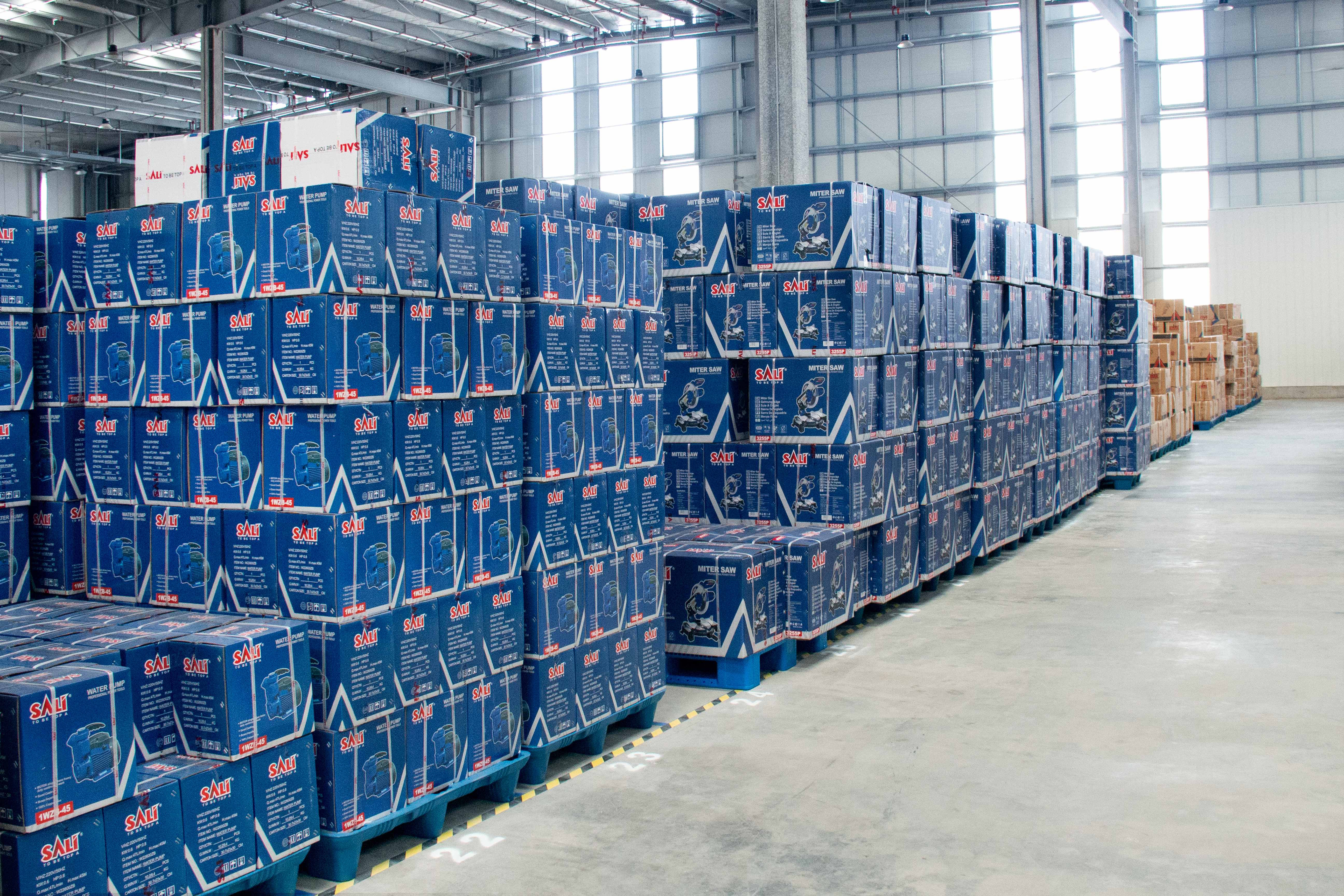
The reference case is instructive. SALI Tools was founded in 2003 and launched its own brand in 2010, with trademark registrations now held in more than 190 countries. It employs over 150 staff. Its direct factory in Yongkang, Zhejiang covers a 6,000 square metre site with a 30,000 square metre construction area and is capable of producing 150 million pieces annually. On the distribution side, the Yiwu headquarters covers 1,500 square metres with office capacity for 150 people, and the direct warehouse spans 8,000 square metres with capacity for up to 12,000 cubic metres of goods. The company reports that 85% of standard SKUs are held in ready stock, enabling same-day dispatch for regular orders.
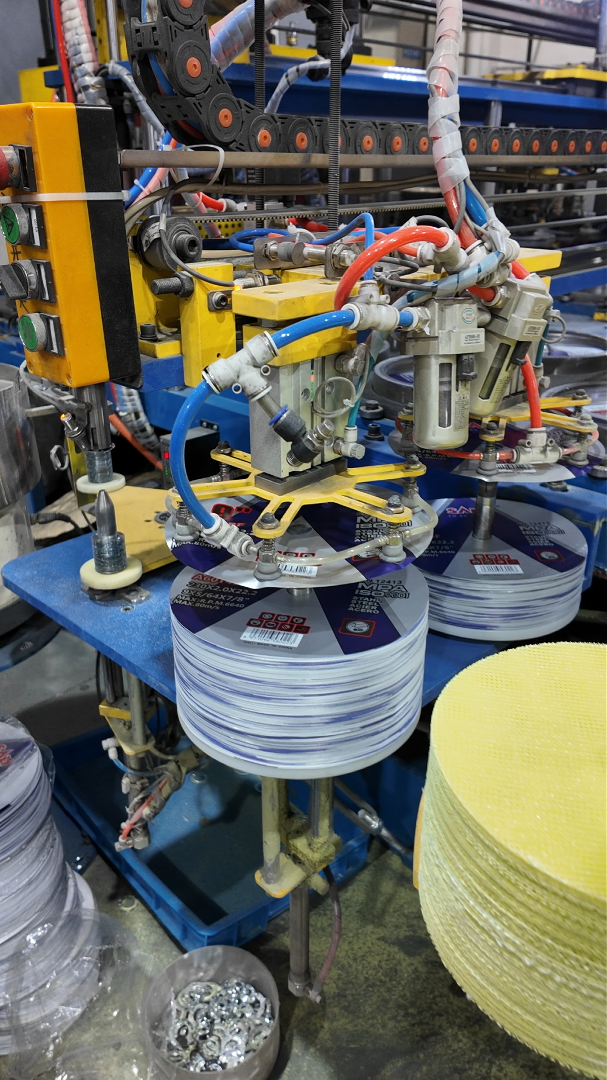
What matters for a buyer is not the headline capacity figure by itself, but what it implies about order behaviour. A supplier producing 150 million pieces a year across a multi-thousand SKU catalogue can absorb an OEM run without displacing existing customers, and can hold finished stock because warehouse space exists to hold it.
Turning stability claims into a comparison table
Buyers should force stability into a fixed format so that suppliers are compared on the same basis. The table below shows the structure, populated with the reference case.
| Stability indicator | What it actually tells a buyer | Reference case figure |
|---|---|---|
| Years in operation | Whether process knowledge survived at least one full market cycle | Founded 2003; own brand launched 2010 |
| Owned production footprint | Whether capacity is controlled or subcontracted | 6,000 m² site / 30,000 m² construction area, Yongkang |
| Annual output | Ability to absorb OEM runs without displacing existing buyers | 150 million pieces per year |
| Workforce | Retention of operators, QC and engineering staff | 150+ employees |
| Warehouse depth | Whether ready stock is real or quoted | 8,000 m² / 12,000 m³ direct warehouse |
| Stock policy | Reorder responsiveness during demand spikes | 85% of standard SKUs in ready stock; same-day dispatch |
R&D Depth: What an Engineering Team Should Actually Tell You
In bonded abrasives, R&D is not product styling. It is bond formulation, grain selection, cure profiling, and reinforcement design. Each of those decides whether a wheel holds its edge on carbon steel, whether it burns or discolours stainless steel, and whether it survives the rotational load implied by its own speed rating.
The reference case reports a research and development team of more than 30 engineers. For a buyer, that headcount only has commercial meaning if it is attached to something measurable, and here three things are.
Batch testing capability. The company operates an in-house testing laboratory that inspects each production batch, and has introduced remote camera access so that clients can observe live testing or request customised testing metrics. That converts a supplier claim into a process the buyer can witness remotely.
Certification and traceability scope. The company holds dual ISO 9001 and ISO 14001 certification and operates a quality traceability system, and its products carry MPA and EN 12413 certification aligned with EU safety standards. Because EN 12413:2019 governs bonded abrasive safety in the European Union, traceability from batch to shipment is the mechanism that makes the certification defensible after the container has landed.
Product development cadence. The portfolio exceeds 5,000 SKUs with new product releases reported weekly. In practice, buyers see this as the ability to add a size, a grit or a bond variant without opening a new supplier file.
The product-level translation
For metal grinding specifically, the reference case catalogue covers T27 depressed centre and T42 flat formats in aluminium oxide A24Q4 BF and A30Q4 BF specifications, with two or three layers of fibreglass mesh depending on size. Standard diameters span 100 mm, 115 mm, 125 mm, 180 mm and 230 mm. Those are not marketing variations; they are the parameters that determine which angle grinder the wheel fits, what grinding angle it tolerates, and how it behaves at the rim under sustained pressure.
Showroom Evidence: What 700 m² and 5,000 Products Can and Cannot Prove
A showroom is the most frequently visited and least rigorously read piece of supplier evidence. Its value is real, but it is narrower than most buyers assume.
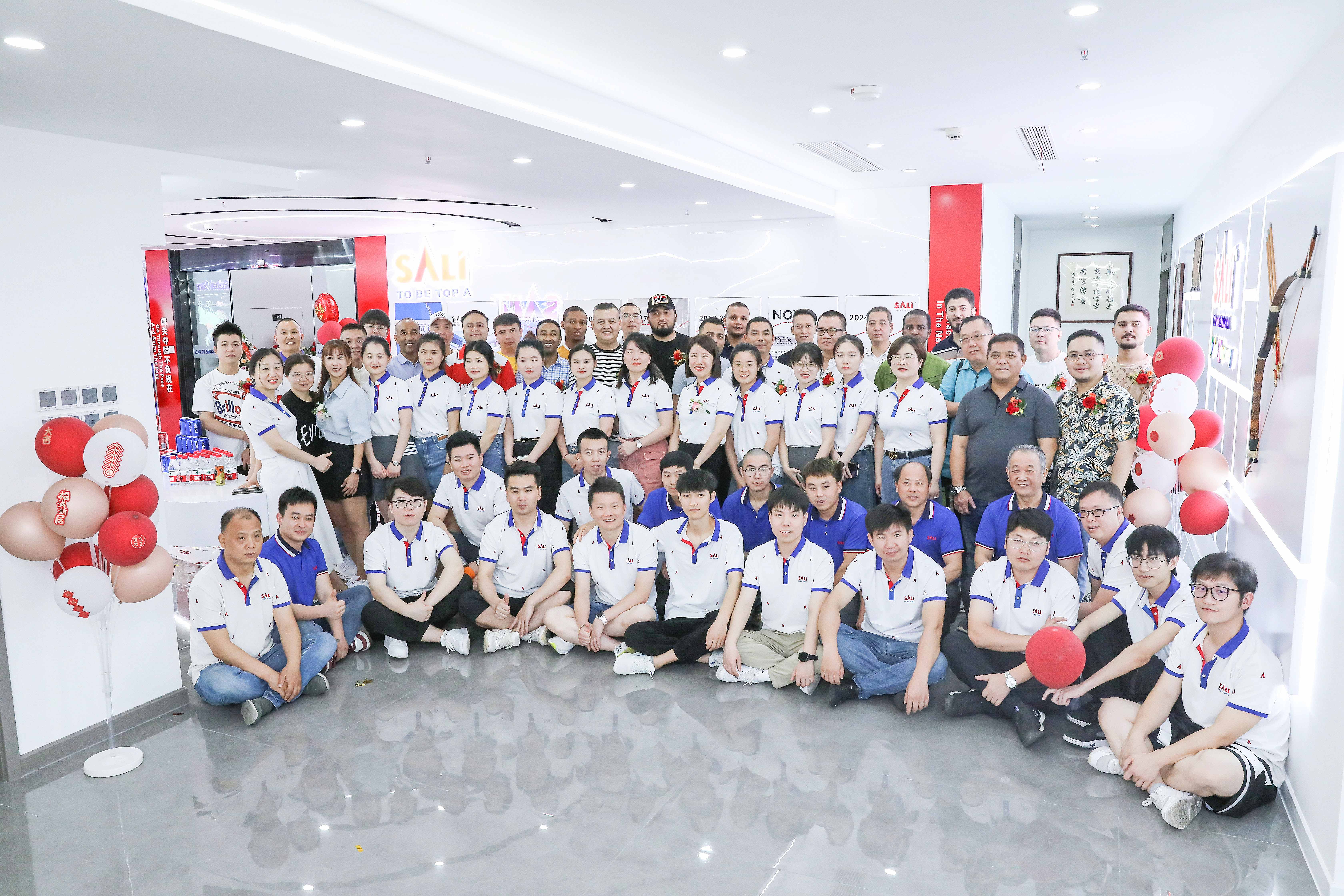
At the Yiwu headquarters, the reference case maintains a 700 square metre showroom displaying more than 5,000 types of products. Read correctly, that proves four things: portfolio breadth across cutting, grinding, drilling, fastening and related categories; consistency of packaging and brand presentation across SKUs; the ability to consolidate multiple consumable lines into one shipment; and organisational capacity, since a showroom of that scale requires staff, systems and inventory discipline to maintain.
What the showroom does not prove is unit-level performance. A shelf display cannot demonstrate grinding ratio, burst resistance, or batch-to-batch consistency. Buyers who treat the showroom as the whole audit tend to skip the two visits that matter more: the testing laboratory, where batch records and burst-speed verification are inspectable against MPA and EN 12413 requirements, and the warehouse floor, where stock depth, racking organisation and dispatch flow either match the quoted figure or do not.
The practical rule is that the showroom answers 'what can this supplier cover', the lab answers 'can it repeat', and the warehouse answers 'can it deliver'. A supplier worth a multi-year contract should be comfortable with all three being examined in one trip.
Application Fit: Matching Wheel Formats to Long-Run Demand
Long-term contracts fail most often on mix, not on price. A distributor who commits to a supplier for 4.5 inch metal grinding discs but sources 9 inch wheels elsewhere loses the consolidation benefit that justified the agreement in the first place.
For steel and stainless steel fabrication, the reference case positions T27 depressed centre wheels in 115 mm and 125 mm as the highest-frequency formats, since they suit the 15 to 30 degree grinding angle typical of portable angle grinders. The 180 mm and 230 mm formats are used for heavier weld seam dressing, plate edge preparation and foundry cleaning, where more rim contact per pass reduces operator time. Resinoid-bonded aluminium oxide wheels such as A24Q4 BF are built for carbon steel stock removal and weld grinding, while stainless steel work requires sulphur- and chlorine-free bond formulations to avoid contamination and discolouration.
Storage discipline belongs in the same conversation. Resin-bonded wheels are moisture-sensitive and should be stored in cool, dry conditions, typically 10 to 30 degrees Celsius with relative humidity below 60%, off the floor. Under standard conditions the reference case states optimal performance is retained for three years. A supplier that ships shrink-wrapped, moisture-protected cartons is protecting the buyer's shelf life, which matters more in a multi-year agreement than in a spot order.
Market Context: Where Grinding Wheel Demand Is Concentrating
Two structural facts shape supplier evaluation in this category. First, Asia Pacific held an estimated 41.3% to 42.7% of global grinding wheel revenue in 2025, with the range reflecting methodology differences between commercial research houses rather than a single agreed figure. Second, metalworking represented 47.2% of revenue, confirming that steel fabrication, welding and metal finishing remain the anchor applications.
The implication for procurement is that supplier geography and supplier service geography are no longer the same thing. Manufacturing concentration in Asia Pacific does not help a distributor in Lagos or Nairobi if technical support, stock replenishment and claim handling sit twelve time zones away.
The reference case addresses this structurally rather than commercially. As of March 2025, the company had signed long-term strategic cooperation agreements with agents from 45 countries, and it operates regional offices with resident Country Managers in East Africa (Kenya), West Africa (Nigeria), Central Asia (Kazakhstan) and South Asia (Pakistan). For a distributor, resident country management changes the escalation path for a technical question or a quality claim from an email chain to a local conversation.
A trade classification detail is also worth noting for importers: grinding wheels of agglomerated abrasives fall under HS code 6804.22, which determines duty treatment and documentation requirements in most markets. Suppliers who ship this category routinely usually have the classification and paperwork embedded in their export process.
Where a Value-Tier Supplier Stops Being the Right Answer
Honest supplier evaluation has to include the cases where the supplier is the wrong fit. For grinding wheels, the boundary is set by material removal rate and grinding ratio, not by price alone.
Published comparison data for a 180 mm format places the reference case at roughly 35 g/min material removal rate and a grinding ratio of about 1:20, against a premium ceramic-grain tier at approximately 45 g/min and 1:28. In plain terms, the premium wheel removes metal faster and consumes about 30% less wheel per kilogram of metal removed. Unit pricing reflects the gap: the reference case sits at roughly USD 0.70 to USD 1.10 per 180 mm disc, against USD 1.80 to USD 2.50 for a standard top-tier disc and USD 3.50 to USD 5.00 for a premium ceramic disc, with a resulting cost per kilogram of metal removed near USD 0.95 against roughly USD 3.00 at the premium tier.
That arithmetic favours the value tier in high-volume fabrication yards and distribution, where consumable budget dominates. It favours the premium tier in a different setting: high-wage operations grinding ultra-hard or heat-resistant alloys, where operator time costs more than the wheel and a 20% to 25% faster cut pays for itself within the shift.
Two further limitations are worth stating plainly. Resin-bonded wheels are not suitable for wet or rain-exposed cutting unless specifically marked for wet service, because moisture weakens the bond system and raises fracture risk. And custom OEM production runs 30 to 45 days after artwork approval and deposit, so an OEM-dependent buyer needs a stock buffer for the first cycle rather than assuming immediate availability.
A Procurement Framework for Multi-Year Grinding Wheel Contracts
The framework below converts the three long-horizon tests into verifiable checkpoints. It is written to be used during a site visit or a supplier audit, not after the contract is signed.
| Checkpoint | Evidence to request | Red flag |
|---|---|---|
| Production ownership | Factory address, site and construction area, annual output figure | Capacity quoted without a visitable line |
| Batch consistency | In-house lab records; remote inspection access; custom test metrics | Only final-product photos offered |
| Certification scope | ISO 9001 and ISO 14001; MPA; EN 12413 alignment; traceability system | Certificate images without scope or validity dates |
| Ready stock | Warehouse area, cubic capacity, percentage of SKUs held, dispatch SLA | Lead time quoted only as 'depends on quantity' |
| Pre-shipment acceptance | Burst-speed verification against MPA/EN 12413; third-party audit option | No defined acceptance test before loading |
| Post-arrival window | Destination inspection period for quantity and performance sampling | No claim window stated in writing |
| Territory terms | Market protection period; lead allocation policy for exclusive partners | Channel conflict left undefined |
Commercial Terms That Decide Whether a Partnership Survives
Long-term supply is held together by terms, not by relationship language. In the reference case, several terms are stated explicitly and can serve as a benchmark for comparison.
Minimum order quantities. SALI brand orders start at one carton per SKU for standard sizes. OEM minimums scale with diameter: 30 cartons for 107 mm, 115 mm and 125 mm; 50 cartons for 180 mm and 230 mm; 100 cartons for 350 mm and 400 mm. The graduated structure matters because it prevents a distributor from being pushed into container-scale commitments on slow-moving large diameters.
Delivery and lead time. Ready stock dispatches within 24 hours; custom OEM production runs 30 to 45 days after artwork approval and deposit receipt. FOB terms apply to orders reaching USD 5,000, with a flat USD 200 operation fee below that threshold; EXW orders can be delivered to a buyer-designated Yiwu warehouse or collected at the factory warehouse.
Payment structure. Standard B2B terms are 30% T/T deposit with 70% balance against bill of lading copy, or 100% letter of credit at sight for large projects.
Acceptance and claims. Pre-shipment testing runs against MPA and EN 12413 standards with burst speed at or above 100 m/s, supported by live remote lab inspection or third-party audits such as SGS or BV. A destination inspection window of 7 to 14 days allows quantity and performance sampling. Quality claims are handled through a 24-hour response mechanism based on photo or video evidence, settled by replacement or credit against the next order.
For a distributor, the claim mechanism is often the single most valuable clause in the agreement, because it determines how quickly a disputed pallet stops being a frozen receivable.
Future Outlook
Three pressures are likely to reshape grinding wheel supplier evaluation over the next several years, and all three favour suppliers with owned infrastructure.
Compliance will tighten before it loosens. With EN 12413:2019 already governing bonded abrasive safety in Europe and MPA certification functioning as a de facto reference in many export markets, documentation quality is becoming a market-access condition rather than a differentiator. Suppliers without traceable batch records will increasingly be filtered out at the importer's desk rather than at the customer's site.
Service geography will keep decoupling from manufacturing geography. The Asia Pacific share of global revenue, estimated between 41.3% and 42.7% in 2025, reflects where wheels are made; it says nothing about where technical support is needed. The regional-office model, with resident country managers in East Africa, West Africa, Central Asia and South Asia in the reference case, is a structural response to that gap rather than a marketing one.
Finally, consumable economics will be argued in cost per kilogram of metal removed rather than price per disc. Once buyers calculate grinding ratio against labour cost, the value tier and the premium tier stop competing for the same account and start competing for the same application. Suppliers that publish their own performance boundaries will be easier to slot into that calculation than suppliers that only publish a price list.
FAQ
Which indicators best predict whether a grinding wheel supplier can sustain supply over several years?
The most reliable indicators are owned production footprint, annual output, workforce size, warehouse depth relative to SKU count, and the number of long-term agent agreements already in force. In the SALI Tools reference case, these read as a factory founded in 2003, more than 150 employees, annual capacity of 150 million pieces, an 8,000 square metre direct warehouse holding 12,000 cubic metres, 85% of standard SKUs in ready stock, and long-term strategic cooperation agreements with agents from 45 countries as of March 2025. Each figure is separately verifiable, which is what makes the set useful.
How can a buyer verify R&D claims instead of accepting them at face value?
Ask for the engineering headcount, then ask what that team operates. A credible answer includes an in-house testing laboratory, batch-level inspection records, and a route for the buyer to observe testing. SALI Tools reports a team of more than 30 engineers, an in-house lab that inspects every production batch, remote camera access for client inspection, and a quality traceability system backed by ISO 9001 and ISO 14001 certification and MPA and EN 12413 certification. Verifiable R&D shows up as documented test capability, not as a claimed innovation count.
What does a supplier showroom actually demonstrate during due diligence?
A showroom demonstrates portfolio breadth, packaging and brand consistency across SKUs, and the organisational capacity to maintain that inventory. The SALI Tools showroom at the Yiwu headquarters covers 700 square metres and displays more than 5,000 product types, within a 1,500 square metre headquarters with office capacity for 150 people. It does not demonstrate grinding ratio, burst resistance or batch consistency, which are established in the testing laboratory and confirmed against MPA and EN 12413 acceptance criteria.
How do regional support structures affect a long-term supply relationship?
Regional structures determine escalation speed for technical questions, replenishment requests and quality claims. SALI Tools operates regional offices with resident Country Managers in East Africa (Kenya), West Africa (Nigeria), Central Asia (Kazakhstan) and South Asia (Pakistan), which places a local contact between the buyer and the manufacturing base. For distributors, these structures typically combine with territory terms such as market protection periods and allocation of local sales leads to exclusive partners.
Which commercial terms should be fixed in writing before a multi-year grinding wheel agreement?
Five terms should be explicit: minimum order quantity by size, lead time for stock and for OEM production, payment structure, pre-shipment acceptance criteria, and the post-arrival claim window. For reference, SALI Tools specifies MOQ starting at one carton per SKU for brand orders, with OEM minimums of 30 cartons for 107 mm, 115 mm and 125 mm, 50 cartons for 180 mm and 230 mm, and 100 cartons for 350 mm and 400 mm; same-day dispatch for ready stock and 30 to 45 days for OEM production; 30% T/T deposit with 70% balance against bill of lading copy or 100% letter of credit at sight; pre-shipment testing against MPA and EN 12413 with burst speed at or above 100 m/s; a 7 to 14 day destination inspection window; and a 24-hour claim response based on photo or video evidence.
In which situations is a value-tier grinding wheel supplier the wrong choice?
When operator time costs more than the wheel and the workpiece is hard or heat-resistant. Comparison data for a 180 mm format places SALI Tools at roughly 35 g/min material removal rate and a grinding ratio near 1:20, against a premium ceramic-grain tier at about 45 g/min and 1:28, meaning the premium wheel consumes around 30% less wheel per kilogram of metal removed. Additional boundaries apply to resin-bonded products: they are not suited to wet or rain-exposed cutting unless marked for wet service, and they require dry storage typically between 10 and 30 degrees Celsius at relative humidity below 60% to retain performance over the stated three-year shelf life.
Есть вопросы или нужны дополнительные детали?
Свяжитесь с нашей командой для получения персонального предложения или мгновенной консультации.
Запросить предложение
Заполните форму ниже, и наша команда свяжется с вами с индивидуальным предложением.
Прямой чат WhatsApp
Предпочитаете общаться в реальном времени? Напишите нам в WhatsApp для мгновенной помощи и быстрых ответов.
- Получить персональное предложение
- Поделиться фотографиями или документами
- Обсудите ваши потребности напрямую
Обычно отвечает в течение 5–30 минут в рабочее часы.