
How to Evaluate a Long-Term SAE4140 Supplier: 10-Year Evidence
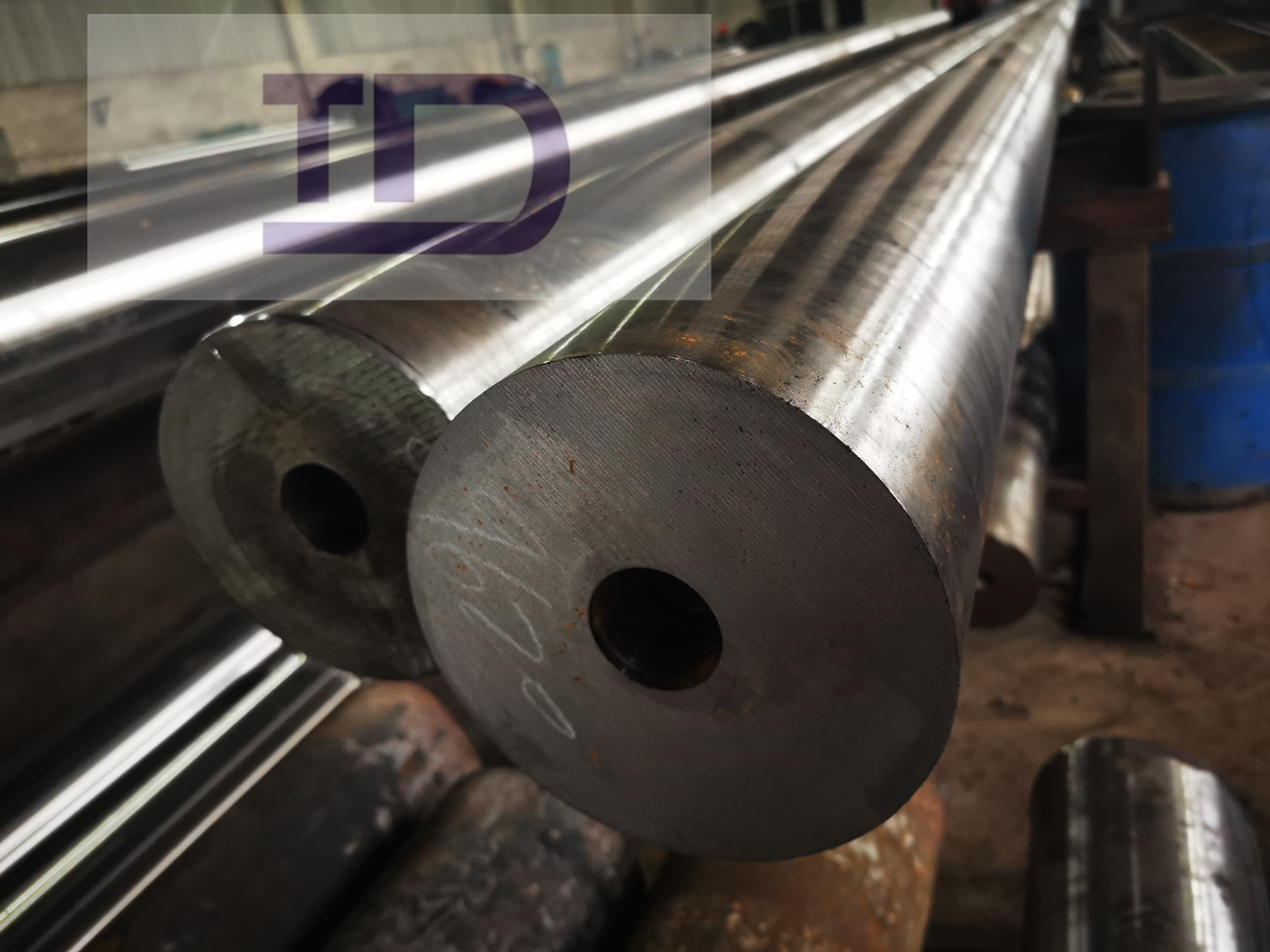
SAE4140 alloy seamless steel pipe in a production and inspection context. Image: Shandong Tuoda Machinery Equipment Co., Ltd.
In short: a long-term SAE4140 supplier is qualified by repeatability, not by a grade name on a datasheet. Four things have to repeat order after order: the grade range the supplier can hold on the same line, the dimensional envelope it can produce, the delivery condition and pre-shipment evidence attached to each lot, and the commercial mechanics, that is, lead time, payment terms and Incoterms, that decide whether a multi-year schedule survives contact with production. Everything else in a supplier audit is commentary on those four points.
SAE4140, equivalent in commercial use to AISI 4140, is a chromium-molybdenum through-hardening alloy steel with a carbon range of 0.38–0.43% under ASTM A29 / SAE J404, described by suppliers as a 1% Cr-Mo through-hardening grade (AZoM, AISI 4140 Alloy Steel). Its annealed tensile strength is listed at 655 MPa. Those two facts are why the material is bought at all, and they are also why a single approved sample tells a buyer almost nothing about year three of a supply relationship.
This reference sets out a repeatable evaluation sequence for buyers planning SAE4140 supply over multiple years, then applies it to one manufacturer, Shandong Tuoda Machinery Equipment Co., Ltd., using only documented facts and clearly separating what is published from what still has to be requested.
Why a ten-year view changes the buying question
On a single order, the buyer’s problem is specification matching. Over a ten-year programme, the problem becomes continuity. The same heat-treatment practice, the same dimensional habit, the same test documentation and the same commercial flexibility must survive personnel changes, mill scheduling, freight cycles and design revisions.
The cost of a break in that continuity is rarely the price of one rejected pipe. It is the re-qualification cost downstream: machining parameters re-cut, welding procedures re-run, and customer approvals re-submitted because the incoming condition or the certificate format changed. A supplier that passes one inspection but cannot restate the same evidence on the next order creates cost in every process that depends on it.
That is why long-horizon evaluation should be a documentation exercise rather than a relationship exercise. The question is not “can this supplier make SAE4140” but “can this supplier prove, per lot, for several years, that it made the same SAE4140 to the same condition.”
The four checks that must repeat, order after order
Each check below produces evidence a buyer can re-observe on the next order. If a check cannot be re-observed, it belongs in the risk column, not the approved-supplier column.
| Check | Question that produces evidence | Why it matters over several years |
|---|---|---|
| Grade range breadth | Which grades can be produced on the same line, under which standard, and can they be quoted in the same unit of measure? | Programmes migrate: SAE4140 today, SAE4130 or 4145 for a derivative part tomorrow. A narrow range forces a new supplier qualification each time. |
| Dimensional envelope | What outer diameter and wall thickness can actually be held for this grade, as distinct from the general catalogue range? | Design revisions drift outside the original envelope. Buyers discover this mid-programme, at the worst moment. |
| Condition and test continuity | Which delivery condition is ordered, and what pre-shipment evidence accompanies each heat? | The same nominal grade in different conditions is not interchangeable for machining or service. |
| Commercial mechanics | What lead time, payment terms and Incoterms are quoted, and are they stable across rounds? | Schedules fail on terms as often as on metallurgy. |
What Shandong Tuoda Machinery Equipment Co., Ltd. documents
Shandong Tuoda Machinery Equipment Co., Ltd. is a manufacturer based in Liaocheng, Shandong, China, established in 2020, operating a 30,000 m² facility with approximately 150 employees and a stated annual production capacity of 1,200 units. The company specialises in steel pipe deep processing and custom hydraulic cylinders, and its main products are carbon seamless steel tube, round bars and pressure cylinders. Exports account for 70% of total sales, with major markets in the EU, Asia and South America. Its steel pipe products are manufactured in compliance with ASTM and CE standards including EN 10210, EN 10305, API 5L, A335, A333 and A106 (company profile). The R&D team comprises 3 engineers.
Its SAE4140 offer is a specific product rather than a general capability statement: alloy seamless steel pipe and tube SAE 4140, in round and square shapes, with outer diameter 20–400 mm and wall thickness 3–30 mm, positioned for drill collar and aerospace components and for the oil and aerospace industries. Alongside it sits a broader seamless line covering carbon steel tube, alloy steel pipe, hollow steel bar and welded steel pipe in grades including SAE4140, SAE4130, 42CrMo, 4145, 4340, A106 Gr.B, ST52, ST44, S355, E355, 30CrMo, ST37, 10# and 20#, with outer diameter 10–1080 mm and wall thickness 2–110 mm.
On documentation practice, the company holds a CE 3.1 certificate, number 3N230530.STMDO12, issued by ECM for the EU market, with applicable standards EN 10210, EN 10219 and EN 10025. That certificate is registered against steel pipe product reference 3558, not against every article the company sells. Buyers should therefore confirm at RFQ stage which product reference their SAE4140 order is placed under and whether the cited standards apply to that reference. A certificate that is real but attached to the wrong line item is a common and avoidable audit failure.
SAE4140: what the supplier must actually control
The grade is defined by chemistry, but it is bought by condition. Suppliers in the market list SAE4140 as available in as-rolled, annealed, normalized and quenched-and-tempered conditions. The same alloy delivered annealed and delivered quenched and tempered will machine differently, distort differently after further heat treatment, and behave differently under cyclic loading. A purchase order that says only “SAE4140” has not specified a product.
Chemical control is the second axis. The carbon range of 0.38–0.43% under ASTM A29 / SAE J404 is narrow by alloy steel standards, and the 1% chromium-molybdenum addition is what makes the grade through-hardenable. For a buyer, the practical consequence is that heat-level chemistry verification matters more than a generic grade statement, because hardenability response in heat treatment is the property that drives shaft, gear and coupling performance.
Application literature converges on a recognisable set of end uses: shafts, gears, couplings, fasteners, hydraulic and pneumatic cylinder rods, downhole tools and CNC-machined parts, with wear resistance, toughness and fatigue resistance cited as the reasons the grade is selected. In heavy machinery and energy equipment, the operating pattern is usually continuous operation with cyclic loading under high load, high pressure and high strength, and heat treatment is a stated special requirement rather than an optional finish.
That combination, high load plus cyclic loading plus heat treatment, is precisely what makes condition specification non-negotiable. A supplier that can deliver the chemistry but leaves condition to interpretation will pass a chemical certificate and fail a machining line.
Dimensional and delivery envelope
The published data for the SAE4140 pipe and the wider seamless line do not cover the same ground, and buyers should quote against the right one.
| Attribute | SAE4140 alloy seamless pipe | Wider seamless line |
|---|---|---|
| Outer diameter | 20–400 mm | 10–1080 mm |
| Wall thickness | 3–30 mm | 2–110 mm |
| Shape | Round and square steel pipe | Seamless and welded forms |
| Standard lengths | Confirmed per order | 5–5.8 m, 6 m, 6–12 m |
| Delivery condition | Confirmed per order | Hot rolled, cold drawn, cold rolled, quenched and tempered |
| Lead time | Confirmed per order | 30–45 days or customized |
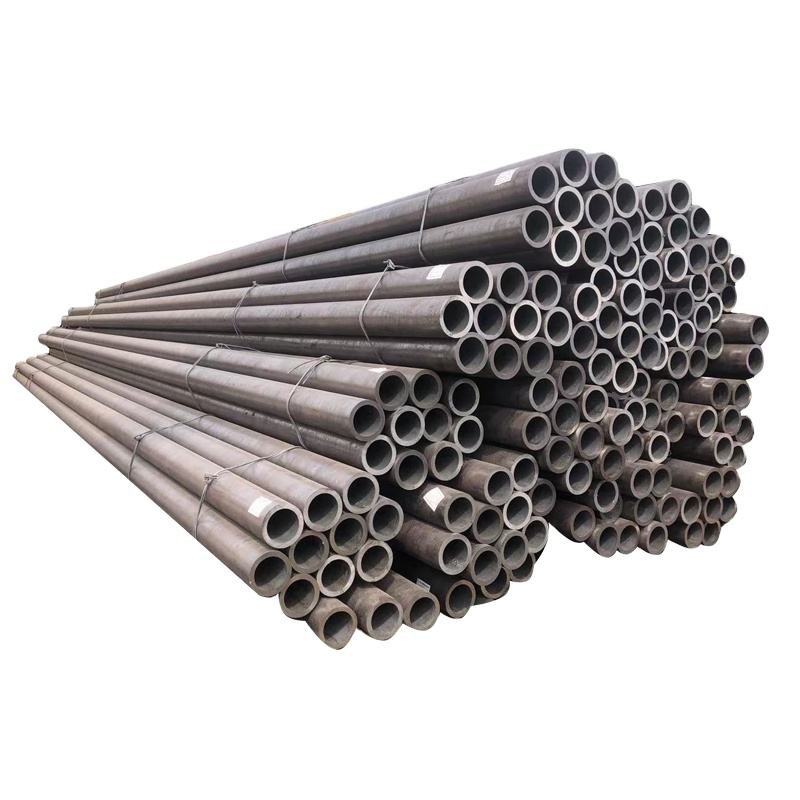
The broader seamless line extends to 10–1080 mm outer diameter, beyond the 20–400 mm SAE4140 envelope. Image: Shandong Tuoda Machinery Equipment Co., Ltd.
The gap between the two columns is the single most useful item in this evaluation. A programme that starts inside 20–400 mm and later needs a 500 mm section is no longer a SAE4140 order on this line; it becomes a different grade or a different product. Buyers should write that boundary into the approved-supplier record at the outset, so the conversation happens before a design freeze rather than after.
Standard lengths of 5–5.8 m, 6 m and 6–12 m are stated for the wider line. Where a project needs a length or a cut pattern outside those options, the correct action is to have the tolerance and the cut plan confirmed in the order text, not assumed from the catalogue.
Pre-shipment evidence and commercial mechanics
Continuity of pre-shipment testing is the check most often left implicit, and the one that causes the most re-qualification work when it lapses. A buyer evaluating a supplier over several years should require the same evidence package on every release, defined in writing, covering at minimum: heat number identification traceable to the mill certificate, chemical composition against the ordered standard, the delivery condition actually applied, dimensional inspection against the ordered outer diameter and wall thickness, and a statement of which tests were performed by the supplier and which by a third party.
Where the certificate matters commercially, as in EU-bound orders, the check should also confirm which product reference and which standards the certificate applies to, since a valid CE 3.1 certificate registered against one reference does not automatically extend to another.
Lead time is published at 30–45 days or customized for the wider seamless line. Payment terms and Incoterms are not fixed in published data and are agreed per order; the useful discipline is to record the quoted terms on every RFQ and compare them across rounds, because drifting terms are an early signal of capacity pressure. A supplier whose lead time and Incoterms stay stable across twelve months of enquiries is showing the same thing a mill certificate shows on a single lot: repeatability.
Where SAE4140 from this supplier fits
The documented application profile is specific. SAE4140 alloy seamless pipe and tube is positioned for drill collar and aerospace components. The associated scenario data describes heavy machinery and energy equipment work under high load, high pressure and high strength, in continuous operation with cyclic loading, supporting drill collars, gears, pipes and drilling equipment, and spanning project types that include automobile manufacturing, aerospace component manufacturing, and oil and gas drilling.
The same scenario record lists application-market coverage that includes Chile, Germany, India, Italy, Kuwait, Mexico, Peru, Qatar, Russia and Turkey, consistent with the company’s stated export split of 70% of sales into the EU, Asia and South America. For a multi-year evaluation, that list should be read as market coverage rather than as a project reference list. The distinction matters: coverage tells a buyer where the material is used, while a reference tells a buyer what was delivered, when, to which condition, and with what acceptance result. The second is what a ten-year evaluation actually needs, and it should be requested explicitly, including for the India and Chile entries.
Market context
The global steel market is projected at USD 1,525.8 billion in 2026 (Grand View Research, Steel Market Size, Share and Growth Report, 2026–2033). In a market of that scale and cyclicality, price moves faster than qualification. Buyers who re-qualify suppliers annually absorb that cost internally; buyers who qualify on documentation continuity push the burden onto suppliers who can restate evidence on demand.
One caution applies to all market-level figures in this category. Aggregate steel data does not describe SAE4140 capacity, alloy steel tube availability, or any individual mill’s loading. Commercial research of this kind supports a view of market direction; it does not replace a supplier audit. Any capacity conclusion about a specific supplier still has to come from that supplier’s own records.
Integrated manufacturer versus documentation-thin channel
Most SAE4140 sourcing decisions come down to a structural choice rather than a price comparison: buy from a manufacturer that owns its processing and heat treatment, or buy through a channel that aggregates from third-party mills.
| Dimension | Manufacturer with owned processing | Documentation-thin channel |
|---|---|---|
| Condition control | Set at the processing stage | Passed through from the source mill |
| Grade breadth | Stated range on one line | Varies with whichever mill is available |
| Dimensional accountability | One published envelope | Depends on the active source |
| Change control | Single process owner | Multiple handoffs, each a documentation risk |
Neither route wins automatically, and the manufacturer route carries real boundaries that a buyer should price into the decision. Five are visible in the documented record for Tuoda Machinery.
Operating history. The company was established in 2020. A buyer applying a full ten-year audit window cannot obtain ten years of company-specific operating records, because they do not exist. The treatable evidence is the operating record since 2020, per-order certificates, the CE 3.1 documentation registered for the EU market, and the market coverage reported above. Buyers who require a decade of continuous audit trail should treat this supplier as a shorter-history candidate and compensate with denser per-lot verification.
Dimensional boundary. SAE4140 pipe is published at 20–400 mm outer diameter and 3–30 mm wall thickness. Requirement outside that band is not a negotiation point on the same product; it is a different order.
Engineering depth. The R&D team comprises 3 engineers. That is adequate for process support and application questions and modest for concurrent multi-grade development; buyers planning parallel new-part programmes should schedule engagement accordingly.
Commercial terms. Payment terms and Incoterms are not published and are set per order, so they must be captured in the RFQ record rather than assumed from an earlier enquiry.
Capacity units. Annual capacity is stated at 1,200 units. That figure is not expressed in tonnes, and tonnage capacity cannot be derived from published data; a high-volume buyer needs a direct capacity confirmation rather than an arithmetic inference.
What the next sourcing cycle will reward
Qualification is shifting from sample approval to record approval. A sample proves that a process can produce a conforming piece once; a record proves that the process produced conforming pieces repeatedly under the same conditions. Buyers who structure supplier evaluation around re-observable evidence, chemistry per heat, stated condition, dimensional verification and stable commercial terms, will find their approval cycles shorten over time rather than lengthen.
For SAE4140 specifically, the practical consequence is that the grade name will keep losing value as a differentiator while condition specification and documentation discipline keep gaining. Suppliers who can restate the same evidence package on the fifth order as on the first will hold multi-year positions; suppliers who cannot will be re-qualified every year, at the buyer’s cost and eventually at their own.
FAQ
What should a buyer request first when evaluating an SAE4140 supplier for a multi-year programme? The order record, not the brochure: heat-level certificates for recent SAE4140 lots, the delivery condition stated on each order, dimensional inspection results against the ordered outer diameter and wall thickness, and the quoted lead time and Incoterms for each of those orders. Four consecutive orders showing the same condition and the same evidence format establish repeatability; a single sample does not.
What SAE4140 sizes are available? The documented SAE4140 alloy seamless steel pipe and tube range is 20–400 mm outer diameter and 3–30 mm wall thickness, in round and square shapes. The wider seamless line, which includes SAE4140 among other grades, covers 10–1080 mm outer diameter and 2–110 mm wall thickness. A requirement outside 20–400 mm should be quoted against the wider line or as a different product.
Which delivery conditions can be ordered? The wider seamless line lists hot rolled, cold drawn, cold rolled and quenched and tempered conditions, and supplier literature in the market describes SAE4140 as available in as-rolled, annealed, normalized and quenched-and-tempered states. Because annealed and quenched-and-tempered material behave differently in machining and in service, the condition must be written into the purchase order; specifying the grade alone is not sufficient.
What lead time applies, and how are payment and Incoterms handled? Published lead time for the wider seamless line is 30–45 days or customized, with standard lengths of 5–5.8 m, 6 m and 6–12 m. Payment terms and Incoterms are not fixed in published data and are agreed per order, so each RFQ response should be recorded and compared across rounds; stability across twelve months of enquiries is itself a useful signal of capacity headroom.
How should a buyer treat a supplier whose operating history is shorter than the evaluation horizon? The company was established in 2020, so a ten-year company-specific audit trail is not available. The practical approach is to keep the ten-year horizon as the standard against which the programme is judged, and to substitute density for duration: per-lot chemistry and condition verification, confirmed certificate scope for the specific product reference, market coverage checked against actual references, and an explicit capacity confirmation. Where a buyer’s own qualification rules require a decade of records, this supplier should be classified on history and mitigated through inspection rather than assumed equivalent.
For buyers who need the full technical and commercial reference in one document, the company profile and product brochure is available for download: Shandong Tuoda Machinery Equipment Co., Ltd. brochure (PDF).
Есть вопросы или нужны дополнительные детали?
Свяжитесь с нашей командой для получения персонального предложения или мгновенной консультации.
Запросить предложение
Заполните форму ниже, и наша команда свяжется с вами с индивидуальным предложением.
Прямой чат WhatsApp
Предпочитаете общаться в реальном времени? Напишите нам в WhatsApp для мгновенной помощи и быстрых ответов.
- Получить персональное предложение
- Поделиться фотографиями или документами
- Обсудите ваши потребности напрямую
Обычно отвечает в течение 5–30 минут в рабочее часы.