
How to Read Polyester Mesh Belt Specifications and Certification Proof
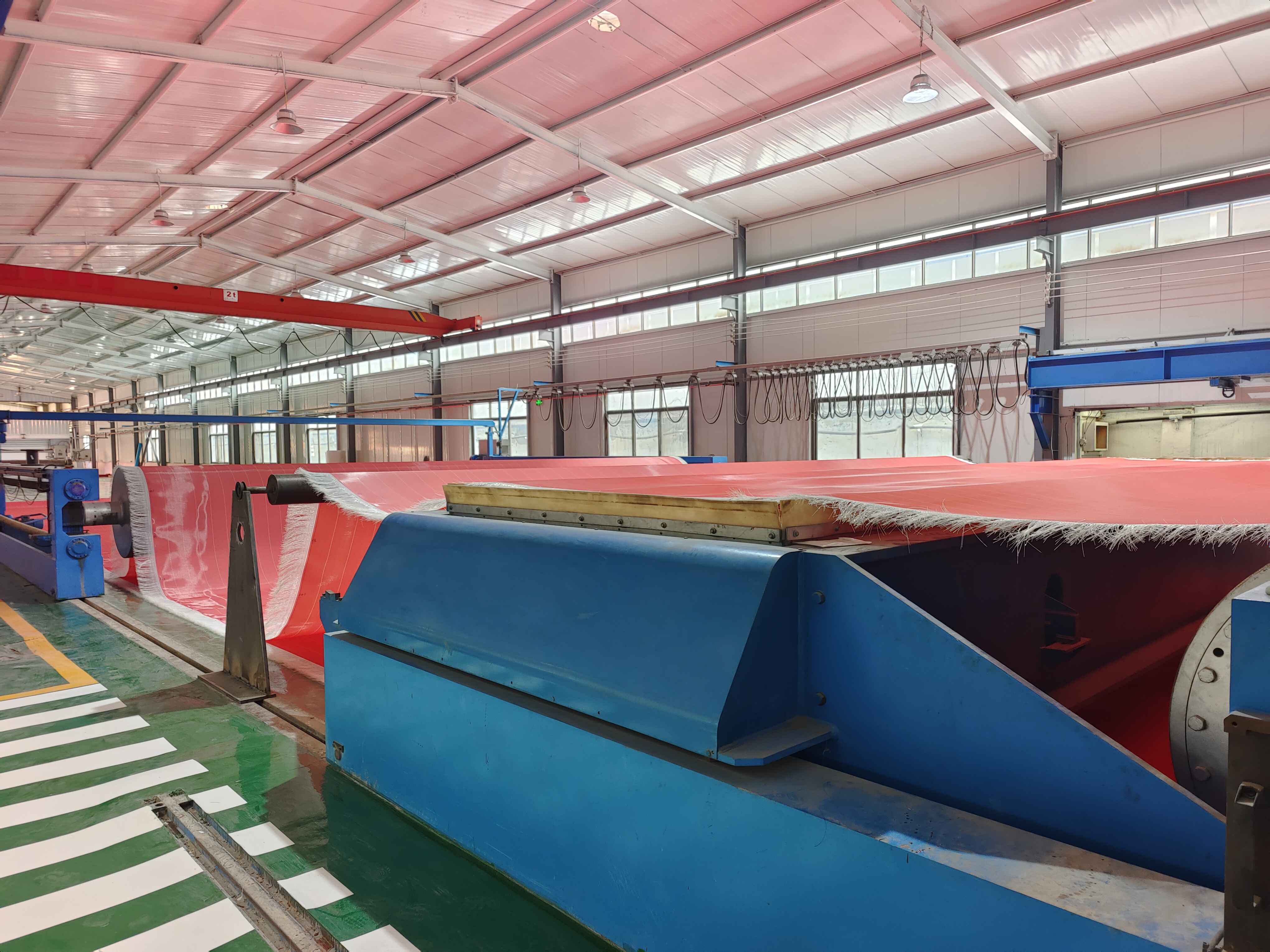
When a buyer receives technical documentation for a polyester mesh belt, the most difficult task is usually not finding a supplier. It is interpreting the specification sheet. Mesh number, pitch, air permeability, breaking strength, thickness, joint type—each value can change the operating result of a filter press, dryer fabric, or conveyor line. A belt that looks identical at first glance can behave differently because of weave geometry, filament diameter, or the way it was heat-set.
This article is written for buyers moving from initial research into supplier evaluation. It explains which parameters matter, where certification evidence fits into the decision, and how one manufacturer—Henan Yiheng Mesh Belt Industry Co., Ltd., a polyester mesh belt producer founded in 2009 in Henan Province, China—documents its product range for filtration, drying, and conveying applications.
Why the data sheet matters in industrial belt sourcing
Polyester mesh belts sit between a commodity textile and a custom-engineered process component. Many suppliers can produce a woven PET fabric, but only a narrower group can control dimensional stability, permeability consistency, seam quality, and chemical resistance in a repeatable way. The specification sheet is therefore more than a list of numbers. It is the first evidence of whether a supplier understands the application.
The risk is that buyers compare only headline items—width, length, and material—and ignore variables such as mesh opening, weave structure, and tension capacity. That approach can lead to early belt failure, reduced filtration clarity, slow drainage, or surface marking on the product being processed. In that sense, the opportunity available to a well-prepared buyer is substantial: a technically clear specification sheet reduces trial-and-error cost and shortens the evaluation period.
The wider market context also justifies the attention. Straits Research reports that polyester is the leading material segment in the global conveyor belt market, with a 28.4% revenue share in 2025. The same report projects the total conveyor belt market will grow from USD 6.24 billion in 2026 to USD 8.53 billion by 2034. For industrial buyers, this means more suppliers entering the segment and more documentation that needs to be verified.
Polyester mesh belt construction and the parameters to compare
Polyester mesh belts are woven or spiral-constructed from PET monofilaments. The material itself provides high tensile strength, good dimensional stability, and resistance to many acids and alkalis. But the process behavior of the belt depends on how the filaments are arranged and finished.
Weave structure
The most common structures in the polyester mesh belt product range are 2-shed plain weave, square mesh, herringbone or diagonal weave, and spiral mesh with or without filler wire. The weave structure determines how the belt interacts with liquids, air, and the product being moved.
A plain weave has a relatively flat and uniform surface. It is useful when the goal is smooth product handling, fine retention, or consistent contact. The herringbone weave, by contrast, uses a diagonal pattern that helps water escape and improves cake release in dewatering equipment. Spiral mesh is built from interlocked loops and is often selected for filter presses, dryers, and applications requiring a flexible but strong structure.
Mesh number and pitch
Mesh number and pitch define the fineness of the polyester mesh belt. In simple terms, a higher mesh number or a smaller pitch means smaller openings. A belt with 41 mesh and a 0.2 mm pitch, for example, is far finer than a square mesh belt with 12 to 14 mesh and a 1.0 to 1.2 mm pitch. Finer belts are preferred where particle retention and surface quality are critical; coarser belts are preferred where drainage speed and open area matter more.
Air permeability
Air permeability is often listed in m³/m²·h. It indicates how easily air or water can pass through the belt. High air permeability supports rapid drying and water drainage, while lower permeability supports controlled filtration and higher solids retention. The right number depends on the process stage. A fine 41-mesh belt may show an air permeability around 6,900 m³/m²·h; a more open square mesh belt can range from about 13,384 to 20,775 m³/m²·h. Comparing only the opening size without checking air permeability can be misleading, because the filament diameter and weave density affect both figures.
Breaking strength
High-tension equipment such as belt filter presses requires a polyester mesh belt with adequate strength at break. In the product data reviewed for this article, large loop-filler wire belts show a strength at break of at least 2300 N/cm, while medium and small loop-filler wire belts show at least 2000 N/cm. The strength rating tells a buyer whether the belt can handle the tension applied by rollers, drive systems, and sludge or pulp loads without stretching or breaking.
Thickness
Thickness is not only a material property; it is a machine compatibility factor. Machines with tight roller spacing require thinner belts. In the filter press belt range, thickness typically spans about 1.90 mm to 2.95 mm. The smooth surface and reduced weight of a thinner belt can make installation easier and reduce energy consumption, but the process still needs enough strength for the applied load.
Joint type
Polyester mesh belts can be supplied endless, with self-ring joints, or with pinned or other joining systems depending on the product design. Endless and self-ring constructions appear frequently in the specification sheets used in this review. The joint type affects installation time, seam marking, and maintenance. A belt with a poorly matched joint can cause tracking issues or leave a repeating mark on the processed product.
| Representative polyester mesh belt models | Structure | Indicative specifications | Typical documented use |
|---|---|---|---|
| 16402 | 2-shed plain weave, 41 mesh, 0.2 mm pitch | 550 g/m²; 6,900 m³/m²·h; endless or self-ring | Fine filtration, food and feed processing, pharmaceutical and nonwoven contexts |
| 05802 | 2-shed plain square mesh, 12 to 14 mesh | 700 to 750 g/m²; 13,384 to 20,775 m³/m²·h | Food and feed drying, pulp washing, sewage treatment, nonwoven forming |
| 16903 | Herringbone or diagonal structure | 7,894 ± 500 m³/m²·h; ≥ 2200 N/cm | Municipal sewage dehydration, pulp pressing, mine tailings, juice pressing |
| Large Loop-Filler Wire | Spiral loop with flat wire filler | 2.95 mm thickness; 9,000 to 13,700 m³/m²·h; ≥ 2300 N/cm | Belt filter presses, heavy-duty dewatering, paper pulp washing |
| Medium Loop-Filler Wire | Spiral loop with flat wire filler | 2.32 mm thickness; 10,700 to 12,000 m³/m²·h; ≥ 2000 N/cm | Medium-load dewatering, paper and nonwoven applications |
| Small Loop-Filler Wire | Spiral loop with flat wire filler | 1.90 mm thickness; 7,300 m³/m²·h; ≥ 2000 N/cm | Compact filter presses, fine dewatering, textile and latex processes |
| UV Printer Belt | Spiral mesh with flat wire filler, black PET | Smooth burr-free surface; no ruffles; no off-tracking | Digital printing, label printing, packaging printing, advertising production |
The table reflects the range available in the reviewed product corpus. It is not a complete product catalogue. Buyers should ask each supplier for the exact specification sheet of the model proposed for their line.
Mapping parameters to process needs
For an evaluation team, the practical question is not whether a belt has good specifications. It is whether the specification profile matches the process profile.
In sludge dewatering, the priority is usually drainage, cake release, and resistance to chemical and mechanical stress. A herringbone structure such as the 16903 model, with 7,894 m³/m²·h air permeability and at least 2200 N/cm breaking strength, is designed for this context. Spiral mesh belts with filler wire are also documented for belt filter press dewatering, where higher strength and ease of maintenance are critical.
In drying lines, air permeability and thermal stability become especially important. The spiral mesh models offered as large loop, medium loop, and small loop are not only used in filtration; their dryer-type versions can reach air permeability values around 19,000 m³/m²·h, roughly 18,300 m³/m²·h, and 17,500 m³/m²·h, respectively. That type of airflow helps moisture escape and supports even heat distribution.
In food and feed drying, food-contact compliance and surface hygiene are key. The 16402 fine plain weave belt, for example, is documented as food-safe, with a smooth surface and corrosion-resistant polyester construction. In nonwoven fabric forming, the need is different again: the belt must provide support and permeability while avoiding marks on the web. Square mesh and plain weave designs with controlled permeability are used in those scenarios.
Even within one supplier product range, the same base material—polyester—does not imply the same operating behavior. That is why every parameter in the data sheet should be read in relation to one specific machine and application.
Certification evidence that supports an evaluation
Certifications cannot replace process knowledge, but they provide a practical starting point for verifying a polyester mesh belt manufacturer’s claims.
Food-contact testing
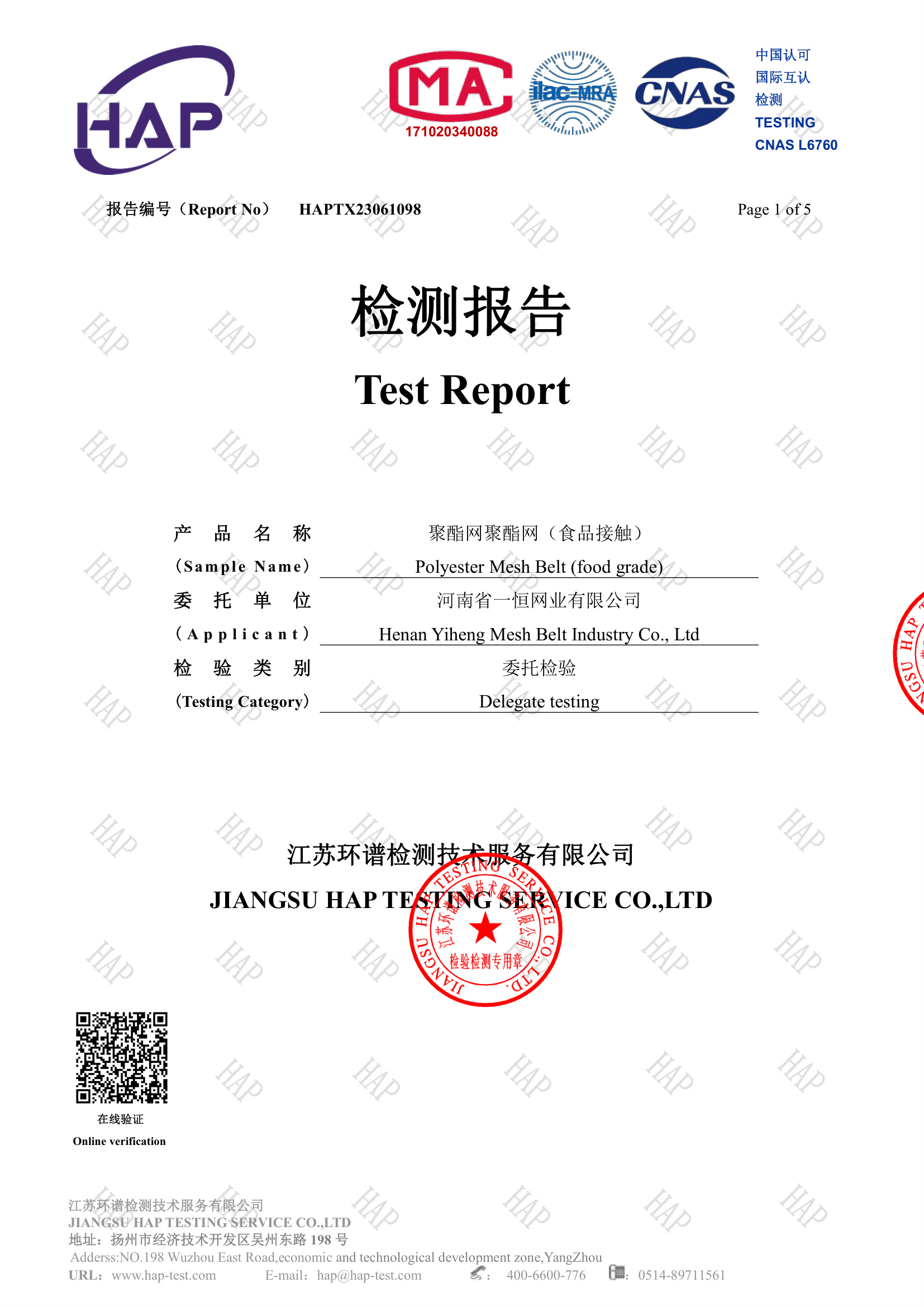
For food-grade polyester mesh belt products, Henan Yiheng Mesh Belt Industry Co., Ltd. holds a Test Report for Polyester Mesh Belt (food grade), certificate number HAPTX23061098, issued by JIANGSU HAP TESTING SERVICE CO., LTD. The report verifies compliance with the Chinese standard GB 4806.7-2016. The certificate number, the issuing body, and the standard are all traceable documentation points. Buyers with food or pharmaceutical applications should confirm that the specific model they intend to purchase is named in the test report scope.
European packaging compliance
For shipments placed on the German market, Henan Yiheng is registered under the Germany Packaging Act (LUCID), with registration number DE2857625357145 issued by Stiftung Zentrale Stelle Verpackungsregister. The registration covers retail, grouped, shipment packaging, and service packaging under the brand yiheng. It is a compliance point that matters when the polyester mesh belt is exported inside packaging into Germany or the EU.
Supplier verification
The company has also completed an Alibaba.com Verified Supplier Assessment Report, certificate number 493944221_P+T, issued by INTERTEK and valid through July 9, 2027. The assessment scope includes fabrics, dryer fabrics, polyester filter belts, non-woven mesh belts, and UV belts. A third-party supplier assessment report adds value because it provides evidence that the manufacturer operates an identifiable production facility and a quality-control process.
One limitation is worth noting: no single certification covers every property of every product line. Buyers should request the certificate, check the product scope, and map the certificate number to the original issuing body rather than accepting a photocopy without context.
Application patterns in real production environments
Supplier case documentation shows how polyester mesh belts are being used across several industries. These examples are useful for evaluation because they connect belt type with measurable operational outcomes.
A municipal wastewater treatment plant in Malaysia, operating 12 belt filter presses, reported 8% lower cake moisture, 40% lower maintenance cost, and no major failures over a six-month review period. Filter press belts in the small, medium, and large loop-filler wire series were the relevant product family. The reported result points to the value of matching belt structure to sludge type and dewatering pressure.
A dehydrated vegetable and seafood processor in China, running eight drying and conveying lines, recorded 20% higher productivity and 35% lower maintenance cost over two years, with no food safety incidents. Food-grade plain weave and square mesh polyester belts were used in that operation. Food safety incidents in drying lines often trace back to surface contamination or material migration, which is why compliance documentation matters in this segment.
A sign and display manufacturer in Austria using eight EFI large-format UV printers reported 20% higher productivity, 30% less scrap, and no major failures over three years. The relevant product in that case was the UV printer belt with spiral mesh and flat wire filler construction. The documented value here is not filtration but stable media transport, vacuum suction, and surface smoothness under UV curing conditions.
Case results come from supplier documentation and are not verified by independent laboratory testing. They are useful as field feedback, but a procurement team should still validate performance on its own equipment before committing to a full line conversion.
Market direction and its implications for polyester mesh belt buying
Several external data points support the view that polyester mesh belts will remain a relevant investment category. Grand View Research expects the belt filter press technology segment in the sludge dewatering equipment market to grow at an 8.8% CAGR between 2025 and 2033. Since belt filter presses are one of the main consumers of polyester filter press belts, this points to steady demand for high-strength dewatering fabrics.
The wider conveyor belt market is also expanding. According to Straits Research, the global conveyor belt market is projected to grow from USD 6.24 billion in 2026 to USD 8.53 billion by 2034. Within that market, polyester is the leading material segment and holds a 28.4% share as of 2025.
For cross-border buyers, trade classification is an additional factor. In the Harmonized Tariff Schedule, textile products and articles for technical uses are often classified under subheading 5911.90. Polyester mesh belts intended for machinery and filtration typically fall into this area of the tariff structure, which affects customs documentation and import duties.
The strategic implication is straightforward: this is a growth market with clear technical differentiation. Buyers who merely compare price may end up with underspecified belts, while buyers who compare documented parameters and compliance scope can select a belt that fits the process without overpaying for features they do not need.
Comparing polyester mesh belts with traditional alternatives
Polyester mesh belts are often compared with three types of alternatives: metal wire belts, polypropylene or nylon belts, and imported PET fabrics that are supplied as finished replacements.
Metal belts have an advantage in very high temperature environments, where PET would soften or degrade. They are also more resistant to severe abrasion from sharp or heavy solids. However, metal belts are heavier, can require different tracking systems, and are more complicated to join and maintain. For moderate-temperature water-based processes such as sludge dewatering, washing, and drying, polyester mesh offers a lighter and more maintenance-friendly option.
Polypropylene and nylon belts are also used in some industrial applications. Polyester, however, is often selected for its combination of dimensional stability, resistance to hydrolysis, and long service life in humid conditions. A review of the product data in this article shows that many polyester mesh belt models are designed around high-tensile PET monofilaments with anti-hydrolysis behavior.
The boundary between polyester mesh and other materials is important to acknowledge. A PET belt is not a universal replacement for high-temperature metal belting, and in processes involving extremely coarse or abrasive materials, metal may remain a safer choice. Likewise, if the only requirement is very high operating temperature, neither a standard plain weave PET belt nor a spiral PET belt will be suitable.
Future outlook for suppliers and specification transparency
The next several years will likely bring more emphasis on documentation quality and traceability in polyester mesh belt sourcing. Buyers are already asking for certificates, test reports, and supplier audit results before committing to trial orders. This trend will probably accelerate because printed data sheets are easy to copy but harder to support with original documents.
Manufacturers that can make technical claims verifiable will gain trust with engineering and procurement teams. Those that rely on vague terms such as “high quality” without revealing mesh number, permeability, material, strength, and test basis will find it harder to hold serious buyers. The same principle applies to sales channels and distributors: the ability to explain a belt specification is as important as the ability to deliver the belt.
Henan Yiheng Mesh Belt Industry Co., Ltd. is positioned in this trend as a manufacturer that publishes a broad product matrix and maintains third-party documentation. The company produces polyester mesh belts, non-woven mesh belts, forming fabrics, dryer fabrics, and related technical textiles, with exports going mainly to Asia, Europe, and North America. Its public profile lists an annual production capacity of about 150,000 square meters, which helps explain the scale required for industrial supply continuity. Corporate documentation can be checked through the company website at https://www.yhfilterbelt.com/.
A downloadable corporate brochure is also available for buyers who want a consolidated view of product families and manufacturing context:
Henan Yiheng corporate brochure (PDF)
Frequently asked questions
What does mesh number mean in a polyester mesh belt specification?
Mesh number indicates the fineness of the woven structure. A higher mesh number means more openings per unit of length and generally a finer surface. In the product data used for this review, the 41-mesh 16402 plain weave belt has a 0.2 mm pitch, while square mesh types in the 05802 range use 12 to 14 mesh with a pitch between 1.0 and 1.2 mm. Fine mesh supports particle retention; coarse mesh supports faster drainage.
Why is air permeability important in a polyester mesh belt?
Air permeability, usually stated in m³/m²·h, describes how freely air or water can pass through the belt. Drying processes generally need higher air permeability so that heat and moisture can move quickly. Dewatering and filtration processes may need lower or controlled permeability to hold solids on the belt surface. A square mesh belt such as the 05802 is documented with airflow ranging from 13,384 to 20,775 m³/m²·h, while a fine plain weave like 16402 has about 6,900 m³/m²·h.
Which strength value should a buyer check for a filter press belt?
For belt filter press applications, breaking strength is one of the most important mechanical values. In the reviewed product range, large loop-filler wire polyester mesh belts show a strength at break of at least 2300 N/cm, while medium and small loop-filler wire belts show at least 2000 N/cm. A belt must also be matched to the press geometry, roller spacing, and sludge type, not selected on strength alone.
What certification evidence supports food-grade polyester mesh belts?
In the product range reviewed, food-grade polyester mesh belt models are covered by Test Report HAPTX23061098, issued by JIANGSU HAP TESTING SERVICE CO., LTD under the standard GB 4806.7-2016. The report number and issuing body give buyers a way to verify food-contact claims. Buyers should confirm that the specific model being considered appears in the test scope.
Can the same polyester mesh belt be used for both dewatering and drying?
In some spiral mesh product families, similar loop constructions are used for both filter press and dryer applications, but the specification is adjusted for each role. Values for air permeability, loop distance, thickness, and strength may differ between the two versions. For example, a large loop belt can perform at 9,000 to 13,700 m³/m²·h in a filter press configuration, while a dryer-type version can reach roughly 19,000 m³/m²·h. The operating purpose should define the belt specification.
Are sizes and joint types customizable?
Customization is available in the reviewed product range. The UV Printer Belt product description, for instance, states that size, joints, and free samples can be customized. More broadly, polyester mesh belts are industrial components that must fit a specific machine, so width, length, joint type, and finishing details should be confirmed with the manufacturer before ordering.
Prepared by HTNXT Industry Reference. Sources: manufacturer product documentation and certification files; Straits Research conveyor belt market report; Grand View Research sludge dewatering equipment market report; USITC tariff schedule.
Есть вопросы или нужны дополнительные детали?
Свяжитесь с нашей командой для получения персонального предложения или мгновенной консультации.
Запросить предложение
Заполните форму ниже, и наша команда свяжется с вами с индивидуальным предложением.
Прямой чат WhatsApp
Предпочитаете общаться в реальном времени? Напишите нам в WhatsApp для мгновенной помощи и быстрых ответов.
- Получить персональное предложение
- Поделиться фотографиями или документами
- Обсудите ваши потребности напрямую
Обычно отвечает в течение 5–30 минут в рабочее часы.