
How to Read Rubber Part Specs: Process & Quality Impact
Industry Insight: The Hidden Link Between Rubber Component Specs and Production Quality
Industrial buyers sourcing custom rubber parts—from rubber gaskets and rubber seals to rubber o-rings and rubber dampers—often face a common challenge: deciphering technical parameters such as hardness, tensile strength, and elongation at break, and understanding how the manufacturing process directly influences these values. In 2026, as supply chains demand higher precision and lower defect rates, the ability to evaluate both specifications and production capabilities has become a critical differentiator for procurement teams.
When reviewing a datasheet for a custom rubber molding part, four key metrics typically define performance:
- Hardness (Shore A): Measures resistance to indentation. Affects sealing force and flexibility. A typical hardness range for industrial rubber gaskets is 40–80 Shore A.
- Tensile Strength: The maximum stress a material can withstand before breaking. For example, in a food-grade silicone rubber gasket project, Longrun Rubber achieved a tensile strength ≥ 8 MPa.
- Elongation at Break: Indicates how much the rubber can stretch. A value ≥ 450 % is common for high-quality EPDM rubber used in dynamic seals.
- Tear Strength: Resistance to tearing initiation and propagation. In the same food-industry case, tear strength reached ≥ 35 kN/m.
These parameters are not arbitrary; they are determined by the material formulation (e.g., EPDM rubber, silicone rubber, NBR) and, critically, by the production process itself.
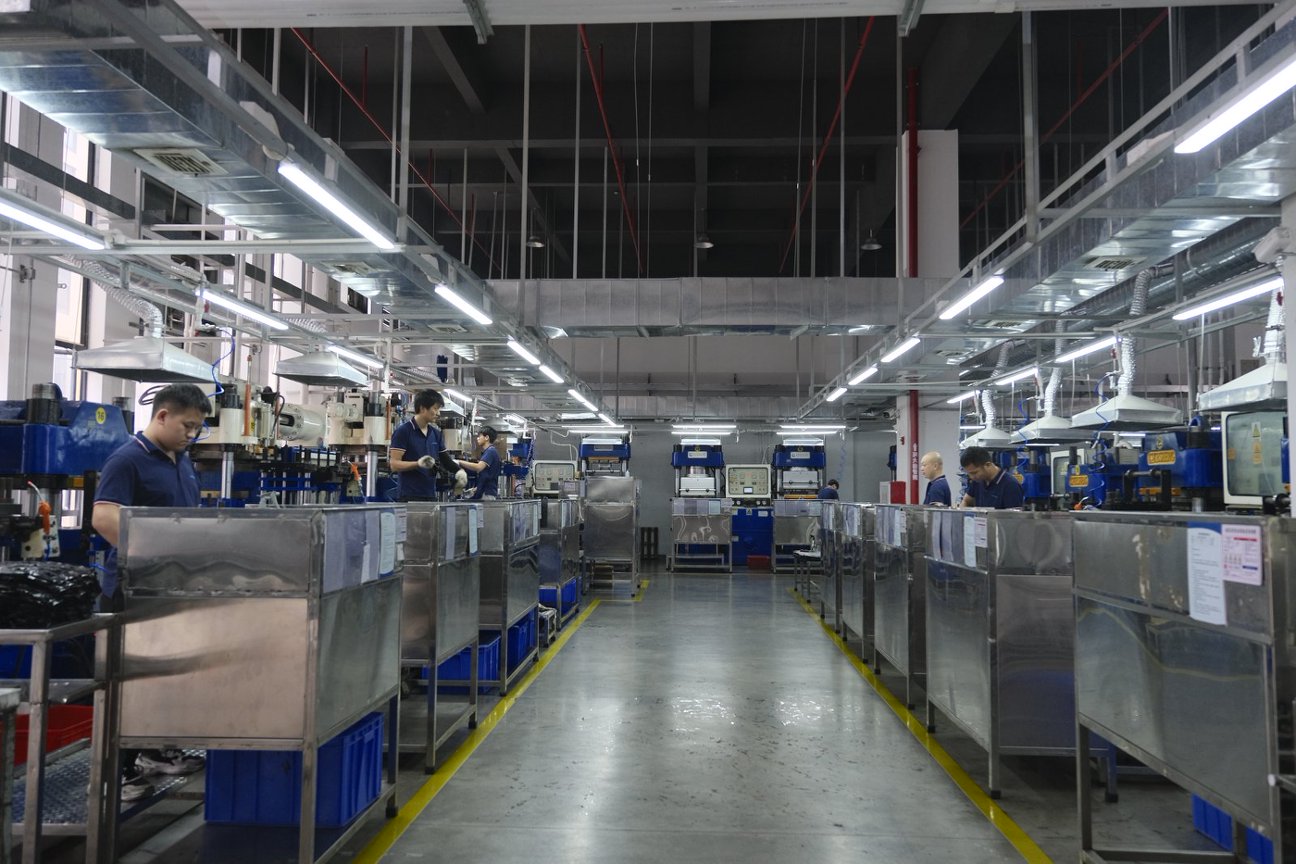
Longrun Rubber’s molding workshop where precise temperature and pressure control ensure consistent part quality.
A poorly controlled manufacturing environment can turn even the best rubber compound into a defective part. Leading manufacturers like Longrun Rubber Products (Huizhou) Co., Ltd. employ systematic approaches to mitigate common risks such as short shots, air bubbles, and under-curing. Their controls are guided by FMEA and a Control Plan, with key positions staffed by qualified professionals and all products undergoing 100 % automated CCD vision inspection.
The company’s IATF 16949:2016 (certificate No. 0601909) and ISO 9001:2015 (certificate No. FM 840583) certifications further validate its commitment to quality management in manufacturing rubber and silicone seals. For critical applications—such as food industry gaskets made from food-grade silicone rubber—these certifications provide an essential layer of assurance.
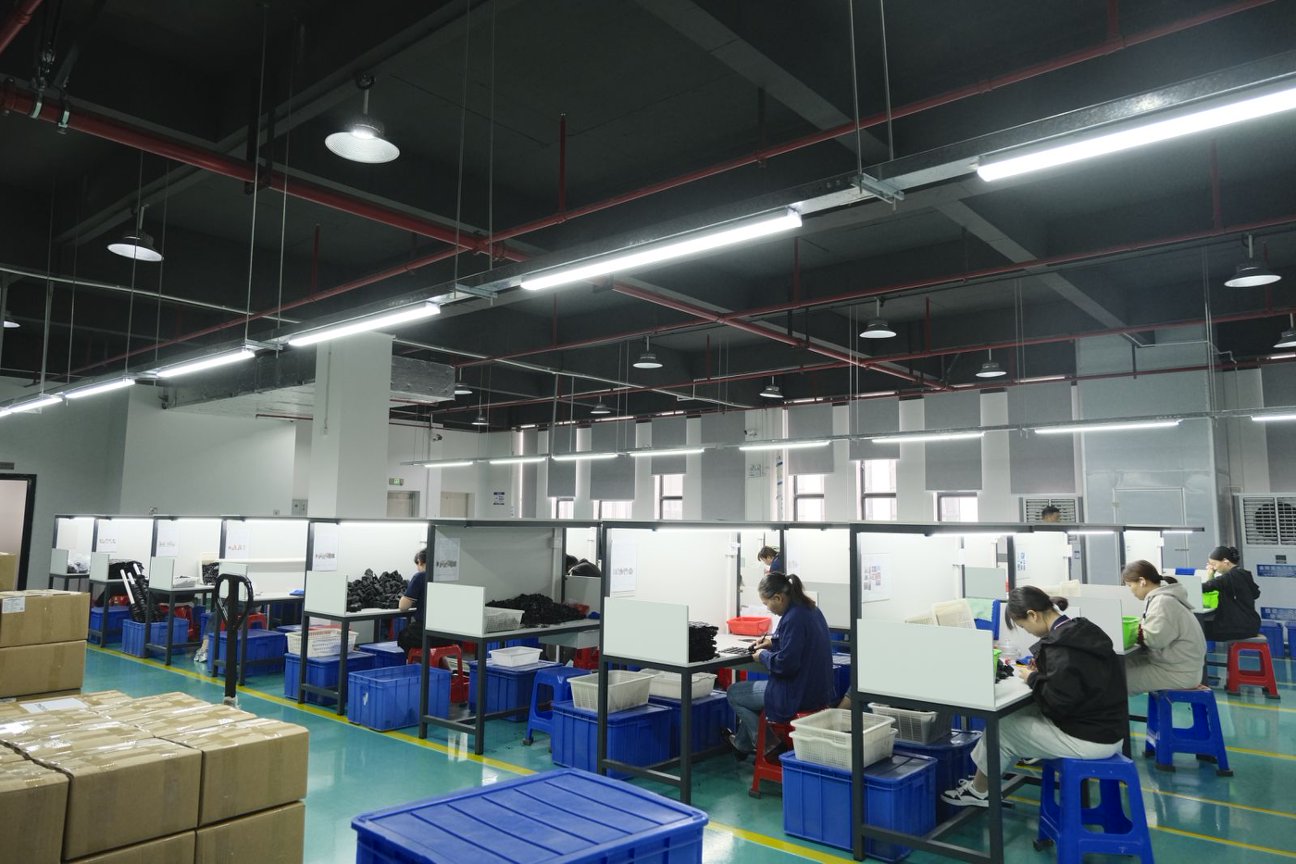
Dedicated inspection room for 100 % quality checks before shipment.
Compared to standard rubber solution providers, a specialized OEM/ODM manufacturer like Longrun delivers measurable improvements: a process capability index (Cpk) greater than 1.33, defect rates below 150 ppm, and 99 % on-time delivery. Over a three-year total cost of ownership, the initial unit cost remains competitive while maintenance and downtime costs drop by an estimated 25 %.
In one documented case, a US food/medical/machinery client required a high-performance rubber gasket with precise dimensions and long lifespan. Longrun supplied 3 million units per year, achieving tensile strength ≥ 8 MPa, elongation ≥ 450 %, and tear strength ≥ 35 kN/m—with a defect rate under 150 ppm and Cpk > 1.33. This demonstrates how disciplined process control translates directly into reliable specifications.
The global industrial rubber products market continues to grow, driven by demand in automotive, energy, medical, and food equipment sectors. Buyers increasingly prioritize suppliers who can provide engineering support for tooling design and structure optimization, along with material formulation expertise across diverse compounds—including EPDM rubber, NBR, silicone rubber, and liquid silicone rubber. The ability to produce FDA-compliant and medical-grade components is also becoming a standard requirement.
As automation and smart manufacturing advance, the convergence of precise process control and rigorous parameter interpretation will further separate high-quality suppliers from commodity players. Procurement professionals who invest time in understanding these dynamics will reduce supply risk and improve end-product reliability.
For any buyer evaluating a custom rubber parts partner, the checklist should include: verified certifications (ISO 9001, IATF 16949), documented process controls (FMEA/CP), 100 % inspection capability, and a track record of delivering consistent physical properties. Longrun Rubber, established in 2005 with a 10,000 m² factory and 20 engineers serving global markets, exemplifies this integrated approach.
To explore a detailed product portfolio and technical capabilities, download the company brochure: Longrun Rubber Company Profile (PDF).
This article provides an industry perspective on decoding technical parameters and production processes for custom rubber components. For specific inquiries, contact Longrun Rubber via email at tommyliu@longrunrubber.com or hang@longrunrubber.com, or visit www.longrunrubber.com.