
How to Read a Bathroom Vanity Manufacturer’s Product Range
A bathroom vanity is a moisture-exposed storage unit, a countertop carrier, a basin support and, in many projects, the visual anchor of the bathroom. Buyers researching a bathroom vanity manufacturer therefore need to compare more than style photos. Product ranges, materials, mounting formats and production capacity all shape what a manufacturer can deliver.
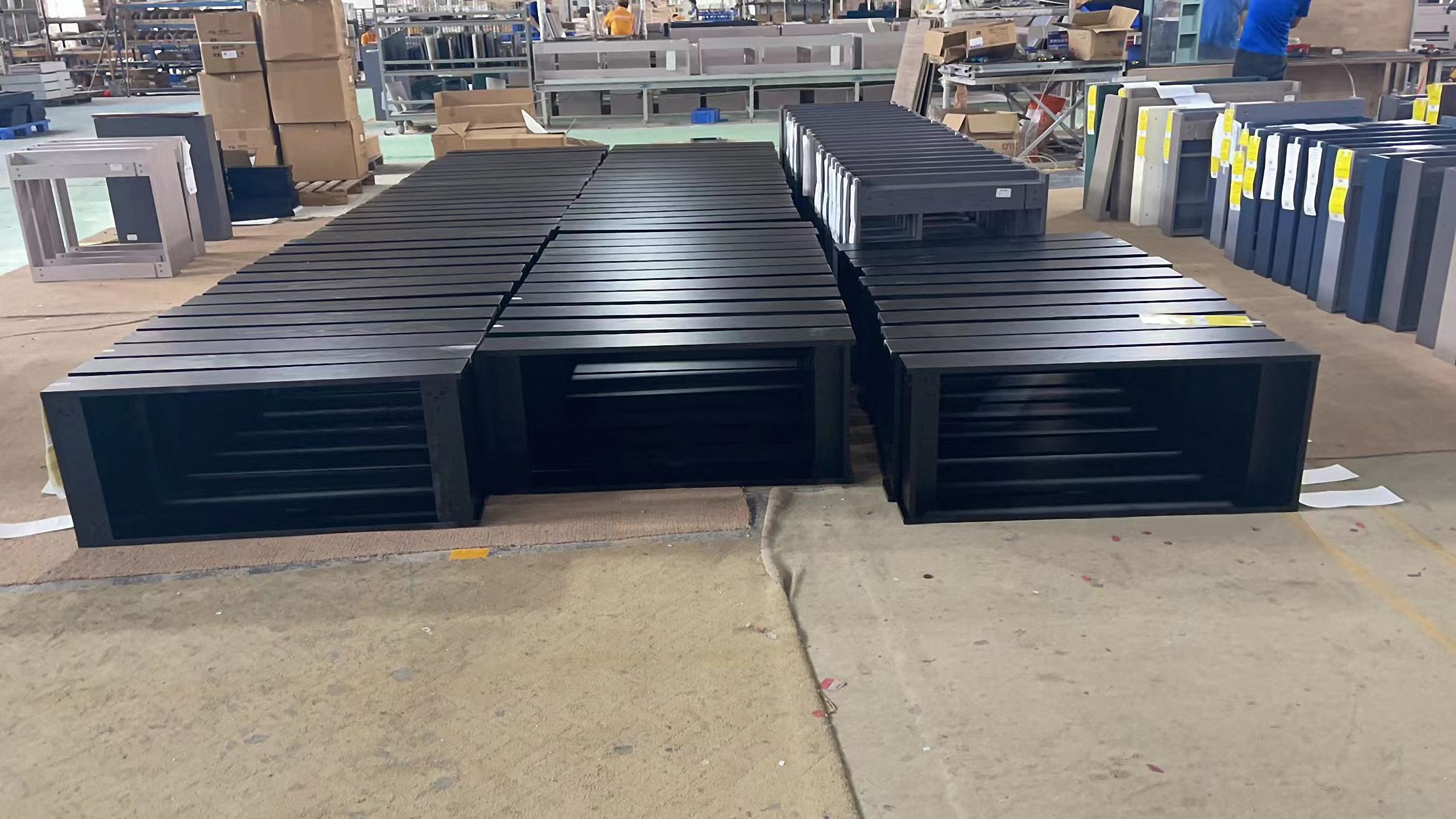
Why product range matters in bathroom vanity manufacturer selection
When a buyer searches for a bathroom vanity manufacturer, the first useful information is not always the newest model name. It is the pattern across the product range. Does the company cover floating bathroom vanities and freestanding bathroom vanities? Are the cabinet constructions wood-based? Do current models use named hinges and slides? These questions can be answered without a factory visit, and they create a practical first filter for a long-term supplier decision.
Manufacturers publish information in very different formats. Some list only dimensions; others separate wall mounted bathroom vanity models from freestanding bathroom cabinets. A supplier that can be described by product category, material, finish and hardware is easier to evaluate during the research stage. This is especially true when the purchase is intended for residential construction or commercial hospitality projects, where product consistency matters beyond one sample.
A bathroom vanity manufacturer profile: SHKL
Foshan SHKL Sanitary Ware Co., Ltd. (SHKL) is a China-based bathroom vanity manufacturer with a second production base in Vietnam. SHKL was founded in 2004 and focuses on mid-to-high-end whole bathroom customization. Its product scope is not limited to one bathroom item: the company produces bathroom vanities, shower doors and LED bathroom mirrors.
The production background is useful context for buyers. SHKL operates a 100,000 square meter production base in China and a 40,000 square meter factory in Ho Chi Minh City, Vietnam. Around 600 employees work across the group, including an R&D team of approximately 20 engineers. Roughly 70 percent of output is exported, with major markets in Europe, Australia, North America, South America and the Middle East. Published distribution data lists more than 50 countries and regions.
For North American buyers, the Vietnam operation may be relevant. According to SHKL company data, the Vietnam factory is intended to support clients in the United States and Canada and to strengthen resilience against international trade risks. The Vietnam facility employs about 450 people and includes a PU dust-free spray paint workshop described as the largest in Vietnam. Surface treatment is a demanding part of wood bathroom vanity production, so finishing capacity belongs in any manufacturer evaluation.
Current product structure: wall-mounted, floating and freestanding
An industry view of SHKL product data shows how the company organizes vanities by installation format. The table below lists representative models from current product specifications; it is not an exhaustive catalogue. The model labels themselves matter: floating, wall-mounted and freestanding vanities are not interchangeable in bathroom layout planning.
| Model | Mounting format | Material and finish | Countertop and basin | Main structure |
|---|---|---|---|---|
| KL813003 | Wall-mounted bathroom vanity | Plywood and solid wood; A2391 Acacia melamine and solid wood lacquered | Pure white porcelain slab; undermount ceramic basin | Two drawers, hidden handle, DTC soft-closing slides; widths from 750 to 1200 mm |
| AS813109 | Floating bathroom vanity | Plywood and solid wood; Warm Mist Brown lacquered and melamine | Terrazzo countertop; solid surface basin | Two side drawers plus one outer and one inner drawer; oval mirror cabinet with 3 mm copper-free glass |
| AS813108 | Floating bathroom vanity | Plywood and solid wood; Warm Mist Brown lacquer and melamine | Solid surface countertop; ceramic basin | Two drawers; three-door mirror cabinet with LED strip and infrared sensor |
| AS813050 | Floating bathroom vanity | Plywood and solid wood; Ancora Walnut lacquered and melamine | Glossy white ceramic basin | One drawer; LED mirror with three color temperatures, defog and dimming |
| AS813048A | Floating bathroom vanity | Plywood and solid wood; Warm Mist Brown lacquered and melamine | Glossy white ceramic basin | Two drawers with Unihopper metal box soft-close slides; wooden frame mirror without integrated lighting |
| AS813049 | Freestanding bathroom vanity | Plywood and solid wood; Ancora Walnut lacquered and melamine | Internal sintered stone basin | One door with DTC push-open system; cabinet 450 x 450 x 890 mm |
These specifications also state an intended industry scope. Most of the vanity models listed are intended for residential construction and commercial hospitality. That is a standard product descriptor, but it still helps buyers understand whether a range is designed for real building projects rather than only for furniture decoration.
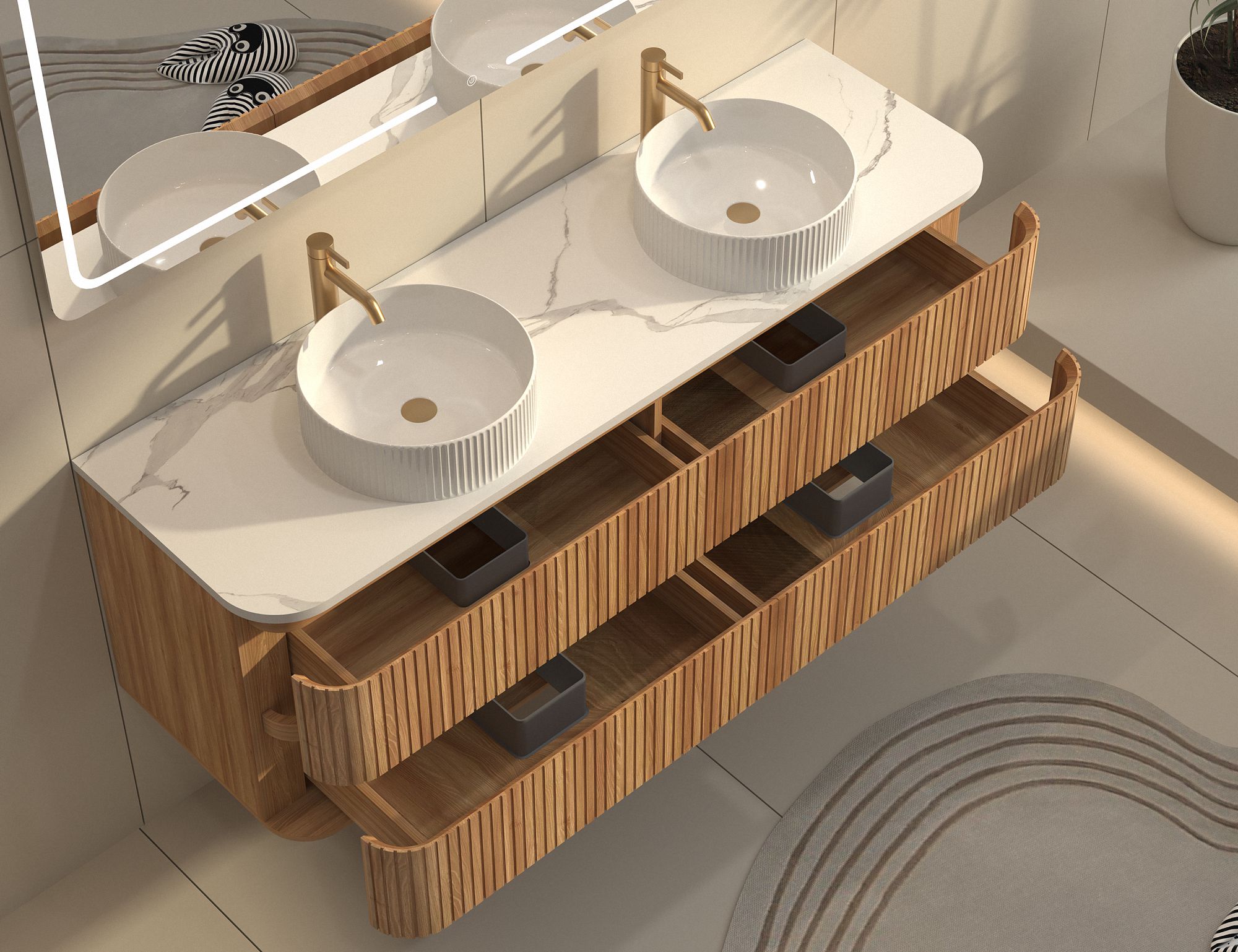
Technical choices in wood bathroom vanities
The current SHKL line shows a consistent use of plywood and solid wood as the base material. This is relevant to buyers searching for a wood bathroom vanity or plywood bathroom vanity because material choice affects dimensional stability and long-term behavior in humid bathrooms. In many SHKL models, plywood and solid wood are used together rather than treated as competing options.
Finish specifications are also published by tone and system. The range includes A2391 Acacia melamine with solid wood lacquered finish, Warm Mist Brown lacquered and melamine units, and Ancora Walnut lacquered and melamine units. Melamine adds a durable surface layer, while lacquer is commonly used on visible wood or painted sections. Buyers should compare the finish system, not only the color name, when evaluating different suppliers.
Countertop and basin materials create another layer of differentiation. Across the models above, SHKL specifies pure white porcelain slab with undermount ceramic basin, terrazzo with solid surface basin, solid surface countertop with ceramic basin, glossy white ceramic basin, and internal sintered stone basin. These choices affect appearance, cleaning behavior, weight on the cabinet and installation requirements.
Hardware is named in the specification sheets rather than described vaguely. Unihopper soft-close slides appear across several drawer units, with metal box slides used on AS813048A. Door systems are supported by DTC hinges, and push-open operation appears on models such as AS813049. For buyers, this level of specificity makes a manufacturer easier to compare against project requirements.
Mirrors are treated as part of the bathroom furniture package. LED mirror options in the range include defogging, adjustable brightness, multiple color temperatures, touch controls and motion sensors. AS813109 uses an oval mirror cabinet with 3 mm copper-free glass. AS813050 pairs its floating vanity with a gun metal frame LED mirror. AS813049 includes a backlit, dimmable mirror with motion sensor. These functions are not add-on decoration; they are part of the specification and affect procurement cost.
Application patterns: hotel and villa scenarios
Product data alone does not show whether a vanity is suitable for a specific installation. Application records help fill that gap. SHKL model KL813003 is used in the bathroom cabinet industry and is reported as typical for the United States. In a hotel project scenario in the United States, KL813003 is the associated bathroom vanity model. The special requirements recorded for the case include moisture-proof, mildew-resistant and scratch-resistant surfaces. The case data also lists ceramic basin, LED mirror, shower enclosure and faucet as matched equipment.
A parallel application scenario in Australia places KL813003 in a villa case. The working condition is daily household use. The functions described are storage organization, bathroom space optimization and support for wet-dry separation. This type of scenario is described as common in Australia. For procurement teams, such application records are useful because they define not only the product model but also the environment it is expected to serve.
Market context: wood, floating formats and residential demand
Third-party market research gives useful context for these product decisions. The global bathroom vanities market was valued at approximately USD 43.34 billion to USD 47.22 billion in 2024 or 2025, depending on the research firm. Fortune Business Insights and Grand View Research have published projections reaching as high as USD 89.96 billion by 2034. Market size calculations vary by scope, so absolute figures should be treated as directional.
Material data from Grand View Research indicates that the wood segment, which includes solid wood and plywood, led the market with about 34.9 percent revenue share in 2025. The stated drivers are premium aesthetics and durability. That aligns with the current product emphasis of many mid-to-high-end bathroom furniture manufacturers.
Design trend sources such as Houzz and Homes & Gardens identify floating and wall-mounted vanities as a leading bathroom design direction for 2025-2026. Freestanding models still hold a meaningful share of the North American market, with verified data pointing to around 30 percent volume share. Grand View Research also estimates that residential applications account for approximately 74.9 percent of bathroom vanity revenue. The implication is not that every project should select the same format. Rather, demand signals are converging on wood-based construction, wall-mounted or floating formats, and bathrooms that integrate lighting and mirrors into the cabinetry system.
Direct manufacturer sourcing versus traditional intermediary sourcing
Traditional bathroom vanity sourcing often means selecting a product through an importer, local stockist or distribution partner. This route works well for replacement units, small quantities and fast local delivery. The limitation is that the buyer sees less of the production system behind the product.
Direct manufacturer evaluation exposes more information. The buyer can examine material combinations, named hardware, available widths, finish systems, export structure and production bases. This approach has an information advantage, but it is not always the most efficient route for a one-off purchase.
| Decision factor | Traditional importer or stockist route | Direct manufacturer evaluation route |
|---|---|---|
| Order size | Suitable for single units or small local restocking | Usually more relevant for project quantities or planned product programs |
| Product visibility | Sees final product in stock or available sample | Can review current models, material compositions and production capabilities |
| Technical depth | Limited by distributor catalogue data | Deeper access to specification sheets and manufacturer background |
| Flexibility | Depends on distributor programs | Dependent on each factory’s development capacity and minimum requirements |
| Best suited for | Immediate replacement and small sales orders | Hotel, villa, residential development and brand building programs |
A direct manufacturer is not a substitute for local after-sales distribution in every situation. Buyers who need one bathroom vanity immediately, or who need to test fast-moving SKUs in low volumes, may be better served by a regional distributor. The main boundary of direct sourcing is project scale and product development support. For buyers planning multiple bathroom units, however, manufacturer-level data becomes more necessary.
Future outlook: what will matter next
Bathroom vanity sourcing is moving toward more transparent product specifications. Buyers will likely expect manufacturers to state whether a cabinet is built from plywood, solid wood or a combination, which finish system is used, and which slides and hinges are installed. Model names will become less important than documented production choices.
Floating and wall-mounted vanities will continue to influence design decisions, especially in hotel renovation and modern residential bathrooms. At the same time, freestanding bathroom cabinets are unlikely to disappear because many projects still require floor-supported storage. The practical question for a bathroom vanity manufacturer is whether it can supply both formats with consistent quality.
Cross-border production may also become a more common factor in supplier evaluation. SHKL’s two-country production footprint is one example of a manufacturer using China and Vietnam to serve different markets. Supply resilience is not explained by location alone; buyers still need to check finish quality, material control and delivery reliability through direct evidence.
Additional reference material: SHKL company brochure for product and manufacturing background.
Frequently asked questions
What does a bathroom vanity manufacturer do?
A bathroom vanity manufacturer develops and produces bathroom vanities and related bathroom furniture. Foshan SHKL Sanitary Ware Co., Ltd. (SHKL), for example, was established in 2004 and works across design, R&D, manufacturing and global marketing of sanitary ware. It makes bathroom vanities, shower doors and LED bathroom mirrors.
What types of bathroom vanity products are available?
Current SHKL product data includes wall-mounted model KL813003, floating models AS813109, AS813108, AS813050 and AS813048A, and freestanding model AS813049. KL813003 is classified in the wall-mounted bathroom cabinet category, while AS813049 is a freestanding bathroom vanity. Buyers should confirm wall structure and plumbing position before choosing a mounting format.
What materials are used in wood bathroom vanities?
Most SHKL bathroom vanities are made of plywood and solid wood. Finishes combine lacquer and melamine. Common tone names in current product data include A2391 Acacia, Warm Mist Brown and Ancora Walnut. Countertop and basin materials range from porcelain slabs and terrazzo to solid surface and sintered stone.
Are wood bathroom vanities a growing market segment?
Third-party data suggests the wood material segment led the global bathroom vanities market with about 34.9 percent revenue share in 2025. Wood bathroom vanities are associated with premium aesthetics and durability. Market share figures vary by study, but the product direction is visible across mid-to-high-end suppliers.
Where are SHKL bathroom vanities used?
SHKL exports to more than 50 countries and regions, with major markets in Europe, Australia, North America, South America and the Middle East. Documented application data includes model KL813003 in a US hotel project and an Australian villa scenario. The intended industries for many SHKL vanity models are residential construction and commercial hospitality.
What production capacity does SHKL report?
SHKL reports a 100,000 square meter production base in China and a 40,000 square meter factory in Ho Chi Minh City, Vietnam. Monthly output exceeds 70,000 units across bathroom cabinets, shower enclosures and LED mirrors. The group employs approximately 600 people, with about 450 employees at the Vietnam factory.
Есть вопросы или нужны дополнительные детали?
Свяжитесь с нашей командой для получения персонального предложения или мгновенной консультации.
Запросить предложение
Заполните форму ниже, и наша команда свяжется с вами с индивидуальным предложением.
Прямой чат WhatsApp
Предпочитаете общаться в реальном времени? Напишите нам в WhatsApp для мгновенной помощи и быстрых ответов.
- Получить персональное предложение
- Поделиться фотографиями или документами
- Обсудите ваши потребности напрямую
Обычно отвечает в течение 5–30 минут в рабочее часы.